.svg "CTA Arrow")


.png "Investor Ready Capital decorative background element")

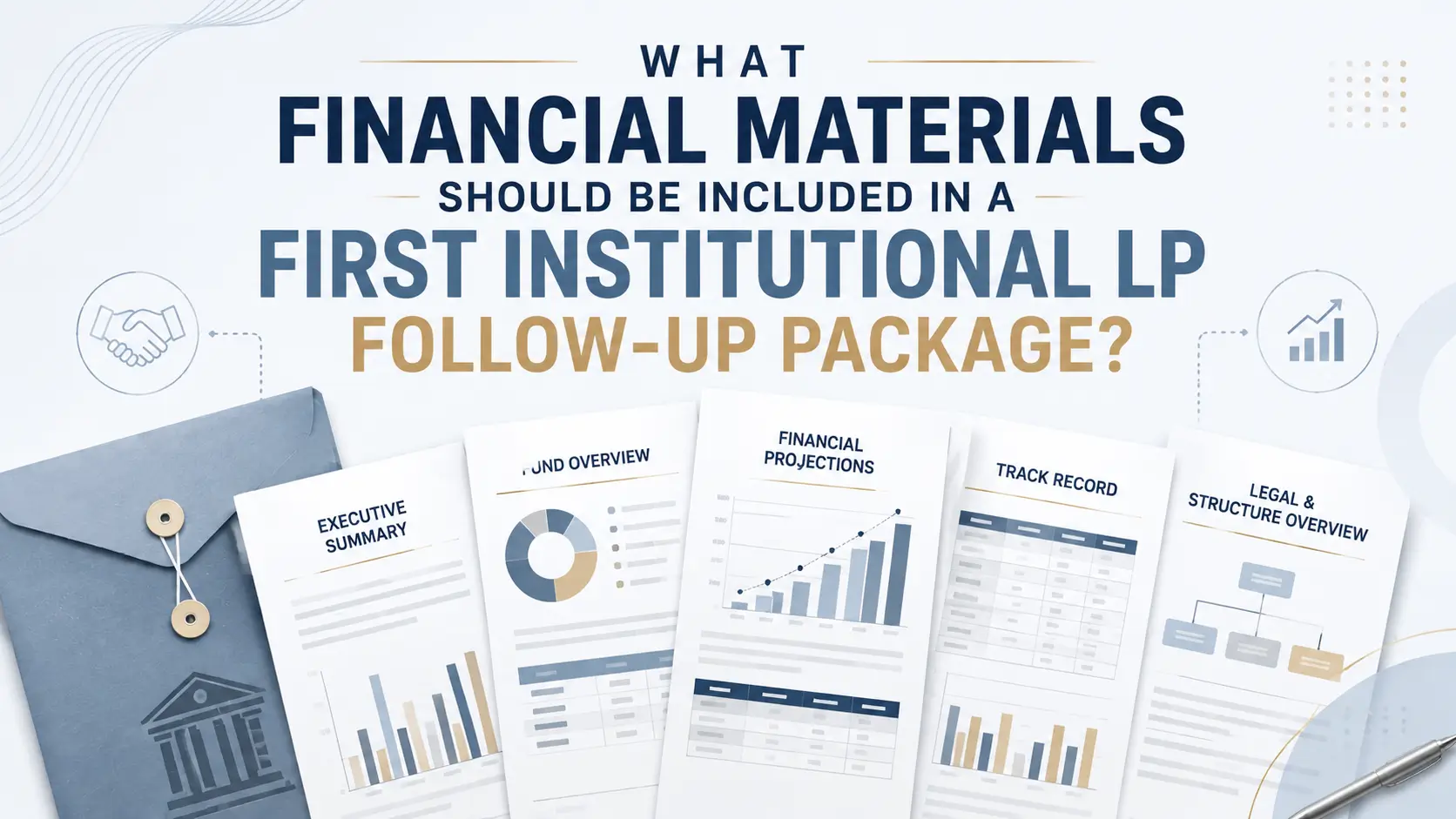
What Financial Materials Should Be Included in a First Institutional LP Follow-Up Package?
What Financial Materials Should Be Included in a First Institutional LP Follow-Up Package?
A first institutional LP follow-up package should include five financial documents: an updated financial model, sources and uses statement, distribution waterfall summary, LP return sensitivity table, and track record schedule. These materials answer the financial questions that remain after the first meeting, allowing the LP to validate underwriting assumptions, capitalization logic, sponsor economics, downside exposure, and historical execution before deciding whether to begin formal diligence. The package must reconcile across every file, be current, and be limited to the financial exhibits needed for a first-pass review.
This package is part of a broader set of materials that sponsors assembling an investor-ready real estate materials package need to prepare before institutional outreach begins. The follow-up package is distinct from that broader set. Its job is narrower: answer the financial questions that survive the first meeting, and do so in a format built for a reviewer who is deciding whether to advance to formal diligence.
Two prior documents in this series are directly relevant here. The institutional LP-ready executive summary establishes how sponsors should present deal logic before the meeting.
Key point: The follow-up package is a financial review set. Its purpose is to validate assumptions and prove internal consistency across all five files.
How the Follow-Up Package Differs From Initial Pitch Materials
The first meeting is an introduction. The follow-up package is a financial audit.
Initial pitch materials, including the deck, the executive summary, and the fund overview, are built to establish the opportunity, the team, and the strategy. They are designed to earn a second conversation. The follow-up package serves a different function. It is sent after the conversation has already happened, and its job is to confirm that the headline returns, assumptions, and capitalization logic hold together when a reviewer looks across all the files at once.
LPs at the institutional level review multiple opportunities at once. A package that requires them to sort through extra materials, reconcile inconsistent numbers, or request basic clarification creates friction that slows the relationship and raises questions about the sponsor's organizational capacity.
The follow-up package solves that problem by arriving in a fixed sequence, with each file answering a specific question the LP is likely asking.
The Five Financial Documents That Belong in the Package
Each document in the follow-up package answers a different question. Together, they give the LP everything needed to complete a first-pass financial review without sending a single follow-up request.
1. Updated Financial Model
The model is the foundation. It should reflect current assumptions, not the version used to build the deck. LPs expect to see:
- A clear version date and deal name on the cover tab
- Scenario tabs for base, downside, and upside cases
- Outputs that tie directly to the equity ask and projected returns
- Assumption inputs isolated in a single tab for easy review
- No broken links, hidden tabs, or unexplained overrides
The model should open cleanly on a standard machine. If a reviewer has to enable macros, call for a password, or find the right tab to see the waterfall output, the package has already created friction.
2. Sources and Uses Statement
This is the capitalization map. It shows where every dollar comes from and where every dollar goes. Institutional LPs use it to verify that the capital stack is complete, that the equity ask matches the model, and that there are no gaps in the financing plan.
The sources and uses should tie exactly to the model. Any preferred equity structure, mezzanine layer, or GP co-invest should be visible here and labeled clearly. Sponsors raising deals with layered structures can reference how preferred equity fits into the capital stack to ensure the exhibit reflects the correct cost and priority of each layer. If the deal involves phased equity draws, a capital call schedule should be prepared in parallel and made available when the LP requests it, though it belongs in the formal diligence data room rather than the follow-up package.
3. Distribution Waterfall Summary
The waterfall summary translates the model's distribution logic into a readable exhibit. It should show:
- The preferred return threshold (typically expressed as an annual percentage)
- The catch-up provision, if applicable
- The promote tiers and the LP/GP split at each tier
- A worked example using the base case model outputs
According to Investopedia's definition of waterfall payments, waterfall structures distribute cash in a defined sequence of priority. The summary should make that sequence clear without requiring the LP to open the model to understand it.
4. LP Return Sensitivity Table
The sensitivity table shows how LP returns move when key assumptions change. It is the document LPs use to stress-test the underwriting. A clean sensitivity table covers at minimum:
- Exit cap rate variance (typically plus or minus 50 to 100 basis points)
- Construction cost overrun scenarios (typically 5% to 15% above budget)
- Lease-up timing delays (typically 3 to 12 months)
- Leverage assumption changes
Each scenario should show the resulting net IRR and equity multiple for the LP position. The table should fit on a single readable page or PDF exhibit.
5. Track Record Schedule
The track record schedule is the sponsor's proof file. It lists completed and active projects with enough detail for an LP to verify the sponsor's claimed experience. At minimum it should include:
- Project name or anonymized identifier
- Asset class and geography
- Total capitalization and equity raised
- Sponsor role and ownership percentage
- Status (realized or unrealized)
- Key return metrics for realized deals
The track record schedule should be formatted for institutional review, with consistent column headers, no missing fields, and a clear distinction between sponsor-led deals and co-investment or advisory roles.
How to Format Each Document for Institutional Review
Format is not cosmetic at this stage. An LP reviewer who finds inconsistent totals, stale dates, or unlabeled exhibits will stop and ask questions before going further. Each question is a delay.
Universal formatting rules across all five files
Every document in the package should follow these standards:
- Version date visible on every file. The cover tab or header should show the date the file was prepared or last updated.
- Consistent deal name. The project or fund name should match exactly across all five documents.
- Numbers that reconcile. The equity ask in the sources and uses should match the model input. The waterfall summary returns should match the model output. The sensitivity table should use the same base case as the model.
- Clean export quality. Every exhibit should be readable as a PDF without scrolling, zooming, or reformatting.
Common errors that trigger avoidable follow-up
What level of detail is expected
The follow-up package is a first-pass financial review set. It should be detailed enough to answer the LP's immediate questions, and restrained enough to leave the formal diligence request as the natural next step.
The right level of detail allows the LP to validate the logic without requiring a separate request. Supporting schedules, legal documentation, and full LPA language belong in the formal diligence data room.
The SEC's investor communication guidance reinforces a consistent principle: investor materials should be complete, accurate, and presented in a way that allows a reasonable reviewer to evaluate the offering without needing to request additional clarification on basic facts.
{{main-cta}}
What to Exclude From the Follow-Up Package
Sending too much is a credibility problem. A bloated package forces the LP to sort signal from noise. It signals that the sponsor does not understand stage-appropriate diligence. It also raises questions about what the sponsor is trying to bury inside a large file set.
Leave these out of the first follow-up package:
- Full legal diligence files (LPA drafts, operating agreements, subscription documents)
- Broad data room exports or folder dumps
- Every supporting spreadsheet behind the financial model
- Market study reports and third-party appraisals
- Organizational charts and team bios beyond what is in the track record
- Environmental reports, title commitments, or survey documents
- Construction contracts or GC bid packages
These materials belong in the formal diligence data room. Sending them before the LP has requested them creates extra review work and signals that the sponsor does not understand where the relationship stands.
A narrow, well-organized package of five documents communicates something important: the sponsor knows what the LP needs at this stage, and they know how to run a disciplined process. That signal has value beyond the documents themselves.
How the Follow-Up Package Connects to Formal Diligence
A clean follow-up package earns the formal diligence request.
When the LP reviews the five documents and finds consistent numbers, a readable waterfall, a credible track record, and a sensitivity table that addresses real risk scenarios, the natural next step is a structured diligence process. That process typically covers legal documents, organizational materials, market data, and operating history. It is broader, deeper, and more time-intensive than the follow-up package review.
The follow-up package sets the tone for that process. Sponsors who send a tight, internally consistent package signal that the formal diligence phase will be equally disciplined. Many LPs use a disorganized package as a reason to pass before the formal request is ever issued.
The Capital Raise Pre-Flight is IRC Partners' fixed-fee diagnostic that scores a raise against the same twelve institutional gates a deal must clear before IRC Partners takes it into a strategic partnership.
Sponsors who have already completed that diagnostic enter the follow-up package stage with their financial materials pre-validated against institutional review standards. That preparation reduces the risk of avoidable follow-up questions and positions the sponsor to move directly into formal diligence without backtracking.
If the follow-up package is ready, the next steps are:
- Send the five documents in a single organized transmission, labeled clearly
- Include a brief cover note identifying what each file contains and the review sequence
- Set a specific follow-up date in the cover note (typically 5 to 7 business days)
- Prepare the formal diligence data room in parallel, so it is ready when the request arrives
Frequently Asked Questions
How soon after the first LP meeting should a sponsor send the follow-up package?
Send the follow-up package within 5 to 7 business days of the first meeting. Waiting longer signals low urgency and allows the LP's attention to move to other opportunities. Sending it the same day risks appearing rushed and may result in a package that has not been properly reviewed for internal consistency. Five to seven business days is the institutional standard for a prepared sponsor.
Does the financial model need to be fully built before the first LP meeting?
The model should be complete and current before the first meeting, but it does not need to be sent at that stage. The first meeting uses the executive summary and deck to establish the opportunity. The follow-up package is when the model is shared. At that point, it should reflect current assumptions, include scenario tabs, and tie exactly to the sources and uses and sensitivity table in the same package.
What format should the financial model be sent in for institutional LP review?
Send the live Excel or Google Sheets file, not a PDF. Institutional LPs and their analysts need to open the model, test assumptions, and verify outputs. A PDF of the model signals that the sponsor does not want the model examined. Include a read-only version only if the model contains proprietary formulas the sponsor needs to protect, and note that clearly in the cover note.
How detailed should the waterfall summary be at the follow-up stage?
The waterfall summary at the follow-up stage should cover the preferred return rate, the catch-up structure if applicable, the promote tiers with LP/GP splits, and a worked example using base case outputs. It does not need to reproduce the full LPA language or every distribution scenario. The goal is to allow the LP to understand the economics without opening the model. One to two pages is the right length.
What return metrics belong in the LP return sensitivity table?
Each scenario in the sensitivity table should show net IRR and equity multiple for the LP position. Some sponsors also include cash-on-cash return by year for the base case. The table should test at least three variables: exit cap rate, construction cost, and lease-up timing. A single-variable sensitivity table is considered underpowered for institutional review and will likely generate a follow-up request for additional scenarios.
Should the track record schedule include unrealized deals?
Yes. The track record schedule should include both realized and unrealized deals, clearly labeled. Institutional LPs want to see the full scope of the sponsor's active portfolio, not just completed exits. Unrealized deals should show current status, total capitalization, and the sponsor's role. Omitting active deals creates a gap that LPs will ask about, and asking about it signals the sponsor may be managing something they prefer not to disclose.
What happens if the LP sends a follow-up question after receiving the package?
A follow-up question after the package is delivered is a positive signal. It means the LP reviewed the materials and found something worth pursuing. Respond within 24 to 48 hours with a direct, specific answer. Do not send additional files unless the LP specifically requests them. If the question reveals a gap in the package, note it and address it in the next version. A clean, fast response to a follow-up question often accelerates the move to a formal diligence request.
Continue reading this series:
- Build a Data Room That Closes Institutional LPs in 30 Days
- 5 LP Financial Exhibits for Real Estate Pitch Decks
- Institutional Real Estate Data Room Setup
The structure you carry into your first investor meeting sets the terms for every round that follows it. Founders who get it wrong spend the next three rounds negotiating from behind. The Capital Raise Pre-Flight is IRC Partners’ fixed-fee diagnostic that scores a raise against the same twelve institutional gates a deal must clear before IRC Partners takes it into a strategic partnership. IRC Partners advises operators raising $5M to $250M of institutional capital. Book your Capital Raise Pre-Flight here.
Need guidance on your capital raise?



How to Use a Competing Offer Window to Protect Shareholder Value When a Drag-Along Is Triggered
How Should a Sponsor Format Projected LP Distribution Outputs for Investor-Facing Materials?
Investment Memorandum vs. Pitch Deck vs. Data Room: Which Document Closes Institutional Investors and When
Disclosure
Nothing on this site constitutes an offer to sell, or a solicitation of an offer to purchase, any security under the Securities Act of 1933, as amended, or any applicable state securities laws. Any offering of securities is made only by means of a formal private placement memorandum or other authorized offering documents delivered to qualified investors.
IRC Partners is a capital advisory firm. IRC Partners is not a registered investment adviser under the Investment Advisers Act of 1940 and does not provide investment advice as defined thereunder.
Certain statements in this article may constitute forward-looking statements, including statements regarding market conditions, capital availability, investor demand, and transaction outcomes. Such statements reflect current assumptions and expectations only. Actual results may differ materially due to market conditions, regulatory developments, company-specific factors, and other variables. IRC Partners makes no representation that any outcome, return, or result described herein will be achieved.
References to prior mandates, transaction volume, network credentials, or capital raised are provided for illustrative purposes only and do not constitute a guarantee or prediction of future results. Past performance is not indicative of future outcomes. Individual results will vary. Network credentials and transaction statistics referenced on this site reflect the aggregate experience of IRC Partners' principals and affiliated advisors and are not a representation of assets managed or transactions closed solely by IRC Partners.
Certain data, statistics, and information presented in this article have been obtained from third-party sources. IRC Partners has not independently verified such information and expressly disclaims responsibility for its accuracy, completeness, or timeliness. Readers should independently verify any third-party data before relying on it.
Readers are strongly encouraged to consult qualified legal, financial, and tax professionals before making any investment, capital raising, or business decision.
Schedule A Meeting
You get one shot to raise the right way. If this raise is worth doing, it’s worth doing with precision, leverage, and control.
This isn’t a practice run. Serious capital. Serious strategy. Let’s raise it right.
We onboard a maximum of seven
new strategic partners each quarter, by application only, to maximize your chances of securing the capital you need.
