.svg "CTA Arrow")


.png "Investor Ready Capital decorative background element")
Investment Memorandum vs. Pitch Deck vs. Data Room: Which Document Closes Institutional Investors and When

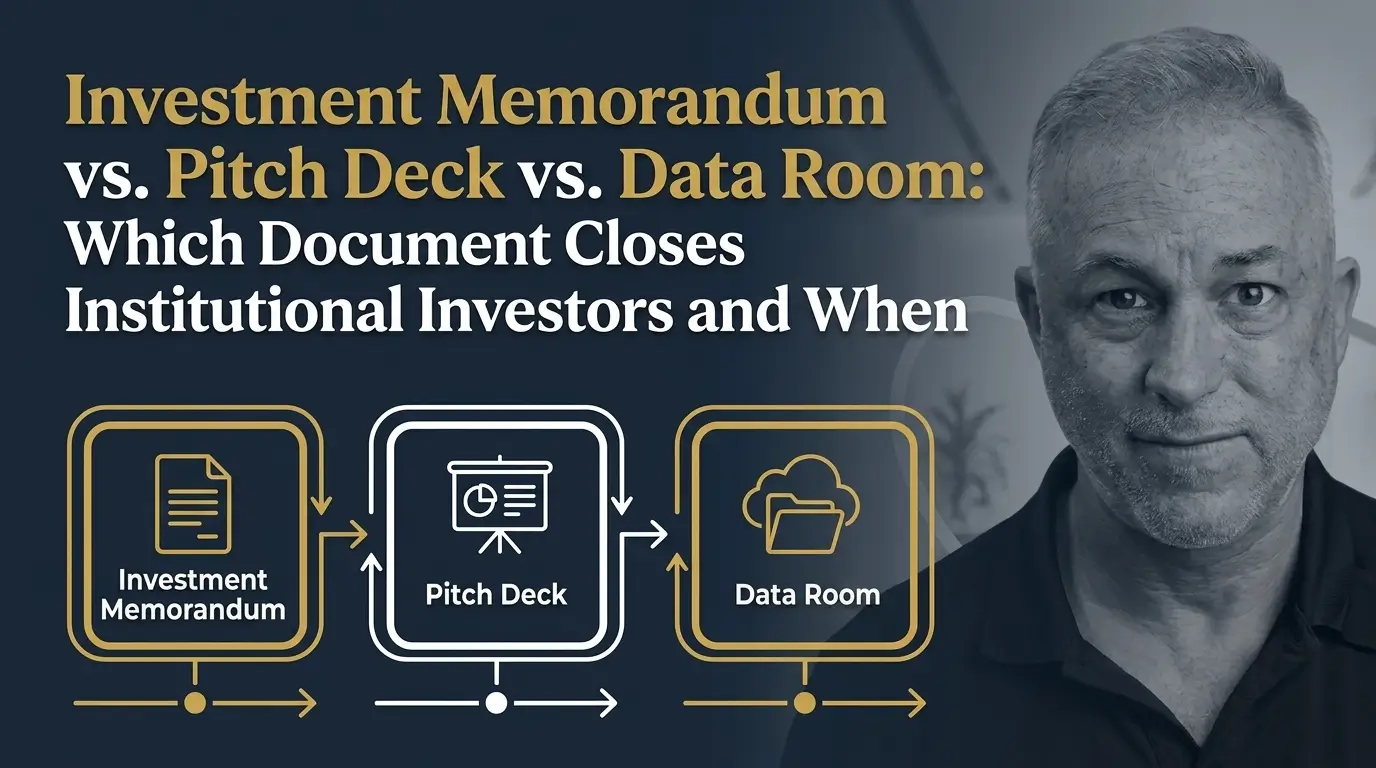
Investment Memorandum vs. Pitch Deck vs. Data Room: Which Document Closes Institutional Investors and When
Most operators preparing for a $10M to $250M institutional raise focus on which document to build. The more important question is which document to send, and when.
Institutional investors do not read a pitch deck, an investment memorandum, and a data room as three versions of the same story. They read each one as a signal of where you are in the process and whether you understand how institutional capital actually moves.
Sending the wrong document at the wrong stage does not just slow things down. It signals that you have not done this before.
Three things this article will answer:
- What job each document actually does in an institutional raise, and why those jobs do not overlap
- The correct sequencing from first outreach to term sheet to close
- What sending materials out of order signals to allocators who evaluate hundreds of deals a year
What Each Document Is Actually For
These three documents serve different functions at different stages. Treating them as interchangeable is the first mistake most first-time institutional fundraisers make.
The pitch deck: a screening tool, not a closing tool
According to MIT Executive Education, effective early-stage fundraising materials must communicate market opportunity, team credibility, and financial logic quickly enough to earn attention. The deck does not need to answer every question. It needs to earn the right to be asked questions.
The investment memorandum: a standalone conviction document
An investment memorandum is text-heavy and explicit. As EquityList explains, it is designed to be forwarded internally, reread, marked up, and compared against diligence findings. In an institutional real estate raise, it typically runs 40 to 100 pages and covers market thesis, deal structure, underwriting rationale, risk factors, and capital stack logic.
The data room: a verification environment
The data room does not tell the story. It confirms the story. It is where investors test whether the narrative in the deck and the memo holds up against actual documentation.
The Stage-by-Stage Sequence: Which Document Goes First, Second, and Third
Institutional capital raises are process-driven. Each stage has a different investor objective, a different decision to make, and a different document that serves that decision.
Stage 1: Outreach and qualification (Weeks 1 to 4)
Document: Pitch Deck
The investor's objective at this stage is simple: should I spend more time on this? They are not evaluating your deal. They are evaluating whether your deal deserves a closer look.
Your pitch deck earns the first real conversation. Nothing more. At this stage, institutional LPs often spend two minutes or less on initial review. The deck has one job: signal enough clarity, credibility, and opportunity to justify a meeting.
Stage 2: Active evaluation (Weeks 4 to 10)
Document: Investment Memorandum
Once a serious conversation happens, the investor's objective shifts. Now they need to understand the opportunity well enough to bring it to their investment committee, compare it against other deals in their pipeline, and build a case for allocating capital.
This is where the investment memorandum does its real work. It travels without you. It gets forwarded to partners, analysts, and committee members who were not in the room. For real estate developers raising $10M to $250M, this document is often the difference between a verbal interest and a term sheet path. It shows whether the thesis survives scrutiny when you are not there to explain it.
Stage 3: Confirmatory diligence (Weeks 8 to close)
Document: Data Room
By this stage, the investor has decided they are interested. The data room is not where they fall in love with the deal. It is where they confirm that everything they were told is true, documented, and organized. According to RaiseTalks, organized data rooms are associated with 40% faster funding closes. The room is the final test of operational discipline before capital commits.
Why the Pitch Deck Earns the Meeting, But Rarely Closes the Capital
The pitch deck is the most overworked document in institutional fundraising. Operators spend months refining it, then wonder why sophisticated allocators still ask for more.
The answer is that the deck is not built to close capital. It is built to open conversations. The Darien Group notes that institutional LPs use pitch materials as internal screening tools. When a deck circulates inside an LP organization, it shapes the first impression and structures the first meeting. That is its ceiling, not its floor.
The overloaded deck problem
Real estate sponsors often try to answer every possible LP question inside the deck. The result is a document that reads like a broker package: dense, operator-focused, and hard for allocators to navigate quickly. As the Darien Group observes, when a pitchbook looks like a broker memo, LPs quietly assume the manager has underinvested in communication, and possibly in organizational discipline.
The fix is not a better deck. It is knowing when to stop relying on the deck.
When a serious investor asks follow-up questions after the first meeting, that is the signal to move to the investment memorandum, not to send a revised slide deck.
Why the Investment Memorandum Earns the Term Sheet Path
The investment memorandum is the document that does the work when you are not in the room.
After a first meeting generates real interest, the allocator's internal process begins. An analyst prepares a summary memo. A committee member asks for more detail. A partner wants to compare your deal against two others in the pipeline. None of those conversations happen with you present. They happen with your investment memorandum.
Visible.vc describes the memo as a standalone artifact that builds conviction without a live presentation. That is exactly right for institutional real estate. The memo needs to survive scrutiny from people who never met you and may never meet you before a term sheet is issued.
What institutional investors use the investment memorandum for:
- Circulating the opportunity internally to partners, analysts, and investment committee members
- Comparing the deal against competing opportunities in the same asset class
- Pressure-testing the thesis against stated market conditions and underwriting assumptions
- Identifying risk factors before committing to a deeper diligence process
- Building the internal case for why capital should be allocated to this sponsor and this deal
The part most coverage misses: In a $10M to $250M institutional real estate raise, the investment memorandum is also a credibility filter. A well-structured memo signals that the sponsor understands how institutional capital thinks. A thin memo or an extended pitch deck masquerading as a memo signals the opposite. Institutional investors are more selective in 2026, with Primior's research showing greater emphasis on conservative underwriting, proven case studies, and clear exit strategies as core evaluation criteria. The memo is where those elements live.
For guidance on what fund documents accompany the memo in a full institutional raise, see what you need to raise $100M from institutional investors in real estate.
Why the Data Room Is What Actually Closes the Deal
By the time an investor enters your data room, they have already decided they want to invest. The data room does not create that conviction. It either confirms it or destroys it.
This is the most misunderstood role in the document sequence. Operators often treat the data room as a formality, something to assemble after interest exists. In reality, it is the final and most consequential test of institutional readiness.
What a well-organized data room proves to institutional investors:
- Your legal, financial, and operational documentation matches what the pitch deck and memo described
- You have the organizational discipline to manage LP capital and reporting obligations
- Diligence can move quickly because materials are complete, labeled, and accessible
- You have been through this process before, or at minimum, you understand how it works
The numbers support the stakes. RaiseTalks reports that organized data rooms are associated with 40% faster funding closes and 15% higher valuations. On the other side, 68% of investors reject disorganized data rooms within 10 minutes of review.
The reinterpretation effect is real. A sloppy data room does not just slow diligence. It causes investors to go back and reread the memo and the deck with more skepticism. If your room is disorganized, every claim you made earlier becomes suspect.
For a full breakdown of data room structure and document sequencing in a 30-day close framework, see How to Build a Data Room That Closes Institutional Investors in 30 Days Instead of 90.
Real estate raises at $10M and above also require a specific document set. The real estate due diligence checklist for $10M+ sponsors outlines the 47 documents institutional lenders and LPs request before committing capital.
What Sending Them Out of Order Signals to Institutional Investors
Every document you send carries a meta-message beyond its content. Institutional investors who review hundreds of deals a year read sequencing as a signal of process sophistication. Getting it wrong does not just create friction. It creates doubt.
Primior's 2026 investor research confirms that institutional allocators are deploying capital with stricter pricing discipline and greater emphasis on execution credibility. In that environment, process missteps carry more weight than they did in earlier market cycles.
{{main-cta}}
The sequencing is not bureaucratic. It reflects how institutional investors actually build conviction, one stage at a time. Matching your documents to those stages is one of the clearest ways to signal that you belong at the table.
If you want to understand what family offices specifically look for before committing capital, see what $17B allocators actually evaluate before backing a sponsor.
Frequently Asked Questions
Should I have all three documents ready before I start outreach?
You do not need all three ready before outreach begins, but you should have a plan for when each one will be ready. Start outreach with a tight pitch deck. Have a draft investment memorandum ready to send within one to two weeks of a first meeting. Your data room should be substantially complete before you invite any LP into active diligence. Building the room after interest exists is one of the most common causes of delayed closes.
How long should an investment memorandum be for a real estate raise?
In an institutional real estate context, an investment memorandum typically runs 40 to 100 pages. Length is driven by deal complexity, not preference. A single-asset development deal may need fewer pages than a fund raise covering multiple markets and capital stack layers. What matters more than length is whether the memo can be read and evaluated without the sponsor in the room. If it requires verbal explanation to make sense, it is not ready.
What can I share with an investor before an NDA is signed?
Before an NDA is signed, most institutional sponsors share a teaser or executive summary, typically two to four pages. This is a condensed version of the pitch deck or a standalone one-pager that covers the thesis, the opportunity, and the capital ask without disclosing sensitive financials, site-specific details, or proprietary underwriting. The full pitch deck, investment memorandum, and data room all come after the NDA, with the memo and data room typically gated behind confirmed interest.
Can a pitch deck ever substitute for an investment memorandum with institutional LPs?
No. A pitch deck and an investment memorandum serve different functions and cannot substitute for each other in a $10M+ institutional raise. Institutional LPs, including family offices and private equity allocators, expect a standalone memo before committing to a formal diligence process. A deck that tries to carry memo-level depth becomes too dense to screen quickly. A memo that reads like a deck lacks the underwriting logic and risk framing that investment committees require. Both documents need to exist, and both need to do their specific job.
What happens if an investor asks for the data room before a term sheet?
This is common and not necessarily a red flag. Some institutional LPs want to run light diligence in parallel with term sheet negotiations to compress timelines. If your room is well-organized and complete, early access can accelerate close. If the room is not ready, declining or staging access is better than sharing a disorganized room. As RaiseTalks data shows, 68% of investors reject disorganized rooms within 10 minutes. A premature, incomplete room is worse than a delayed one.
How is an investment memorandum different from a private placement memorandum?
An investment memorandum is a marketing and conviction document prepared by the sponsor to present the investment opportunity to potential LPs. A private placement memorandum (PPM) is a legal disclosure document prepared with fund counsel that governs the terms of the offering, risk factors, and LP rights. Both are used in institutional real estate raises, but they serve different audiences and different stages. The investment memo builds interest and earns the term sheet. The PPM is reviewed by LP legal counsel before subscription documents are signed. For a full comparison, see Private Placement Memorandum vs. Data Room: When You Need Both and How They Work Together.
What do institutional investors look for in a pitch deck for a real estate fund versus a single-asset deal?
For a fund raise, institutional LPs evaluate the pitch deck for strategy clarity, team attribution, track record summary, and target return profile across a portfolio. For a single-asset deal, the deck needs to communicate site-specific thesis, market context, capital structure, and projected returns at the deal level. In both cases, the deck should not attempt to be the full underwriting document. That is what the investment memorandum is for. The financial projections institutional LPs expect in a real estate fund pitch deck covers the specific metrics allocators look for at the deck stage.
Continue reading this series:
- How to Build a Data Room That Closes Institutional Investors in 30 Days Instead of 90
- What Fund Documents Do You Need to Raise $100M From Institutional Investors in Real Estate
- Family Office Investment: What $17B Allocators Actually Look for Before They Commit Capital to a Sponsor
IRC Partners advises founders raising $5M to $250M in institutional capital on structure, positioning, and round architecture. We work with 7 strategic partners per quarter - no placement agent model, no success-only theater. If you want a structural review of your current raise, apply HERE.
Sponsors weighing this decision should first complete a capital raise readiness assessment for sponsors to confirm the raise is investor-ready.
Need guidance on your capital raise?



The Convertible Note Overhang Problem: Why Uncapped Notes From Your Seed Round Are a Series B Red Flag
How Should a Sponsor Present Acquisition Basis and Total Project Cost in Investor Materials?
How Should a Sponsor Address Concentration Risk When One Family Office Could Fund More Than Half of a Real Estate Equity Raise?
Disclosure
Nothing on this site constitutes an offer to sell, or a solicitation of an offer to purchase, any security under the Securities Act of 1933, as amended, or any applicable state securities laws. Any offering of securities is made only by means of a formal private placement memorandum or other authorized offering documents delivered to qualified investors.
IRC Partners is a capital advisory firm. IRC Partners is not a registered investment adviser under the Investment Advisers Act of 1940 and does not provide investment advice as defined thereunder.
Certain statements in this article may constitute forward-looking statements, including statements regarding market conditions, capital availability, investor demand, and transaction outcomes. Such statements reflect current assumptions and expectations only. Actual results may differ materially due to market conditions, regulatory developments, company-specific factors, and other variables. IRC Partners makes no representation that any outcome, return, or result described herein will be achieved.
References to prior mandates, transaction volume, network credentials, or capital raised are provided for illustrative purposes only and do not constitute a guarantee or prediction of future results. Past performance is not indicative of future outcomes. Individual results will vary. Network credentials and transaction statistics referenced on this site reflect the aggregate experience of IRC Partners' principals and affiliated advisors and are not a representation of assets managed or transactions closed solely by IRC Partners.
Certain data, statistics, and information presented in this article have been obtained from third-party sources. IRC Partners has not independently verified such information and expressly disclaims responsibility for its accuracy, completeness, or timeliness. Readers should independently verify any third-party data before relying on it.
Readers are strongly encouraged to consult qualified legal, financial, and tax professionals before making any investment, capital raising, or business decision.
Schedule A Meeting
You get one shot to raise the right way. If this raise is worth doing, it’s worth doing with precision, leverage, and control.
This isn’t a practice run. Serious capital. Serious strategy. Let’s raise it right.
We onboard a maximum of seven
new strategic partners each quarter, by application only, to maximize your chances of securing the capital you need.
