.svg "CTA Arrow")


.png "Investor Ready Capital decorative background element")

What Should a Capital Call Schedule Include for Institutional LP Review?
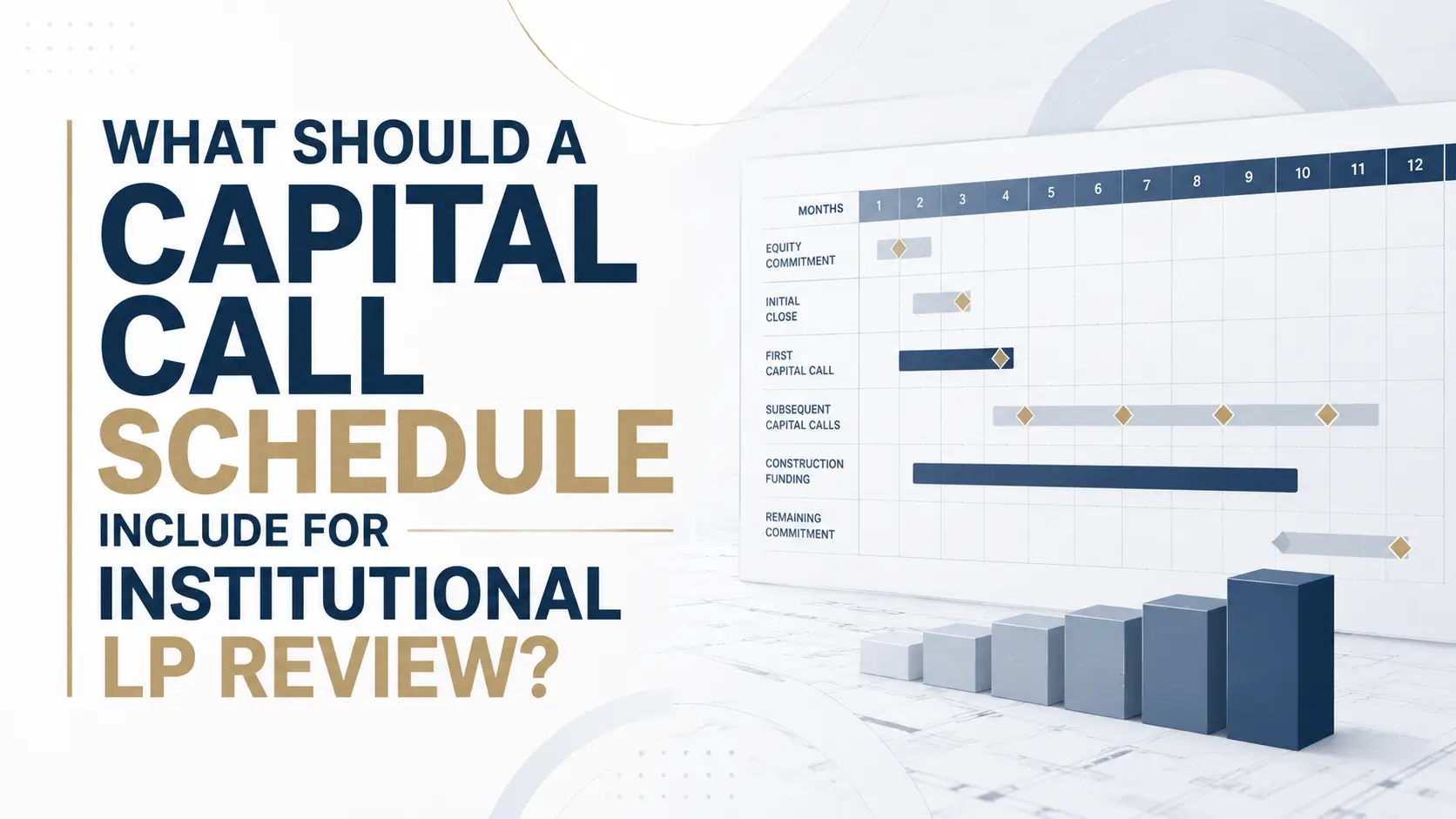
A real estate development model can create diligence friction when its capital call schedule does not show when equity is drawn, who contributes what, how each call ties to a construction milestone, or when preferred return accrual begins. Without this detail, institutional LPs cannot verify that equity enters the deal in the right sequence relative to loan proceeds, the construction timeline, and the partnership agreement. A complete capital call schedule solves this by mapping every draw period with the call amount, LP and GP contribution lines, cumulative funded capital, remaining unfunded commitment, use-of-proceeds reference, and milestone trigger before outreach begins.
This article is part of a series on building an investor-ready materials package for a real estate sponsor. It follows the pieces on required financial model tabs and construction draw presentation, and connects directly to the waterfall, hold-period, and LP committee review materials in the same package.
A capital call schedule is the equity deployment map inside a development model. When it is missing or incomplete, LPs read it as evidence that capital timing has not been pressure-tested. That reading happens before a single term sheet is issued.
The Minimum Components of an Institutional-Grade Capital Call Schedule
An institutional LP reviewer expects to open the capital call schedule and answer six questions immediately: When is equity called? How much is called each period? What is the draw funding? Who is contributing what? How much remains unfunded? And where does this tie to the rest of the model?
Every field in the schedule should answer at least one of those questions directly.
Separating LP and GP lines is required. A single blended equity line does not let reviewers verify sponsor alignment or test whether GP capital is staged as a real funded input or held as a headline number with no timing behind it.
The schedule should also carry a notes column for any assumptions that govern timing, including lender sequencing requirements, equity-before-debt conventions, or reserve build triggers. For investor notice and transparency standards, capital call and reporting guidance gives a useful baseline for how institutional LPs expect funding activity to be documented.
How to Sequence LP Equity Calls Relative to Debt Draws and Construction Milestones
Sequencing is where most capital call schedules fail institutional review. The question LPs are testing is simple: does equity arrive when the project actually needs it, in the order the lender and partnership agreement require?
The schedule should show equity and debt draws side by side, period by period, so reviewers can trace the funding story without reconstructing it themselves.
The Standard Sequencing Logic for Development Deals
- Acquisition close. Equity funds first. LP and GP contributions cover the land purchase or closing costs before any construction loan proceeds are drawn.
- Permit and pre-development phase. Soft costs, entitlement fees, and pre-development expenses are typically equity-funded. The construction loan does not open until the lender's conditions are satisfied.
- Construction loan activation. Once the lender's draw conditions are met, hard cost draws begin. Equity may continue to fund a portion of hard costs alongside debt, depending on the loan-to-cost structure.
- Vertical construction phases. LP equity calls should align with the monthly or periodic construction draw schedule. Each call should reference the corresponding draw period and the hard cost categories being funded.
- Completion and lease-up reserves. Reserve funding, if equity-sourced, should appear as a named call with a specific trigger, such as certificate of occupancy or a defined lease-up threshold.
Key point: If the model draws LP equity in a pattern that conflicts with lender requirements or the actual build sequence, the schedule loses credibility. LP reviewers will compare the capital call schedule against the construction loan draw schedule to confirm the two documents tell the same funding story. How those draw periods should be structured and presented is covered in the guide to presenting construction draws in a development financial model.
A mismatch between equity draw timing and construction cash need signals that the model was built from a top-down equity input rather than a bottom-up project schedule. That is a first-pass diligence flag.
GP Contributions, Preferred Return Accrual, and Notice Requirements
How GP Contributions Should Be Staged
The GP contribution line should appear at the same periodic level as LP calls. It should show the dollar amount funded each period, the cumulative GP contribution to date, and the remaining unfunded GP commitment.
LPs use this view to confirm that sponsor capital is a real funded input with timing, not a placeholder percentage held as a headline number. If GP capital appears only as a total at the top of the schedule with no period-by-period staging, reviewers will question whether the model reflects actual funding obligations or a simplified assumption.
The staging should be consistent with the partnership agreement and any lender requirements that govern the order and timing of sponsor contributions. If the lender requires GP equity to fund before LP equity in certain periods, that sequencing must be visible in the schedule.
Alignment check: Reviewers look at whether GP funding tracks LP funding proportionally or front-loads LP exposure. A schedule where LP capital is drawn heavily in early periods while GP capital arrives later signals a structural misalignment that will generate committee questions.
How Preferred Return Accrual Timing Connects to the Call Schedule
Preferred return accrual should begin from the date capital is funded, not from the date of commitment. The call schedule is the document that defines when each tranche becomes funded, which means it directly controls when accrual starts.
If capital is called in tranches, the schedule must track accrual tranche by tranche. Assuming the full commitment is in from day one inflates the projected preferred return and creates a discrepancy between the call schedule and the waterfall tab. LP reviewers compare these two documents directly, and the mismatch will be found. The mechanics of how preferred return flows through the waterfall are covered in the guide to hold-period modeling and return timing.
Capital Call Notice Requirements
The schedule should reflect a notice convention. This means showing the assumed number of business days between the notice date and the funding due date for each call.
The model does not control the legal process. The partnership agreement governs actual notice requirements. But the schedule should make the assumed timing visible so LP reviewers can assess whether the modeled cash flow cadence is operationally realistic.
- Show the notice assumption in a notes column or schedule header
- Avoid timing assumptions where equity arrives the same period it is called with no admin lag
- If the deal structure includes a capital call line of credit or bridge mechanism, note that in the schedule so reviewers understand how timing gaps are managed
Assumptions that are not visible force diligence teams to infer them. Inferred assumptions slow review.
Reconciliation to Sources and Uses and the Construction Draw Tab
The capital call schedule must reconcile to two other documents: the sources and uses schedule and the construction draw tab.
Reconciliation checklist:
- Total LP equity called across all periods equals the LP equity line in sources and uses
- Total GP contributions called across all periods equals the GP co-investment line in sources and uses
- Period-by-period equity funding aligns with the construction draw tab for the same periods
- Reserve draws, fee timing, and contingency usage that affect equity timing are visible and consistent across all three documents
- Any period where equity and debt fund simultaneously shows the correct sequencing relative to lender draw conditions
A clean reconciliation means an LP reviewer can move across the model without generating follow-up questions. A gap between the call schedule and the sources and uses, even a small one, signals that the documents were built at different times and not cross-checked before outreach.
The same discipline applies to the construction draw tab. If the draw tab shows $2.4M in hard costs funded in month six but the call schedule shows no equity draw in that period, reviewers must determine whether debt is funding 100% of that draw, whether there is a timing lag, or whether the model has an error. That determination takes time and generates questions that slow committee preparation.
Sponsors raising $5M to $250M for development deals should treat the call schedule, sources and uses, and construction draw tab as a single reconciled package. The full list of supporting schedules required in a capital raise model covers how each tab connects to the others.
{{main-cta}}
What a Missing or Incomplete Capital Call Schedule Signals During Diligence
LP reviewers read the capital call schedule early in first-pass diligence. What they find shapes how they approach every other document in the model.
What a missing schedule signals:
- Capital timing has not been fully modeled, only projected at a total level
- Construction cash planning may not be tied to a real draw sequence
- Preferred return accrual may be based on assumptions that do not match funded capital behavior
- The model may not have been built to support investor reporting during the hold period
What an incomplete schedule signals:
- GP staging is a placeholder, raising alignment questions
- Equity and debt sequencing has not been reconciled with lender requirements
- Notice timing is assumed but not documented, creating operational uncertainty
- The broader model package may have similar gaps in other tabs
Neither condition is fatal at the outreach stage if the sponsor addresses it before sending materials. The problem is that diligence confidence is shaped in the first review session. Reviewers who must reconstruct funding logic from incomplete documents carry that friction into committee preparation.
The fix is straightforward. Review the schedule against five tests before outreach: completeness of all required fields, correct sequencing relative to debt draws and milestones, visible GP staging at the same periodic level as LP calls, tranche-level accrual timing tied to funded capital, and full reconciliation to sources and uses and the construction draw tab.
If the schedule passes all five, it is ready for institutional LP review.
What to Do If Your Schedule Exists but Is Not Ready
A capital call schedule that exists but fails the five-point review has a structural problem. The fix requires going back into the model and rebuilding the schedule from the construction draw sequence up.
Start with the construction draw tab and work forward. Map each draw period to the corresponding equity call. Separate LP and GP lines. Add accrual start dates by tranche. Document notice timing assumptions. Then reconcile the completed schedule back to sources and uses and verify that every number matches.
This process is part of the broader work of building a model package that supports LP committee review from the first conversation. The capital call schedule does not stand alone. It connects directly to the financial model output tabs, the waterfall and promote structure, and the hold-period model. All of those documents must tell the same capital story.
Sponsors who want to confirm their capital call schedule is structured and sequenced correctly for institutional LP review can book a strategy call with IRC Partners. IRC works with sponsors raising $5M to $250M on development deals to build capital call schedules that are complete, correctly sequenced, and tied to the broader model before outreach begins.
Frequently Asked Questions
What is the difference between a capital call schedule and a sources and uses schedule in a real estate development model?
A capital call schedule shows when equity is drawn, in what amounts, and from which contributor, period by period across the construction timeline. A sources and uses schedule shows the total capitalization of the deal at a point in time, with each funding source and its corresponding use. The call schedule is the dynamic, time-sequenced version of the equity side of sources and uses. Both documents must reconcile exactly.
How far in advance should a capital call notice be modeled in the development financial model?
The modeled notice period should reflect a realistic operational assumption, typically five to fifteen business days between the notice date and the funding due date. The partnership agreement will govern the legal requirement, but the model should not assume instant funding with no admin lag. If the deal includes a capital call credit facility to bridge notice timing, that mechanism should be noted in the schedule.
Can LP equity be drawn before the construction loan is funded?
Yes, and in many development deals it must be. Equity typically funds acquisition costs, entitlement fees, and pre-development soft costs before the construction loan activates. The call schedule should show these early equity draws separately from the construction-phase draws, with a clear reference to the milestone or cost category each draw funds.
How does preferred return accrual work when LP equity is called in multiple tranches?
Preferred return accrues on funded capital from the date each tranche is funded. If a $10M LP commitment is called in four tranches over the construction period, preferred return accrues on each tranche from its individual funding date. Modeling the full commitment as funded from day one overstates the projected preferred return and creates a discrepancy that LP reviewers will identify when they compare the call schedule against the waterfall tab.
What should a sponsor do if the lender requires equity to fund before each construction draw?
The capital call schedule should reflect that sequencing explicitly. Show the equity draw in the period before the corresponding construction loan draw, with a note referencing the lender's equity-first requirement. LP reviewers who understand construction lending will expect to see this pattern. A schedule that shows equity and debt funding simultaneously in every period, without explanation, raises questions about whether the sponsor has confirmed the draw sequence with the lender.
How should contingency funding appear in a capital call schedule?
Contingency should appear as a named line item with a trigger condition, such as a budget overrun threshold or a specific construction event. If contingency is equity-funded, the call schedule should show when that draw would occur and what conditions activate it. A contingency line that appears only in the sources and uses as a total amount, with no timing or trigger in the call schedule, is a gap that LP reviewers will flag during diligence.
What does an institutional LP committee expect to see when reviewing the capital call schedule alongside the rest of the model?
The committee expects the call schedule to reconcile cleanly to sources and uses and the construction draw tab, with no unexplained gaps between equity draws and project cash needs. They expect GP and LP lines to be separated with period-by-period staging. They expect preferred return accrual start dates to match funded capital timing. And they expect notice assumptions to be documented so the modeled cash flow cadence is operationally credible. A schedule that passes those four checks allows the committee to move forward without generating a list of follow-up questions.
Continue reading this series:
- What should be included in an investor-ready materials package for a real estate sponsor?
- How to structure a capital stack for a $10M to $50M real estate development deal
- How to calculate the right GP/LP split for your deal
By the time most founders are rehearsing the pitch, the outcome of the raise has already been set by the structure underneath it. IRC Partners advises operators raising $5M to $250M of institutional capital and accepts seven strategic partners per quarter. If you are going to market this year, have the structure reviewed before investors do. Schedule a call with our team here.
Need guidance on your capital raise?


Real Estate Construction Financing: The Complete Data Room $10M+ Developers Need to Close Institutional Construction Lenders

How Do You Present Management Fees and Carried Interest in a Real Estate Fund Terms Sheet
How Should Founders Negotiate a Bridge Financing Round When an Existing Investor Requests Enhanced Pro Rata Rights?
Disclosure
Nothing on this site constitutes an offer to sell, or a solicitation of an offer to purchase, any security under the Securities Act of 1933, as amended, or any applicable state securities laws. Any offering of securities is made only by means of a formal private placement memorandum or other authorized offering documents delivered to qualified investors.
IRC Partners is a capital advisory firm. IRC Partners is not a registered investment adviser under the Investment Advisers Act of 1940 and does not provide investment advice as defined thereunder.
Certain statements in this article may constitute forward-looking statements, including statements regarding market conditions, capital availability, investor demand, and transaction outcomes. Such statements reflect current assumptions and expectations only. Actual results may differ materially due to market conditions, regulatory developments, company-specific factors, and other variables. IRC Partners makes no representation that any outcome, return, or result described herein will be achieved.
References to prior mandates, transaction volume, network credentials, or capital raised are provided for illustrative purposes only and do not constitute a guarantee or prediction of future results. Past performance is not indicative of future outcomes. Individual results will vary. Network credentials and transaction statistics referenced on this site reflect the aggregate experience of IRC Partners' principals and affiliated advisors and are not a representation of assets managed or transactions closed solely by IRC Partners.
Certain data, statistics, and information presented in this article have been obtained from third-party sources. IRC Partners has not independently verified such information and expressly disclaims responsibility for its accuracy, completeness, or timeliness. Readers should independently verify any third-party data before relying on it.
Readers are strongly encouraged to consult qualified legal, financial, and tax professionals before making any investment, capital raising, or business decision.
Schedule A Meeting
You get one shot to raise the right way. If this raise is worth doing, it’s worth doing with precision, leverage, and control.
This isn’t a practice run. Serious capital. Serious strategy. Let’s raise it right.
We onboard a maximum of seven
new strategic partners each quarter, by application only, to maximize your chances of securing the capital you need.
