.svg "CTA Arrow")


.png "Investor Ready Capital decorative background element")

What Should Be Included in an Investor-Ready Materials Package for a Real Estate Sponsor?
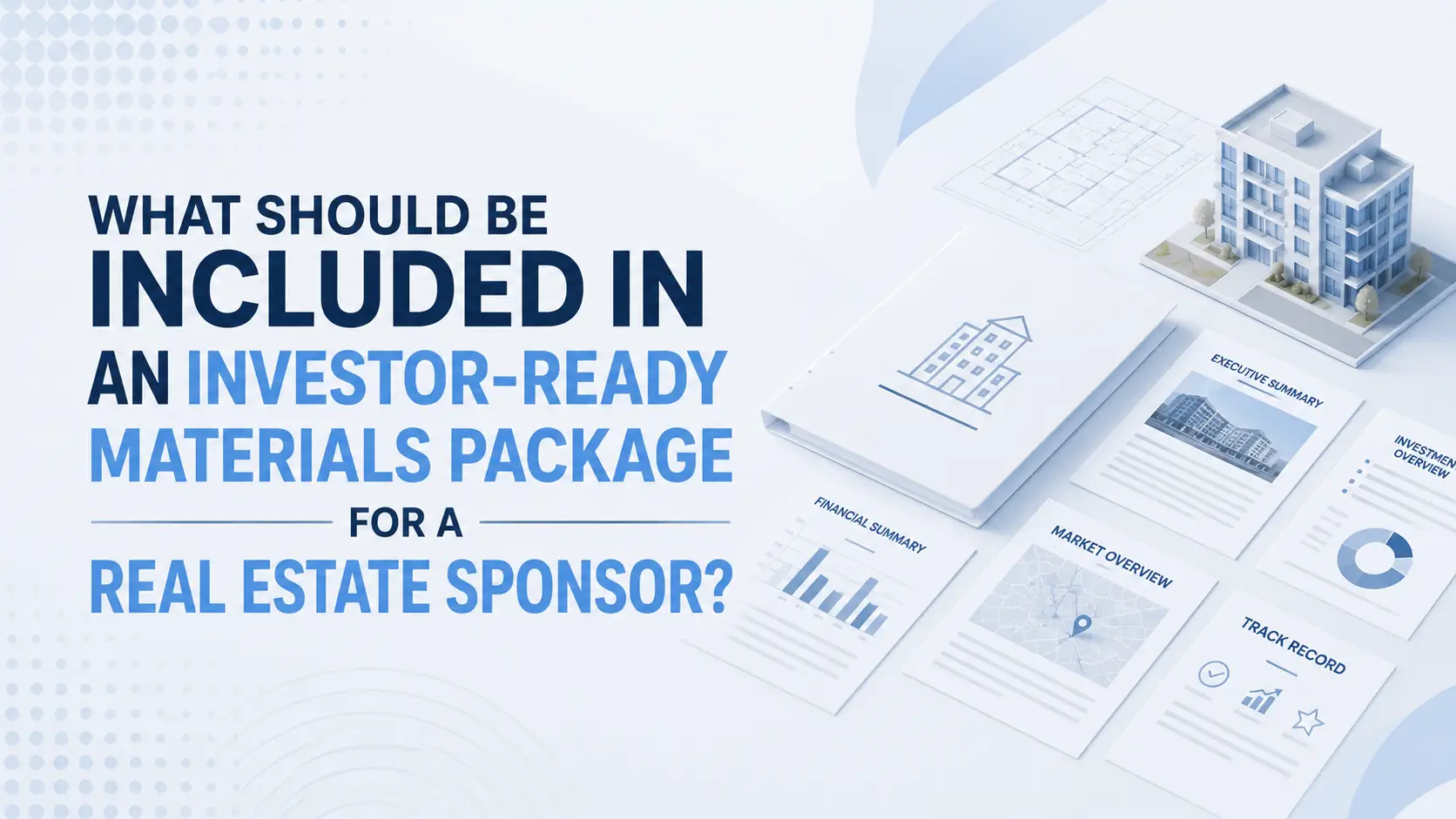
What Should Be Included in an Investor-Ready Materials Package for a Real Estate Sponsor?
A real estate sponsor raising $10M or more can lose institutional investor interest before the first diligence call if its materials are incomplete, inconsistent, or too promotional. An investor-ready package solves that problem by giving LPs nine core documents that clearly explain the opportunity, verify the sponsor's track record, reconcile the capital structure, support financial review, and disclose project-specific risks. Every document must stand on its own, align with the rest of the package, and answer the questions an investment committee will ask without requiring the sponsor to explain it live.
That standard matters more in 2026 than it did three years ago. Global real estate fundraising fell roughly 50% quarter-over-quarter in early 2026, according to quarterly real estate fundraising data for Q1 2026, and capital has concentrated among sponsors whose materials reduce uncertainty for investment committee reviewers. Institutional LPs and family offices are moving slower because they can afford to be selective, and a weak package gives them an easy reason to pass before the first call.
The package, assembled correctly, functions as a committee-grade diligence system. Understanding how institutional LP due diligence actually works is the starting point for building materials that survive it. Raises typically run 4 to 9 months from first LP contact to close, and a weak package adds friction at every stage of that window. The components listed below form a structured argument that the sponsor controls the facts, reconciles the numbers, and understands the risks before asking for a capital commitment.
What belongs in an investor-ready materials package:
- LP-ready executive summary (one document, standalone readable)
- Verified track record schedule with attribution and dates
- Project-level business plan or investment memorandum
- Capitalization summary (sources, uses, structure overview)
- Key financial model outputs (returns, cash flows, draw logic, sensitivity)
- Uses and sources exhibits and budget summary
- Data room index with organized folder structure
- Legal and governance documents (operating agreement, PPM if applicable, entity structure)
- Risk disclosures and downside case framing
Why Packaging Standards Got Tighter in 2026
Capital is still available for real estate sponsors with proven track records and structured deals. North America-focused real estate funds raised $109 billion in 2025, with residential strategies representing the largest share of deal value, according to 2026 private real estate investment data. The issue is access, and access in 2026 is filtered through package quality before it is filtered through asset quality.
Investment committees at institutional LPs are running longer review cycles. Family offices have shifted decisively toward deal-by-deal structures, which means each individual transaction receives the same level of scrutiny that a blind pool fund would have received at the fund level. A sponsor who sends a loosely organized set of files into that environment is not just unprepared. They are creating delay that the LP can avoid by moving to the next deal in their pipeline.
The real threshold in 2026 is not the quality of your deal. It is whether your materials can survive committee review without you on the phone to explain them.
Three dynamics are compressing the window between first contact and committee decision:
- Slower IC calendars. Investment committees meet less frequently than they did in 2021-2022. A package with missing or inconsistent files does not get a follow-up call. It gets pushed to the next meeting cycle, which can be 60 to 90 days away.
- Higher document expectations. LPs who have reviewed dozens of sponsor packages in the past 18 months have developed sharper filters. They know what a professional package looks like, and they use its absence as a signal about post-close reporting discipline.
- Deal-by-deal scrutiny. Family offices writing $10M or more per transaction are evaluating governance, attribution, and fee structures at the project level, not just the sponsor level. The package must address all three.
Sponsors who treat materials preparation as an afterthought tend to discover this problem during diligence, when fixing it creates exactly the kind of delay that kills deal momentum. The pre-data-room mistakes that stall real estate raises almost always trace back to a package that was built reactively rather than designed in advance.
The 7 Core Components Every Institutional LP Expects to See
A well-structured investor materials package is organized around three functions: introducing the opportunity, proving sponsor capability, and supporting financial and legal diligence. Each component serves one of those functions, and the package fails when any function is missing or poorly executed.
1. The LP-Ready Executive Summary
The executive summary is the first document an LP reads and often the only one that reaches a committee before the sponsor gets a second conversation. It must stand alone. Think of it as the document a committee member reads on a plane before the meeting. If they land with questions the summary did not answer, the deal loses momentum before the sponsor speaks. It should cover the raise size, asset type, business plan, key milestones, capitalization snapshot, use of proceeds, and a brief risk acknowledgment. The full field-level requirements for an LP-ready executive summary are covered in what an institutional LP-ready executive summary must include for a real estate raise.
2. The Track Record Schedule
The track record is the sponsor's proof of execution. It must show completed or stabilized projects with specific dates, role attribution, acquisition basis, total capitalization, financing context, and exit or current value. Vague references to portfolio size or aggregate deal count do not satisfy institutional LP standards. A sponsor who lists "15 projects completed" with no dates, no role description, and no financing context is telling the LP nothing useful. Each entry should be comparable in strategy and scale to the current raise. The exact format and field requirements for a committee-ready schedule are covered in how to prepare a track record schedule for institutional LP review.
3. The Project-Level Business Plan or Investment Memorandum
This document explains the specific deal: the site, the strategy, the entitlement or permitting status, the construction or lease-up plan, the exit thesis, and the key risks. It is the narrative layer that connects the financial model to the real-world execution plan. LPs use it to evaluate whether the sponsor's thesis is defensible and whether the team has the operational depth to execute. A business plan that reads like a brochure, with no permitting timeline, no contractor context, and no exit comparables, signals that the sponsor has not done the hard thinking yet.
4. The Capitalization Summary
The capitalization summary presents the deal's capital structure at a level that allows an LP to understand the sources and uses without reading the full model. It should show total project cost, senior debt sizing and terms, any mezzanine or preferred equity layers, LP equity contribution, and GP co-investment. This document must reconcile exactly with the financial model and the legal structure. When those numbers do not match, even by a small margin, LPs flag it as a process failure and ask why.
5. Key Financial Model Outputs
LPs do not need the full model in the initial package. They need the output pages that answer the most common diligence questions: projected returns at the LP level, cash flow timing, draw logic, budget summary, financing assumptions, and a downside sensitivity case. These pages should be clearly labeled, consistently formatted, and reconciled to the capitalization summary. Sending a 40-tab model with no summary page is the same problem as sending a two-page summary with no supporting logic. Neither answers the question a committee reviewer is actually asking.
6. Uses and Sources Exhibits and Budget Summary
The uses and sources exhibit breaks down how capital is deployed and where it comes from. The budget summary shows total development cost by category: land, hard costs, soft costs, financing costs, and contingency. These exhibits must be consistent with each other and with the model outputs. A budget that shows $2.4M in contingency while the model shows $1.8M will generate an immediate LP question. That question, in a committee setting, creates delay.
7. Data Room Index, Legal Documents, and Risk Disclosures
The data room index tells LPs what is available and where to find it. A clean, numbered folder structure with a clear index signals organizational discipline. Legal documents include the operating agreement, entity structure, and PPM if applicable. Risk disclosures should address market risk, execution risk, financing risk, and any project-specific risks the sponsor has identified. A sponsor who lists "market risk" as a single bullet with no project-specific analysis is using boilerplate. LPs recognize boilerplate immediately, and it raises more concern than a well-written two-paragraph risk section would.
What Each Document Must Actually Contain
Knowing which documents belong in the package is the first step. Knowing what each document must contain at the field level is what separates a package that advances to committee from one that stalls in the initial screen.
The table below maps each core document to its primary purpose, the fields LPs expect to see, and the most common failure point that causes the document to underperform.
A note on the financial model outputs section
The financial model outputs section deserves particular attention because sponsors frequently over-include or under-include. Sending a 40-tab model without a summary is the same problem as sending a two-page summary with no supporting logic. LPs want to see the answer pages clearly labeled, the assumptions summarized, and the downside case modeled with enough specificity to evaluate risk. The full model belongs in the data room, staged for access after the initial screen. How a PPM and data room work together in a $10M+ raise is a distinction that shapes how sponsors should stage disclosure across the package.
On risk disclosures
Risk disclosures are the section most sponsors underwrite. The instinct is to minimize risk language to avoid scaring off LPs. The actual effect is the opposite. A sponsor who identifies risks specifically and explains how they are mitigated demonstrates project control. A sponsor who uses generic boilerplate or omits risk analysis signals that they have not done the hard thinking, or that they are hoping LPs will not ask.
What Institutional LPs Are Really Evaluating When They Review the Package
LPs evaluate sponsor readiness before they evaluate deal upside. A package that projects strong returns but shows inconsistencies across documents, gaps in attribution, or vague governance framing will not advance on the strength of the return projections. The committee reviewer's first job is to assess whether the sponsor is in control of their own deal.
The signals LPs look for during initial package review fall into three categories:
- Factual control. Does the sponsor know their own numbers? Are the same figures consistent across the executive summary, the capitalization summary, the model outputs, and the budget? A $200K discrepancy between the budget and the model output page is not a rounding error to a committee reviewer. It is a question about whether the sponsor has reviewed their own materials.
- Risk transparency. Has the sponsor identified the real risks of the project and addressed them specifically? A package that presents only the upside case signals optimism bias. LPs have seen enough deals to know which risks are project-specific. A ground-up multifamily raise in a permit-heavy market with no mention of entitlement timeline or contingency logic is a package that has not been stress-tested.
- Organizational discipline. Is the data room structured and complete? Are documents version-controlled and labeled clearly? Is there a document index? The quality of the data room is treated as a proxy for how the sponsor will run post-close reporting. A folder labeled "Financials - FINAL v3 USE THIS ONE" tells an LP everything they need to know about the sponsor's internal process.
The speed of response matters as much as the content. LPs who make a document request and wait two weeks for a response draw a direct inference about operational capacity. Sponsors who can answer diligence questions within 48 hours, with organized, consistent files, signal that their back-office is functional and that the deal team is ready to close, not still building.
This is why the package must be built before outreach, not assembled in response to LP requests. A reactive package always arrives with gaps, version conflicts, and the implicit message that the sponsor was not ready. The capital stack risk reduction strategies that matter most in 2026 include documentation discipline, not just structural choices.
Proof Point: Package Discipline at Scale
The relationship between materials discipline and raise outcome is clearest on complex, large-scale transactions where multiple LP types are involved simultaneously.
IRC Partners served as capital advisor on a mixed-use development in Florida with a total capitalization of $900 million. At that scale, the materials package was not a single document set. It was a layered system: separate executive summaries tailored for different LP types, a track record schedule with attribution across multiple asset classes, component-level financial exhibits for the residential and commercial portions of the project, a unified capitalization summary reconciling multiple debt and equity layers, and a data room organized to support parallel diligence tracks running on different timelines.
The complexity of the transaction required every document to be independently readable and internally consistent. Any inconsistency between the residential component financials and the overall capitalization summary would have created a committee-level question that could not be answered in real time. The package had to answer those questions in advance.
The lesson for sponsors raising $10M to $75M is the same, scaled down. A $25 million multifamily raise does not require the same volume of materials as a $900 million mixed-use project, but it requires the same standard of internal consistency, attribution clarity, and risk framing. LPs reviewing a $25 million deal are asking the same questions as LPs reviewing a $900 million deal. They want to know whether the sponsor controls the facts, whether the numbers reconcile, and whether the risks are understood. The package either answers those questions or it does not.
Sponsors who build their materials package as a committee-grade system before outreach begins are not just better prepared. They are signaling to LPs that their operational standards match the capital they are seeking.
{{main-cta}}
Common Package Failures That Stall a $10M+ Raise
Most package failures are predictable. They fall into patterns that sponsors repeat because they have not been through institutional LP diligence before, or because they built their materials for a retail investor audience and did not update them for institutional standards.
The failures that cause the most damage are the ones that prevent the deal from advancing to diligence at all.
- Mismatched numbers across files. The executive summary shows one equity raise amount, the capitalization summary shows another, and the model shows a third. The LP stops reading and moves to the next deal. There is no follow-up call asking for clarification.
- Missing track record attribution. A list of projects with no role description, no dates, and no financing context raises more questions than it answers. An LP who cannot verify that the sponsor actually led the deals they are claiming will not advance the conversation.
- Unclear fee and promote framing. Sponsors who bury asset management fees, acquisition fees, and promote structures in the legal documents without summarizing them in the materials package create the impression they are hiding something. LPs will find these numbers. The question is whether the sponsor made it easy or made it feel like excavation.
- Reactive data room assembly. A data room built in response to LP requests, with folders labeled "TBD" and documents missing version dates, signals that the sponsor was not ready to raise. One family office allocator described this pattern as "the sponsor is raising capital before they have finished building the deal."
- Marketing language without downside analysis. A package that uses phrases like "exceptional opportunity" and "high-demand market" without a downside sensitivity case or a specific risk analysis is a pitch, not a diligence package. Institutional LPs do not respond to pitch language. They respond to evidence.
- Broad claims without asset-level backup. Statements about portfolio scale, market position, or LP relationships that cannot be verified through the documents in the package are treated as unsubstantiated. If a claim is important enough to make, it needs a document in the data room that supports it.
- One generic package sent to all LP types. Family offices, institutional LPs, and PE funds have different diligence standards and different information priorities. A package built for one audience will underperform with the others.
The most common capital raising mistakes that kill $10M to $50M raises share a common root: the sponsor treated materials preparation as a formatting exercise rather than a diligence strategy.
How to Prepare the Package Before First Outreach
Building the package in the right order matters. Sponsors who start with the pitch deck and work backward to the supporting documents consistently end up with inconsistencies. The correct sequence follows the order in which LPs review materials.
- Start with the track record. Before any other document is drafted, the track record schedule should be complete, attributed, and verified. A sponsor who discovers mid-outreach that two of their five projects lack clean role attribution has to pause, fix the record, and re-send. That sequence signals disorganization at the worst possible moment.
- Build the capitalization summary and model outputs together. These two documents must reconcile exactly. Draft them in parallel and cross-check every figure before either document is finalized. A $500K gap between the two is the kind of detail that stops a committee reviewer cold.
- Write the executive summary last. The executive summary should be a distillation of the documents that exist, not a preview of documents that are still being assembled. Sponsors who write the summary first tend to make claims the supporting documents do not yet support, and experienced LPs notice the gap.
- Assemble the data room before outreach, not after the first LP request. The folder structure, document index, and access protocol should be in place before the first conversation. Building a data room that closes institutional LPs efficiently requires planning, not reactive assembly.
- Reconcile all numbers across every document. Before the package is sent to any LP, every figure in the executive summary, the capitalization summary, the model outputs, the budget, and the legal documents should match. Run a reconciliation checklist. This step catches the inconsistencies that derail diligence.
- Tailor the package to the LP type. A family office reviewing a deal-by-deal opportunity has different information priorities than a pension fund evaluating a first-time manager. The core documents are the same. The emphasis and framing should be adjusted for the audience. Sending the same package to a $50M family office and a $2B institutional fund without any adjustment is a missed opportunity to speak directly to what each reviewer cares about most.
Sponsors who complete these steps before outreach are meeting the baseline standard that institutional LPs apply in 2026. The sponsors who skip steps are the ones who discover the gaps after the LP has already moved on.
Frequently Asked Questions
How far in advance should a real estate sponsor prepare the investor materials package before starting LP outreach?
A sponsor should have the full package complete at least 30 to 60 days before the first LP conversation. The track record schedule and capitalization summary take the most time to build correctly because they require reconciliation across multiple sources. Starting outreach before these documents are finalized means the first LP contact happens before the package can support the conversation, which creates the impression of unpreparedness at the worst possible moment.
What is the minimum depth of a track record schedule that satisfies institutional LP review?
Institutional LPs expect a track record schedule that shows each completed or stabilized project with at minimum: the asset type, geographic market, acquisition date, completion or stabilization date, total project cost, financing structure, the sponsor's specific role, and current or realized value. A schedule with fewer than three completed projects at comparable scale and strategy to the current raise will face significant scrutiny. Sponsors with shorter track records should supplement with team-level attribution from prior employers where verifiable.
Do institutional LPs expect a PPM before they will review a deal?
A PPM is required for fund-level raises and for any offering that requires securities registration or exemption. For deal-by-deal LP equity raises structured as private placements, the PPM is typically prepared in parallel with diligence rather than as a precondition for the initial conversation. However, the operating agreement, entity structure, and fee summary should be available in the data room before diligence advances beyond the initial screen. LPs who ask for the PPM at the first meeting are usually testing whether the sponsor has begun legal preparation.
Can a sponsor update the materials package while LP diligence is already underway?
Documents can be updated during diligence, but every update must be version-controlled and communicated to all active LPs simultaneously. Sending an updated capitalization summary to one LP without notifying others creates a disclosure problem. The preferred approach is to build the package at a level of completeness that minimizes the need for material updates during diligence. Minor corrections are normal. Material changes to the capital structure, raise size, or return projections during active diligence are red flags that require careful management.
What information in an investor materials package can a sponsor keep confidential from LPs during initial outreach?
Sponsors can and should stage disclosure. The initial package typically includes the executive summary, track record overview, project summary, and key model outputs. The full financial model, operating agreement, and detailed legal documents are released in the data room after the LP signs an NDA and advances past the initial screen. Confidential lender terms, third-party appraisals, and proprietary cost data are typically held until the LP has indicated serious interest. The data room index should disclose what exists even if access to specific documents is gated.
How does the materials package differ when approaching family offices versus institutional fund LPs?
Family offices evaluating deal-by-deal opportunities focus heavily on governance, key person provisions, fee transparency, and the sponsor's personal track record on comparable transactions. Institutional fund LPs focus on portfolio-level attribution, process documentation, and the sponsor's ability to scale across multiple deals. The core documents are the same for both audiences. The executive summary framing, the track record emphasis, and the governance section depth should be adjusted based on which LP type is being approached. How to present funding needs to family offices involves a different emphasis than approaching a pension fund or PE co-investor.
What signals in a materials package tell an LP that the sponsor is ready for committee-level review?
The signals that advance a package to committee review are: complete and reconciled documents across all files, a track record schedule with verifiable attribution, a risk disclosure section that addresses project-specific risks with specificity, a data room that is organized and accessible without a guided tour, and a capitalization summary that matches the model outputs exactly. Speed of response to follow-up document requests is also evaluated. LPs treat a sponsor who delivers organized, consistent files within 48 hours as operationally mature. Documentation consistency and reporting transparency are among the top factors evaluated during initial manager screening, according to institutional real estate investment standards.
Continue reading this series:
- How to Build a Data Room That Closes Institutional LPs in 30 Days
- What Materials Help Institutional Investors Evaluate a Sponsor's Capital Formation Readiness
- Fund Documents Needed to Raise $100M From Institutional LPs
By the time most founders are rehearsing the pitch, the outcome of the raise has already been set by the structure underneath it. IRC Partners advises operators raising $5M to $250M of institutional capital and accepts seven strategic partners per quarter. If you are going to market this year, have the structure reviewed before investors do. Schedule a call with our team here.
Need guidance on your capital raise?


When Should Bridge Financing Include a Minimum-Cash Covenant for the Period Before the Next Equity Round?

Quarterly vs Annual Reporting: Negotiate for $10M+ Growth Rounds

How Do You Write an Annual Report for a Real Estate Closed-End Fund That Satisfies Institutional LP Standards
Disclosure
Nothing on this site constitutes an offer to sell, or a solicitation of an offer to purchase, any security under the Securities Act of 1933, as amended, or any applicable state securities laws. Any offering of securities is made only by means of a formal private placement memorandum or other authorized offering documents delivered to qualified investors.
IRC Partners is a capital advisory firm. IRC Partners is not a registered investment adviser under the Investment Advisers Act of 1940 and does not provide investment advice as defined thereunder.
Certain statements in this article may constitute forward-looking statements, including statements regarding market conditions, capital availability, investor demand, and transaction outcomes. Such statements reflect current assumptions and expectations only. Actual results may differ materially due to market conditions, regulatory developments, company-specific factors, and other variables. IRC Partners makes no representation that any outcome, return, or result described herein will be achieved.
References to prior mandates, transaction volume, network credentials, or capital raised are provided for illustrative purposes only and do not constitute a guarantee or prediction of future results. Past performance is not indicative of future outcomes. Individual results will vary. Network credentials and transaction statistics referenced on this site reflect the aggregate experience of IRC Partners' principals and affiliated advisors and are not a representation of assets managed or transactions closed solely by IRC Partners.
Certain data, statistics, and information presented in this article have been obtained from third-party sources. IRC Partners has not independently verified such information and expressly disclaims responsibility for its accuracy, completeness, or timeliness. Readers should independently verify any third-party data before relying on it.
Readers are strongly encouraged to consult qualified legal, financial, and tax professionals before making any investment, capital raising, or business decision.
Schedule A Meeting
You get one shot to raise the right way. If this raise is worth doing, it’s worth doing with precision, leverage, and control.
This isn’t a practice run. Serious capital. Serious strategy. Let’s raise it right.
We onboard a maximum of seven
new strategic partners each quarter, by application only, to maximize your chances of securing the capital you need.
