.svg "CTA Arrow")


.png "Investor Ready Capital decorative background element")

What Financial Exhibits Should Sit Behind a Real Estate Development Pitch Deck for LP Follow-Up?
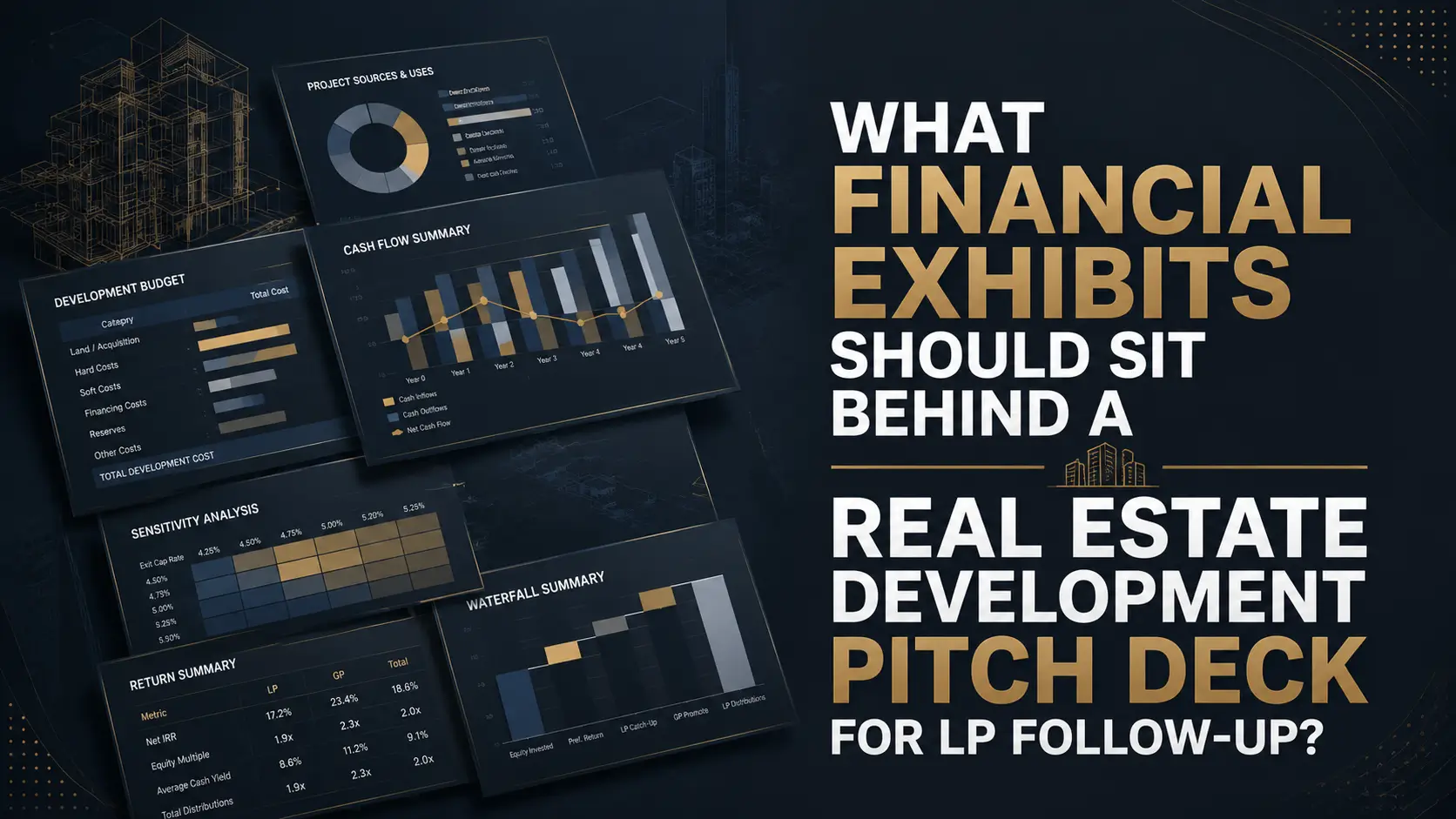
What Financial Exhibits Should Sit Behind a Real Estate Development Pitch Deck for LP Follow-Up?
A real estate development pitch deck alone is not enough to move an LP committee into diligence. After the first review, LPs need five financial exhibits to verify the deal: a project-level financing exhibit, one-page capitalization summary, sources and uses statement, key model output pages, and a downside sensitivity summary. These documents bridge the gap between the deck and the data room by showing how the debt, equity, costs, returns, and risks reconcile in a format that a committee can validate without a guided walkthrough.
The investor-ready materials package covers the full set of nine documents a sponsor needs before institutional outreach. This article focuses on the financial exhibit subset: the documents sent after the pitch deck, in response to a committee's first-pass review. Getting this subset right is a separate calibration from building the full package. The exhibit package is the bridge between the deck and the data room, and it carries a specific job.
The one-page capitalization exhibit and the capital raise model supporting schedules each address a different layer of the same question: how is this deal capitalized and can the numbers be verified? The exhibit package brings those layers together in a sequence the committee can follow without a guided tour.
Key insight: The exhibit package is the financial proof layer that sits underneath the deck. Every document in the package should resolve a question the deck raised, in the order a committee reviewer would ask it.
Why the Pitch Deck Alone Is Insufficient for LP Committee Follow-Up
A pitch deck is a screening tool. Its job is to get a deal past the first filter: does this opportunity meet our strategy, size, and return threshold? A well-built deck answers that question in 15 to 20 slides. It shows the asset, the business plan, the sponsor's track record, and a return summary. That is all it needs to do.
The problem starts when a committee says yes to the first filter. At that point, the deck has done its job and is no longer sufficient. Committee reviewers now need to verify the numbers, not just see them. They need to understand the capital structure at a level of detail the deck cannot provide without becoming a different document entirely.
What the deck cannot resolve on its own:
- Whether the total project cost in the return slide reconciles to the budget
- How each capital source is sized, labeled, and sequenced in the stack
- Whether the senior debt terms assumed in the model are consistent with current lender criteria
- Whether the LP equity contribution shown in the deck matches the sources and uses statement
- What the downside case looks like when exit cap rates widen or lease-up extends
These are committee questions. They come up in the 24 to 72 hours after a deck is reviewed. The sponsor who has a clean exhibit package ready to send in that window moves the process forward. The sponsor who has to go build the exhibits after the question arrives loses momentum and signals that the financial work was not done in advance.
The institutional standard: The institutional standard for LP due diligence holds that financial documentation must be organized, verifiable, and available without requiring the GP to explain it in real time. The institutional due diligence framework that governs how most LP committees structure their review process makes this expectation explicit. The exhibit package is the first test of whether a sponsor meets that standard.
Which Financial Exhibits Belong in a Standard LP Follow-Up Package
Five exhibits cover the financial questions a committee asks after a first-pass deck review. Each one has a specific job. Together, they form a complete picture of the deal's capital structure and financial mechanics.
The Five Core Exhibits
1. Project-level financing exhibit. This exhibit presents the debt stack in detail: loan type, lender category, loan-to-cost ratio, interest rate basis, term, and any reserve or holdback requirements. It answers the committee's first financial question after the deck: how does the debt work? For a ground-up development deal, this exhibit should also show the construction-to-permanent loan conversion logic or the takeout financing assumption. The deck may show a 65% LTC figure. This exhibit explains what that means in practice.
2. One-page capitalization summary. This is the capital structure at a glance: total project cost, senior debt, any mezzanine or preferred equity layers, LP equity contribution, and GP co-investment. Every figure on this page must reconcile to the sources and uses statement and the model. The purpose of the one-page format is speed. A committee reviewer should be able to verify the capital structure in under two minutes.
3. Sources and uses statement. This exhibit breaks down every dollar of project cost by category on the uses side, and every dollar of capital by source on the sources side. The two sides must balance to the penny. Any gap between the sources and uses total and the capitalization summary total is an immediate committee flag.
4. Key model output pages. LPs do not need the full model at the follow-up stage. They need the pages that answer return questions: the summary tab showing gross and net IRR, equity multiple, and cash-on-cash by tranche; the waterfall mechanics at a high level; and the cash flow timing. These pages should carry the same labels used in the deck. Inconsistent terminology between the deck and the model output pages creates confusion that slows the process.
5. Sensitivity or scenario summary. This is the downside case. It shows what happens to LP returns when exit cap rates widen by 50 to 100 basis points, when lease-up extends by six to twelve months, or when construction costs run over budget. A committee that does not see a downside case will ask for one. Providing it proactively signals underwriting discipline.
How to Sequence the Exhibits So Each One Answers the Next Committee Question
Sequence matters as much as content. A committee reviewer reads the exhibit package in the order it arrives. The wrong sequence forces them to jump between documents to answer a single question, which creates friction and follow-up requests.
The correct sequence follows the logic of how a committee thinks about a deal after seeing the deck:
- How is the debt structured? (financing exhibit first)
- What is the full capital structure? (capitalization summary second)
- Where does every dollar come from and go? (sources and uses third)
- What are the projected returns and how were they calculated? (model outputs fourth)
- What happens if the deal underperforms? (sensitivity summary last)
This order mirrors the committee's verification sequence. They start with the debt because it is the largest capital source and the most verifiable. They move to the capitalization summary to see how all layers fit together. The sources and uses confirms the arithmetic. The model outputs show the return thesis in detail. The sensitivity summary closes the loop on downside risk.
What Breaks When the Sequence Is Wrong
Sending the model outputs before the sources and uses statement forces the reviewer to accept return projections without first verifying the capital structure. That is a credibility problem. A reviewer who cannot trace the IRR back to a verified sources and uses total will stop and ask questions before reading further.
Sending the sensitivity summary before the base case model outputs is equally disruptive. The downside case only makes sense in the context of the base case. Present the base case first. Then show what happens when it deteriorates.
Practical rule: Number the exhibits. Label them clearly. A cover page or transmittal note that lists the five exhibits in order, with a one-line description of what each one covers, takes five minutes to prepare and eliminates the most common sequencing confusion.
How the Four Core Exhibits Work Together as a Coordinated Set
The financing exhibit, the capitalization summary, the sources and uses statement, and the model output pages are not four separate documents. They are one coordinated system. A number that appears in any one of them must appear consistently in all of them. Any discrepancy across the four is a reconciliation failure, and reconciliation failures stop committee reviews.
The Reconciliation Chain
Think of the four exhibits as a chain. Each link connects to the next:
- The financing exhibit establishes the debt terms: loan amount, rate, LTC, and term.
- The capitalization summary picks up the loan amount from the financing exhibit and places it in the capital stack alongside equity layers.
- The sources and uses statement picks up the total capital from the capitalization summary and allocates it across cost categories.
- The model output pages use the sources and uses totals as the foundation for every return calculation.
If the loan amount in the financing exhibit is $28.5M and the capitalization summary shows $27.8M, the chain is broken. A committee reviewer will catch that gap. The follow-up question will not be about the deal. It will be about whether the sponsor's documents are reliable.
The Tombstone Test
A useful internal check before sending the package: can a reviewer reconstruct the deal's capital structure from the financing exhibit alone, verify it against the capitalization summary, confirm it in the sources and uses, and then trace the return projections back to those figures in the model outputs? If the answer is yes, the package is ready. If any step in that trace breaks, the package needs more work.
For reference, IRC Partners has advised on deals at this level of complexity across the $5M to $250M raise range, including a multifamily development in Texas with $150M in total capitalization. At that scale, a single reconciliation gap across the exhibit package can add weeks to the committee review cycle. The same principle applies at $10M. Institutional reviewers apply the same verification logic regardless of deal size.
The financial model tabs guide covers how the model itself should be structured to support this kind of exhibit-level reconciliation. The model and the exhibit package should be built as one system.
What Happens When Exhibits Are Missing, Mismatched, or Formatted Inconsistently
Missing exhibits, number mismatches, and inconsistent formatting each produce a different kind of committee friction. Understanding the difference helps sponsors prioritize fixes before the package goes out.
Missing Exhibits
A missing exhibit signals that the financial work behind the deck is incomplete. If a sponsor sends the model output pages without a sources and uses statement, the committee cannot verify where the capital comes from. If the financing exhibit is absent, the debt terms are unverified. Either gap produces a follow-up request, which adds days to the process and shifts the conversation from the deal to the documentation.
The specific risk: committees that receive an incomplete package often do not ask for what is missing. They simply deprioritize the deal until the package is complete. The sponsor may not know the review has stalled.
Number Mismatches
A number mismatch is more damaging than a missing document. A missing document can be explained as a packaging oversight. A mismatch between the financing exhibit and the capitalization summary, or between the sources and uses and the model outputs, raises a question about the reliability of the underwriting itself.
Common mismatch triggers:
- The model was updated after the exhibits were printed or exported
- The capitalization summary uses a rounded figure while the sources and uses uses the precise figure
- The financing exhibit reflects a term sheet that was later revised but the model was not updated to match
- The GP co-investment amount changed between drafts and was corrected in one document but not all
Formatting Inconsistency
Formatting inconsistency is the most overlooked problem. An LP committee that receives a financing exhibit in one format, a capitalization summary in a different template, and model output pages in a third style has to spend cognitive effort just orienting to each document. That effort slows review and creates an impression of disorganization.
Minimum formatting standards across the package:
- Consistent font and header style across all five exhibits
- Consistent number formatting (no mixing of $28.5M and $28,500,000 in the same package)
- Consistent terminology (if the deck says "LP equity," every exhibit says "LP equity," not "investor equity" or "limited partner contribution")
- Consistent date labeling (every exhibit should show the same version date)
{{main-cta}}
How to Calibrate Exhibit Depth for First-Pass Review Versus Full Diligence
The exhibit package sent after the deck is a first-pass package. It is calibrated for a committee reviewer who has 30 to 60 minutes to evaluate whether the deal warrants deeper engagement. That is a different document than what goes into the full data room.
First-Pass Review: What to Include
At the first-pass stage, the goal is verification speed. The reviewer needs to confirm that the capital structure is coherent, the returns are credible, and the financial work is complete. The package should be concise enough to review in a single sitting.
First-pass exhibit calibration:
- Financing exhibit: one to two pages, covering loan structure, terms, and key conditions
- Capitalization summary: one page, showing total capital stack with percentages and dollar amounts
- Sources and uses: one to two pages, with line-item detail but no supporting methodology notes
- Model outputs: three to five pages, showing the summary tab, waterfall overview, and cash flow timing
- Sensitivity summary: one page, showing two to three scenarios with net IRR and equity multiple for each
That is a package of seven to eleven pages. A committee reviewer can verify the core financial thesis in under an hour. That is the target.
Full Diligence: What Changes
When a committee advances the deal to full diligence, the package expands. The financing exhibit gains a full term sheet or lender sizing guidance. The sources and uses gains a detailed budget backup. The model outputs are replaced by the full model with all tabs. The sensitivity summary expands to include a full scenario matrix.
The key distinction: the first-pass package is curated. The full diligence package is comprehensive. Sending the full diligence package at the first-pass stage overwhelms reviewers and signals a misread of how committees work. Sending the first-pass package at the full diligence stage signals that the financial work is shallow.
Calibration rule: Match the depth of the package to the stage of the process. First-pass review requires a package that can be verified quickly. Full diligence requires a package that can withstand detailed scrutiny. Each stage has a distinct document with a distinct purpose.
Structure the Exhibit Package Before the Deck Goes Out
The exhibit package is not a reactive document. It is a pre-built asset that sits ready before the first LP conversation begins. Sponsors who assemble exhibits in response to committee questions are always behind the process. Sponsors who send a clean, sequenced package within 24 hours of a committee's first-pass review move the deal forward without friction.
The five exhibits covered in this article answer every financial question a committee asks after seeing a deck. They do it in the right order, at the right depth, and in a format that allows verification without a guided tour.
If the financial work behind your deck cannot support a clean exhibit package, the deck is ahead of the deal. The exhibit package is where that gap becomes visible.
Ready to structure your exhibit package? The Capital Raise Pre-Flight is IRC Partners' fixed-fee diagnostic that scores a raise against the same twelve institutional gates a deal must clear before IRC Partners takes it into a strategic partnership. Book a strategy call to find out where your current package stands before LP outreach begins.
Frequently Asked Questions
How many financial exhibits should a sponsor send after the pitch deck?
A standard LP follow-up package contains five exhibits: the project-level financing exhibit, the one-page capitalization summary, the sources and uses statement, the key model output pages, and a sensitivity or scenario summary. That produces a package of seven to eleven pages. A committee reviewer can verify the core financial thesis in under an hour at that length.
What is the difference between the exhibit package and the data room?
The exhibit package is a curated set of five documents calibrated for first-pass committee review. It sits between the deck and the data room. The data room is the comprehensive document repository used during full diligence. Sending the full data room at the first-pass stage overwhelms reviewers. Sending the exhibit package at the full diligence stage signals that the financial work is shallow.
Why does exhibit sequencing matter for LP committee review?
Committees verify a deal in a specific order: debt structure first, then full capital stack, then cost allocation, then return projections, then downside risk. Sending exhibits in a different order forces reviewers to jump between documents to answer a single question. That friction slows the process and generates follow-up requests that could have been avoided.
What happens if the sources and uses statement does not reconcile to the capitalization summary?
A gap between the two documents is an immediate committee flag. Reviewers cannot verify the return projections without first confirming that the capital structure arithmetic is correct. A reconciliation failure shifts the committee's attention from the deal to the reliability of the sponsor's financial work. That is a credibility problem that takes days to recover from, not hours.
How detailed should the sensitivity analysis be in a first-pass exhibit package?
At the first-pass stage, a one-page sensitivity summary showing two to three scenarios is sufficient. Each scenario should show net IRR and equity multiple under adverse conditions: exit cap rate widening of 50 to 100 basis points, lease-up extension of six to twelve months, and construction cost overrun. The full scenario matrix with additional variables belongs in the full diligence package.
What formatting standards apply across the five exhibits?
All five exhibits should share a consistent font and header style, consistent number formatting (no mixing of abbreviated and expanded figures in the same package), consistent terminology that matches the deck exactly, and a consistent version date on every document. Formatting inconsistency forces reviewers to spend cognitive effort orienting to each document, which slows review and signals disorganization.
When should a sponsor have the exhibit package ready?
The exhibit package should be ready before the first LP conversation begins. Assembling exhibits in response to a committee question adds days to the process and signals that the financial work was not done in advance. A sponsor who sends a clean, sequenced package within 24 hours of a first-pass review moves the deal forward. A sponsor who takes a week to respond loses momentum.
Continue reading this series:
- How to Build a Data Room That Closes Institutional LPs in 30 Days
- What Documents Should Support a Real Estate Financial Model in an Investor Data Room
- What Financial Projections Do Institutional LPs Expect to See in a Real Estate Fund Pitch Deck
IRC Partners advises operators raising $5M to $250M of institutional capital on structure, positioning, and round architecture. We take seven strategic partners per quarter. No placement agent model. No success-only theater. Capital is raised on the strength of how the deal is built. If you want your current raise reviewed before it reaches the market and silently fails, apply here.
Need guidance on your capital raise?


How to Find Investors for a $20M+ Raise
REIT vs. Private Real Estate Fund: Which Structure Should $10M+ Sponsors Use to Raise Institutional Capital
.jpg "How to get ahead of 99% of startups in seed rounds")
How to Get Ahead of 99% of Startups in Seed Rounds
Disclosure
Nothing on this site constitutes an offer to sell, or a solicitation of an offer to purchase, any security under the Securities Act of 1933, as amended, or any applicable state securities laws. Any offering of securities is made only by means of a formal private placement memorandum or other authorized offering documents delivered to qualified investors.
IRC Partners is a capital advisory firm. IRC Partners is not a registered investment adviser under the Investment Advisers Act of 1940 and does not provide investment advice as defined thereunder.
Certain statements in this article may constitute forward-looking statements, including statements regarding market conditions, capital availability, investor demand, and transaction outcomes. Such statements reflect current assumptions and expectations only. Actual results may differ materially due to market conditions, regulatory developments, company-specific factors, and other variables. IRC Partners makes no representation that any outcome, return, or result described herein will be achieved.
References to prior mandates, transaction volume, network credentials, or capital raised are provided for illustrative purposes only and do not constitute a guarantee or prediction of future results. Past performance is not indicative of future outcomes. Individual results will vary. Network credentials and transaction statistics referenced on this site reflect the aggregate experience of IRC Partners' principals and affiliated advisors and are not a representation of assets managed or transactions closed solely by IRC Partners.
Certain data, statistics, and information presented in this article have been obtained from third-party sources. IRC Partners has not independently verified such information and expressly disclaims responsibility for its accuracy, completeness, or timeliness. Readers should independently verify any third-party data before relying on it.
Readers are strongly encouraged to consult qualified legal, financial, and tax professionals before making any investment, capital raising, or business decision.
Schedule A Meeting
You get one shot to raise the right way. If this raise is worth doing, it’s worth doing with precision, leverage, and control.
This isn’t a practice run. Serious capital. Serious strategy. Let’s raise it right.
We onboard a maximum of seven
new strategic partners each quarter, by application only, to maximize your chances of securing the capital you need.
