.svg "CTA Arrow")


.png "Investor Ready Capital decorative background element")

How Should a Sponsor Format Projected LP Distribution Outputs for Investor-Facing Materials?
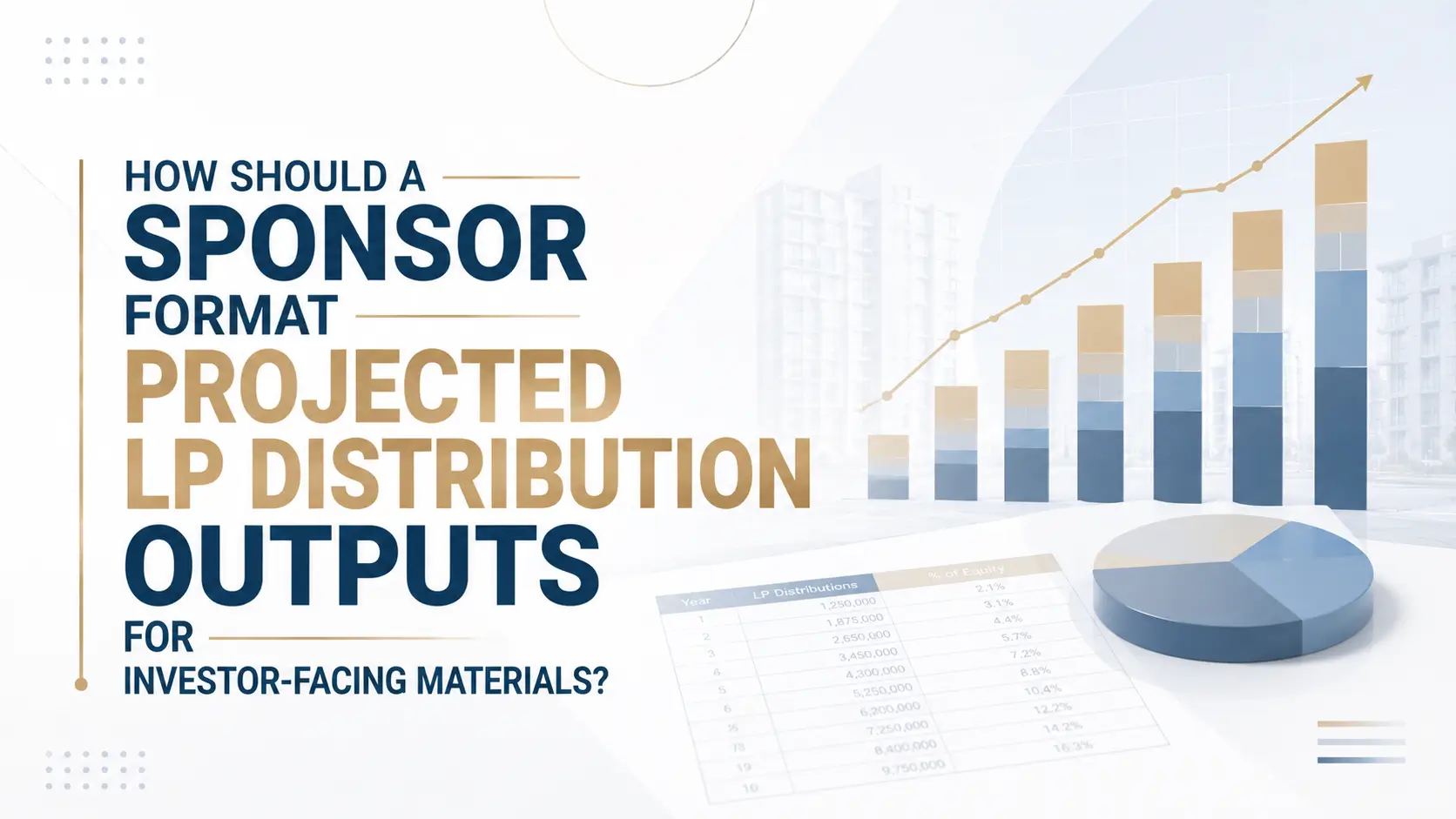
How Should a Sponsor Format Projected LP Distribution Outputs for Investor-Facing Materials?
A projected LP distribution output is a formatted, reviewer-ready schedule that shows when limited partners receive capital back, in what priority order, and at what projected return. It is a purpose-built section of the investor-ready materials package, organized for first-pass validation by an investment committee reviewer. It presents four tiers in plain language: return of capital, preferred return, promoted interest, and residual distributions. Each tier carries a label, a dollar amount or percentage, and a timing reference. A reviewer who opens this document should be able to confirm the full LP return profile without requesting a model walk-through.
The LP distribution output is one of the most reviewed sections in the package. Sponsors raising between $5M and $250M for development projects frequently receive waterfall clarification requests because the distribution outputs were formatted for internal use, not for institutional review. The LP-facing financial model summary and the one-page capitalization exhibit establish the capital structure and return metrics. The LP distribution output takes those metrics one level deeper. It shows the mechanics of how capital flows back to LPs, period by period and tier by tier, in a format a reviewer can read without opening the model.
The core formatting principle: every label in the LP distribution output must match the operating agreement and the LP summary term sheet, word for word.
LP Distribution Output vs. the Internal Waterfall Model
The internal waterfall model is a calculation engine. It contains the full logic for how proceeds flow through the capital stack: debt repayment, return of capital, preferred return accrual, catch-up mechanics, and residual splits. It is built to run scenarios and test assumptions.
The LP distribution output is a presentation layer. It extracts the outputs that matter to an LP reviewer and formats them for readability. A reviewer does not need to see the formulas. They need to see the results, labeled clearly, in the order the operating agreement specifies.
Key distinction: The waterfall model proves the math. The LP distribution output makes the math legible to a reviewer who has not seen the model.
The two documents serve different audiences. The internal model is built for the sponsor's finance team. The LP distribution output is built for an investment committee member who has 20 minutes to review the deal economics before a decision meeting.
What the LP distribution output removes from the waterfall model:
- Raw formula rows and intermediate calculation cells
- Sensitivity toggles and scenario flags
- Tabs or columns that apply to GP economics only
- Debt repayment schedules and lender waterfall logic
What the LP distribution output keeps:
- Tier labels that match the operating agreement
- LP-specific dollar amounts at each tier
- Projected timing by phase (construction, stabilization, exit)
- Preferred return rate and accrual basis
- Residual split percentages by LP and GP layer
Here's a quick reference for what belongs in each document:
Required Components of a Formatted LP Distribution Output
A formatted LP distribution output has four required tiers. Each tier must appear as a labeled row or block, in this sequence, with no tiers skipped and no tiers combined.
Tier 1: Return of Capital
Return of capital is the first distribution. LP contributions are returned before any profit distributions begin. The document should show the total LP equity contribution, the projected period of return, and whether capital is returned at a single exit event or through interim distributions during the hold.
Label this row exactly as it appears in the operating agreement. If the agreement says "Return of Contributed Capital," use that phrase. Do not shorten it to "ROC" or "capital return" in the investor-facing document. The SEC's guidance on limited partnership disclosure requirements is clear that prospective distribution language must distinguish between a return of capital and a return on capital, and that distinction starts with precise labeling in every investor-facing document.
Tier 2: Preferred Return
The preferred return is the LP's priority yield on unreturned capital. Show the annual rate (for example, 8% per annum), the compounding basis (simple or compounded), and the projected dollar amount at each phase. The preferred return coverage article covers the accrual roll-forward and phase-level coverage table in detail. In the distribution output, the preferred return line shows the projected total pref amount due at each distribution event.
Tier 3: Promoted Interest
Promoted interest, also called the GP promote, is the sponsor's share of profits above the preferred return tier. Show the promote percentage and the basis on which it is calculated. If a catch-up provision applies before the promote tier activates, disclose it here as a labeled sub-row. Do not embed the catch-up inside the preferred return tier.
Tier 4: Residual Distributions
Residual distributions are the remaining proceeds split between LP and GP after all prior tiers are satisfied. Show the split percentage for each party. If the deal has multiple promote hurdles (for example, an 8% pref with a 70/30 split to a 15% IRR, then 60/40 above), list each hurdle as a separate labeled row.
Required fields for each tier:
How to Label and Sequence Distribution Tiers
Label matching is the most common formatting failure in LP distribution outputs. A reviewer who sees "Preferred Yield" in the distribution output but "Preferred Return" in the operating agreement will stop and ask for clarification. That question delays the review and signals a process gap.
Match the Operating Agreement, Word for Word
Pull the exact tier labels from the operating agreement before building the distribution output. If the agreement defines the first tier as "Return of Invested Capital," that phrase goes on the document. If it says "Cumulative Preferred Return," use that. Abbreviations and paraphrases belong in internal working files only.
Sequence Rules
Tiers must appear in the exact order specified in the operating agreement's distribution waterfall section. The standard sequence for most development deals is:
- Return of capital (LP first, then GP)
- Preferred return on unreturned capital
- Catch-up (if applicable, labeled separately)
- Residual splits (LP and GP, by hurdle if multiple tiers exist)
If the operating agreement places GP co-investment return alongside LP return in Tier 1, show them as sub-rows under the same tier header. Do not separate them into independent tiers.
Cross-Check Against the LP Summary Term Sheet
The LP summary term sheet is the document LPs sign or reference before the operating agreement is executed. Every tier label and percentage in the distribution output must match both documents. A three-way check (distribution output, operating agreement, LP term sheet) before the package goes out catches the label mismatches that generate clarification requests.
Formatting rule: If the operating agreement and the LP term sheet use different language for the same tier, use the operating agreement language in the distribution output and add a footnote that references the term sheet description.
How to Present Distribution Timing by Project Phase
Distribution timing tells the LP when to expect capital back. It is one of the first things a reviewer checks because it determines whether the LP's capital is tied up for 24 months or 60 months before any return of principal.
The LP distribution output should present timing across three phases: construction, stabilization, and exit event.
Construction Period
During construction, most development deals do not distribute capital to LPs. The construction phase section of the distribution output should confirm this. Label it clearly: "Construction Period: No LP Distributions Projected." If the deal structure includes a preferred return accrual during construction (which it usually does), show the projected accrual amount building during this period as a running balance, not a distribution.
Stabilization Period
If the deal generates operating income before exit, such as rent from a stabilized multifamily asset, show any projected interim distributions during this phase. Label the timing: "Stabilization Phase: Projected Quarterly Distributions Beginning [Month/Year]." Show the projected per-period amount and confirm whether these distributions are applied first to preferred return, return of capital, or a blended basis per the operating agreement.
Exit Event
The exit event is where most LP capital returns in a development deal. Show the projected exit date, the projected gross proceeds, and the tier-by-tier breakdown of how proceeds flow to LPs at that event. This is the most important block in the document. It should be formatted as a waterfall summary table, not a narrative paragraph.
Exit event distribution table format:
Use this table format at the exit event block. Fill in projected amounts from the model. Every number in this table must reconcile to the LP-facing financial model summary.
Preferred Return Accrual and Catch-Up Provisions in Investor-Facing Format
Preferred return accrual and catch-up provisions are the two most frequently misrepresented elements in LP distribution outputs. Presenting them incorrectly generates more clarification requests than any other formatting issue.
Preferred Return Accrual
The preferred return accrues from the date LP capital is funded, on the unreturned capital balance. In the investor-facing distribution output, present the accrual in three lines:
- Accrual rate: The annual preferred return rate (for example, 8% per annum, simple interest)
- Accrual basis: Funded LP equity only, accruing from first capital call date
- Projected accrued balance at exit: The total preferred return amount due at the exit event
Do not show a month-by-month accrual table in the investor-facing document. That level of detail belongs in the internal model. Show the total projected accrued balance at each distribution event, and note the assumption that drives it (funded date, rate, compounding method).
If the deal has multiple capital call dates, note that accrual begins on the date each tranche is funded, and show the blended projected total at exit. A footnote is appropriate for this level of detail.
{{main-cta}}
Catch-Up Provisions
A catch-up provision allows the GP to receive a disproportionate share of distributions after the LP preferred return is satisfied, until the GP reaches a target percentage of total distributions. Real estate operating agreement drafting guidance consistently identifies the catch-up as one of the most frequently ambiguous provisions in waterfall structures, which is precisely why it requires a separate labeled tier in the investor-facing distribution output.
How to present a catch-up in investor-facing format:
- Label it "GP Catch-Up" or the exact phrase used in the operating agreement
- State the catch-up percentage (for example, 100% to GP until GP receives X% of total distributions)
- Show the projected dollar amount of the catch-up at the exit event
- Place it between the preferred return tier and the residual split tier, in the sequence the operating agreement specifies
Common error: Sponsors omit the catch-up tier from the investor-facing output because it reduces the visible LP return at that tier. Omitting it is a disclosure problem. Reviewers who find the catch-up in the operating agreement but not the distribution output will flag it immediately.
The catch-up is a standard structural feature in many development deals. Present it clearly. A well-labeled catch-up provision signals that the sponsor understands their own deal structure.
How the LP Distribution Output Connects to the Rest of the Package
The LP distribution output is one document in a coordinated financial package. It does not stand alone. Every number in it must reconcile to three other documents already in the package.
Connection to the LP-Facing Financial Model Summary
The LP-facing financial model summary shows LP-level net IRR, LP equity multiple, and a waterfall output summary. The LP distribution output expands that waterfall summary into a full tier-by-tier schedule with dollar amounts and timing. The return of capital amount, the preferred return rate, and the residual split percentages must match exactly between the two documents. If the model summary shows an 8% preferred return and the distribution output shows 7.5%, a reviewer will stop the review.
Connection to the Sources and Uses Statement
The LP equity contribution line in the sources and uses statement is the starting point for the return of capital tier. The total LP equity shown in sources and uses must equal the total return of capital amount in Tier 1 of the distribution output. Any difference signals a version mismatch or a data entry error.
Connection to the One-Page Capitalization Exhibit
The capitalization exhibit establishes the LP equity tranche amount and the GP equity co-investment. Those figures flow directly into the distribution output as the capital base for Tier 1. The LP equity amount on the capitalization exhibit, the sources and uses statement, and the distribution output must all show the same number.
Package reconciliation checklist before outreach:
- LP equity in Tier 1 of distribution output = LP equity in sources and uses = LP equity on capitalization exhibit
- Preferred return rate in distribution output = preferred return rate in LP-facing financial model summary
- Residual split percentages in distribution output = residual split percentages in LP-facing model summary
- Catch-up provision in distribution output = catch-up provision in operating agreement
- Version date on distribution output matches version date on all other package documents
IRC Partners served as capital advisor on a multifamily development project in Texas with $150M in total capitalization. The LP distribution output on that engagement reconciled across the model summary, sources and uses, and capitalization exhibit before the first institutional LP meeting. The review session proceeded without a single waterfall clarification request.
The formatting standard is simple: if a reviewer can validate the full LP return profile from the distribution output alone, without opening the model, the document is ready. If they have to ask, it is not.
Frequently Asked Questions
What is a projected LP distribution output in a real estate development deal?
A projected LP distribution output is a formatted, reviewer-ready schedule that shows limited partners when they receive capital back, in what priority order, and at what projected return. It extracts the LP-relevant results from the internal waterfall model and presents them in a sequence that matches the operating agreement. A reviewer should be able to confirm the full LP return profile from this document without opening the model.
How many tiers must appear in a formatted LP distribution output?
A formatted LP distribution output must include four tiers in sequence: return of capital, preferred return, promoted interest, and residual distributions. If the deal includes a catch-up provision, it appears as a labeled sub-tier between the preferred return and residual tiers. No tier may be skipped or combined with another, regardless of how simple the deal structure appears.
Why do waterfall clarification requests happen during institutional LP review?
Waterfall clarification requests happen when the LP distribution output was formatted for internal use rather than for a reviewer who has not seen the model. The most common triggers are tier labels that do not match the operating agreement, a missing catch-up disclosure, preferred return accrual presented without a basis or rate, and distribution timing that is described in narrative form rather than shown in a phase-by-phase table. A reviewer who cannot validate the return profile on first pass will ask for a model walk-through.
What is the correct way to label distribution tiers in investor-facing materials?
Pull the exact tier labels from the operating agreement before building the distribution output. If the agreement defines the first tier as "Return of Invested Capital," that phrase goes on the document. Abbreviations and paraphrases belong in internal working files only. Every label in the LP distribution output must match the operating agreement and the LP summary term sheet, word for word. A three-way check before the package goes out catches label mismatches before they reach a reviewer.
How should a sponsor present the preferred return accrual in investor-facing format?
Present the preferred return accrual in three lines: the annual rate (for example, 8% per annum, simple interest), the accrual basis (funded LP equity only, accruing from first capital call date), and the projected accrued balance at each distribution event. Do not show a month-by-month accrual table in the investor-facing document. If the deal has multiple capital call dates, note that accrual begins on the date each tranche is funded and show the blended projected total at exit as a footnote.
Does the LP distribution output need to show GP economics?
The LP distribution output shows GP amounts only at the tiers where LP and GP proceeds split, specifically the catch-up tier and the residual distribution tier. GP-only economics, including asset management fees, acquisition fees, and GP co-investment returns that do not affect LP distributions, belong in the internal model and the sponsor fees exhibit. Showing GP-only economics in the LP distribution output adds complexity without adding information a reviewer needs to validate the LP return profile.
How does the LP distribution output reconcile with the rest of the investor-facing package?
Three reconciliation checks are required before outreach. First, the LP equity in Tier 1 of the distribution output must equal the LP equity in the sources and uses statement and on the one-page capitalization exhibit. Second, the preferred return rate in the distribution output must match the rate in the LP-facing financial model summary. Third, the residual split percentages must match across both documents. A version date on the distribution output header confirms all documents are from the same model version.
Continue reading this series:
- How a Sponsor Should Model Fee Income, Promote Economics, and GP Participation for Investors
- What Supporting Schedules Should Be Included in a Real Estate Capital Raise Model
- What Should a Capital Call Schedule Include for Institutional LP Review
By the time most founders are rehearsing the pitch, the outcome of the raise has already been set by the structure underneath it. IRC Partners advises operators raising $5M to $250M of institutional capital and accepts seven strategic partners per quarter. If you are going to market this year, have the structure reviewed before investors do. Schedule a call with our team here.
Need guidance on your capital raise?



What Diligence Questions Do Family Offices Ask About Leasing Assumptions In a Value-Add Commercial Real Estate Deal?
How Partial-Sale Loopholes in Drag-Along Clauses Allow Controlling Blocks to Transfer in Stages and Dodge Tag Rights
How Should a Startup Structure Bridge Financing if a Major Customer Contract is Expected to be The Next Financing Catalyst?
Disclosure
Nothing on this site constitutes an offer to sell, or a solicitation of an offer to purchase, any security under the Securities Act of 1933, as amended, or any applicable state securities laws. Any offering of securities is made only by means of a formal private placement memorandum or other authorized offering documents delivered to qualified investors.
IRC Partners is a capital advisory firm. IRC Partners is not a registered investment adviser under the Investment Advisers Act of 1940 and does not provide investment advice as defined thereunder.
Certain statements in this article may constitute forward-looking statements, including statements regarding market conditions, capital availability, investor demand, and transaction outcomes. Such statements reflect current assumptions and expectations only. Actual results may differ materially due to market conditions, regulatory developments, company-specific factors, and other variables. IRC Partners makes no representation that any outcome, return, or result described herein will be achieved.
References to prior mandates, transaction volume, network credentials, or capital raised are provided for illustrative purposes only and do not constitute a guarantee or prediction of future results. Past performance is not indicative of future outcomes. Individual results will vary. Network credentials and transaction statistics referenced on this site reflect the aggregate experience of IRC Partners' principals and affiliated advisors and are not a representation of assets managed or transactions closed solely by IRC Partners.
Certain data, statistics, and information presented in this article have been obtained from third-party sources. IRC Partners has not independently verified such information and expressly disclaims responsibility for its accuracy, completeness, or timeliness. Readers should independently verify any third-party data before relying on it.
Readers are strongly encouraged to consult qualified legal, financial, and tax professionals before making any investment, capital raising, or business decision.
Schedule A Meeting
You get one shot to raise the right way. If this raise is worth doing, it’s worth doing with precision, leverage, and control.
This isn’t a practice run. Serious capital. Serious strategy. Let’s raise it right.
We onboard a maximum of seven
new strategic partners each quarter, by application only, to maximize your chances of securing the capital you need.
