.svg "CTA Arrow")


.png "Investor Ready Capital decorative background element")

How Should a Real Estate Sponsor Organize a Data Room Before Institutional Outreach?
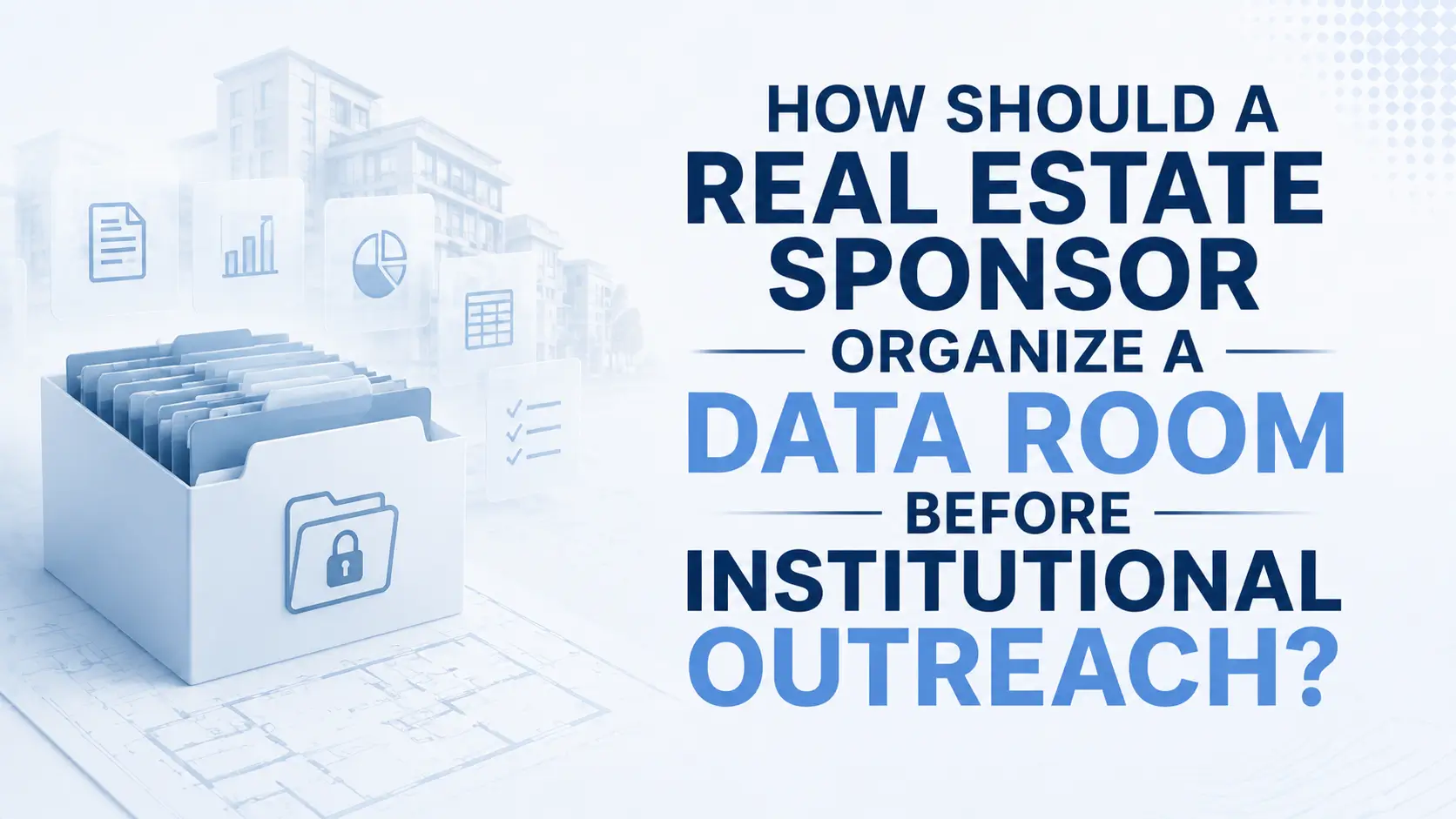
A disorganized data room can stall an institutional real estate raise before an LP evaluates the deal itself. When reviewers cannot quickly find a current executive summary, track record, capital stack, or model output, they infer weak process control and move on to a better-prepared sponsor. The solution is a staged data room built before outreach: Phase 1 materials for first-pass review, Phase 2 diligence files for qualified investors, and a clear folder, naming, and version-control system that makes every document easy to locate and verify.
Three things an institutional data room must do before the first LP opens it:
- Prove that the sponsor has organized their process, not just their files
- Allow an LP to complete a first-pass credibility review without sending a single follow-up request
- Signal that Phase 2 depth exists and will be released in a controlled, deliberate sequence
Why Data Room Discipline Is a Fundraising Execution Issue in 2026
Institutional fundraising in 2026 is running on tighter timelines and deeper diligence. Deal selectivity has increased across private markets as allocators contend with higher financing costs, compressed exit windows, and more complex underwriting requirements, according to a Q1 2026 private equity market analysis. LPs are not moving slower because they are uncertain. They are moving slower because they are doing more work per deal.
In that environment, a data room is a fundraising execution asset. A well-organized room shortens the LP's path from first review to investment committee recommendation. A poorly organized room adds friction at every step, and friction in 2026 costs more than it did two years ago.
The real competitive advantage in the current market is being the easiest sponsor to get to conviction on. Institutional reviewers have limited bandwidth. They advance the deals that require the least work to evaluate.
The data room is one of the first signals of that ease. In 2026, the LP diligence process runs on two independent tracks: investment due diligence and operational due diligence, both evaluated separately before capital moves. Before an LP reads the underwriting, they read the room. Folder structure, document completeness, and naming discipline all communicate something about how the sponsor runs their business. That signal forms before a single file is opened.
For sponsors raising $5M to $250M in institutional LP equity, a disorganized room creates two problems: a slower raise and referral network exposure. Institutional LP communities are small. A sponsor who shows up unprepared to one allocator is often quietly flagged to others. Understanding the most common mistakes that kill a first institutional raise before outreach begins is how sponsors avoid that outcome.
Phase 1: What Goes In First and In What Order
Phase 1 is the LP's first-pass credibility screen. It should contain only the materials needed to evaluate the sponsor's qualifications and form a high-level view of the deal structure.
Every document in Phase 1 should be available before the first access link goes out. Releasing Phase 1 materials reactively, one file at a time as LPs request them, signals that the room was never built with institutional review in mind.
The Phase 1 Document Sequence
The sequence matters as much as the content. Institutional reviewers move through a predictable evaluation logic: sponsor credibility first, deal economics second, capital structure third, market context fourth. That is why the executive-summary spoke matters here, because it explains the first document LPs use to validate the room: what should an institutional LP-ready executive summary include for a real estate raise.
- Room index file (root level): A one-page document listing every folder, its contents in plain language, and which phase each folder belongs to. This is the first document every LP should see.
- Executive summary: A concise narrative covering the opportunity, the sponsor's role, the capital ask, and the return thesis. This is the document that earns the next 30 minutes of review. See the adjacent spoke on what an institutional LP-ready executive summary must include for the full standard. It should also sit right beside the room logic discussed in what should an institutional LP-ready executive summary include for a real estate raise, since LPs often read the summary and the room structure together.
- Sponsor overview and team bios: A clear statement of who the GP is, what they have built, and why they are qualified to execute this specific deal or strategy.
- Track record summary: A project-by-project summary showing the sponsor's specific role, total capitalization, realized exits, and key return metrics. This is an attribution schedule. The full treatment of what this document must contain is covered in the spoke on how a sponsor should prepare a track record schedule for institutional LP review.
- Capital stack summary: A one-page overview of the proposed capital structure, preferred return terms, promote structure, and GP co-investment amount. Economics must be resolved before outreach begins.
- Financial model summary: Net IRR, equity multiple, MOIC, and base case return schedule. Include summary metrics only.
- Market and deal narrative: A focused overview of the submarket, demand drivers, and the specific opportunity being pursued. Not a full market study. A clear thesis statement.
Key insight: Phase 1 should contain 15 to 25 documents. More than that and the LP is overwhelmed before diligence begins. Fewer than that and the LP will send follow-up requests before they have enough to form a view.
Phase 2: Active Diligence Documents and When to Release Them
Phase 2 materials go to LPs who have signed an NDA and confirmed active investment interest. The purpose of gating Phase 2 is clarity. Releasing everything on day one overwhelms reviewers and buries the most important materials under documents that are only relevant weeks into the process.
Phase 2 should be organized by diligence track so LP teams can divide the work cleanly across legal, investment, and operations reviewers.
Why Gated Release Protects Process Quality
The document review sequence used by institutional allocators starts with updated offering materials, subscription documents, and DDQ responses before moving to audited financials and operational files. That order maps directly to why Phase 2 should be organized by diligence track.
A staged release keeps the diligence process in sequence. LPs who receive everything at once tend to jump to the sections that concern them most, often legal or waterfall mechanics, before they have formed a complete view of the deal thesis. That creates misaligned conversations and premature objections.
Controlled release also protects the sponsor from a common problem: multiple LP teams working from different versions of the same document. When Phase 2 materials are released only to qualified parties, version control becomes manageable.
Folder Naming, Version Control, and Access Staging Rules
Naming and version discipline are where most sponsor data rooms quietly fail. An LP who opens a folder and finds files named "Proforma FINAL v3 revised" or "Track Record Updated NEW" cannot determine which document is authoritative. That uncertainty creates follow-up requests. Follow-up requests add days.
Naming Convention to Use
Apply a consistent file naming format across every document in the room:
[FolderNumber].[DocumentType].[EntityOrAsset].[YYYY-MM-DD]
Examples:
- 02.TrackRecordSummary.GPEntity.2026-07-15
- 03.FinancialModelSummary.ProjectName.2026-07-15
- 04.CapitalStackOverview.FundLP.2026-07-15
This format makes the folder number, document type, asset or entity, and date visible without opening the file. An LP reviewing 40 documents can orient themselves in seconds.
Version Control Rules
- One live version per document. When a document is updated, the prior version moves to an archive subfolder. Two versions of the same document should never sit side-by-side in the active folder.
- Every document must carry a date in both the filename and the document header or footer.
- Track changes by version number for any document that goes through multiple LP-facing revisions. Format: v1.0, v1.1, v2.0.
Access Staging Checklist
- Phase 1 folders are accessible to all prospective LPs from day one
- Phase 2 folders are locked until NDA is signed and investment interest is confirmed
- Legal and subscription folders are locked until a term sheet or LOI is signed
- Permissions are set by reviewer role, not by individual LP, so access expands cleanly as the process advances
- Audit trail is enabled so the sponsor can see which documents each LP is reviewing and how often
- A dummy account test is run before the first access link goes out to confirm permissions work as intended
{{main-cta}}
What a Disorganized Data Room Signals to an Institutional Allocator
An institutional LP reviewing a disorganized data room does not send a rejection email. They send silence. The deal stops moving and the sponsor rarely learns why.
Here is what specific data room failures communicate to a professional allocator:
- No index file or read-me: The sponsor has not thought about how an outsider navigates this room. If they cannot organize a folder, the LP questions whether they can manage a construction timeline or an LP relationship.
- Multiple conflicting versions of the same document: The LP must now determine which version is authoritative before they can begin their analysis. That is work the sponsor should have done. It creates doubt about whether the numbers are reliable.
- Phase 2 materials mixed into Phase 1 access: Releasing everything at once tells the LP that the sponsor has no process for managing disclosure. It also signals that the sponsor may not understand what a qualified LP conversation looks like.
- Files named by internal shorthand: Documents named "New Model JL edits" or "Final Deck 3" are internal working files, not LP-facing materials. They signal that the room was assembled from a desktop, not built for review.
- Missing documents with no explanation: A gap in the track record, a missing entitlement summary, or an absent GP entity chart forces the LP to ask. Each follow-up request adds time and reduces confidence.
- No version dates on financial documents: An undated proforma cannot be verified as current. LPs who cannot confirm currency default to conservative assumptions or route to a clarification call.
The data room is a proxy for how the sponsor manages everything else. In a 2026 market where LPs are doing more work per deal and advancing fewer opportunities, a room that creates friction gets deprioritized before a single substantive question is asked.
What to Do If Your Current Room Is a File Dump
If the current data room was assembled by uploading files as LPs requested them, the room was built reactively. That is the most common starting point, and it is fixable before the next outreach campaign.
Three steps to rebuild the room around LP review logic:
- Audit against phase and sequence. Pull every document and sort it into Phase 1 (first-pass credibility), Phase 2 (active diligence), or Phase 3 (legal and subscription). Anything that does not belong in Phase 1 should be locked. Anything missing from Phase 1 should be identified and assigned a completion date.
- Apply the naming convention and reconcile numbers. Rename every file using the format above. Then reconcile every top-line number across the pitch deck, financial model, executive summary, and any prior LP communications. One number per metric. One source of truth. This single step eliminates the most common cause of LP follow-up requests.
- Add the index file and test access. Write a one-page room index before sending the first access link. Run a dummy account test to confirm Phase 1 and Phase 2 permissions work as intended.
IRC Partners has served as capital advisor on transactions including a $900M mixed-use development in Florida, a $150M multifamily development in Texas, and a $300M condominium development in California. At that scale, document architecture and LP-facing disclosure discipline are not administrative details. They are part of the institutional credibility case the sponsor builds before the first serious diligence call.
Frequently Asked Questions
How many top-level folders should a real estate sponsor data room have before institutional outreach?
An institutional-grade real estate data room should have 8 to 10 numbered top-level folders before outreach begins. Each folder should map to a distinct diligence track: deal overview, sponsor track record, financial model, capital stack and waterfall, market and business plan, property and development diligence, legal and entity documents, third-party reports, debt and financing, and operations and reporting. Fewer than 8 folders typically means critical categories are collapsed or missing, which forces LPs to send clarification requests before they complete a first-pass review.
What is the difference between Phase 1 and Phase 2 data room access for institutional LPs?
Phase 1 access contains the materials needed for a first-pass credibility screen: the room index, executive summary, sponsor overview, track record summary, capital stack overview, and financial model summary. Phase 2 access is released after a signed NDA and confirmed investment interest, and includes the full financial model with sensitivity analysis, complete waterfall mechanics, deal-level track record attribution, third-party reports, and property diligence files. The purpose of the two-phase structure is to match document depth to LP qualification level, not to withhold information.
What file naming format do institutional LPs expect in a real estate data room?
Institutional LPs expect every document to carry a folder number, document type, entity or asset identifier, and date in the filename. A consistent format such as [FolderNumber].[DocumentType].[EntityOrAsset].[YYYY-MM-DD] eliminates version ambiguity and lets reviewers orient themselves without opening files. Documents named with internal shorthand like "Final v3 revised" or "New Model JL edits" signal that the room was assembled from a desktop rather than built for LP review.
How should a sponsor handle version control when a financial model is updated mid-diligence?
When a financial model or any LP-facing document is updated mid-diligence, the revised version should replace the prior version in the active folder, and the superseded version should move to a clearly labeled archive subfolder with a date stamp. Two versions of the same document should never sit side-by-side in the active folder. Every document update should also be flagged to active LP reviewers with a brief note explaining what changed, so reviewers know which version is current without having to compare files.
What should the root-level index file in a data room include?
The root-level index file should list every folder by number and name, describe its contents in one sentence, note the current version date for key documents, and identify which folders belong to Phase 1 versus Phase 2. It should be the first document every LP sees when they open the room. A well-written index eliminates most navigation friction and signals that the sponsor has thought carefully about how an outside reviewer will move through the materials. The index should be no longer than one page.
What does a sponsor's data room access control setup communicate to an institutional LP?
Access control setup communicates how the sponsor manages governance and investor relationships. A data room with no permission structure, no audit trail, and no phase-gating signals that the sponsor has not invested in the infrastructure that institutional-grade capital raises require. Conversely, a room with role-based permissions, phase-gated access, and a visible audit trail tells the LP that the sponsor can manage disclosure discipline, which is a proxy for how they will manage capital, reporting, and LP communications after close.
How does a sponsor know if their current data room is ready for institutional LP outreach?
A data room is ready for institutional outreach when a first-time reviewer can answer five questions from Phase 1 materials alone, without sending a single follow-up request: Who is the sponsor and what have they built? What is the capital ask and how is the deal structured? What are the projected returns and how were they derived? What is the market opportunity and why is this deal positioned to capture it? What is the GP's economic alignment? If any of those five questions requires a follow-up email to answer, the room is not ready. Sponsors working with IRC Partners on their institutional disclosure package run this test before the first access link goes out.
Continue reading this series:
- Build a Data Room That Closes Institutional LPs in 30 Days
- 47 Due Diligence Documents $10M+ Sponsors Must Have Ready
- Financial Model Red Flags Institutional Diligence Catches in 15 Minutes
IRC Partners advises operators raising $5M to $250M of institutional capital on structure, positioning, and round architecture. We take seven strategic partners per quarter. No placement agent model. No success-only theater. Capital is raised on the strength of how the deal is built. If you want your current raise reviewed before it reaches the market and silently fails, apply here.
Need guidance on your capital raise?


10 Mistakes That Kill Your First Institutional Raise
How Does Venture Capital Fundraising Advisory Work

AI and Automation in Capital Markets: How Technology is Reshaping Financial Services in 2026
Disclosure
Nothing on this site constitutes an offer to sell, or a solicitation of an offer to purchase, any security under the Securities Act of 1933, as amended, or any applicable state securities laws. Any offering of securities is made only by means of a formal private placement memorandum or other authorized offering documents delivered to qualified investors.
IRC Partners is a capital advisory firm. IRC Partners is not a registered investment adviser under the Investment Advisers Act of 1940 and does not provide investment advice as defined thereunder.
Certain statements in this article may constitute forward-looking statements, including statements regarding market conditions, capital availability, investor demand, and transaction outcomes. Such statements reflect current assumptions and expectations only. Actual results may differ materially due to market conditions, regulatory developments, company-specific factors, and other variables. IRC Partners makes no representation that any outcome, return, or result described herein will be achieved.
References to prior mandates, transaction volume, network credentials, or capital raised are provided for illustrative purposes only and do not constitute a guarantee or prediction of future results. Past performance is not indicative of future outcomes. Individual results will vary. Network credentials and transaction statistics referenced on this site reflect the aggregate experience of IRC Partners' principals and affiliated advisors and are not a representation of assets managed or transactions closed solely by IRC Partners.
Certain data, statistics, and information presented in this article have been obtained from third-party sources. IRC Partners has not independently verified such information and expressly disclaims responsibility for its accuracy, completeness, or timeliness. Readers should independently verify any third-party data before relying on it.
Readers are strongly encouraged to consult qualified legal, financial, and tax professionals before making any investment, capital raising, or business decision.
Schedule A Meeting
You get one shot to raise the right way. If this raise is worth doing, it’s worth doing with precision, leverage, and control.
This isn’t a practice run. Serious capital. Serious strategy. Let’s raise it right.
We onboard a maximum of seven
new strategic partners each quarter, by application only, to maximize your chances of securing the capital you need.
