.svg "CTA Arrow")


.png "Investor Ready Capital decorative background element")

Mixed-Use Real Estate Development: How $10M+ Sponsors Structure Mixed-Use Deals That Institutional Lenders Will Fund
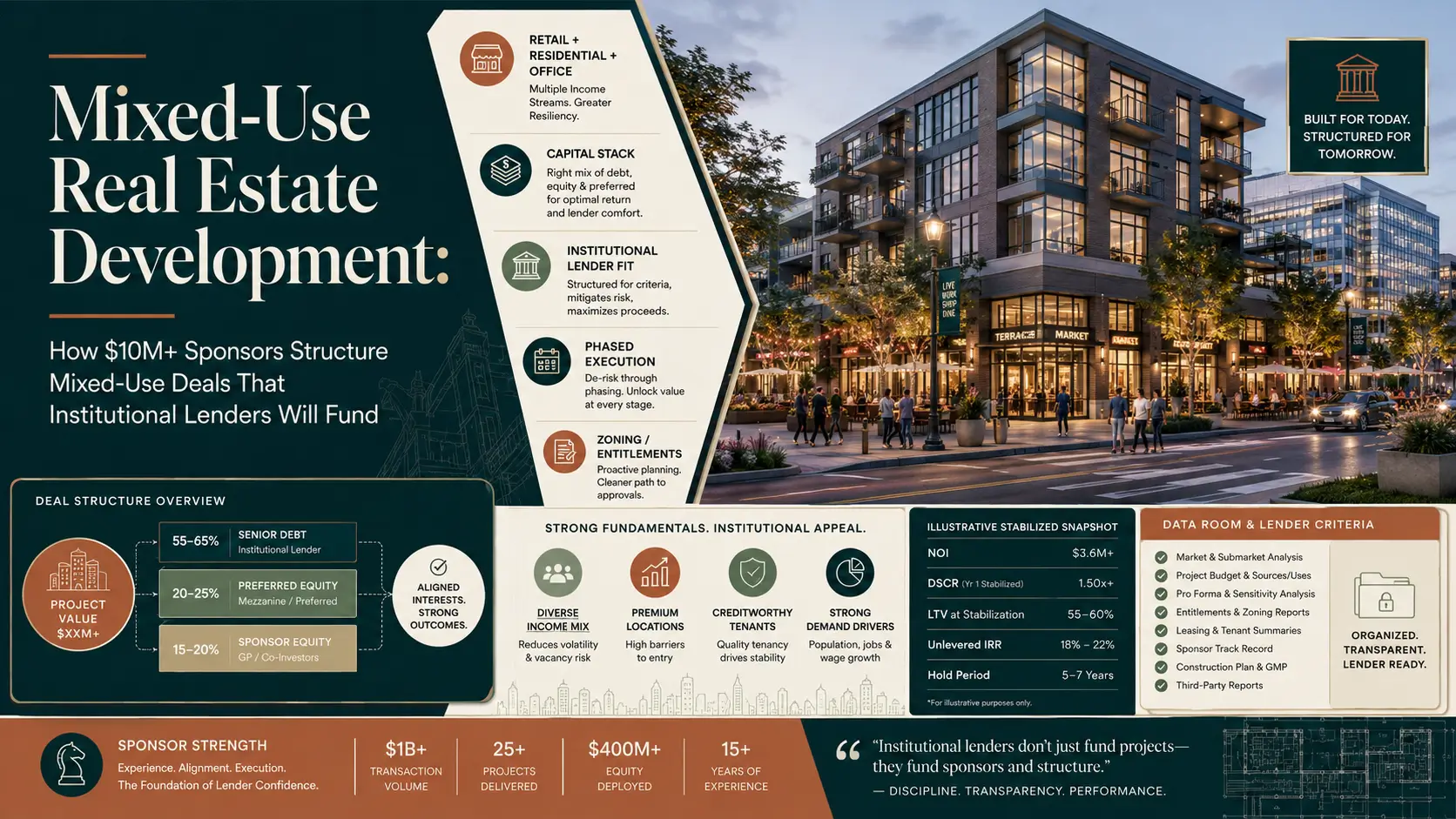
Mixed-Use Real Estate Development: How $10M+ Sponsors Structure Mixed-Use Deals That Institutional Lenders Will Fund
Mixed-use real estate development is the fourth-ranked institutional allocation target by asset class in 2026 - and capital is available. But available capital isn't the same as accessible capital. In 2025-2026, underwriting is disciplined, asset-specific, and focused on downside durability, and mixed-use projects carry more moving parts than single-use assets. Most sponsors who fail at institutional raises aren't failing because the asset class is wrong - they're failing because the deal isn't structured to institutional standards before outreach begins. This guide shows exactly what that standard looks like, from capital stack logic to component-level underwriting, before your first LP conversation starts.
But available capital is not the same as accessible capital. In 2025-2026, underwriting is disciplined, asset-specific, and focused on downside durability. The $950 billion to $1 trillion CRE debt maturity wall pressing through 2027 has made lenders and equity allocators more conservative across the board, and mixed-use projects carry more moving parts than single-use assets. That means the bar for institutional engagement is higher, not lower.
Most mixed-use sponsors who fail at institutional raises are not failing because the asset class is wrong. They are failing because the deal is not structured to institutional standards before outreach begins.
The first screen is not your deck. It is whether your structure already answers the questions institutional LPs will ask.
Key takeaways for this article:
- Institutional LPs underwrite mixed-use components separately, not as a blended story
- The capital stack, waterfall, GP co-invest, and fee logic must be resolved before outreach
- Track record attribution matters at the deal level, not just the portfolio level
- Weak structure produces silent passes, not feedback
- Sponsors who structure first and pitch second move faster and protect GP economics
How Institutional LPs Underwrite Mixed-Use Deals Differently Than HNWI Investors
HNWI investors typically evaluate a mixed-use project as a single story: the location, the sponsor's reputation, and the projected return. Institutional LPs do not work that way. They separate every income-producing component and underwrite each one on its own terms.
That distinction matters because it changes what you need to prove before a conversation gets traction.
The Commercial Component Is the Drag Variable
In a residential-led mixed-use project, the residential piece usually carries the most predictable income. The retail or office component is where institutional underwriting slows down. Lenders and LPs want to see tenant quality, lease term, rollover risk, and market depth for the commercial uses. If that component is speculative, it will often drive the entire investment committee discussion regardless of how strong the residential story is.
As NAIOP's research noted in 2025, institutional capital in mixed-use is concentrating around projects where commercial uses are either pre-leased, grocery-anchored, or demonstrably need-based. Office-heavy mixed-use schemes are facing continued capital constraints.
Sequencing Risk and Track Record Attribution
Mixed-use projects do not lease up on one clock. Residential absorption, retail lease-up, and condo sellout all move on different timelines. Institutional LPs model each sequence separately and stress-test what happens when one component is delayed.
Track record attribution adds another layer. A sponsor who has completed three mixed-use projects needs to show which components they personally executed. Completing a project where a co-developer handled the retail leasing does not give you institutional credit for retail leasing expertise. Component-level attribution is how institutional LPs determine whether the sponsor can actually execute each piece of the deal in front of them.
What the Capital Stack Must Look Like for a $10M+ Mixed-Use Raise
A credible mixed-use capital stack in 2025-2026 does not start with maximum leverage. It starts with a senior debt position sized to survive stress, with every tranche above it carrying a clear purpose and documented intercreditor logic.
Senior Debt Sizing in 2025-2026
Senior debt coupon rates are running 100 to 200 basis points above the 4-4.7% levels common in prior cycles. That means sponsors who sized their stack based on pre-2022 leverage assumptions are working with the wrong model. Institutional LPs will check whether the senior debt position is sized to actual current DSCR requirements, not optimistic stabilization assumptions.
For mixed-use specifically, lenders are applying asset-specific analysis to the commercial component. If retail or office income is speculative, lenders may size the senior debt to the residential income only and treat commercial income as upside. That compresses proceeds and shifts more of the gap into the mezzanine or preferred equity layer.
The Mezzanine and Preferred Equity Layer
Mezzanine debt and preferred equity are not interchangeable. Mezzanine debt sits above the equity in the capital structure and requires a pledge of the borrower's ownership interest. Preferred equity sits within the equity structure with negotiated priority distributions. Both are common in $10M+ mixed-use stacks, but the intercreditor agreement between the senior lender and the mezzanine or preferred equity provider must be documented before LP outreach. Institutional LPs will ask for it.
GP Co-Invest as a Credibility Signal
A GP co-invest of 2-5% of total equity is a practical floor for institutional credibility. Sponsors who contribute meaningfully above that floor signal conviction. Sponsors who try to minimize co-invest or structure it with deferred or promoted capital rather than cash-at-risk will face direct questions from institutional allocators.
Waterfall, Promote, and Preferred Return Mechanics at the Institutional Level for Mixed-Use
Institutional LPs expect a waterfall that is documented, sequenced, and defensible before the first conversation. The sequence is not negotiable once diligence starts. Sponsors who try to resolve waterfall mechanics during live LP conversations lose credibility and slow the raise.
The Standard Institutional Waterfall Sequence
- Return of capital to all investors, including GP co-invest, pro rata
- Preferred return to LP investors (typically 7-9% for mixed-use development, reflecting higher execution risk than stabilized single-use assets)
- GP catch-up if applicable, bringing the GP to its negotiated promote percentage of total distributions to that point
- Residual split between LP and GP at the negotiated promote tier (commonly 70/30 or 80/20 at the first tier, with GP promote increasing at higher return hurdles)
For mixed-use development specifically, a preferred return in the 7-9% range reflects the added execution risk of managing multiple lease-up timelines and, where applicable, a condo sellout schedule. Sponsors who propose a 6% preferred return on a ground-up mixed-use project with a retail component will face pushback from institutional allocators who understand the risk profile.
Promote Logic and Timing
The GP promote must be earned, not assumed. Institutional LPs scrutinize whether the promote is structured to pay out only after the LP has received its full preferred return and capital back. Promotes that accelerate early, or that are structured around partial milestones rather than full LP recovery, are a common reason institutional conversations stall. Sponsors who want to model the right promote percentage before outreach should review how to calculate the right GP/LP split for your deal before finalizing waterfall language.
Fee Disclosure: What Institutional LPs Expect to See
Fee stacking is one of the fastest ways to lose an institutional LP's confidence. Every fee must be disclosed upfront with plain-language logic. The standard fee set for a $10M+ mixed-use development looks like this:
- Acquisition fee: 0.5-1.5% of total project cost, paid at closing
- Asset management fee: 1-2% of invested equity annually, paid from operations
- Construction management fee: 3-5% of hard construction costs, paid during construction
- Disposition fee: 0.5-1% of gross sale proceeds, paid at exit
If fees stack in ways that reduce LP returns before the preferred return is met, institutional LPs will model the impact and factor it into their return expectations. Transparent disclosure is not optional. It is a baseline credibility requirement.
For more on how institutional LPs evaluate GP and LP economics across deal structures, see how multifamily sponsors structure $10M+ apartment deals that institutional capital funds.
{{main-cta}}
The Minimum Deal Structuring Standard Before Institutional Outreach Begins
A pitch deck is not a deal structure. Institutional LPs evaluate whether a sponsor has already resolved the fundamental economic and governance questions before they agree to open a data room. If those questions are still open, the conversation ends before diligence starts.
What Must Be Resolved Before Outreach
The following items represent the minimum institutional deal structuring standard for a $10M+ mixed-use raise. Each one must be documented, not just thought through.
- Capital stack term sheet: Senior debt sizing, mezzanine or preferred equity tranche if applicable, LP equity sizing, and GP co-invest amount, all documented with intercreditor logic
- Waterfall language: Full sequence drafted, preferred return rate stated, catch-up provision addressed, promote split defined at each tier
- Fee schedule: All four fees disclosed with basis, timing, and LP impact modeled
- Component-level underwriting model: Separate cash flow projections for residential, retail or office, and condo sellout if applicable, with a documented downside case for each
- Lease-up and sellout schedule: Unit-level absorption for residential, pre-lease status for commercial, and condo sellout timeline with stress scenarios
- Sponsor track record package: Deal-level attribution by component, not just portfolio headlines
- Reporting and governance framework: Quarterly reporting cadence, key decision rights, LP consent thresholds, and preferred equity or mezzanine lender rights if applicable
The Cost of Going to Market Too Early
Sponsors who approach institutional LPs before these items are resolved face predictable outcomes: no second call, a pass before diligence, or a long negotiation that forces the GP to give away economics under time pressure. The real estate due diligence checklist for $10M+ sponsors covers the 47 documents institutional LPs expect in a data room. The deal structuring standard above is what must exist before that data room is even assembled.
ILPA's DDQ 2.0 framework is the benchmark institutional LPs use to evaluate sponsor readiness. If a sponsor cannot answer ILPA-style questions on governance, alignment, and fee disclosure before outreach, they are not ready for institutional capital.
The practical rule is simple: structure first, then build the data room, then begin outreach. Reversing that sequence costs time, capital, and referral credibility.
Mixed-Use Capital Gets Funded When the Structure Is Already Solved
Mixed-use real estate development can attract meaningful institutional capital in 2025-2026. Residential-led projects with credible commercial components are still on institutional LP target lists. But demand for the asset class is not the same as demand for your deal.
Institutional LPs are not evaluating your mixed-use project in isolation. They are evaluating whether the sponsor has already solved the structure. A resolved capital stack, documented waterfall, transparent fee schedule, and component-level underwriting model tell institutional allocators that the GP is ready for the conversation, not still preparing for it.
The sponsors who close institutional raises fastest are not the ones with the best pitch. They are the ones who removed the most uncertainty before outreach began.
Sponsors who want to pressure-test their mixed-use deal structure against institutional standards before approaching LPs should see how industrial sponsors structure warehouse and logistics deals that institutional capital funds as a parallel framework, and explore single-family office vs. multi-family office for real estate LP equity to understand which LP type is the right first call for a mixed-use raise of this size.
Frequently Asked Questions
How do institutional LPs underwrite the retail or office component of a mixed-use deal when residential is the dominant use?
Institutional LPs underwrite the retail or office component independently, not as a supporting element of the residential story. They assess tenant quality, lease term length, rollover risk, and market depth for the commercial use on its own merits. If the commercial component is speculative or pre-lease rates are below 30-40%, it can become the controlling variable in the investment committee review regardless of how strong the residential income is. Sponsors should treat the commercial component as a standalone underwriting case, not a blended NOI contributor.
What preferred return hurdle do institutional LPs expect for a mixed-use development with a condominium sellout component vs. a rental-only mixed-use deal?
For a rental-only mixed-use development, institutional LPs typically expect a preferred return in the 7-8% range, reflecting standard execution risk on residential and commercial lease-up. When a condo sellout component is involved, the preferred return expectation often moves to 8-9% or higher because sellout timing, pricing risk, and presale requirements introduce an additional layer of execution uncertainty. Sponsors should model the preferred return to the riskiest component, not the blended average.
How does lease-up sequencing risk in a mixed-use project affect institutional LP underwriting compared to a single-use residential or retail deal?
In a single-use deal, lease-up risk is linear: one product type, one absorption timeline. In a mixed-use project, residential absorption, retail lease-up, and condo sellout all run on separate clocks. Institutional LPs model each sequence independently and stress-test what happens when one component is delayed by 6-9 months. That delay can compress total project returns, extend the hold period, and trigger covenant issues on the senior debt. Sponsors must present a sequencing schedule with documented downside scenarios for each component, not a single blended stabilization date.
What is the GP co-invest expectation for a mixed-use development with both residential and retail components at the $10M+ institutional raise level?
Institutional LPs expect GP co-invest of at least 2-5% of total equity for a $10M+ mixed-use raise. For projects with both residential and retail components, where execution complexity is higher, LPs often view co-invest below 2% of total equity as a credibility risk. The co-invest must be cash-at-risk capital, not promoted interest or deferred contribution. Sponsors who contribute at or above the 5% threshold signal conviction and tend to move through institutional diligence faster than sponsors who negotiate co-invest down to the minimum.
How do institutional LPs treat condominium sellout risk in a mixed-use capital stack vs. a for-rent residential component?
Condo sellout risk is treated as a discrete underwriting event, not a passive income stream. Institutional LPs require a presale threshold, often 30-50% of units under contract before construction funding is released, and a documented sellout schedule with pricing assumptions tied to comparable sales data. For-rent residential is underwritten on stabilized NOI and cap rate assumptions. Condo sellout is underwritten on absorption pace, pricing per square foot, and market velocity. The two require separate models, and institutional LPs will not accept a blended residential story that obscures which units are for sale and which are for rent.
What NOI blending methodology do institutional LPs use when underwriting a mixed-use asset with retail, office, and residential income streams?
Institutional LPs do not blend NOI across uses at the underwriting stage. Each income stream is modeled separately with its own stabilization timeline, vacancy assumption, and cap rate or exit multiple. The blended NOI figure that appears in a sponsor's pro forma is a summary output, not an underwriting input. LPs will disaggregate it and apply component-specific assumptions. Sponsors who present only blended NOI without component-level support will be asked to resubmit with disaggregated models before diligence proceeds.
How long does it typically take to close a $10M+ institutional raise for a mixed-use development compared to a single-use multifamily or industrial raise?
A $10M+ institutional raise for a mixed-use development typically takes 6-12 months from first LP conversation to close, compared to 4-8 months for a single-use multifamily or industrial raise with equivalent capitalization. The additional time reflects the complexity of component-level diligence, the need to resolve intercreditor agreements between senior lenders and mezzanine or preferred equity providers, and the additional LP review time required for retail lease-up or condo sellout assumptions. Sponsors who enter outreach with a fully documented capital stack and waterfall reduce this timeline by 30-60 days on average.
Continue reading this series:
- How to Build a Data Room That Closes Institutional Investors in 30 Days Instead of 90
- Real Estate Due Diligence Checklist: The 47 Documents $10M+ Sponsors Must Have Ready
- How to Structure a Capital Stack for a $10M-$50M Real Estate Development Deal
The wrong structure doesn't just cost you this round. It costs you the next three. IRC Partners advises founders raising $5M to $250M of institutional capital. If you're about to go to market and want the structure reviewed before investors see it, book a call here.
Sponsors weighing this decision should first complete a capital raise readiness assessment for sponsors to confirm the raise is investor-ready.
Need guidance on your capital raise?


How to Choose an Advisor for Sovereign Wealth and Pension Capital

Which Advisory Firms Offer Comprehensive Capital Raising Services for Real Estate Developers?

What Should a Capital Call Schedule Include for Institutional LP Review?
Disclosure
Nothing on this site constitutes an offer to sell, or a solicitation of an offer to purchase, any security under the Securities Act of 1933, as amended, or any applicable state securities laws. Any offering of securities is made only by means of a formal private placement memorandum or other authorized offering documents delivered to qualified investors.
IRC Partners is a capital advisory firm. IRC Partners is not a registered investment adviser under the Investment Advisers Act of 1940 and does not provide investment advice as defined thereunder.
Certain statements in this article may constitute forward-looking statements, including statements regarding market conditions, capital availability, investor demand, and transaction outcomes. Such statements reflect current assumptions and expectations only. Actual results may differ materially due to market conditions, regulatory developments, company-specific factors, and other variables. IRC Partners makes no representation that any outcome, return, or result described herein will be achieved.
References to prior mandates, transaction volume, network credentials, or capital raised are provided for illustrative purposes only and do not constitute a guarantee or prediction of future results. Past performance is not indicative of future outcomes. Individual results will vary. Network credentials and transaction statistics referenced on this site reflect the aggregate experience of IRC Partners' principals and affiliated advisors and are not a representation of assets managed or transactions closed solely by IRC Partners.
Certain data, statistics, and information presented in this article have been obtained from third-party sources. IRC Partners has not independently verified such information and expressly disclaims responsibility for its accuracy, completeness, or timeliness. Readers should independently verify any third-party data before relying on it.
Readers are strongly encouraged to consult qualified legal, financial, and tax professionals before making any investment, capital raising, or business decision.
Schedule A Meeting
You get one shot to raise the right way. If this raise is worth doing, it’s worth doing with precision, leverage, and control.
This isn’t a practice run. Serious capital. Serious strategy. Let’s raise it right.
We onboard a maximum of seven
new strategic partners each quarter, by application only, to maximize your chances of securing the capital you need.
