.svg "CTA Arrow")


.png "Investor Ready Capital decorative background element")

5 Drag-Along Clause Variations That Favor Investors Over Founders - And What to Ask For Instead

5 Drag-Along Clause Variations That Favor Investors Over Founders - And What to Ask For Instead
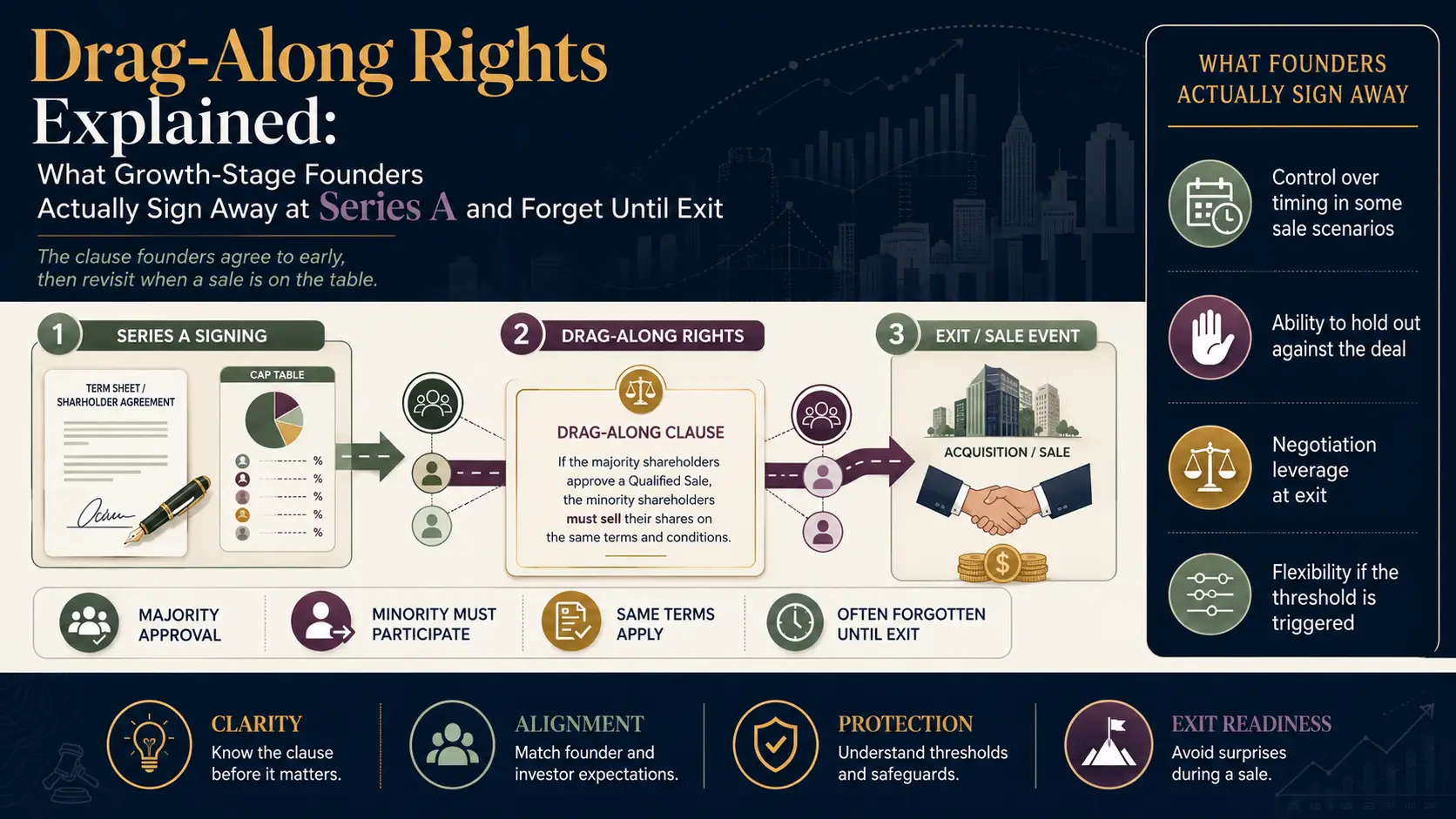
Most founders negotiate drag-along provisions by focusing on the threshold percentage - the 51% or 75% headline number that determines how many votes are required to activate a forced sale. That number matters, but it is not where investor-favorable drafting does its most consequential work. The five clause variations that shift structural power most quietly operate underneath the threshold: they determine who holds trigger authority, whether a minimum price floor protects common stockholders, whether board approval can be cleared by investor-appointed directors alone, whether written consent can activate the drag without any process requirements, and whether the voting calculation is structured in a way that systematically reduces common stockholder leverage. Each variation is negotiable before the round closes. Almost none of them are changeable after it does.
The broader mechanics of how drag-along provisions work in growth-stage companies are covered in the foundation drag-along article. The specific question of how these clauses affect a founder's ability to control exit timing is covered in the drag-along and founder exit timing article. This article focuses on something different: the five clause variations that shift structural power quietly, what each one costs a founder in concrete terms, and what to ask for instead before the next round closes.
What investor-favorable drag-along language has in common:
- It reduces the number of approvals required to activate the clause
- It removes price minimums that would otherwise protect founder economics
- It treats board consent as procedural rather than substantive
- It compresses the timeline available to founders once a sale process starts
- It counts votes in a way that systematically weakens common stockholder leverage
The 5 Clause Variations Founders Should Flag Before the Next Round
These five variations appear regularly in term sheets and voting agreements. None of them are unusual. All of them are negotiable before the round closes, and almost none of them are changeable after it does.
Variation 1: Single-Class Preferred Trigger With No Common Approval Requirement
The investor-favorable default gives the preferred stockholder majority the sole authority to activate the drag-along. Common stockholders, including founders, have no independent approval right.
Investor-favorable default
Preferred majority alone can trigger the drag; common approval is not required
What it costs the founder
Founders can be forced into a sale they would not have approved, at a price and time set by preferred holders whose liquidation preferences are already satisfied at lower valuations
What to ask for instead
A separate common stock approval requirement, or a named founder approval right, that must be satisfied independently before the drag can be activated
Variation 2: No Minimum Valuation Floor
The investor-favorable default allows the drag-along to be activated at any price once the threshold vote is met. There is no minimum enterprise value or per-share price below which the clause cannot be triggered.
Investor-favorable default
Drag can be triggered at any transaction price once the voting threshold is reached
What it costs the founder
A preferred investor with a 1x or 1.5x liquidation preference can be made whole at a sale price that leaves common stockholders with little or nothing, and the drag forces common to go along
What to ask for instead
A defined minimum enterprise value or a minimum per-share price for common stock below which the drag-along cannot be activated, regardless of how many votes the preferred majority controls
Variation 3: Board Approval Satisfied by an Investor-Controlled Board
Most drag-along provisions require board approval before activation. The investor-favorable default treats that requirement as satisfied whenever the board votes in favor, even if every board seat is held by investor-appointed directors.
Investor-favorable default
Board approval is satisfied by a simple board majority, which preferred investors control through their appointed seats
What it costs the founder
The board approval requirement, which looks like a protection, becomes a procedural step that investor-appointed directors can clear without any independent review
What to ask for instead
A requirement that at least one independent director, meaning a director not appointed by any investor party to the drag, must affirmatively approve activation before the clause can be triggered
Variation 4: Written Consent Without Process Requirements
Under Delaware General Corporation Law Section 228, stockholder action can be taken by written consent without a formal meeting. The investor-favorable default allows a preferred majority to deliver written consent and activate the drag-along with no mandatory marketing process, no minimum notice window, and no fairness review requirement. How this activation sequence plays out in practice, including the three moments it tends to trigger against founder interests, is covered in the how drag-along rights get buried in your term sheet article.
Investor-favorable default
Written consent from the preferred majority activates the drag immediately, with no process steps required before founders are bound
What it costs the founder
Founders can be locked into a sale process before they have time to organize a competing bid, engage their own advisors, or evaluate whether the proposed transaction reflects fair value
What to ask for instead
Explicit process requirements in the drag-along provision itself: a minimum marketing period, a defined notice window before consent is effective, and where deal size warrants it, a requirement for a fairness opinion or independent financial review before activation
Variation 5: As-Converted Voting Calculation Without Class Carve-Outs
The investor-favorable default counts all votes on an as-converted-to-common basis. Because preferred investors hold large blocks of preferred stock that convert into common at a defined ratio, this calculation method can give the preferred majority effective control of the vote even when common stockholders hold a nominal majority of shares outstanding.
Investor-favorable default
All shares vote on an as-converted basis, which concentrates voting power with preferred holders who hold large conversion blocks
What it costs the founder
Common stockholders, including founders and employees holding options, can be outvoted on a forced sale even when they represent a majority of the fully diluted share count by number of holders
What to ask for instead
Class-specific voting carve-outs that require a separate affirmative vote of the common stockholders as a class, independent of the as-converted preferred calculation, before the drag can be triggered
The ambiguous voting calculations article goes deeper on how imprecise voting calculation language creates structural ambiguity that typically resolves in favor of the investor-drafted interpretation at the moment it matters most.
Why These Variations Compound Across Rounds
Each of these five variations is a problem on its own. When two or more appear in the same document, the structural risk multiplies rather than adds. The combinations that create the most founder exposure are the ones where a low-friction trigger pairs with a mechanism that eliminates the founder's ability to respond.
Three compounding risk patterns to watch:
- A threshold that looks protective at Series A can become ineffective once a second preferred class is added, as covered in the Series B drag-along layering article
- The 51% vs. 75% threshold analysis shows how the headline percentage becomes less meaningful when the underlying voting calculation is investor-favorable
- The seed-round threshold article documents how thresholds written for one capital structure can fail entirely when the cap table changes at a later round
{{main-cta}}
What to Do Before the Next Term Sheet Closes
Founders who flag these variations early have real leverage. Founders who raise them after the term sheet has been signed, after the process has momentum, and after co-investors have aligned on terms have very little.
The right time to review drag-along language is before the first markup round on the voting agreement, not after the lead investor has already circulated a redline.
Pre-close drag-along review checklist:
- Pull the current voting agreement, amended charter, investor rights agreement, and any side letters together and read them as a single document, not separately. While reviewing, confirm whether any tag-along rights are embedded alongside drag-along provisions - the difference between drag-along and tag-along rights matters structurally and the two clauses are frequently confused before a sale process begins
- Identify which class or classes hold trigger authority and whether common has any independent approval right
- Check whether a minimum valuation floor or per-share price floor exists anywhere in the drag-along provision
- Confirm whether board approval can be satisfied solely by investor-appointed directors
- Check whether written consent is permitted and whether any process steps are required before it becomes effective
- Identify whether votes are calculated on an as-converted basis and whether any class-specific carve-outs exist for common stockholders
- Bring a specific list of asks to counsel before the first investor call, not a general objection to investor-friendly language
IRC Partners works with founders on pre-close capital structure reviews before new financing rounds and M&A conversations begin, specifically to identify structural terms like these before they become fixed. The goal is to enter the next investor conversation with a clear picture of what the existing documents allow, not to discover it afterward.
The NVCA Model Legal Documents provide a useful baseline for what negotiated drag-along language looks like in practice, including optional protective provisions that are routinely included in founder-favorable drafts but absent from investor-side defaults.
Frequently Asked Questions
What makes a drag-along clause variation investor-favorable rather than founder-neutral?
An investor-favorable drag-along variation reduces the number of approvals required to activate a forced sale, removes price minimums that protect common stockholders, or compresses the process timeline available to founders once a sale is initiated. Neutral drafting gives both preferred and common stockholders meaningful approval rights and requires a defined process before activation. Most term sheet defaults are not neutral because they are drafted from the investor's side.
Can founders negotiate drag-along language after a term sheet is signed?
Negotiating drag-along language after a term sheet is signed is structurally possible but practically difficult. Once the term sheet is signed, process momentum, co-investor alignment, and time pressure all work against reopening structural terms. The realistic window for negotiating trigger authority, valuation floors, and process requirements is before the term sheet is executed, not after.
What is a valuation floor in a drag-along clause and why does it matter to founders?
A valuation floor is a defined minimum enterprise value or per-share price below which the drag-along cannot be activated, regardless of whether the preferred majority has the votes to trigger it. Without a floor, a preferred investor holding a 1x or 1.5x liquidation preference can support a sale at a price that satisfies their preference while leaving common stockholders with little or no proceeds, and the drag forces common to accept those terms.
How does written consent without process requirements affect a founder's ability to respond to a forced sale?
Written consent without process requirements means a preferred majority can activate the drag-along without calling a meeting, without a minimum marketing period, and without a notice window that gives founders time to respond. Under Delaware law, written consent is effective once delivered, which means founders can be bound to a sale process before they have organized a competing bid or engaged independent advisors. Adding explicit process requirements to the drag-along provision is the direct fix.
What happens when two or more investor-favorable variations appear in the same drag-along document?
When multiple investor-favorable variations appear together, the structural risk compounds rather than adds. A single-class preferred trigger paired with written consent and no valuation floor creates a scenario where investors can activate the drag quickly, at any price, with no independent founder approval. Each variation removes a layer of protection, and their combined effect is a drag-along that can be used as a liquidity tool with minimal friction for the investor and minimal recourse for the founder.
Is a board approval requirement in a drag-along clause a real protection if the board is investor-controlled?
A board approval requirement is only a real protection if the board includes directors who are not appointed by the investor parties seeking to activate the drag. When every board seat is investor-appointed, board approval becomes a procedural step that the same parties triggering the drag can clear themselves. The founder-protective version requires at least one independent director, meaning a director not affiliated with any investor party to the drag, to affirmatively approve before activation.
What is the single most important drag-along clause change a founder should request before Series A closes?
The single most impactful change is adding a separate common stock approval requirement as an independent condition to drag-along activation. This ensures that preferred holders cannot trigger a forced sale without the affirmative consent of the common stockholders, including founders, as a separate class. Without this, every other variation in the drag-along document operates against a backdrop where founders have no independent veto over the sale decision itself.
Continue Reading This Series
- Why your drag-along threshold from your seed round no longer protects you at Series A
- How drag-along consent structures can let a minority investor force a majority outcome
- What happens to drag-along rights when you layer a Series B
The Capital Raise Pre-Flight is IRC Partners’ fixed-fee diagnostic that scores a raise against the same twelve institutional gates a deal must clear before IRC Partners takes it into a strategic partnership. It is where every engagement begins, whether you are pre-revenue building toward a first institutional round or scaling a company that has raised before. For deals that clear, the full strategic partnership follows. IRC Partners advises operators raising $5M to $250M of institutional capital. If you are taking a raise to market, start here.
Sponsors weighing this decision should first complete a capital raise readiness assessment for sponsors to confirm the raise is investor-ready.
Need guidance on your capital raise?


Drag-Along Rights Explained: What Growth-Stage Founders Actually Sign Away at Series A and Forget Until Exit
How Does Venture Capital Fundraising Advisory Work

How Do You Set Up a Real Estate Fund GP Entity Before Launching a $100M Raise?
Disclosure
Nothing on this site constitutes an offer to sell, or a solicitation of an offer to purchase, any security under the Securities Act of 1933, as amended, or any applicable state securities laws. Any offering of securities is made only by means of a formal private placement memorandum or other authorized offering documents delivered to qualified investors.
IRC Partners is a capital advisory firm. IRC Partners is not a registered investment adviser under the Investment Advisers Act of 1940 and does not provide investment advice as defined thereunder.
Certain statements in this article may constitute forward-looking statements, including statements regarding market conditions, capital availability, investor demand, and transaction outcomes. Such statements reflect current assumptions and expectations only. Actual results may differ materially due to market conditions, regulatory developments, company-specific factors, and other variables. IRC Partners makes no representation that any outcome, return, or result described herein will be achieved.
References to prior mandates, transaction volume, network credentials, or capital raised are provided for illustrative purposes only and do not constitute a guarantee or prediction of future results. Past performance is not indicative of future outcomes. Individual results will vary. Network credentials and transaction statistics referenced on this site reflect the aggregate experience of IRC Partners' principals and affiliated advisors and are not a representation of assets managed or transactions closed solely by IRC Partners.
Certain data, statistics, and information presented in this article have been obtained from third-party sources. IRC Partners has not independently verified such information and expressly disclaims responsibility for its accuracy, completeness, or timeliness. Readers should independently verify any third-party data before relying on it.
Readers are strongly encouraged to consult qualified legal, financial, and tax professionals before making any investment, capital raising, or business decision.
Schedule A Meeting
You get one shot to raise the right way. If this raise is worth doing, it’s worth doing with precision, leverage, and control.
This isn’t a practice run. Serious capital. Serious strategy. Let’s raise it right.
We onboard a maximum of seven
new strategic partners each quarter, by application only, to maximize your chances of securing the capital you need.
