.svg "CTA Arrow")


.png "Investor Ready Capital decorative background element")

How to Calculate the Right GP/LP Split for Your Deal
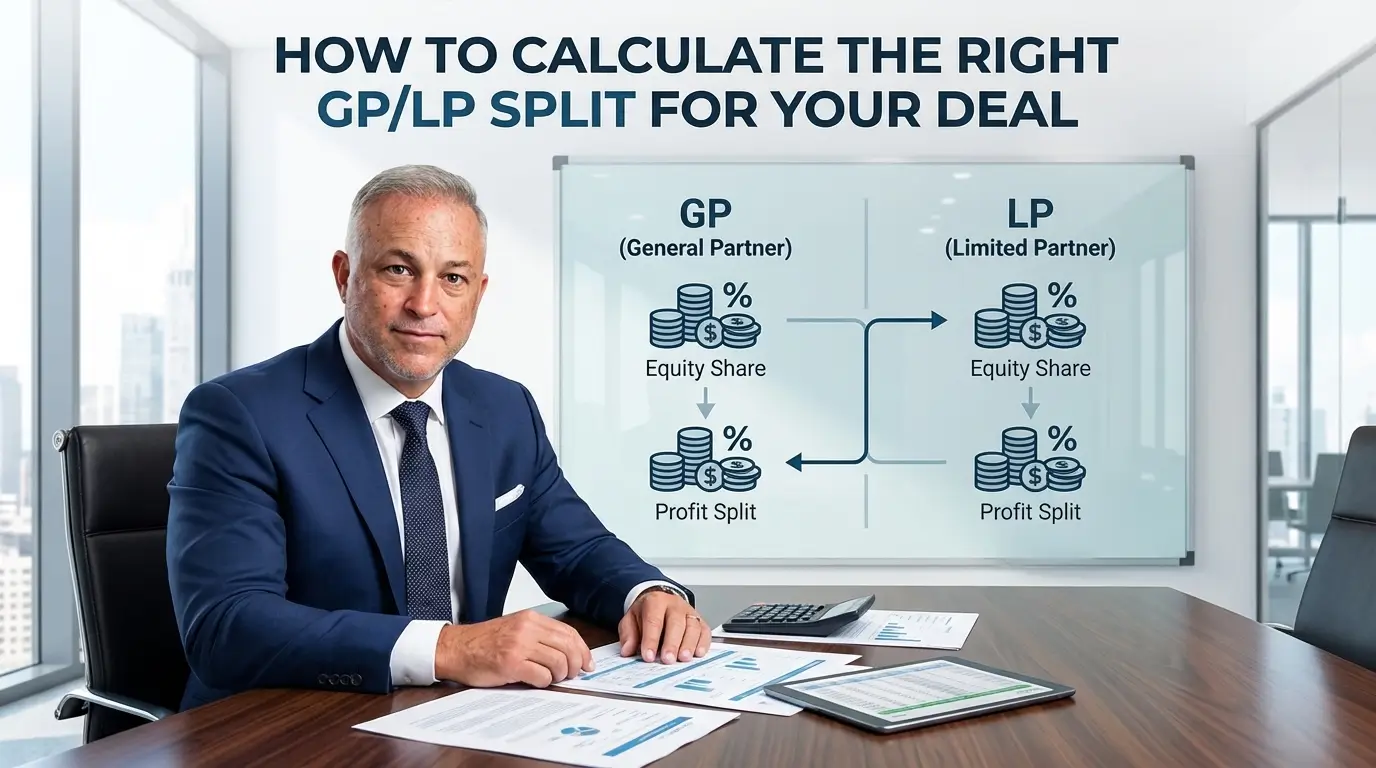
The right GP/LP split is not a market convention. It is a calculation based on four deal-specific inputs: the LP's risk-adjusted preferred return hurdle, the GP's genuine contribution to value creation, the promote structure that reflects that contribution, and waterfall tiers that hold up under institutional diligence.
A 70/30 split or an 80/20 split is only defensible if the math behind it matches the deal in front of you. In 2026, institutional LPs writing $10M+ checks are testing every term against the specific risk profile of the deal - not accepting split structures on faith.
Most developers arrive at their GP/LP split one of two ways: they copy the terms from their last deal, or they anchor to a market convention like 70/30 and assume that is close enough. Neither approach survives institutional diligence. A split that worked on your last multifamily acquisition does not automatically work on a ground-up mixed-use development with a 48-month construction timeline.
This article is part of the capital stack series at IRC Partners. It does not re-explain how each layer of the stack works and does not cover structural risk reduction levers - those are handled in dedicated spokes. This piece answers one question: given that you understand your deal and your stack, how do you calculate the GP/LP split that is fair to LPs, defensible in diligence, and still protects your economics as the GP?
This article covers:
- How to set the preferred return hurdle so it reflects actual LP risk
- How to size and defend your promote based on what you are genuinely contributing
- How to use co-invest, waterfall tiers, and 2026 market comps to build a structure that holds up under scrutiny
Step 1: Set the LP Floor with the Preferred Return Hurdle
The preferred return is the first number to lock. It sets the minimum annual return the LP must receive before the GP earns any disproportionate upside. Get this number wrong in either direction and the rest of the waterfall is built on a bad foundation.
The institutional market reference range sits between 6% and 10% IRR annually, with 8% remaining the most common center point across deal types. But the right number for your deal is not whatever is most common - it is the number that accurately reflects the LP's risk given your asset class, business plan, and hold period.
The timing problem most developers miss
A higher pref is not always better for closing the deal. If your project has a 24-month construction period with no distributable cash flow, an 8% cumulative pref accrues against your capital account the entire time. By the time you reach stabilization, the LP hurdle balance is larger than most developers model for. Run the actual accrual schedule before committing to a rate. The pref you set today determines how long it takes before the GP sees any promote.
Step 2: Size the Promote Based on What the GP Is Actually Contributing
Once the LP hurdle is set, the next question is how much of the upside above that hurdle the GP has actually earned. The promote is not a reward for raising capital. It is compensation for specific execution risk that the GP is absorbing and that the LP is not.
What justifies a larger promote
Before you assign a promote percentage, list what you are actually doing on this deal:
- Sourcing and site control - Did the GP originate the deal off-market or through a competitive process?
- Entitlement and permitting execution - Is the GP carrying entitlement risk through a multi-year approval process?
- Development management - Is the GP managing GC relationships, draw schedules, and construction risk?
- Lease-up and stabilization - Is the GP responsible for achieving the projected NOI that justifies the exit cap?
- Recap or exit timing - Is the GP making the call on when to refinance or sell in a volatile rate environment?
The more of these the GP is absorbing, the stronger the case for a promote at or above 20%. The fewer items on this list, the harder it is to defend anything above 15%.
How the math actually works
With a 90/10 equity split and a 20% promote, the GP's effective share of distributions above the hurdle rises to 28%, calculated as:
GP effective share = Promote % + (GP equity % x (1 - Promote %)) 20% + (10% x 80%) = 28%
That is a meaningful difference from the headline 10% equity ownership. Make sure the LP sees that math laid out clearly in your waterfall model. Institutional LPs do not object to a 28% effective GP share when the execution burden justifies it. They object when the GP cannot explain why.
Step 3: Use GP Co-Invest to Change the Negotiation, Not Just the Optics
GP co-invest is the variable most developers underuse as a negotiating lever. It is not just about signaling alignment. The size of the GP's equity check changes the actual waterfall math, and it changes what an institutional LP is willing to accept on promote.
GP co-invest in institutional real estate deals typically falls between 5% and 20% of total equity. The right number for your deal depends on three things: your balance sheet capacity, the total deal size, and what the LP expects to see given the deal's risk profile.
Why co-invest and promote are negotiated together
If you want a 25% promote on a ground-up industrial development with a 48-month hold, the LP's first question will be how much skin you have in the deal. A 5% co-invest with a 25% promote is a difficult position to defend. A 15% co-invest with a 25% promote is a much easier conversation because the GP's absolute dollar exposure is meaningful relative to the upside being claimed.
Key point: Increasing co-invest is often the fastest way to protect or improve your promote position without changing the LP's headline economics.
Step 4: Design Waterfall Tiers That Protect GP Upside on Longer or More Complex Deals
A single-tier waterfall is the right structure for simple deals with short holds, predictable cash flows, and limited execution risk. For most $10M+ institutional deals, it is not enough.
Multi-tier waterfalls solve a specific problem: they let LPs get stronger downside protection in the early hurdles while preserving meaningful GP upside if the deal performs beyond baseline projections. The tiers are where the GP actually captures the economics of a well-executed deal.
Example: Three-tier waterfall on a ground-up multifamily deal
In Tier 2, the effective GP share of 28% is calculated using the same formula from Step 2. In Tier 3, a 30% promote plus the GP's 10% pro rata share of the remaining 70% produces a 37% effective GP share. The LP still captures 63% of the upside above that hurdle, which is a credible outcome for a well-structured institutional deal.
When to use a multi-tier structure
- Hold period exceeds 4 years
- Deal involves ground-up construction or phased delivery
- Entitlement risk is carried through the development period
- Business plan depends on lease-up execution rather than in-place cash flow
- GP is managing a recap or refinancing decision mid-hold
The catch-up provision question
A GP catch-up tier allows the GP to receive 100% of distributions above the pref until they have reached their target promote share. It is a powerful tool for deals where the LP receives all cash flow during operations and the GP is relying on exit proceeds. Catch-up structures are common in institutional-style waterfalls but require careful modeling because they change the effective GP economics more than the headline promote percentage suggests.
{{main-cta}}
Step 5: Calibrate the Split Against 2026 Market Comps Without Becoming Hostage to Them
Market comps are the last input, not the first. Once you have set the pref, sized the promote, determined co-invest, and designed the waterfall tiers, you benchmark the result against what institutional LPs are actually accepting in 2026. The goal is to confirm your structure is within an acceptable band, not to copy what everyone else is doing.
Global investors remained significantly under-allocated to real estate entering 2026, which means capital is available. But institutional LPs have also become more diligence-intensive, particularly on GP economics. A structure that sits outside market norms needs a clear explanation. A structure that is within market norms but poorly justified is almost as weak.
Five benchmarking questions to run before you present
- Is my pref within the 6-10% range for my asset class and hold period? If you are outside that band, document why.
- Is my promote consistent with the GP execution burden on this specific deal? A 20% promote on a passive acquisition is harder to defend than a 20% promote on a ground-up entitlement play.
- Does my co-invest percentage reflect meaningful alignment given the deal size? A 5% co-invest on a $15M equity raise is $750K. A 5% co-invest on a $75M equity raise is $3.75M. The percentage matters less than the absolute dollar exposure.
- Can I show an LP where my structure sits relative to comparable deals in the same asset class? Anecdotal comparisons weaken your position. Model-backed benchmarking strengthens it.
- If an LP pushes back on any single term, which variable has the most room to move without materially damaging GP economics? Know your negotiating flexibility before you walk into the room.
The real risk in 2026 is not that your split is wrong. It is that you cannot explain why it is right.
Case Example: An Anonymized IRC Structure That Passed Institutional Scrutiny
IRC Partners worked with a seasoned developer on a ground-up multifamily project in a high-growth Sun Belt market. Total capitalization was approximately $150M. The developer's initial term sheet proposed an 8% pref with a flat 80/20 split and a 5% GP co-invest.
The structure was not wrong. It was just generic. An institutional LP reviewing that term sheet had no way to connect the economics to the deal's specific execution burden or hold period.
Before IRC restructuring:
- 8% preferred return (cumulative, non-compounding)
- Flat 80/20 split above the hurdle
- 5% GP co-invest
- No catch-up, no tiered promotes
- Promote not tied to GP execution milestones
After IRC restructuring:
- 8% preferred return (cumulative, compounding)
- Three-tier waterfall: 90/10 up to 8% IRR, 72/28 from 8-14%, 63/37 above 14%
- GP co-invest increased to 10% to support the tiered promote position
- GP catch-up provision added at Tier 2 transition
- Promote narrative tied explicitly to entitlement execution, construction management, and lease-up delivery
The institutional LP passed first-round diligence on economics without a single pushback on promote. The GP preserved more upside in Tier 3 than the original flat split would have produced on a well-performing deal. The difference was not the numbers. It was the defensibility of the structure.
What to Prepare Before You Present Your Split to Institutional LPs
Institutional-grade GP/LP economics are designed before outreach, not revised after an LP pushes back. If you are still adjusting your split in response to LP feedback, you have already lost credibility on structure.
Before you present your economics to any institutional LP, confirm you have the following ready:
- A pref sensitivity model showing how the LP hurdle accrues under three scenarios: base case, delayed stabilization, and downside
- A promote scenario table showing GP and LP distributions at each IRR hurdle under the same three scenarios
- A co-invest justification memo explaining the GP's absolute dollar commitment and how it scales with deal risk
- A waterfall narrative that ties each tier transition to a specific deal milestone or performance threshold
- A market comp reference showing where your structure sits relative to comparable institutional deals in the same asset class and geography
- A negotiation map identifying which terms have flexibility and which are non-negotiable before the LP conversation starts
If you are raising capital for a deal where the capital stack layers are already determined and you want to understand how to reduce structural risk alongside GP/LP economics, the risk reduction spoke in this series covers those levers in detail.
IRC Partners works with developers to pressure-test and structure institutional-grade GP/LP economics before the deal is shown to LPs. If your current split is based on a prior deal or a market convention rather than a deal-specific calculation, that is the conversation to have before outreach begins.
Frequently Asked Questions
How do I calculate the right developer investor split for a deal?
The split is the final output of a calculation involving five sequential inputs: preferred return hurdle, profit split size, developer co-investment, waterfall tier design, and market benchmark calibration. It is not a starting point, but a reflection of the risk-reward balance. In 2026, sophisticated deals move away from arbitrary ratios toward formulas that reward developers only after hitting specific performance milestones.
What is a typical promote structure for an institutional deal in 2026?
The standard institutional benchmark is a 20 percent profit split above an 8 percent internal rate of return hurdle. Many structures now include a second tier at a 14 to 15 percent return, where the developer share steps up to 25 or 30 percent. This tiered approach ensures that developers are disproportionately rewarded for exceptional performance rather than just meeting the baseline.
How do I set the preferred return hurdle for my deal?
The preferred return must match the actual risk profile of the asset. Core-plus deals typically price at 6 to 7 percent, while ground-up development involving construction and entitlement risk prices at 8 to 10 percent. It is critical to run an accrual schedule, especially for projects with long construction phases, to understand the compounding impact on the final distribution.
How do institutional investors evaluate developer economics?
Investors prioritize alignment of interests, ensuring the developer is sufficiently invested with their own cash. They also evaluate the execution burden. This means checking whether the profit split reflects the actual work involved and comparing the structure against current market benchmarks. They ensure the co-investment represents meaningful skin in the game that puts the developer at risk alongside the partners.
When should I use a multi-tier waterfall instead of a single split?
Multi-tier structures are best for holds exceeding four years, ground-up construction, or projects with high complexity. They are particularly effective when the success of the business plan relies on long-term execution, such as a complex lease-up, rather than immediate cash flow. This structure allows the investor to receive a larger share early on while giving the developer a larger upside for long-term success.
How much developer co-investment is enough for institutional LPs?
The institutional floor is typically 5 percent of total equity. For deals with higher profit splits or extreme execution risk, investors often demand 10 percent or more. The absolute dollar amount is scrutinized as heavily as the percentage. It must represent a significant financial commitment relative to the developer size to ensure true alignment.
Is a 70/30 split still common in 2026?
While a flat 70/30 split exists in smaller syndications, it is rare in the 10M dollar plus institutional space. Most sophisticated deals in 2026 favor tiered waterfalls where the split dynamically shifts at various return hurdles. This ensures the developer only captures a high percentage of profits after achieving the target performance benchmarks that satisfy the institutional mandate.
Operators who want to pressure-test readiness first can start with an investor readiness assessment before opening a data room.
Continue reading this series:
- Structuring the capital stack for $10M+ real estate deals
- Capital stack risk reduction strategies: 5 ways developers can lower risk before a $10M+ raise
- Which capital stack layers are best for minimizing risk?
The wrong structure doesn't just cost you this round. It costs you the next three. IRC Partners advises founders raising $5M to $250M of institutional capital. If you're about to go to market and want the structure reviewed before investors see it, book a call here
Need guidance on your capital raise?


Avoid Broad Audit Rights Before Signing $10M+ Sponsor Investment Deals

Which Firms Offer the Best Anti-Dilution Protections for Real Estate Developers?
How Should a Startup Handle Bridge Financing When a Founder or Executive Wants to Invest Personally in The Round?
Disclosure
Nothing on this site constitutes an offer to sell, or a solicitation of an offer to purchase, any security under the Securities Act of 1933, as amended, or any applicable state securities laws. Any offering of securities is made only by means of a formal private placement memorandum or other authorized offering documents delivered to qualified investors.
IRC Partners is a capital advisory firm. IRC Partners is not a registered investment adviser under the Investment Advisers Act of 1940 and does not provide investment advice as defined thereunder.
Certain statements in this article may constitute forward-looking statements, including statements regarding market conditions, capital availability, investor demand, and transaction outcomes. Such statements reflect current assumptions and expectations only. Actual results may differ materially due to market conditions, regulatory developments, company-specific factors, and other variables. IRC Partners makes no representation that any outcome, return, or result described herein will be achieved.
References to prior mandates, transaction volume, network credentials, or capital raised are provided for illustrative purposes only and do not constitute a guarantee or prediction of future results. Past performance is not indicative of future outcomes. Individual results will vary. Network credentials and transaction statistics referenced on this site reflect the aggregate experience of IRC Partners' principals and affiliated advisors and are not a representation of assets managed or transactions closed solely by IRC Partners.
Certain data, statistics, and information presented in this article have been obtained from third-party sources. IRC Partners has not independently verified such information and expressly disclaims responsibility for its accuracy, completeness, or timeliness. Readers should independently verify any third-party data before relying on it.
Readers are strongly encouraged to consult qualified legal, financial, and tax professionals before making any investment, capital raising, or business decision.
Schedule A Meeting
You get one shot to raise the right way. If this raise is worth doing, it’s worth doing with precision, leverage, and control.
This isn’t a practice run. Serious capital. Serious strategy. Let’s raise it right.
We onboard a maximum of seven
new strategic partners each quarter, by application only, to maximize your chances of securing the capital you need.
