.svg "CTA Arrow")


.png "Investor Ready Capital decorative background element")

How Drag-Along Rights Get Buried in Your Term Sheet and Activated at the Worst Possible Moment
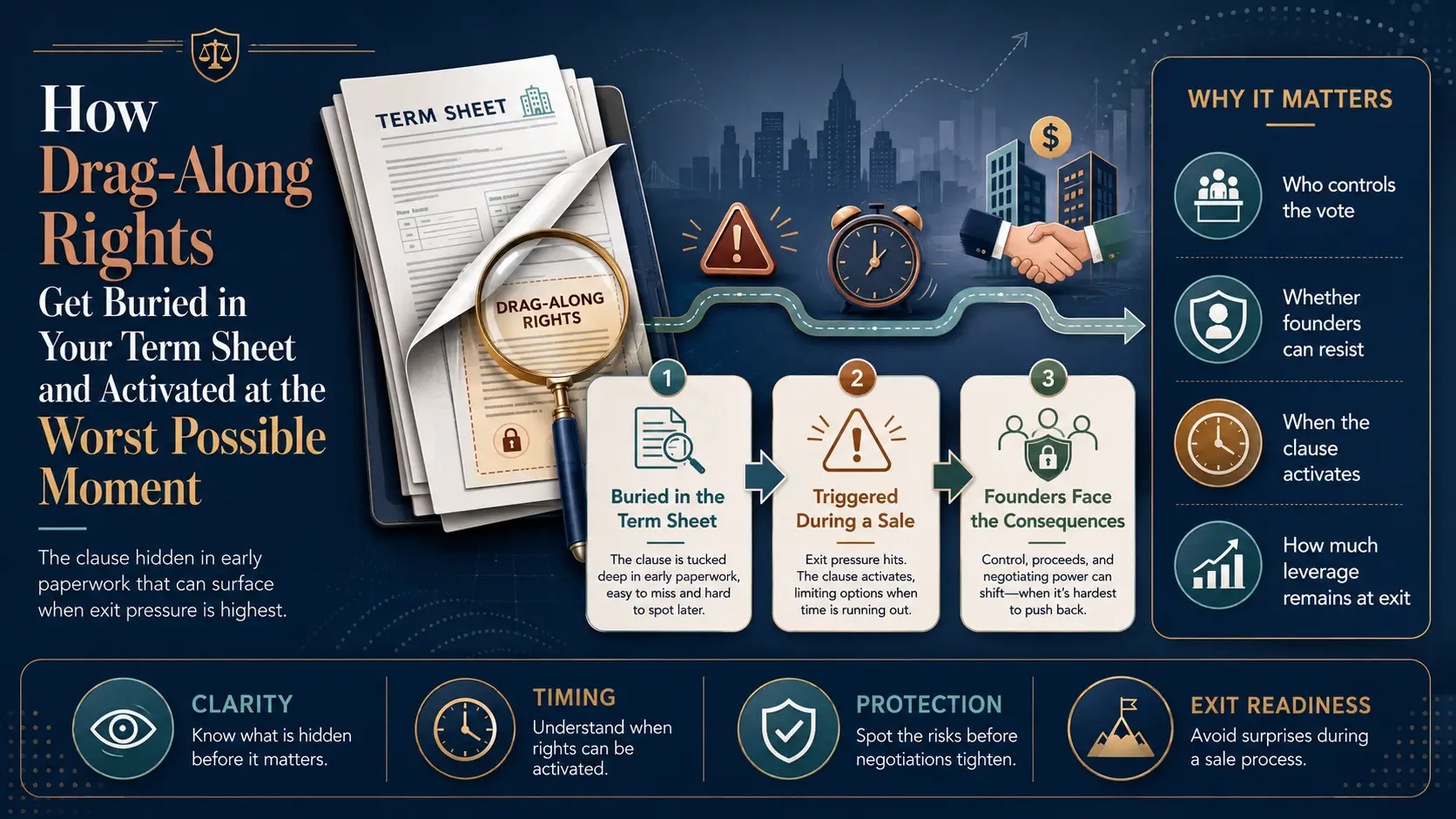
How Drag-Along Rights Get Buried in Your Term Sheet and Activated at the Worst Possible Moment
Drag-along rights appear first in your term sheet as a short summary, then become binding in your voting agreement - and the clause activates when a specified approval group, typically preferred stockholders representing a majority of the outstanding preferred, votes to approve a sale. Once that threshold is met, all other stockholders including founders holding common stock can be required to vote in favor of the transaction and sell their shares on the same terms. Activation does not require investor bad faith. It only requires the negotiated thresholds to be satisfied. The problem is not that founders ignore the clause - it is that they see it, recognize it as standard, and move on without understanding what it permits in a live exit.
If you are raising a $5M+ round and have not read what growth-stage companies need to know about drag-along provisions, start there. That hub article covers the full governance risk picture. This spoke narrows the focus to one specific problem: how founders miss the clause during term sheet review and what it actually looks like when it triggers.
Drag-along rights are also frequently confused with tag-along rights, which do something entirely different. The difference between drag-along and tag-along rights explains that distinction in full. For this article, the focus stays on drag-along: the provision that compels minority holders to participate in a sale approved by the majority.
What founders should take away from this article:
- Drag-along language is not hidden in fine print. It sits in standard documents founders already sign.
- The clause triggers on approval thresholds, not on founder consent.
- The negotiation window closes before long-form documents are finalized.
- Modeling the approval math before signing is the only way to know your real exposure.
Where the Clause Actually Sits in the Document Stack
Most founders think of drag-along as a term sheet issue. It is not. The term sheet introduces the concept in a sentence or two. The binding mechanics live elsewhere, spread across multiple documents that get signed in sequence during a financing.
Here is where drag-along language actually appears, what each document covers, and what founders typically miss at each stage:
The NVCA model legal documents show exactly how this structure works in standard venture financings. The voting agreement is where the drag-along obligation is typically set out in full, including the threshold, the covered transaction definition, and the mechanics for how dissenting holders must vote and transfer shares.
Founders who review documents by label, rather than by what each document actually controls, often treat the voting agreement as an administrative formality. It is not. It is where the exit governance gets decided.
Why Founders Miss It During Term Sheet Review
Drag-along language does not get missed because founders are careless. It gets missed because of how term sheet review actually works under fundraising pressure.
Three patterns explain most of the misses:
- Founders triage toward the high-stakes numbers. Valuation, dilution, liquidation preference, and board seat composition get the most attention during term sheet review. Drag-along, when it appears at all, sits near other governance provisions that look standard. It rarely triggers a negotiation on its own.
- Fast raises reward momentum over scrutiny. When a round is moving quickly, slowing down to model the downstream effect of an approval threshold feels like friction. The assumption is that standard wording is safe wording. That assumption is usually wrong.
- Long-form documents feel like implementation, not decisions. By the time the voting agreement arrives, founders often treat it as the legal team converting shorthand into paperwork. The real control decisions were already made, or so the thinking goes. In practice, this is the moment when drag-along becomes binding.
The real risk is not that founders ignore the clause. The risk is that they see it, recognize it as standard, and move on without understanding what it permits in a live exit.
Founders who want to understand how negotiating information rights in a $10M+ VC term sheet works will recognize the same pattern: governance provisions that look routine at signing can create meaningful constraints later. Drag-along follows the same logic, with higher stakes.
IRC works with founders before investor outreach begins, not after a term sheet is already circulating. That timing difference is where the negotiation leverage actually lives.
{{main-cta}}
The Three Moments When Drag-Along Activates Against Founder Interests
Drag-along clauses do not activate during calm strategic planning. They activate during moments when a founder's negotiating position is already weakened. Three scenarios account for most of the cases where founders feel the clause working against them.
Moment 1: An acquirer is at the table and investors want deal certainty.
A strategic buyer has submitted a term sheet. Lead investors support the deal. The approval threshold is met by preferred holders. The drag-along clause now requires all stockholders, including founders and employees with common stock, to vote in favor and transfer shares. Whether the founder thinks the price is right is no longer the deciding factor.
Moment 2: The deal economics work for preferred but not for common.
Liquidation preferences mean that preferred holders can be made whole at a price that leaves common stockholders with much less than the headline number suggests. If preferred holders approve the sale at that price, the drag-along can require common holders to participate in a deal that effectively transfers most of the exit value to the preferred stack. Understanding how the capital stack affects your economics is essential context here.
Moment 3: Runway pressure makes resistance impractical.
When a company is approaching the end of its runway, a sale at a price the founder dislikes may be the only realistic option. If the drag-along threshold has already been met by the investor group supporting the deal, the founder's ability to delay or block the transaction is limited regardless of their personal preference.
Key insight: Drag-along is most powerful in exactly the moments when founders have the least leverage. That is not a coincidence. It is the clause working as designed.
What the Approval Math Actually Looks Like in a Live Deal
The practical power of a drag-along clause depends less on how it reads in the abstract and more on who counts toward the threshold and how shares are measured.
Threshold Structures and What They Mean for Founders
A 50% preferred-only threshold is materially more investor-friendly than a dual-approval structure. As Cooley GO explains in its drag-along definition, the specifics of who must approve the transaction, and on what basis, determine whether the clause functions as a minority protection or a majority enforcement tool.
What founders should check on their own cap table:
- How many preferred holders exist, and what percentage does the lead investor control?
- Does the threshold require common approval separately, or is preferred-only sufficient?
- Are there transfer restrictions or deemed-liquidation definitions in the charter that expand what qualifies as a drag-along event?
- Does board approval serve as an additional prong, and who controls the board?
Founders who have worked through an M&A due diligence process know that these mechanics surface quickly once a buyer starts reviewing governance documents. The time to understand them is before that process begins, not during it.
How to Catch It Before It Becomes a Problem
The negotiation window for drag-along terms is narrow. It opens when a term sheet is being discussed and closes when long-form documents are signed. After that, changing the threshold or the approval structure requires reopening documents with investors who no longer have a reason to give ground.
Four Questions Every Founder Should Ask Before Signing
Before accepting drag-along language in any financing, founders should be able to answer these four questions clearly:
- Who can trigger it? Which stockholder groups must approve, and can the lead investor meet the threshold alone or with one co-investor?
- What transactions qualify? Does the definition cover only a full sale, or does it extend to mergers, asset sales, or change-of-control events that stop short of a full acquisition?
- What threshold applies? Is it a simple majority of preferred, a supermajority, or a dual-approval structure that includes common holders or board consent?
- What protections limit minority burden? Are there price floors, pro-rata economic protections, or representation and warranty carve-outs that protect smaller common holders from being dragged into a bad deal?
Founder pre-signing checklist:
- Read the voting agreement drag-along section in full, not just the term sheet summary
- Map the threshold against your current cap table to see who can trigger it today
- Check charter definitions for "sale of the company" and "deemed liquidation"
- Confirm whether board approval is a separate required prong
- Ask your advisor whether the threshold is standard or investor-favorable for your stage
IRC Partners works with founders at the pre-outreach stage, before term sheets are in circulation, to review capital structure and governance terms before leverage disappears. Founders raising $5M or more who want to understand their current exposure before the next round can review how IRC structures that advisory work.
Frequently Asked Questions
Does drag-along language in a term sheet become legally binding before I sign the voting agreement?
The term sheet summary of drag-along rights is typically non-binding. The clause becomes legally enforceable when you sign the voting agreement as part of the financing close. However, agreeing to the term sheet creates strong practical momentum toward accepting the same structure in long-form documents. Founders who want to negotiate the threshold should do so before the term sheet is countersigned, not after.
Can a drag-along clause be triggered by a single large investor without board approval?
It depends on the threshold structure. If the drag-along requires only a majority of preferred stock and one investor controls more than 50% of the preferred on an as-converted basis, that investor can meet the threshold alone. A dual-approval structure requiring both investor majority and board consent adds a meaningful check. Founders should confirm which structure applies before signing.
What happens to unvested founder shares if a drag-along is activated?
Drag-along obligations typically apply to all shares held by the dragged stockholder, including unvested shares subject to repurchase rights. Depending on the deal structure and any acceleration provisions in the founder's stock agreement, unvested shares may be cancelled, accelerated, or subject to the acquirer's standard treatment. Founders should review their stock purchase agreement alongside the voting agreement to understand the full picture.
Does a drag-along clause affect employee option holders?
Option holders generally are not dragged directly because they hold options rather than shares. However, the sale process triggered by a drag-along can determine the price at which options are cashed out, the treatment of unvested grants, and whether option holders receive any consideration at all depending on the strike price relative to the deal price. The drag-along affects the sale outcome that determines what options are worth.
Is there a standard drag-along threshold in venture-backed companies?
There is no single standard. NVCA model documents include drag-along provisions but leave the threshold as a negotiated variable. Common structures range from a simple majority of preferred to a supermajority of 67% or higher, with or without a separate common holder vote. What looks standard in one deal may be materially more investor-favorable than what a founder at the same stage negotiated in a comparable financing.
Can a founder negotiate a minimum price floor into the drag-along provision?
Yes. Some drag-along provisions include a price floor or a minimum return requirement that must be met before the clause can be invoked. This protects common holders from being forced into a sale that does not generate meaningful upside. These protections are negotiable at term sheet stage and become much harder to add after the voting agreement is signed. Founders should ask about them explicitly during term sheet review.
What role does the board play in activating a drag-along clause?
The board's role depends entirely on the drag-along structure negotiated in the voting agreement. In some structures, board approval is a required prong alongside investor majority consent, meaning the clause cannot trigger without board sign-off. In others, the board has no formal role and the investor vote alone is sufficient. Founders who hold board seats should understand whether their board position gives them a meaningful check on drag-along activation or whether the investor threshold can be met independently.
Continue reading this series:
- The Difference Between Drag-Along and Tag-Along Rights
- Drag-Along Rights Explained: What Growth-Stage Founders Actually Sign Away at Series A and Forget Until Exit
- The 51% vs. 75% Drag-Along Threshold: How One Number Determines Whether Two Investors Can Force Your Exit Without a Single Founder Vote
By the time most founders are rehearsing the pitch, the outcome of the raise has already been set by the structure underneath it. IRC Partners advises operators raising $5M to $250M of institutional capital and accepts seven strategic partners per quarter. If you are going to market this year, have the structure reviewed before investors do. Schedule a call with our team here.
Sponsors weighing this decision should first complete a capital raise readiness assessment for sponsors to confirm the raise is investor-ready.
Need guidance on your capital raise?


How Should a Startup Document Investor Default Remedies in a Multi-Close Bridge Financing?

Fees for Real Estate Capital Raising

Key Benefits of Investor Relations Management for Growth Companies
Disclosure
Nothing on this site constitutes an offer to sell, or a solicitation of an offer to purchase, any security under the Securities Act of 1933, as amended, or any applicable state securities laws. Any offering of securities is made only by means of a formal private placement memorandum or other authorized offering documents delivered to qualified investors.
IRC Partners is a capital advisory firm. IRC Partners is not a registered investment adviser under the Investment Advisers Act of 1940 and does not provide investment advice as defined thereunder.
Certain statements in this article may constitute forward-looking statements, including statements regarding market conditions, capital availability, investor demand, and transaction outcomes. Such statements reflect current assumptions and expectations only. Actual results may differ materially due to market conditions, regulatory developments, company-specific factors, and other variables. IRC Partners makes no representation that any outcome, return, or result described herein will be achieved.
References to prior mandates, transaction volume, network credentials, or capital raised are provided for illustrative purposes only and do not constitute a guarantee or prediction of future results. Past performance is not indicative of future outcomes. Individual results will vary. Network credentials and transaction statistics referenced on this site reflect the aggregate experience of IRC Partners' principals and affiliated advisors and are not a representation of assets managed or transactions closed solely by IRC Partners.
Certain data, statistics, and information presented in this article have been obtained from third-party sources. IRC Partners has not independently verified such information and expressly disclaims responsibility for its accuracy, completeness, or timeliness. Readers should independently verify any third-party data before relying on it.
Readers are strongly encouraged to consult qualified legal, financial, and tax professionals before making any investment, capital raising, or business decision.
Schedule A Meeting
You get one shot to raise the right way. If this raise is worth doing, it’s worth doing with precision, leverage, and control.
This isn’t a practice run. Serious capital. Serious strategy. Let’s raise it right.
We onboard a maximum of seven
new strategic partners each quarter, by application only, to maximize your chances of securing the capital you need.
