.svg "CTA Arrow")


.png "Investor Ready Capital decorative background element")
How Does Capital Raising Outcomes and Advisor Success Rates Work
Capital raising outcomes depend on investor fit, deal readiness, advisor process, and market timing - not just the advisor’s network. A strong advisor improves positioning, diligence readiness, and investor targeting so the raise has a higher chance of closing with the right capital.
Advisor success rates work the same way. A high success rate is not just a function of how many deals an advisor works. It reflects how selectively an advisor qualifies mandates, how precisely they match investor fit, and how consistently they manage each stage from targeting through term negotiation. Volume without discipline produces low success rates. Selectivity with strong process discipline produces high ones.
Three things this article will show you:
- How each stage of a raise maps to a specific, measurable output
- What inputs move an advisor's success rate up or down
- Why some raises close weakly even when the company is fundable
How the Raise Process Produces an Outcome at Each Stage
Every raise runs through six stages. Each one has a defined task and a measurable output. Skipping a stage or doing it poorly does not just slow the raise. It changes what the raise produces at the end.
Why Stage Sequence Matters
The table above looks linear. In practice, it is. A founder who starts outreach before diligence preparation is complete will generate meetings that stall. An advisor who skips mandate definition and goes straight to investor targeting will reach the wrong investors. The output of each stage feeds directly into the quality of the next one.
Institutional LPs now apply a structured diligence framework before committing. The ILPA Due Diligence Questionnaire sets the standard for what institutional investors expect to review across governance, economics, and reporting. A raise that has not prepared for those questions at the diligence preparation stage will hit a wall when serious LP interest arrives.
What Mandate Definition Actually Controls
Mandate definition is the most underbuilt stage in most raises. Founders treat it as a formality. Institutional advisors treat it as the foundation. Getting the capital stack right before any investor sees the deal is the single highest-leverage thing a founder can do, and structuring your capital stack before outreach begins is a practical starting point for that work.
A well-defined mandate answers four questions before outreach begins:
- How much capital is being raised, and in what structure?
- What will the capital be used for, tied to which milestones?
- What investor profile fits the opportunity by check size, sector, and decision timeline?
- What governance and reporting terms are acceptable, and which are not?
When those four questions are answered clearly, every downstream stage becomes faster and more precise. When they are not answered, the raise starts with structural ambiguity that compounds at every stage.
How Advisor Success Rate Is Calculated in Practice
An advisor's success rate is calculated as completed closes divided by qualified mandates accepted. It is not calculated against every inbound inquiry or introduction request. The denominator is the set of mandates the advisor agreed to work, not the universe of founders who reached out.
This distinction matters. An advisor who accepts every mandate and closes 30% of them has a lower success rate than an advisor who accepts only well-structured, investor-ready mandates and closes 70% of them. The second advisor is not just more selective. They are more useful to the founders they work with.
Five Inputs That Move the Ratio
Success rates shift based on five specific inputs:
- Mandate qualification discipline. Advisors who filter out weak, mistimed, or structurally broken mandates before market exposure protect their success rate and their LP relationships.
- Investor fit precision. Outreach to investors whose check size, sector focus, or decision timeline does not match the opportunity produces meetings that do not convert. Every non-converting meeting costs time and credibility.
- Material consistency. When numbers in the deck do not reconcile with the model or the data room, LP confidence drops fast. Inconsistency across documents is one of the most common reasons diligence stalls.
- Diligence response speed. Institutional LPs run parallel processes. A slow response to a diligence request signals operational weakness. Advisors who manage response time tightly keep investors engaged through the conversion window.
- Raise timing relative to the company or deal cycle. Starting a raise too early, before milestones are hit or documents are complete, forces the advisor to manage investor skepticism rather than investor interest. Timing is a structural input, not a market condition.
When all five inputs are strong, the success rate rises because fewer mandates stall and more investors convert. When even one input is weak, the failure usually shows up two stages later, making it harder to trace back to the original cause.
What Breaks the Process and Creates a Weak Outcome
A raise can close and still produce a weak outcome. This is the part most founders miss. Closing is not the same as closing well.
A strong close looks like this:
- Capital committed at terms that protect GP promote and governance rights
- Investor mix that fits the company's stage, sector, and future raise trajectory
- Reporting and governance obligations that are manageable through the next capital event
- Use of funds tied clearly to milestones that the next investor class will recognize
A weak close looks like this:
- Capital committed but with governance terms that restrict future flexibility
- Investor mix that includes LPs who were never a true mandate fit and will be difficult to manage
- Avoidable dilution accepted under time pressure because the process ran too long
- Reporting obligations that will create operational drag before the next raise begins
Most weak closes start at the mandate definition or investor targeting stage. By the time the close happens, the structural problems are already locked in. A founder who accepted a mismatched LP because the raise was running out of runway did not make a bad decision at the close. They made a bad decision at the investor targeting stage, and the close just made it permanent. The full governance and deal control framework for avoiding this outcome is covered in the guide on raising $10M to $50M without giving up deal control.
The 5 Common Real Estate Capital Raising Mistakes article covers the most frequent structural errors in detail. The pattern is consistent: founders who avoid those errors upstream close faster and on better terms.
How One Process Fix Changed the Outcome Quality
In one IRC advisory engagement involving a mixed-use development raise, the initial outreach effort had generated LP interest but stalled repeatedly at the diligence stage. The business was real. The asset was credible. The numbers worked.
The problem was not the deal. It was the document stack.
Before: The pitch deck, financial model, and data room had been built at different times by different people. The use-of-funds summary in the deck did not match the capital stack breakdown in the model. Investors who requested deeper materials found inconsistencies within the first 30 minutes of review and went quiet.
The fix: IRC restructured the mandate definition, reconciled all three document layers, and rebuilt the outreach list around investors whose check size and sector focus actually matched the opportunity. Staged data room access was implemented so that LP depth of review corresponded to their progression through the process.
After: Meeting-to-diligence progression improved. Investors who entered diligence stayed engaged because the materials held up under scrutiny. The process moved to term discussion without the stalls that had previously killed momentum.
The deal did not change. The process did. That is the core mechanic of how outcome quality is produced: structural inputs, when corrected at the right stage, change what the raise produces at the end.
{{main-cta}}
What Founders Should Monitor Before and During a Raise
Process problems are easier to fix before outreach than after. Here is what to track at each phase.
Before outreach begins:
- Mandate clarity: raise size, structure, use of funds, and milestone logic are all documented and internally consistent
- Investor-fit logic: the target list is filtered by check size, sector focus, and decision timeline, not just by name recognition
- Document consistency: deck, model, and data room all reconcile to the same numbers
- Data room readiness: materials are staged and accessible within 24 hours of a serious LP request
During outreach:
- Response quality: are investors asking follow-up questions, or going quiet after the first contact?
- Meeting-to-diligence progression: what percentage of first meetings move to a second meeting or a data room request?
- Stall location: where in the process are investors dropping off? Stalls at the same stage repeatedly point to a process bottleneck, not a market problem.
- Follow-up speed: how quickly is the team responding to LP requests? Slow responses signal operational weakness to investors running parallel processes.
Key signal: If a raise stalls at the same stage across multiple investor conversations, the problem is almost always structural. Fix the stage, not the pitch.
For a deeper look at how institutional LP due diligence timelines affect process planning, that resource covers the full timeline and what drives delays.
Frequently Asked Questions
What is the difference between a raise that closes and a raise that closes well?
A raise closes when capital is committed. It closes well when the terms protect GP economics, the investor mix fits the company's next capital event, and the governance and reporting obligations are manageable through the next raise. Many founders who close on unfavorable terms did not make a bad decision at the close. The structural problems were locked in earlier, at the mandate definition or investor targeting stage.
How do institutional LPs decide whether to move from a first meeting into active diligence?
Institutional LPs move from a first meeting into active diligence when the opportunity matches their mandate on check size, sector, and decision timeline, and when the materials they receive are internally consistent. A deck that references a capital structure that does not match the model, or a use-of-funds summary that does not tie to a milestone schedule, is enough to stop progression. The meeting quality matters far less than the document quality that follows it.
What does investor fit actually mean in the context of a raise?
Investor fit means the investor's check size, sector focus, decision timeline, and governance preferences align with the specific opportunity being raised. An investor who writes $2M checks into early-stage software companies is not a fit for a $25M real estate development raise, regardless of their interest level. Outreach to mismatched investors produces meetings that do not convert and damages credibility with the investors who do fit.
How should a founder evaluate whether their data room is ready before outreach begins?
A data room is ready when three conditions are met: the deck, financial model, and data room all reconcile to the same numbers; materials are staged so that the depth of LP access corresponds to their stage in the process; and any document a serious LP would request within the first 30 days of diligence can be delivered within 24 hours. If any of those three conditions is not met, outreach will generate meetings that stall rather than progress.
Why do raises stall at diligence even when the business is strong?
Raises stall at diligence because of document inconsistency, slow response to LP requests, or a mismatch between what was represented in the pitch and what the materials actually show. Institutional LPs run parallel processes and have limited tolerance for delays or surprises. A strong business with weak diligence materials will lose to a comparable business with clean, staged, responsive materials. The business quality gets the meeting. The document quality closes it.
What is mandate qualification and why does it affect advisor success rates?
Mandate qualification is the process an advisor uses to decide which raises to accept before committing to market exposure. Advisors who qualify mandates rigorously, filtering out raises that are structurally weak, mistimed, or targeting the wrong investor class, protect both their LP relationships and their success rate. An advisor with a high success rate is not just lucky. They are selective about which mandates they take to market and disciplined about how they manage each one.
How does raise timing affect outcome quality?
Raise timing affects outcome quality because institutional LPs evaluate companies relative to their current milestone position, not their projected one. A raise that starts before key milestones are hit forces the advisor to manage investor skepticism rather than investor interest. It also compresses negotiating leverage, since founders who need capital urgently accept terms they would not accept if the process had started at the right point in the company or deal cycle. Timing is a structural input, not a market condition.
Continue reading this series:
- Key Benefits of Capital Raising Outcomes and Advisor Success Rates
- What Is Capital Raising Outcomes and Advisor Success Rates
- When Does a Company Need Capital Raising Outcomes and Advisor Success Rates
By the time most founders are rehearsing the pitch, the outcome of the raise has already been set by the structure underneath it. IRC Partners advises operators raising $5M to $250M of institutional capital and accepts seven strategic partners per quarter. If you are going to market this year, have the structure reviewed before investors do. Schedule a call with our team here.
Sponsors weighing this decision should first complete a capital raise readiness assessment for sponsors to confirm the raise is investor-ready.
Need guidance on your capital raise?


Private Placement Memorandum vs. Data Room: When You Need Both and How They Work Together
M&A Due Diligence Checklist: The 47 Documents Buyers Request and How to Have Them Ready
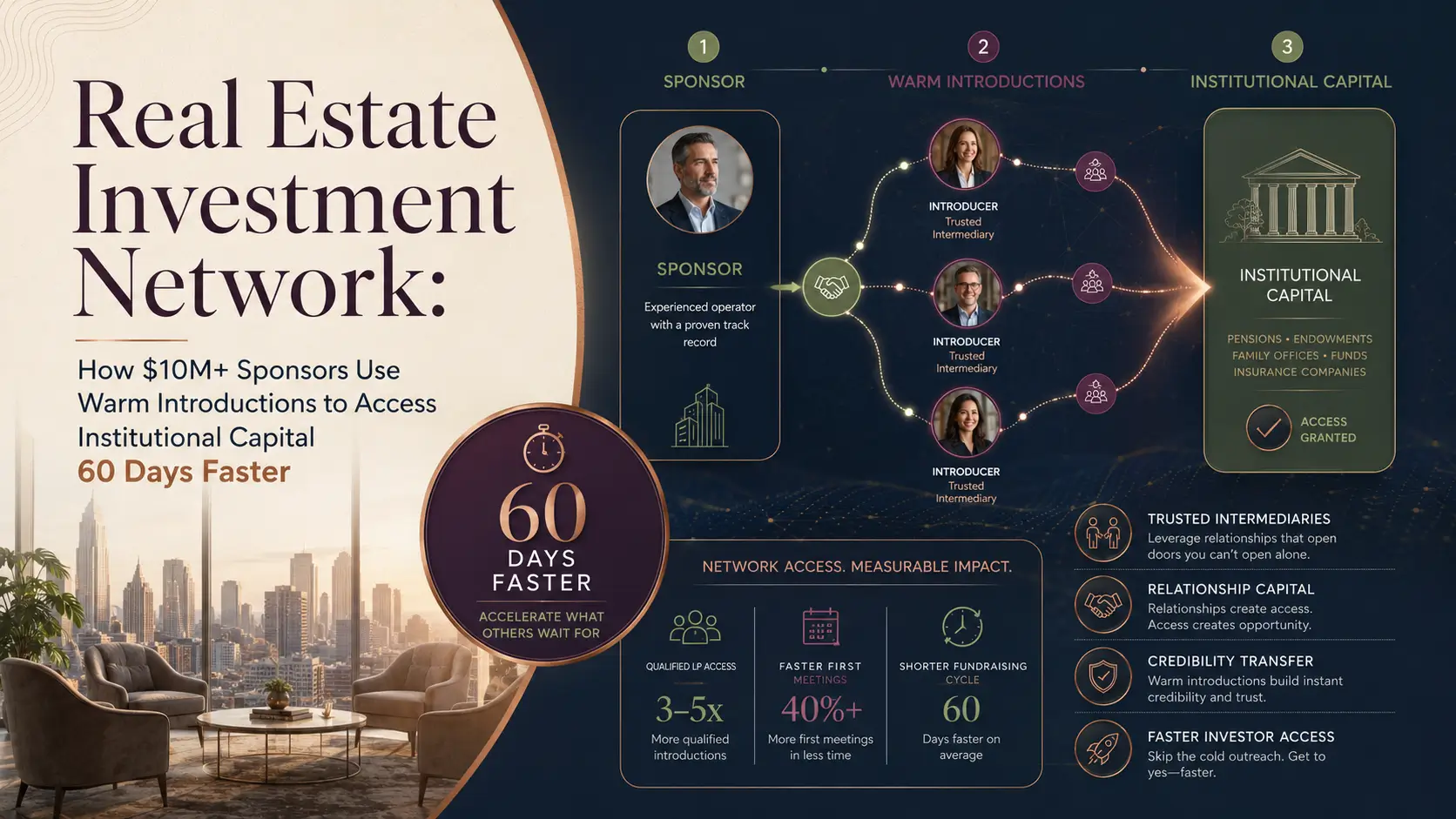
Real Estate Investment Network: How $10M+ Sponsors Use Warm Introductions to Access Institutional Capital 60 Days Faster
Disclosure
Nothing on this site constitutes an offer to sell, or a solicitation of an offer to purchase, any security under the Securities Act of 1933, as amended, or any applicable state securities laws. Any offering of securities is made only by means of a formal private placement memorandum or other authorized offering documents delivered to qualified investors.
IRC Partners is a capital advisory firm. IRC Partners is not a registered investment adviser under the Investment Advisers Act of 1940 and does not provide investment advice as defined thereunder.
Certain statements in this article may constitute forward-looking statements, including statements regarding market conditions, capital availability, investor demand, and transaction outcomes. Such statements reflect current assumptions and expectations only. Actual results may differ materially due to market conditions, regulatory developments, company-specific factors, and other variables. IRC Partners makes no representation that any outcome, return, or result described herein will be achieved.
References to prior mandates, transaction volume, network credentials, or capital raised are provided for illustrative purposes only and do not constitute a guarantee or prediction of future results. Past performance is not indicative of future outcomes. Individual results will vary. Network credentials and transaction statistics referenced on this site reflect the aggregate experience of IRC Partners' principals and affiliated advisors and are not a representation of assets managed or transactions closed solely by IRC Partners.
Certain data, statistics, and information presented in this article have been obtained from third-party sources. IRC Partners has not independently verified such information and expressly disclaims responsibility for its accuracy, completeness, or timeliness. Readers should independently verify any third-party data before relying on it.
Readers are strongly encouraged to consult qualified legal, financial, and tax professionals before making any investment, capital raising, or business decision.
Schedule A Meeting
You get one shot to raise the right way. If this raise is worth doing, it’s worth doing with precision, leverage, and control.
This isn’t a practice run. Serious capital. Serious strategy. Let’s raise it right.
We onboard a maximum of seven
new strategic partners each quarter, by application only, to maximize your chances of securing the capital you need.
