.svg "CTA Arrow")


.png "Investor Ready Capital decorative background element")

How Long Does Institutional LP Due Diligence Take for a First-Time Real Estate Fund?
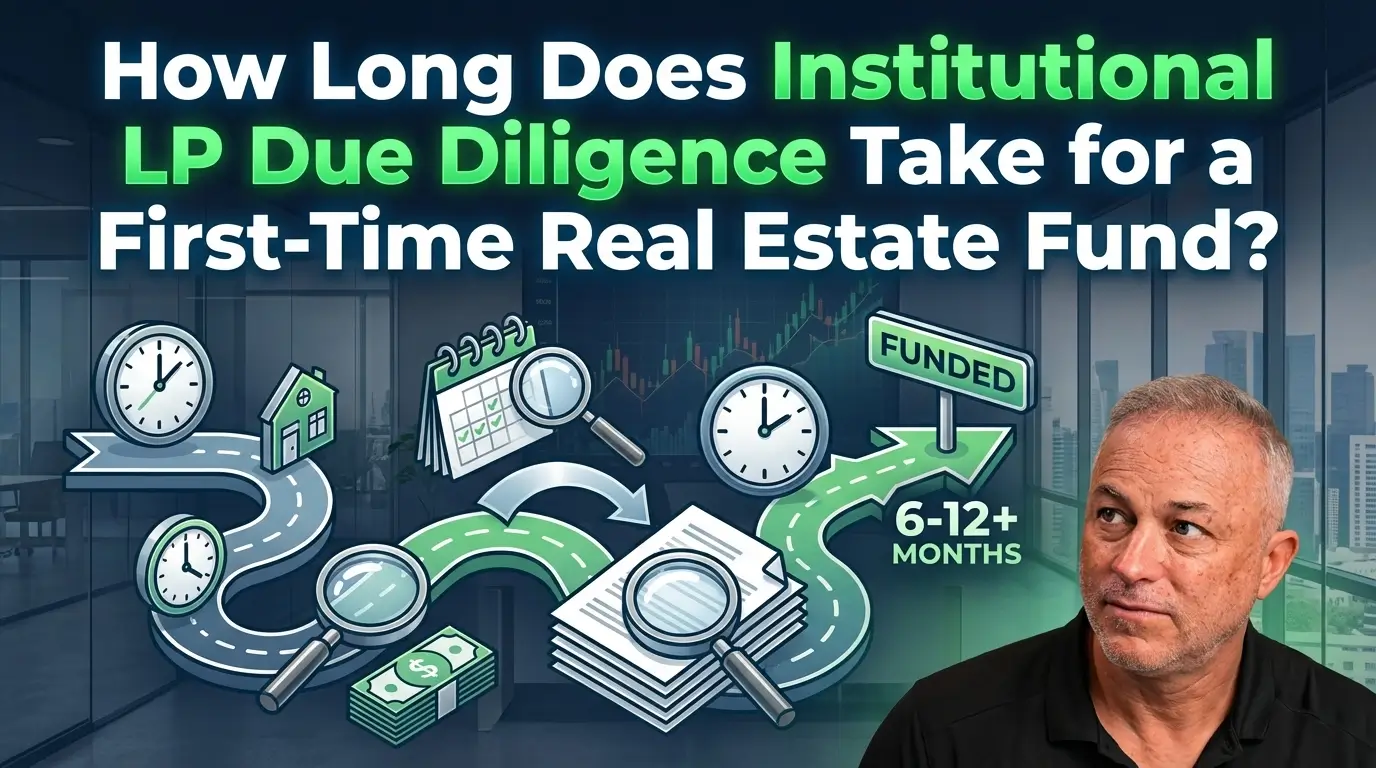
Institutional LP due diligence for a first-time real estate fund typically takes 6 to 18 months from first contact to a funded commitment, and can extend to 24 months with large pensions or endowments establishing a new manager relationship. Most developers underestimate this by 6 to 12 months because they plan for the investment review but not the full sequence of overlapping approval tracks that run behind it.
For pensions, endowments, and similar allocators, due diligence is not a single review. It is a set of overlapping tracks, each with their own gatekeepers, timelines, and failure points:
- Investment diligence: strategy review, track record attribution, team assessment, pipeline logic
- Operational due diligence (ODD): fund infrastructure, service providers, reporting, controls
- Consultant or OCIO review: independent gatekeeper evaluation before board access
- Legal review: LPA, subscription documents, side letters, AML/KYC compliance
- Committee or board approval: governance-driven calendar windows that wait for no one
Each track can stall independently. A process can look positive from the GP side while still being months away from approval because a consultant has not finished their memo or the investment committee does not meet for another quarter.
The realistic planning range for a first-time institutional real estate raise is 6 to 18 months. Most of the time lost is not during diligence. It is before outreach begins, between tracks, and in the approval queue.
Understanding the most common mistakes that kill a first institutional raise starts with understanding the timeline. Developers who misread the clock pitch before they are ready, lose momentum mid-process, and miss committee windows they cannot get back.
The Timeline Table: What Each Diligence Track Usually Takes
The table below reflects typical institutional allocator benchmarks based on published LP due diligence frameworks and emerging manager process data. Actual durations vary by LP type, consultant structure, and committee calendar. For first-time real estate funds, assume the higher end of each range.
Key insight: These tracks overlap, but they do not move together. A first-time fund can clear investment diligence and still wait three months for ODD, legal, and committee approval to align. The bottleneck for pensions and endowments is often the investment committee and board approval process, which can add one to two months or more even after the core review is complete.
{{main-cta}}
Track 1: Investment Diligence Is Only the First Gate
Investment diligence is what most GPs prepare for. It is also the track they treat as the finish line.
Institutional LPs evaluate a first-time real estate fund across five dimensions: strategy fit, track record attribution, team credibility, pipeline logic, and vehicle rationale. For first-time funds, every claim about repeatability has to be documented from scratch. LPs cannot rely on prior fund history. That means role-level attribution on prior deals, written process memos, and evidence the team's approach transfers to a fund structure.
The ILPA due diligence questionnaire covers 250 or more questions across strategy, team, track record, economics, and operations. Gaps in any area, especially track record portability, will trigger follow-up cycles that add weeks.
Investment diligence is the first gate. It is not the only one.
Track 2: Operational Due Diligence Is Where Many First-Time Funds Fail
Operational due diligence is not a back-office formality. It is a parallel veto track with its own team, its own checklist, and the power to kill an investment even after investment diligence is complete.
According to the Standards Board for Alternative Investments (SBAI), ODD teams typically have the right to veto an investment outright. The process includes a desktop review of submitted documents, onsite visits, service-provider verification, and follow-up checks that extend for weeks after the visit.
ODD teams evaluate fund administration, auditing, valuation policy, reporting infrastructure, capital call processes, cybersecurity controls, compliance framework, and key-person succession. Every item needs to be in place before the review starts.
"Operational due diligence now equals investment due diligence in weight. Roughly 50% of fund closures stem from operational failures, not investment returns." - Industry analysis, cited across multiple 2025-2026 LP diligence frameworks
This is where developers moving from deal-by-deal structures face the steepest learning curve. A track record built on individual project financing does not automatically translate into fund-level operational credibility. If the fund administrator is not yet engaged, the auditor is not selected, or the valuation policy is not documented, ODD cannot start. And it cannot be rushed once it begins.
Track 3: Consultant, OCIO, and Gatekeeper Review Adds a Second Decision Layer
Winning over the LP contact in the room is often not enough. Most public pensions and endowments rely on external consultants, OCIOs, or internal staff teams who conduct their own independent review before any board-level decision can happen.
The typical sequence: the LP contact refers the fund to a consultant, who runs their own manager review with a separate questionnaire, reference checks, and policy-fit assessment. The consultant writes a recommendation memo. The board votes at a scheduled meeting, monthly or quarterly. If that meeting has already passed, the decision waits for the next one.
Consultant-driven processes often run 15 to 18 months in total. A GP who thinks the process ends when the LP contact says "we're moving forward" may still be 3 to 6 months from an actual approval. That gap is invisible to the GP and very real to the timeline.
Track 4: Legal Review, Side Letters, and Documentation Can Slow the Final Stretch
Legal review is rarely the first bottleneck. But it is frequently the last one, and it can add weeks or months to a process that feels nearly done.
Legal review depends on everything that came before it. If IDD or ODD surfaced issues that required structural changes, the legal documents need to reflect those before LP counsel will sign off. A first-time fund with a still-evolving LPA or unclear waterfall mechanics will lose time at the worst possible moment. Institutional LP counsel expects clean, complete documentation. Gaps trigger back-and-forth cycles that extend closing even when the investment decision has already been made.
Where First-Time Real Estate Funds Lose 6-12 Extra Months
The 6-18 month range is not random. The time lost almost always comes from the same set of avoidable failure points.
The Most Common Sources of Timeline Slippage
Pitching before the operational stack is ready. Fund administrator not engaged. Auditor not selected. Valuation policy not documented. ODD cannot start, and the LP clock is already running.
Incomplete or slow DDQ responses. The ILPA DDQ can take 40 to 60 hours to complete properly. Institutional LPs now expect response windows of approximately 7 days for follow-up questions. Slow or inconsistent responses signal unreadiness and can cause LP staff to deprioritize the manager.
Fragmented data rooms. A data room that is missing documents, inconsistently labeled, or organized around deal-level rather than fund-level logic forces the LP team to ask for materials repeatedly. Each request cycle adds days or weeks.
Missing committee windows. Investment committees and boards meet on fixed schedules, often monthly or quarterly. A manager who is not ready for the committee packet when the deadline hits waits for the next cycle. That can mean a 90-day delay on a decision that was otherwise ready to move.
Inconsistent materials across documents. Strategy described one way in the pitch deck, another way in the DDQ, and a third way in the LPA triggers red flags. LPs assume inconsistency in materials reflects inconsistency in operations.
The data room and pitch materials quality issue is not just about aesthetics. For institutional LPs, sloppy materials are a signal about how the fund will be managed.
Pass-Fail Diagnostic: Are You Institutionally Ready to Start the Clock?
Use this diagnostic before beginning live LP outreach. Each item maps to a specific track in the diligence process. Gaps here translate directly into timeline delays later.
Pass: Ready to Begin Outreach
- Track record documented at the deal and role level, with attribution for each principal's contribution
- Fund structure, economics, and waterfall finalized and consistent across all materials
- Fund administrator engaged and operational scope defined
- Auditor selected with relevant real estate fund experience
- Valuation policy documented and independent oversight established
- Investor reporting template drafted and approved
- Data room organized at the fund level, not the deal level, with all core documents present
- DDQ responses drafted and reviewed for consistency with deck and LPA
- Legal counsel engaged with fund formation experience
Caution: Materials Exist but Are Not Consistent
- Core documents exist but differ in strategy description, team roles, or return assumptions across the deck, DDQ, and model
- Service providers identified but not yet formally engaged
- Data room populated but organized around prior deal structures rather than fund-level diligence expectations
Fail: Core Pieces Are Still Being Built
- Fund administrator or auditor not yet selected
- Valuation policy not documented
- LPA still being drafted during outreach
- Track record is deal-level only, with no role attribution
The timeline consequence of a "fail" rating: the LP clock starts when outreach begins. If operational infrastructure is still being assembled during the process, ODD cannot proceed, and the GP is effectively losing months of calendar time while appearing active in the market.
How to Plan Your Fundraising Calendar Backward from a Realistic Close Date
Most first-time managers plan forward from their first meeting. The smarter approach is to plan backward from the LP's likely approval window.
A Backward-Planning Framework for a First-Time Institutional Raise
Step 1: Identify the target close date. Pick a realistic first close target. For most first-time institutional raises, that is 12 to 18 months from now, not 6.
Step 2: Work backward from committee approval. Investment committee and board meetings operate on fixed calendars. Identify which quarterly or monthly window you are targeting for approval. That is your hard deadline for completing all diligence tracks.
Step 3: Back out the legal and ODD timeline. Legal review and ODD each need 6 to 10 weeks minimum. Both need to be complete before the IC packet is prepared. That means both tracks need to start roughly 3 to 5 months before the target committee window.
Step 4: Back out investment diligence and DDQ. IDD and the full DDQ response cycle typically take 6 to 12 weeks. Add 2 to 4 weeks for follow-up questions. Budget 3 to 4 months before ODD begins.
Step 5: Identify your operational readiness date. All service providers need to be engaged, all core documents finalized, and the data room organized before the first LP meeting. That preparation phase alone takes 2 to 3 months for most first-time managers.
The bottom line: if the target LP committee window is in Q4 of a given year, operational readiness needs to be in place by Q1 at the latest. Outreach should begin no later than Q2.
Start the Right Clock
Institutional LP due diligence for a first-time real estate fund is not one process. It is four overlapping tracks, each with its own gatekeepers and failure points, running against a governance calendar that does not flex for GP readiness.
The developers who close institutional capital on schedule are not the ones with the best assets. They are the ones who understood the machine before they walked into the first meeting.
The three things that determine your actual timeline:
- Whether your operational infrastructure is ready before outreach begins
- Whether your materials are consistent and complete enough to survive all four tracks simultaneously
- Whether you have planned around the LP's approval calendar, not your own pitch schedule
Ready to find out where you stand? Contact IRC Partners to assess whether your materials, data room, and timeline are institutionally ready before live LP outreach begins. A readiness gap identified now is a timeline problem avoided later.
Frequently Asked Questions
How long does institutional due diligence take for a first-time fund?
The standard window is 6 to 18 months from initial contact to a funded commitment. For large pensions and endowments establishing a new manager relationship, this can stretch to 24 months. The timeline is long because multiple diligence tracks, such as investment, operational, and legal, run in parallel and each must be satisfied before capital moves.
Why do pension funds and endowments take so much longer?
Pensions and endowments operate under rigid governance structures. Decisions typically require approval from external consultants or Outsourced Chief Investment Officers followed by a formal board or investment committee vote. These bodies often meet on fixed monthly or quarterly cycles. Missing one meeting window can delay a close by 90 days or more.
What is operational due diligence and why does it matter?
Operational Due Diligence is the review of a fund back office infrastructure rather than its assets. It scrutinizes fund administration, auditing, valuation policies, and internal controls. For managers moving from deal-by-deal raises, this is often a deal-breaker. An operational team has veto power. They can kill a commitment even if the investment team loves the deal, simply because the reporting or compliance infrastructure is not institutional grade.
What is a DDQ and how long does it take to complete?
A Due Diligence Questionnaire is an exhaustive document covering strategy, team, track record, and legal details. It is often based on the 250 plus question ILPA format. Completing a high-quality questionnaire takes roughly 40 to 60 hours of internal work. Institutional partners expect follow-up queries to be answered within 7 days. Delays here are a primary cause of process stagnation.
Can a first-time fund speed up the committee approval process?
You cannot change the investor calendar, but you can prevent delays. The best way to speed up the process is to have all diligence materials and legal documents 100 percent ready before the committee packet deadline. If a developer provides incomplete data, they are bumped to the next cycle, which adds months to the timeline.
When should legal review begin relative to the process?
Legal review should run in parallel with the late stages of investment and operational diligence. The Limited Partnership Agreement and subscription documents should be finalized early so that the legal phase focuses on specific partner side letter negotiations rather than foundational drafting, which can take weeks.
When is the right time to begin preparing for a raise?
Preparation should begin 2 to 3 months before the first investor meeting. This phase includes hiring service providers, setting up the virtual data room, and completing the fund legal formation. If your goal is a first close in 12 months, the operational and structural work must start immediately to ensure you are ready for the initial wave of scrutiny.
Continue reading this series:
- What do pension funds and endowments require before investing in a first-time real estate fund?
- What types of LPs write $5M-$20M checks into a $100M real estate fund?
- What team size and experience do pension funds require before investing in a real estate fund?
This isn't for pre-revenue companies or first-time founders. It's for operators at $1M+ ARR, raising $5M to $250M of institutional capital, who've done this before and want the next round architected right. If that's you, schedule a call to discuss HERE.
Need guidance on your capital raise?



Best Advisors for Capital Raising Outcomes and Success Rates

What Is Debt Advisory and Venture Debt Placement?

What SAFE Note Legal and Structuring Work Costs
Disclosure
Nothing on this site constitutes an offer to sell, or a solicitation of an offer to purchase, any security under the Securities Act of 1933, as amended, or any applicable state securities laws. Any offering of securities is made only by means of a formal private placement memorandum or other authorized offering documents delivered to qualified investors.
IRC Partners is a capital advisory firm. IRC Partners is not a registered investment adviser under the Investment Advisers Act of 1940 and does not provide investment advice as defined thereunder.
Certain statements in this article may constitute forward-looking statements, including statements regarding market conditions, capital availability, investor demand, and transaction outcomes. Such statements reflect current assumptions and expectations only. Actual results may differ materially due to market conditions, regulatory developments, company-specific factors, and other variables. IRC Partners makes no representation that any outcome, return, or result described herein will be achieved.
References to prior mandates, transaction volume, network credentials, or capital raised are provided for illustrative purposes only and do not constitute a guarantee or prediction of future results. Past performance is not indicative of future outcomes. Individual results will vary. Network credentials and transaction statistics referenced on this site reflect the aggregate experience of IRC Partners' principals and affiliated advisors and are not a representation of assets managed or transactions closed solely by IRC Partners.
Certain data, statistics, and information presented in this article have been obtained from third-party sources. IRC Partners has not independently verified such information and expressly disclaims responsibility for its accuracy, completeness, or timeliness. Readers should independently verify any third-party data before relying on it.
Readers are strongly encouraged to consult qualified legal, financial, and tax professionals before making any investment, capital raising, or business decision.
Schedule A Meeting
You get one shot to raise the right way. If this raise is worth doing, it’s worth doing with precision, leverage, and control.
This isn’t a practice run. Serious capital. Serious strategy. Let’s raise it right.
We onboard a maximum of seven
new strategic partners each quarter, by application only, to maximize your chances of securing the capital you need.
