.svg "CTA Arrow")


.png "Investor Ready Capital decorative background element")
Real Estate Debt Fund: How $10M+ Sponsors Access Alternative Debt Capital That Closes Faster Than Bank Financing

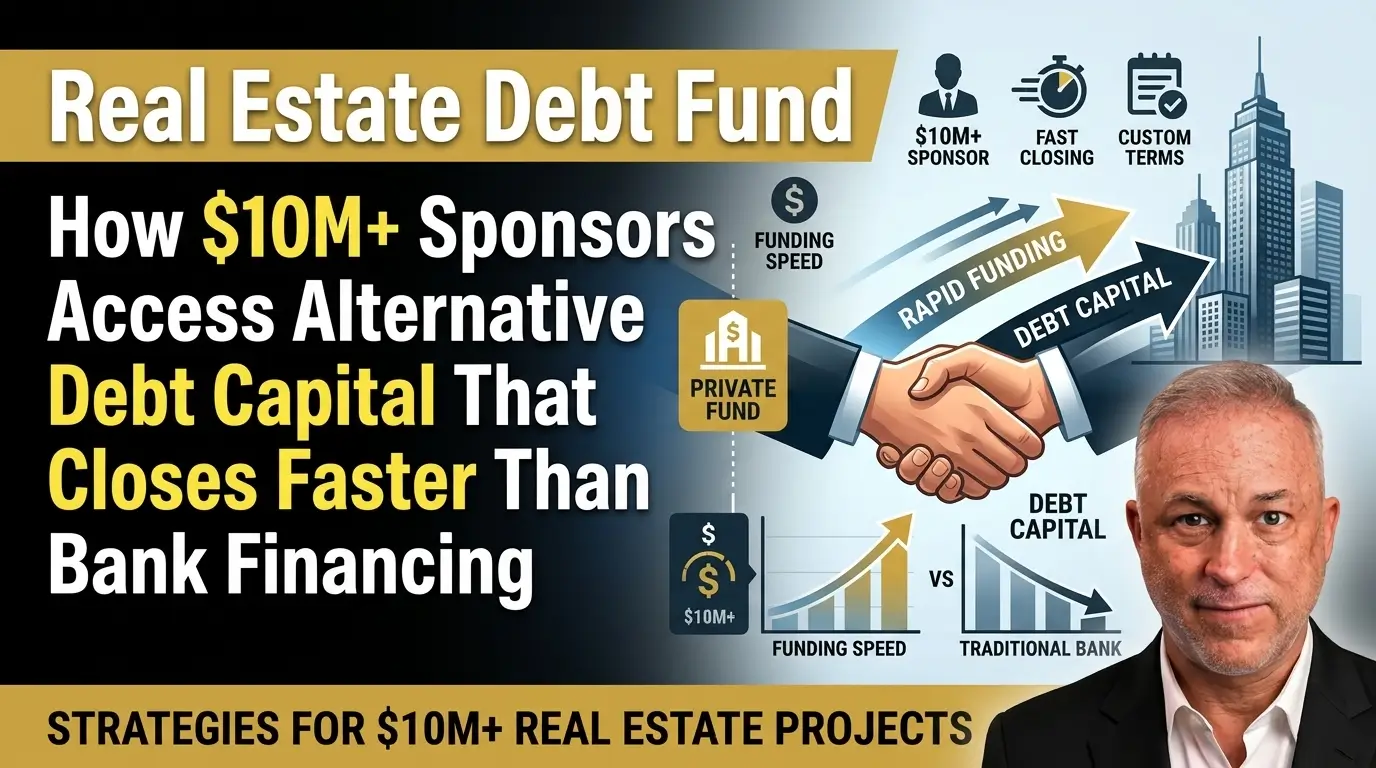
Real Estate Debt Fund: How $10M+ Sponsors Access Alternative Debt Capital That Closes Faster Than Bank Financing
Debt Funds Are Not Backup Capital. They Are a Different Lending Instrument.
Most sponsors call the bank first. That default made sense when banks were the primary source of transitional and bridge capital. It makes less sense now.
CRE mortgage originations climbed to $633 billion in 2025, with MBA projecting $805 billion for 2026. The capital is there. But the lender landscape has changed. Debt funds captured 31% of private real estate fundraising in 2025, raising $51 billion in final closes. They are not a niche alternative. They are a fully formed institutional lending channel, and they are built for a different kind of deal than a bank is.
A real estate debt fund is a pooled, closed-end or open-end credit vehicle that originates senior, bridge, or transitional loans secured by commercial real estate. It operates outside the regulatory constraints that govern bank lending, which means it can move faster, underwrite more flexibly, and tolerate higher leverage on the right business plan.
The question is not whether a debt fund is more expensive than a bank. The question is whether your deal needs what a debt fund actually provides.
Three things this guide will give you:
- A decision framework for when a real estate debt fund is the right first call
- A clear picture of 2025-2026 pricing, fees, and covenant norms across lender types
- A debt-fund-specific data room checklist that shortens diligence and improves certainty of close
When a Real Estate Debt Fund Makes Sense and When It Does Not
Debt funds are not universally better or worse than bank financing. They are optimized for a specific set of deal conditions. Calling one before you have clarity on those conditions wastes time and signals to the lender that you have not done the work.
The screening question is simple: does your deal require proceeds, speed, or underwriting flexibility that a bank is unlikely to provide at the right moment in the business plan?
Debt funds are a poor fit in two specific situations:
- When the sponsor needs ultra-low-cost, long-duration capital and the deal qualifies for bank or agency pricing. Paying a debt fund spread on a stabilized, fully leased asset is unnecessary.
- When the sponsor cannot support the reporting cadence, draw documentation, and milestone accountability that debt funds expect during the loan term. A debt fund financing a transitional business plan will track progress closely. Sponsors who are not prepared for that level of engagement will find the relationship difficult.
The capital stack risk reduction framework for $10M+ raises covers how provider behavior under stress should factor into lender selection. That principle applies here directly: choose the lender channel based on what the deal needs, not what you have used before.
What Real Estate Debt Funds Cost in 2025-2026: Pricing, Fees, and Return Structure Norms
The most common mistake sponsors make when evaluating debt fund pricing is stopping at the spread. The spread is only part of the cost. The total economic package includes origination points, exit fees, extension fees, reserve requirements, interest rate cap obligations, and the cost of more frequent reporting and legal coordination during the loan term.
With term SOFR sitting around 3.99% in Q4 2025 and all-in debt costs down roughly 66 basis points year over year, the rate environment has improved. But debt fund spreads remain wider than bank spreads by design. The NCREIF/CREFC Open-End Debt Fund Aggregate tracked 683 loans with $35.5 billion in fair value at year-end 2025, posting a one-year gross return of 7.7%. That return target is what drives debt fund pricing. Understand the fund's return requirement and you understand its floor.
Pricing ranges shift materially based on three variables:
- Sponsor quality and track record. Experienced sponsors with institutional-grade reporting histories consistently access the tighter end of the range.
- Asset type and business plan risk. A multifamily value-add with a credible lease-up model prices differently than a ground-up construction bridge loan.
- Loan size and fund mandate. Funds targeting $20M-$100M loan sizes often have more pricing flexibility than smaller bridge lenders with tighter capital constraints.
Extension options are a material cost that most sponsors underestimate. Debt fund loan terms typically run 12-36 months with one or two extension options at 6-12 months each. Extensions are not automatic. They are tested against milestones: minimum occupancy, debt yield tests, capex completion, or leasing benchmarks. Extension fees commonly run 25-50 basis points per option exercise. If the business plan runs long, the cost of those extensions must be modeled upfront.
Key insight: The true cost of a debt fund loan is not the spread. It is the spread plus points plus extension costs plus reserve drag, evaluated against the value of faster execution and higher proceeds. Sponsors who model only the coupon consistently underestimate the total package.
Debt Fund vs. Bank Financing vs. Other Institutional Lenders: The Dimensions That Actually Matter
Rate and leverage are the two dimensions most sponsors compare. They are also the two dimensions that matter least when the deal hits a speed bump. The dimensions that actually determine execution quality are underwriting flexibility, covenant intensity, draw control, extension mechanics, and how each lender behaves when the business plan runs six months long.
The table below compares debt funds against the three most common alternative capital sources across eight decision-relevant dimensions. For a deeper look at how subordinate layers stack against each other, see Senior Debt vs. Mezzanine vs. Preferred Equity: Which Layer Do You Actually Need?
The stress-case question every sponsor should ask: if lease-up slips by six months, which lender is most likely to cooperate on an extension without triggering a default, and at what cost?
Banks often require a full reunderwrite and credit committee approval for extensions. Debt funds typically have pre-negotiated extension tests and fee schedules. Mezzanine lenders and preferred equity investors may have intercreditor restrictions that limit flexibility. Knowing the answer before you sign the term sheet is not optional.
For sponsors evaluating whether preferred equity belongs in the stack alongside a debt fund, the Preferred Equity in Real Estate analysis covers the governance, pricing, and intercreditor tradeoffs in detail.
What Debt Funds Underwrite Differently Than Banks, Mezz Funds, and Preferred Equity Investors
Each capital source underwrites a different version of your deal. Knowing which version they are evaluating tells you what to lead with in your materials and where your story needs to be strongest.
How Each Lender Reads Your Deal
- Banks underwrite the current income stream. They want stabilized cash flow, a supportable DSCR (typically 1.20x or better), a borrower with clean credit and liquidity, and a property that fits policy guidelines. They are not underwriting your capex plan or your lease-up projection. They are underwriting what exists today.
- Real estate debt funds underwrite the business plan. They want to understand where the asset is going, what it will be worth when the plan executes, what the capex path looks like, and whether the exit is credible. They still want downside protection, but they are evaluating future value creation rather than current income. As CREFC panelists noted at the January 2026 conference, underwriting discipline remains centered on realistic exit assumptions and structural protections, not just current yield.
- Mezzanine lenders underwrite intercreditor risk. They are focused on where they sit in the stack, what the senior lender's cure and acceleration rights look like, and whether their subordinate position can recover in a downside scenario. Their underwriting is more legal and structural than operational.
- Preferred equity investors underwrite downside recoverability and governance leverage. They want to know what they get if the deal underperforms, what control rights they can exercise, and how their return is protected if the sponsor cannot service the preferred coupon.
Draw Control: The Debt Fund Difference
What no one tells sponsors upfront: debt funds financing transitional assets often control the draw process more tightly than any other lender. Draws are typically milestone-gated, inspection-verified, and subject to lien waiver and budget reconciliation requirements. This is not bureaucracy. It is how the fund protects its senior position while the business plan executes.
Sponsors who have not managed a draw-controlled loan before should build additional time and internal process capacity into their project plan. Missing a draw deadline because documentation was not ready is a real execution risk, not a hypothetical one.
For a structured look at how the capital stack layers interact on a $10M-$50M deal, see How to Structure a Capital Stack for a $10M-$50M Real Estate Development Deal.
{{main-cta}}
What the Data Room Must Include Before Approaching a Real Estate Debt Fund
A debt fund data room is not a general investor data room with a few extra documents added. It is a lender-underwriting package built around a specific asset, a specific business plan, and a specific draw and exit timeline. The materials need to tell a coherent story, not just check boxes.
As Mayer Brown's fund finance analysis notes, bridge and transitional debt diligence requires coordinated review across legal, valuation, and finance workstreams. That coordination starts with what you put in the room. Sponsors who want a broader framework for building that room before outreach begins should review How to Build a Data Room That Closes Institutional Investors in 30 Days Instead of 90.
The table below is organized into five tiers. Each tier reflects a distinct review track in the debt fund's underwriting process.
The most common gap in sponsor data rooms: Tier 5 materials. Most sponsors prepare Tiers 1 through 4 reasonably well. The reserve schedule, draw schedule with milestones, and extension test assumptions are almost always missing or underdeveloped. Debt funds spend significant time building these themselves when sponsors do not provide them. That adds time, reduces lender confidence, and creates a negotiating disadvantage.
For a broader look at data room organization for institutional capital raises, see How to Build a Data Room That Closes Institutional Investors in 30 Days Instead of 90.
Choose the Lender Channel Before the Clock Starts
The most expensive mistake in a debt capital raise is not choosing a debt fund over a bank. It is choosing the wrong lender channel for the deal and discovering it four to six weeks into a process that cannot restart without cost.
Debt funds are not expensive alternatives to bank debt. They are a precision instrument for deals that need higher proceeds, faster execution, or transitional underwriting that a bank cannot provide at the right moment. The sponsors who close on better terms are not the ones who found the cheapest coupon. They are the ones who matched the lender channel to the deal's actual requirements, priced the full economic package correctly, and showed up with materials that made underwriting straightforward.
Three things to do before approaching a debt fund:
- Confirm the deal fits the debt fund mandate: transitional, bridge, value-add, or higher-proceed situations where bank underwriting is structurally insufficient. For a full map of all seven institutional capital sources available at this stage, see Real Estate Financing Options: The 7 Institutional Capital Sources $10M+ Sponsors Should Know Before Building a Data Room
- Model the total cost including spread, points, extension fees, and reserve requirements, not just the headline rate
- Build a Tier 5 data room package with draw schedule, reserve assumptions, and extension test inputs before outreach begins
IRC Partners advises sponsors on capital stack structuring and lender-readiness preparation before institutional debt outreach. Apply for a structural review before you start the clock.
Frequently Asked Questions
How long does it typically take a real estate debt fund to issue a term sheet?
Most institutional real estate debt funds can issue a term sheet within 5-10 business days of receiving a complete loan request package. Execution from term sheet to closing typically runs 3-6 weeks depending on third-party report timing, legal review, and borrower document readiness. Sponsors who submit incomplete packages routinely add 2-4 weeks to that timeline.
What is the minimum loan size most real estate debt funds will consider?
Most institutional real estate debt funds have minimum loan sizes of $10M-$15M, with many larger funds focused on $20M and above. Smaller bridge lenders may go as low as $5M, but the underwriting rigor and institutional-grade reporting expectations remain consistent regardless of loan size.
Do real estate debt funds require personal guarantees from sponsors?
Debt funds vary significantly on guaranty requirements. Many institutional debt funds accept carve-out guarantees limited to bad acts and environmental liability rather than full recourse guarantees. Sponsor track record, loan-to-value, and asset quality all affect the guaranty negotiation. Sponsors with strong institutional track records and lower-leverage requests typically have more room to limit guaranty exposure.
How are extension tests typically structured in a real estate debt fund loan?
Extension tests are deal-specific but commonly include a minimum debt yield test (often 7-9% on stabilized NOI), a minimum physical occupancy threshold (often 75-85%), and confirmation that the capex budget has been substantially completed. Extension fees of 25-50 basis points per option exercise are standard. All tests must be satisfied at the time of the extension request, not projected to be satisfied by the new maturity date.
Can a real estate debt fund loan be prepaid without penalty?
Most debt fund loans include prepayment protection during the initial loan term, commonly structured as a yield maintenance provision, step-down prepayment premium, or a minimum interest guarantee covering the first 12-18 months. After the protection period, loans are typically open to prepayment at par. Sponsors should model prepayment costs when underwriting an early exit or refinance scenario.
What is the difference between a transitional debt fund and a bridge lender?
A transitional debt fund is typically a larger, institutional, closed-end or open-end vehicle with a defined mandate, LP capital, and formal credit committee approval process. A bridge lender may be a smaller balance sheet lender, family office, or specialty finance company with faster but less structured underwriting. Transitional debt funds generally offer more covenant flexibility and lower pricing in exchange for more rigorous diligence requirements.
How do debt funds treat interest reserves and when are they required?
Most debt funds require a funded interest reserve at closing for transitional and bridge loans where the asset is not generating sufficient income to service debt. The reserve typically covers 6-18 months of projected interest payments and is held in a lender-controlled account. Draw requests against the interest reserve are subject to the same milestone and documentation requirements as capex draws.
Continue reading this series:
- Which Capital Stack Layers Are Best for Minimizing Risk
- Data Room Setup for a First-Time $100M Real Estate Fund
- Raise $10M-$50M Without Losing Deal Control
IRC Partners advises founders raising $5M to $250M in institutional capital on structure, positioning, and round architecture. We work with 7 strategic partners per quarter - no placement agent model, no success-only theater. If you want a structural review of your current raise, apply HERE.
Sponsors weighing this decision should first complete a capital raise readiness assessment for sponsors to confirm the raise is investor-ready.
Need guidance on your capital raise?



What Diligence Questions Do Family Offices Ask About Leasing Assumptions In a Value-Add Commercial Real Estate Deal?

How Much GP Co-Investment Do Family Offices Expect from a Real Estate Sponsor Raising $20M in Equity?

How Should a Startup Document a Convertible Note Transfer From the Original Investor To a New Holder?
Disclosure
Nothing on this site constitutes an offer to sell, or a solicitation of an offer to purchase, any security under the Securities Act of 1933, as amended, or any applicable state securities laws. Any offering of securities is made only by means of a formal private placement memorandum or other authorized offering documents delivered to qualified investors.
IRC Partners is a capital advisory firm. IRC Partners is not a registered investment adviser under the Investment Advisers Act of 1940 and does not provide investment advice as defined thereunder.
Certain statements in this article may constitute forward-looking statements, including statements regarding market conditions, capital availability, investor demand, and transaction outcomes. Such statements reflect current assumptions and expectations only. Actual results may differ materially due to market conditions, regulatory developments, company-specific factors, and other variables. IRC Partners makes no representation that any outcome, return, or result described herein will be achieved.
References to prior mandates, transaction volume, network credentials, or capital raised are provided for illustrative purposes only and do not constitute a guarantee or prediction of future results. Past performance is not indicative of future outcomes. Individual results will vary. Network credentials and transaction statistics referenced on this site reflect the aggregate experience of IRC Partners' principals and affiliated advisors and are not a representation of assets managed or transactions closed solely by IRC Partners.
Certain data, statistics, and information presented in this article have been obtained from third-party sources. IRC Partners has not independently verified such information and expressly disclaims responsibility for its accuracy, completeness, or timeliness. Readers should independently verify any third-party data before relying on it.
Readers are strongly encouraged to consult qualified legal, financial, and tax professionals before making any investment, capital raising, or business decision.
Schedule A Meeting
You get one shot to raise the right way. If this raise is worth doing, it’s worth doing with precision, leverage, and control.
This isn’t a practice run. Serious capital. Serious strategy. Let’s raise it right.
We onboard a maximum of seven
new strategic partners each quarter, by application only, to maximize your chances of securing the capital you need.
