.svg "CTA Arrow")


.png "Investor Ready Capital decorative background element")

When Does a Company Need Capital Raising Outcomes and Advisor Success Rates

A company needs structured capital raising outcomes and qualified advisor support the moment its raise size, investor type, deal structure, or timeline pressure exceeds what a founder-led process can execute with institutional credibility. That threshold is not a feeling - it is a set of specific conditions. When those conditions are present and the process is not designed to meet them, the raise fails. Not because capital is unavailable, but because the company was not ready to receive it. Most failed institutional raises do not fail because the market had no capital. They fail because the company went out before its documents, metrics, investor targeting, and capital structure could survive scrutiny.
This article is about timing. The question here is narrower and more important for most founders: how do you know when you are ready to go to market, and when you are not?
The central argument is this: most failed institutional raises do not fail because the market had no capital. They fail because the company went out before its documents, metrics, investor targeting, and capital structure could survive scrutiny. Timing is a structural readiness decision. It is not a market timing call. Founders who understand this protect their investor relationships. Founders who do not often spend those relationships on a process they were not ready to run. The key benefits of capital raising outcomes and advisor success rates are only accessible to companies that meet the structural conditions first.
Milestone Thresholds That Signal Institutional Raise Readiness
Revenue alone does not make a company ready to raise institutionally. A founder at $2M ARR with inconsistent reporting, a vague use of proceeds, and no data room is less ready than a founder at $1.2M ARR with clean financials, a coherent milestone story, and a complete document set. Institutional readiness is a combination of factors. Revenue is one of them.
The table below maps the four threshold categories that determine whether a company is positioned to run an institutional process or still needs preparation work.
Key threshold: A company is not ready to approach institutional investors until all four categories are in the ready column. Missing one is manageable with preparation time. Missing two or more means the process will stall in diligence, not at the term sheet stage.
Prior fundraising experience helps, but it is not a substitute for institutional-grade materials. Many founders who have raised successfully from angels or family offices underestimate how different the institutional standard is. Institutional investors run formal diligence processes. They compare your numbers across documents. They check consistency between your deck, your model, your CRM pipeline, and your legal disclosures. If those sources disagree, the conversation ends. Reviewing the financial projections institutional LPs expect to see in a pitch deck is a useful benchmark for whether your current materials meet that standard.
Deal Conditions That Make Advisor Involvement Necessary
Some raises can be run founder-led. Many cannot. The conditions that make advisor involvement necessary are not about founder capability. They are about process complexity. When complexity outruns internal bandwidth, the raise suffers.
The comparison below shows where the line sits.
When Raise Size Changes Everything
Raises above $5M require a different process. Investor targeting becomes more precise. Diligence takes longer. Round choreography, meaning the sequencing of who hears the deal first, who anchors, and who fills, requires active management. A founder managing that process solo while also running the company is almost always slower and less effective than a structured process with dedicated support.
When Investor Type Changes the Standard
First-time outreach to institutional LPs, family offices, or institutional allocators raises the bar on every element of the process. These investors receive hundreds of inbound opportunities. They run structured screens. They check references. They compare your materials against others they have seen. The process mechanics behind how structured raises are produced exist specifically because institutional investors expect a structured process, not an informal conversation. Founders who have not yet worked through how each capital layer affects dilution and investor control will struggle to answer the structure questions that come up in early LP conversations.
Compressed timelines are the highest-risk condition. When a founder needs to close in 90 days because runway is short, the negotiating position weakens. Investors can sense urgency. Urgency reduces leverage. A structured process with an advisor who controls sequencing and pacing protects the founder from the most expensive form of time pressure: accepting worse terms because there is no alternative ready.
Signals You Are Not Ready Yet
The clearest sign a company is not ready to raise is that the founder cannot answer the following question in one sentence: how much are you raising, in what structure, from what type of investor, and what does the capital unlock?
If that answer takes a paragraph, the mandate is not clear. And an unclear mandate is the first thing institutional investors notice.
Here are the most common readiness gaps, and what each signals to an investor who sees them:
- No defined mandate. Amount, structure, investor type, and use of proceeds are still open. Signals: the company has not done the internal work yet.
- No data room. Diligence files are scattered, missing, or have not been assembled. Signals: the company is not operationally prepared for institutional scrutiny. If this gap applies, the priority before any outreach is building a data room that closes institutional investors.
- Metric inconsistency. ARR, churn, growth rate, or unit economics differ between the deck, the model, and the board materials. Signals: the numbers cannot be trusted, or the team does not have control over its own reporting.
- No warm investor relationships. Outreach plan is cold email or LinkedIn. No references, no intermediary introductions, no prior relationship with the target investors. Signals: the company is not positioned to earn access at the institutional level.
- Round structure undecided. Valuation, instrument type, and key terms are still being figured out during outreach. Signals: the company is using investor conversations to think through decisions that should already be made.
The practical rule: if two or more of these gaps are present, the company is not ready to begin institutional outreach. It is ready to begin a preparation sprint. The difference matters because going to market with these gaps does not just slow the raise. It damages the relationships that would have made the raise possible.
{{main-cta}}
Why Raising Too Early Gets Expensive
Founders often treat an early raise attempt as a learning experience. Institutional investors do not. They treat it as a data point about management quality.
According to PitchBook and NVCA's Q1 2026 Venture Monitor, median time-to-close for institutional rounds has extended across all stages as diligence standards tighten. In that environment, a company that goes out with weak materials, an unclear mandate, or misaligned investor targeting does not get a second chance with the same investors. It gets a pass letter and a note in their CRM.
The cost of raising too early compounds in four ways:
The dilution problem deserves particular attention. A founder who goes to market too early, stalls, and then re-enters with runway pressure is negotiating from the weakest possible position. The company that could have raised at a strong valuation with leverage now raises at a discount with urgency signals visible to every investor in the room.
The 10 mistakes that kill your first institutional raise are almost always timing and readiness mistakes, not market mistakes. The capital was available. The company was not ready to receive it.
What Corrected Timing Actually Looks Like
The following is a composite example based on the pattern IRC sees repeatedly. No client names or confirmed close amounts are referenced.
A founder at $1.8M ARR approached institutional investors before completing the data room, before defining a clear round structure, and before establishing warm introductions to target LPs. The first 60 days of outreach produced no term sheets and two pass letters citing "insufficient diligence readiness." The founder paused the process.
Over the following 90 days, three things changed:
- Materials were reconciled. The deck, the model, and the legal documents were aligned to tell the same story with the same numbers.
- The mandate was tightened. Amount, structure, use of proceeds, and target investor type were defined before any further outreach.
- Introductions were sequenced. Outreach restarted through warm introductions rather than cold channels, with investor fit matched to the specific round structure.
The second process ran differently. Investor conversations moved faster because the materials held up under scrutiny. The round did not close because the company was better. It closed because the company was ready.
The lesson is not that the company needed more time to grow. It needed more time to prepare. Those are different problems with different solutions. Growing takes quarters. Preparing takes weeks.
Self-Assessment: Are You Ready to Raise Now?
Use this checklist before beginning any institutional outreach. It is not a guarantee of outcome. It is a structural test of whether the conditions are in place for a process to work.
- Can you state your raise amount, structure, investor type, and use of proceeds in one sentence?
- Is your ARR at or above $1M with consistent growth for at least two consecutive quarters?
- Do your deck, financial model, and data room tell the same story with the same numbers?
- Is your data room complete enough to withstand a formal diligence request without a scramble?
- Have you identified specific institutional investors who are a fit for your stage, sector, and structure?
- Do you have warm introductions or existing relationships with at least some of those investors?
- Is your runway long enough to run a 6 to 9 month process without accepting terms under pressure?
- Is your round structure defined, including instrument type, valuation range, and key terms?
- Are your financials audited or reviewed by an independent firm?
- Does your team have dedicated capacity to manage investor outreach, diligence, and follow-up alongside normal operations?
Scoring guide: If you answered yes to 8 or more, the structural conditions are in place to begin. If you answered yes to 5 to 7, a focused 60 to 90 day preparation sprint will likely close the gaps. If fewer than 5 are yes, the company is in education and preparation mode, not market mode.
The next step is not to start outreach. It is to close the specific gaps this checklist reveals. A well-prepared company raises faster, at better terms, with less relationship damage than a company that goes out early and figures it out along the way.
Frequently Asked Questions
What revenue threshold signals a company is ready to raise institutional capital?
$1M ARR is a common floor for institutional conversations, but revenue alone is not the trigger. Consistent growth over at least two consecutive quarters matters more than the absolute number. A company at $1.2M ARR with 15% month-over-month growth and clean reporting is better positioned than a company at $3M ARR with flat or inconsistent revenue and no clear growth driver.
How do you know when to engage an advisor versus going directly to investors?
Engage an advisor when your raise size exceeds $5M, when you are approaching institutional investors for the first time, or when your capital structure involves multiple tranches, preferred equity, or side letters. Direct outreach works for smaller rounds within an existing warm network. Once the process requires investor sequencing, diligence management, and round choreography, the complexity justifies dedicated advisory support.
What is the real cost of starting an institutional raise too early?
The cost is not just a failed round. It is damaged LP relationships, a credibility gap that follows the company into the next raise, and often worse dilution because the founder re-enters the market with less runway and less leverage. Institutional investors track prior outreach. A company that approached them with weak materials 12 months ago needs a materially stronger story to earn a second conversation.
What milestone gaps will disqualify a raise before the first investor meeting?
Metric inconsistency across documents is the fastest disqualifier. If your ARR figure differs between your deck and your model, or your churn rate in the board update does not match your investor presentation, institutional diligence will surface it immediately. Other disqualifiers include no data room, an undefined round structure, and cold outreach with no fit or reference.
How long should a company spend preparing before starting institutional outreach?
Most companies need 60 to 90 days of focused preparation before institutional outreach is productive. That window covers data room completion, document reconciliation, mandate definition, and warm introduction sequencing. Companies that skip this phase and go to market in 30 days or less almost always spend more total time on the raise because they stall in early diligence and have to restart.
Can a company be too early for a structured capital raising process even if it has strong revenue?
Yes. Revenue is one threshold, not the only one. A company with $2M ARR but no data room, an undefined round structure, and no institutional investor relationships is not ready for a structured process. The process requires all four readiness categories: revenue and growth, capital need clarity, document completeness, and capital stack clarity. Strong revenue with gaps in the other three categories still produces a weak process.
When should a CFO or finance lead get involved in institutional raise preparation?
The CFO or finance lead should be involved from the start of preparation, not from the start of outreach. Their role is to ensure metric consistency across all documents, build and maintain the financial model, manage data room completeness, and own the reporting trail that institutional investors will audit. A finance lead who enters the process after outreach has started is almost always cleaning up problems that should not have existed.
Continue reading this series:
- Key Benefits of Capital Raising Outcomes and Advisor Success Rates
- What Is Capital Raising Outcomes and Advisor Success Rates
- How Does Capital Raising Outcomes and Advisor Success Rates Work
By the time most founders are rehearsing the pitch, the outcome of the raise has already been set by the structure underneath it. IRC Partners advises operators raising $5M to $250M of institutional capital and accepts seven strategic partners per quarter. If you are going to market this year, have the structure reviewed before investors do. Schedule a call with our team here.
Sponsors weighing this decision should first complete a capital raise readiness assessment for sponsors to confirm the raise is investor-ready.
Need guidance on your capital raise?


What Information Should a Board Review Before Approving an Insider-Led Bridge Financing Round?
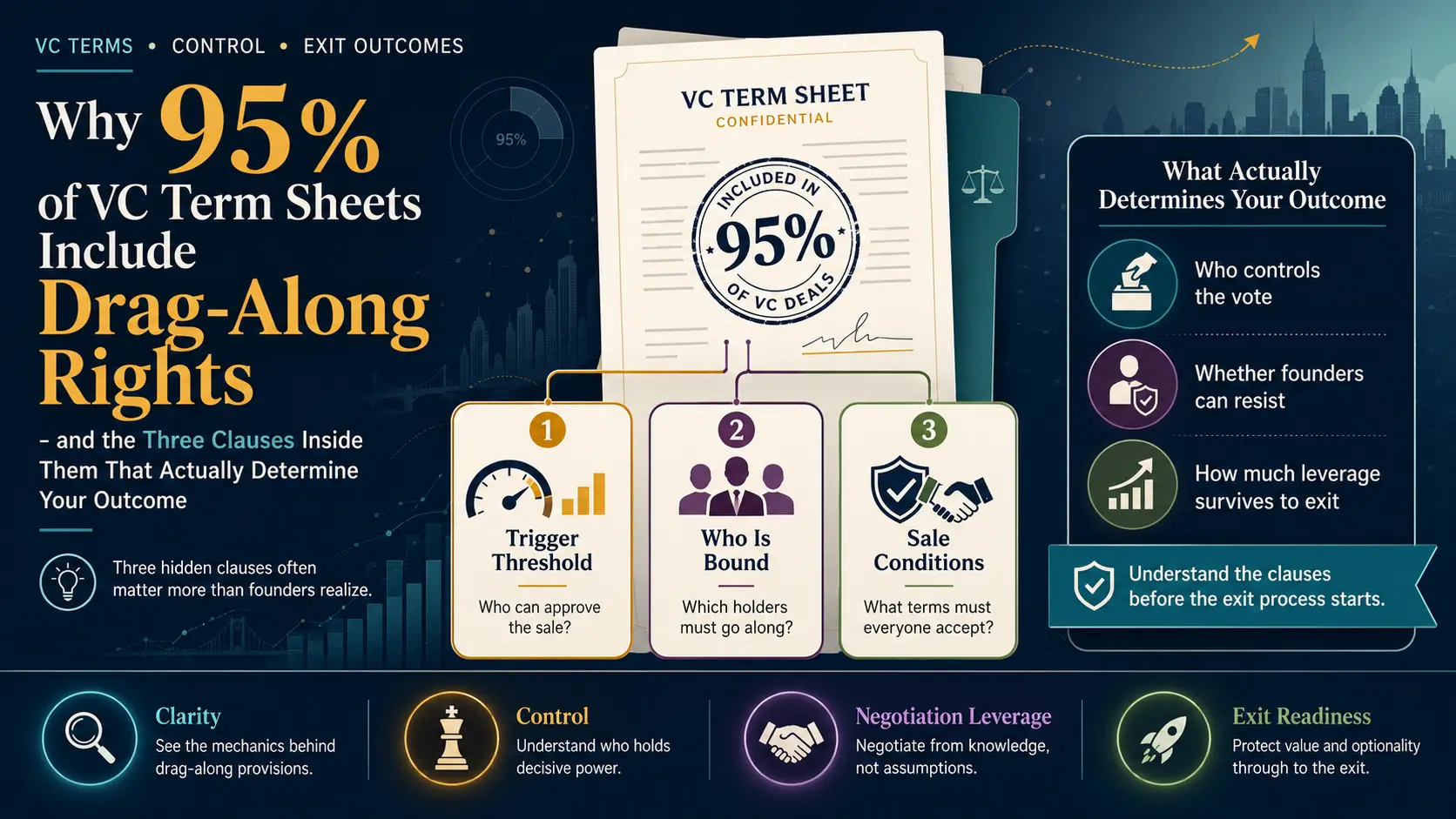
Why 95% of VC Term Sheets Include Drag-Along Rights - and the Three Clauses Inside Them That Actually Determine Your Outcome
What a Price Floor Provision Is - and Why Accepting a Drag-Along Without One Puts Founders at Risk in a Down Market
Disclosure
Nothing on this site constitutes an offer to sell, or a solicitation of an offer to purchase, any security under the Securities Act of 1933, as amended, or any applicable state securities laws. Any offering of securities is made only by means of a formal private placement memorandum or other authorized offering documents delivered to qualified investors.
IRC Partners is a capital advisory firm. IRC Partners is not a registered investment adviser under the Investment Advisers Act of 1940 and does not provide investment advice as defined thereunder.
Certain statements in this article may constitute forward-looking statements, including statements regarding market conditions, capital availability, investor demand, and transaction outcomes. Such statements reflect current assumptions and expectations only. Actual results may differ materially due to market conditions, regulatory developments, company-specific factors, and other variables. IRC Partners makes no representation that any outcome, return, or result described herein will be achieved.
References to prior mandates, transaction volume, network credentials, or capital raised are provided for illustrative purposes only and do not constitute a guarantee or prediction of future results. Past performance is not indicative of future outcomes. Individual results will vary. Network credentials and transaction statistics referenced on this site reflect the aggregate experience of IRC Partners' principals and affiliated advisors and are not a representation of assets managed or transactions closed solely by IRC Partners.
Certain data, statistics, and information presented in this article have been obtained from third-party sources. IRC Partners has not independently verified such information and expressly disclaims responsibility for its accuracy, completeness, or timeliness. Readers should independently verify any third-party data before relying on it.
Readers are strongly encouraged to consult qualified legal, financial, and tax professionals before making any investment, capital raising, or business decision.
Schedule A Meeting
You get one shot to raise the right way. If this raise is worth doing, it’s worth doing with precision, leverage, and control.
This isn’t a practice run. Serious capital. Serious strategy. Let’s raise it right.
We onboard a maximum of seven
new strategic partners each quarter, by application only, to maximize your chances of securing the capital you need.
