.svg "CTA Arrow")


.png "Investor Ready Capital decorative background element")

What Should an LP-Facing Development Budget Summary Include for a Ground-Up Real Estate Raise?
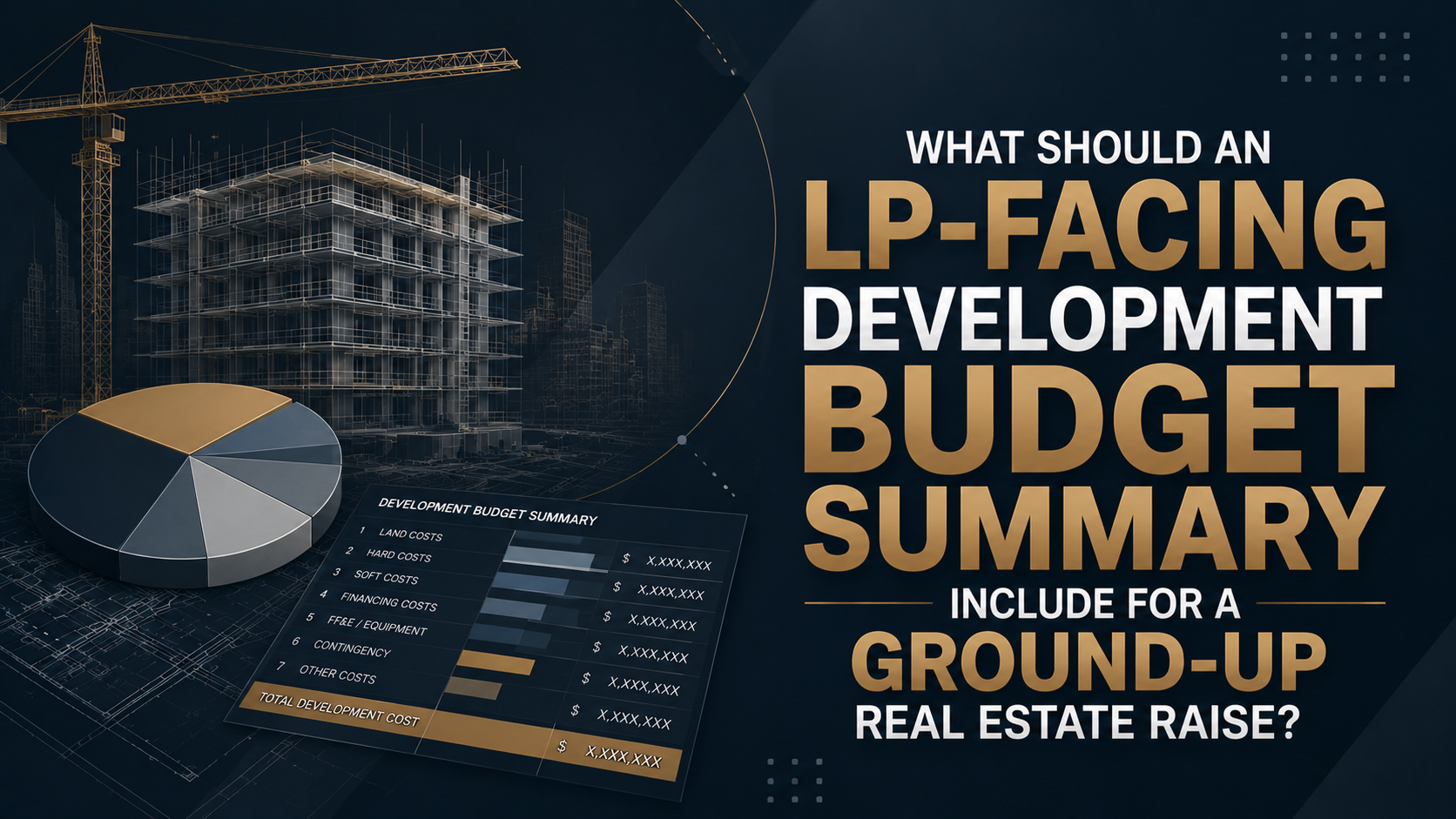
What Should an LP-Facing Development Budget Summary Include for a Ground-Up Real Estate Raise?
An LP-facing development budget summary must present total project cost across six labeled categories: land or acquisition cost, hard costs, soft costs, financing costs, developer fee, and contingency. These six lines give an institutional reviewer enough cost structure to validate the equity need, confirm the debt coverage assumption, and move forward without requesting the full trade-by-trade construction budget. A budget summary that is missing categories, uses inconsistent labels, or fails to reconcile to the sources and uses statement will generate follow-up requests before the deal advances to diligence.
This document serves a different purpose than the internal construction budget. The internal budget is built for the general contractor, the cost consultant, and the project manager. It contains trade-level breakdowns, allowances by scope, and subcontractor line items. The LP-facing summary is built for the capital reviewer. It shows cost at a level of aggregation that supports financial analysis without exposing detail that belongs in the data room.
Sponsors raising $5M to $250M for ground-up development projects need this document in place before outreach begins. The investor-ready materials package describes the full set of documents a reviewer expects to see. The LP-facing financial model summary and the one-page capitalization exhibit both reference the budget summary as their cost input source. If the budget summary is missing, inconsistent, or formatted as an internal spreadsheet, the downstream documents cannot reconcile, and the review stalls.
The document has one job: give the reviewer enough cost structure to validate the equity need and move to the next step.
What the LP-Facing Budget Summary Is and How It Differs from the Internal Construction Budget
The internal construction budget is a working document. It is organized by trade, scope, and subcontractor. It includes allowances, bid alternates, owner-furnished items, and line-item detail that the project team uses to manage cost. Capital reviewers need cost at a category level, organized for financial analysis.
The LP-facing budget summary operates at a different level. It shows total development cost organized by category, with each line labeled in plain English that matches the rest of the investor package. The reviewer uses it to answer three questions:
- What is the total project cost?
- How much of that cost is covered by the senior construction loan?
- How much equity is required to fund the gap?
Those three questions drive the equity sizing calculation. A reviewer who cannot answer them from the budget summary will request the full data room budget. That request signals that the package is incomplete, and it adds friction to a process that should move forward.
The Six Required Categories
Every LP-facing development budget summary should present cost in six labeled categories. These categories align with the way institutional reviewers analyze development cost and match the uses side of the sources and uses statement.
These six lines are the minimum. A sponsor may add a line for pre-development costs if those costs are material and not yet captured in land or soft costs. The goal is to present cost at a level that supports financial analysis, with no line so large that it requires explanation and no line so small that it creates noise.
How to Present Hard Costs at the Summary Level
Hard costs are the largest single line in most ground-up development budgets. They are also the line most likely to generate follow-up requests if presented incorrectly.
The right approach is to present hard costs as a single aggregated number with two supporting data points: cost per square foot and cost per unit if applicable. Those two metrics give the reviewer a benchmark check without requiring the full trade breakdown.
What to show on the hard cost line:
- Total hard cost dollar amount
- Cost per square foot (gross or rentable, labeled)
- Cost per unit for residential projects
What to keep in the data room:
- Trade-by-trade breakdown
- GC contract or letter of intent
- Subcontractor bid summary
- Site work and infrastructure detail
A reviewer who can benchmark the hard cost per square foot against market comparables for the asset type and geography will rarely ask for the trade breakdown at first pass. The request for the full GC budget typically comes at the due diligence stage, after the deal has cleared initial review. Presenting the benchmark metrics in the LP-facing summary prevents that request from arriving too early.
The Benchmark Metric Rule
If the hard cost per square foot falls within the range a reviewer would expect for the asset type and market, the summary passes the first-pass check. If it falls outside that range, the reviewer will ask questions regardless of how the document is formatted. The fix in that case is underwriting. A sponsor who knows their hard cost is above market should address that in the investment memo, not try to obscure it in the budget summary.
Key point: Hard cost benchmarks vary by asset class, market, and construction type. The LP-facing summary should show the metric clearly and let the underwriting speak for itself.
How to Handle Soft Costs, Financing Costs, and Developer Fee
These three categories are where LP-facing budget summaries most often break down. Each one carries a different analytical function for the reviewer. Grouping them together or burying them in a catch-all line creates confusion that generates follow-up questions.
Soft Costs
Soft costs cover the professional fees and permit costs required to design, permit, and manage the project. For the LP-facing summary, present soft costs as a single line with a percentage of hard costs shown parenthetically. Institutional reviewers use the soft cost percentage as a reasonableness check. According to standard soft cost ranges for ground-up residential and mixed-use development, residential projects typically land in the 15% to 25% range of hard costs, while mixed-use and commercial projects run 25% to 35%. A line significantly above or below that range will draw questions.
Soft costs should include architecture and engineering, permit and impact fees, owner's representative fees, legal fees related to entitlement and construction, and any third-party consulting costs incurred during development.
Financing Costs
Financing costs cover the cost of the construction loan. This line should include loan origination fees, interest reserve, lender legal fees, and any other carry costs tied to the debt facility. The interest reserve is typically the largest component and should be sized based on the projected draw schedule and the assumed loan rate.
For sponsors structuring a capital stack with senior construction debt at 50% to 65% of total project cost, the interest reserve line will be material. A reviewer who cannot identify the interest reserve in the budget summary will ask about it separately.
{{main-cta}}
Developer Fee
The developer fee is the capitalized compensation for the sponsor's development services. It should appear as its own labeled line in the LP-facing summary. Combining it with soft costs or general overhead obscures the economics and makes the fee harder for the reviewer to evaluate against the operating agreement.
Developer fee disclosure checklist for the LP-facing budget summary:
- Fee amount in dollars
- Basis for the fee calculation (percentage of hard costs, total project cost, or fixed amount)
- Draw timing reference (tied to construction draws or paid at a specific milestone)
- Cross-reference to the fee table in the operating agreement or PPM, consistent with how the fee and promote model presents developer compensation to institutional reviewers
How Contingency Should Appear in the LP-Facing Summary
Contingency must be a standalone line. It should never be embedded in hard costs, soft costs, or any other category. Institutional reviewers look for contingency because its size relative to hard costs is a direct signal of how conservatively the project is underwritten.
A contingency line that is buried inside another category raises an immediate question: what else is hidden in the budget? A contingency line that is visible and sized appropriately signals that the sponsor has thought through cost risk.
Sizing Contingency for the LP-Facing Summary
Contingency sizing depends on the stage of design and the nature of the project. A project with a permitted set of construction documents carries less design risk than a project still in schematic design. The LP-facing summary should reflect that stage.
These ranges are general guides, not guarantees, and align with contingency sizing guidance published by the American Institute of Architects. A complex project with significant site risk, phased construction, or a volatile supply chain may warrant a higher contingency at any stage. Capital stack advisory work typically stress-tests cost overrun scenarios at 10% to 15% of hard costs before any LP outreach begins, which informs where the contingency line should be set. The LP-facing summary should show the dollar amount and the percentage. If the contingency is below 5% of hard costs, a brief note in the budget summary explaining why is appropriate.
What contingency should never be:
- A rounding buffer spread across other line items
- A plug number used to make total project cost hit a target
- Combined with soft costs or financing costs in a single line
A well-structured contingency line in the LP-facing summary reduces reviewer friction. It shows that the sponsor has accounted for cost risk explicitly rather than assuming the budget is perfect.
How the Budget Summary Connects to the Rest of the Package
The LP-facing development budget summary does not stand alone. It is the cost input that feeds three other documents in the investor-ready package. Each of those documents must reconcile to the budget summary, label for label and dollar for dollar.
The Three Reconciliation Points
1. Total project cost
The total of all six budget lines must equal the total project cost figure shown in the executive summary, the investment memo, and the model summary. A reviewer who sees different total project cost figures across documents will stop the review and ask for a reconciliation. That request is avoidable. The fix is to build the budget summary first and populate every other document from it.
2. The sources and uses statement
The uses side of the sources and uses statement is a compressed version of the budget summary. Every category in the budget summary should appear as a corresponding line in the uses column. The labels must match exactly. A reviewer who sees "hard costs" in the budget and "construction costs" in the sources and uses will flag the inconsistency. Consistent terminology across every document in the package is a non-negotiable standard.
3. The capitalization exhibit
The one-page capitalization exhibit carries a sources-and-uses tie line that must reconcile to the standalone sources and uses statement. The budget summary is the upstream source of that tie line. If the budget summary changes after the capitalization exhibit is finalized, both documents must be updated simultaneously. Version dates on each document should match.
The capital call schedule also draws on the budget summary indirectly. The equity call amounts in the schedule must reconcile to the LP equity line in sources and uses, which traces back to the total project cost in the budget summary. A sponsor who updates the budget without updating the capital call schedule creates a reconciliation error that surfaces during review.
The reconciliation rule: Build the budget summary first. Populate the sources and uses from it. Build the capitalization exhibit from the sources and uses. Update all three simultaneously whenever a number changes.
IRC has advised on capital structures for ground-up development projects, including a multifamily development in Texas with $150M in total capitalization. In every engagement at that scale, document reconciliation across the budget summary, sources and uses, and capitalization exhibit is one of the first structural issues addressed before LP outreach begins.
Structure the Budget Summary Before Outreach Begins
The LP-facing development budget summary is a structural document. It is built once, reconciled across the package, and updated every time a material cost assumption changes. A sponsor who gets this document right before outreach removes one of the most common sources of first-pass friction.
The six-category structure is the starting point. Hard costs with benchmark metrics, soft costs with a percentage of hard costs, financing costs with the interest reserve identified, developer fee as a standalone line, and contingency visible and sized to the design stage. Every label consistent with every other document in the package.
If the budget summary is not ready, the package is not ready.
IRC works with real estate sponsors raising $5M to $250M on ground-up development projects to structure LP-facing materials packages that pass first-pass institutional review. That work includes building and reconciling the development budget summary before any LP outreach begins.
Frequently Asked Questions
What is the difference between an LP-facing development budget summary and a sources and uses statement?
The LP-facing development budget summary shows total project cost organized by category, with each line presenting what the money is spent on. The sources and uses statement shows both where the money comes from and where it goes, presenting cost categories on the uses side and capital layers on the sources side. The budget summary is the upstream document. The uses side of the sources and uses statement is derived from it, using the same labels and the same dollar amounts.
How many line items should an LP-facing development budget summary include?
Six categories are the standard for most ground-up development projects: land or acquisition cost, hard costs, soft costs, financing costs, developer fee, and contingency. Adding more lines is appropriate only when a cost is material enough to warrant separate disclosure and distinct enough to confuse a reviewer if buried in another category. Pre-development costs are the most common addition. Fewer than six categories typically means one or more cost types are being combined in a way that will generate follow-up questions.
What hard cost metrics should appear alongside the dollar total?
The LP-facing summary should show hard cost per square foot, labeled as gross or rentable, and cost per unit for residential projects. These two metrics allow a reviewer to benchmark the hard cost against market comparables for the asset type and geography without requesting the full trade breakdown. The per-square-foot figure is the primary benchmark. The per-unit figure is a secondary check for residential and mixed-use projects.
How should a sponsor handle a developer fee that is partially deferred?
A deferred developer fee should be disclosed in the LP-facing budget summary with the total fee amount, the portion paid during construction, and the deferred balance. The deferred portion should be treated as a use of proceeds in the sources and uses statement and disclosed in the waterfall section of the operating agreement. Combining the current and deferred portions into a single line without disclosure creates a reconciliation question when the reviewer reaches the waterfall analysis.
What happens if the LP-facing budget summary does not match the total project cost in the executive summary?
A mismatch between the budget summary total and the total project cost figure in the executive summary or model summary is a document control failure. The reviewer will flag the discrepancy and request a reconciliation before moving forward. The fix is to build the budget summary first, derive all other cost figures from it, and carry a version date on every document so that updates are tracked and applied consistently across the package.
Should the LP-facing budget summary include a column for percentage of total project cost?
Yes. A percentage column alongside the dollar amounts gives the reviewer a fast way to assess the relative weight of each cost category without doing mental math. Soft costs as a percentage of hard costs and contingency as a percentage of hard costs are the two ratios reviewers check most frequently. Showing those percentages in the budget summary reduces the number of calculations a reviewer needs to perform and signals that the sponsor has thought through the cost structure.
At what stage of development should the LP-facing budget summary be prepared?
The LP-facing development budget summary should be prepared before any LP outreach begins, regardless of the design stage. The level of cost certainty will vary by stage, and the contingency line should reflect that. A project in schematic design carries more cost uncertainty than a permitted project with a GMP contract. The budget summary should reflect the current stage accurately and be updated as design advances and cost certainty increases. A budget summary that reflects a later design stage than the project has actually reached will create credibility problems during due diligence.
Continue reading this series:
- What Should an LP-Facing Financial Model Summary Include When Presenting a Single Real Estate Development Project?
- How Should a Real Estate Sponsor Summarize Project Capitalization at the One-Page Exhibit Level?
- What Should a Capital Call Schedule Include for Institutional LP Review?
By the time most founders are rehearsing the pitch, the outcome of the raise has already been set by the structure underneath it. IRC Partners advises operators raising $5M to $250M of institutional capital and accepts seven strategic partners per quarter. If you are going to market this year, have the structure reviewed before investors do. Schedule a call with our team here.
Need guidance on your capital raise?


How Seasoned Real Estate Developers Access Institutional Allocators: The Warm Introduction Framework for $10M+ Raises
Do Convertible Notes Count Toward the Drag-Along Threshold? The Definition Gap That Blows Up Acquisition Closings
.jpg "How to get ahead of 99% of startups in seed rounds")
How to Get Ahead of 99% of Startups in Seed Rounds
Disclosure
Nothing on this site constitutes an offer to sell, or a solicitation of an offer to purchase, any security under the Securities Act of 1933, as amended, or any applicable state securities laws. Any offering of securities is made only by means of a formal private placement memorandum or other authorized offering documents delivered to qualified investors.
IRC Partners is a capital advisory firm. IRC Partners is not a registered investment adviser under the Investment Advisers Act of 1940 and does not provide investment advice as defined thereunder.
Certain statements in this article may constitute forward-looking statements, including statements regarding market conditions, capital availability, investor demand, and transaction outcomes. Such statements reflect current assumptions and expectations only. Actual results may differ materially due to market conditions, regulatory developments, company-specific factors, and other variables. IRC Partners makes no representation that any outcome, return, or result described herein will be achieved.
References to prior mandates, transaction volume, network credentials, or capital raised are provided for illustrative purposes only and do not constitute a guarantee or prediction of future results. Past performance is not indicative of future outcomes. Individual results will vary. Network credentials and transaction statistics referenced on this site reflect the aggregate experience of IRC Partners' principals and affiliated advisors and are not a representation of assets managed or transactions closed solely by IRC Partners.
Certain data, statistics, and information presented in this article have been obtained from third-party sources. IRC Partners has not independently verified such information and expressly disclaims responsibility for its accuracy, completeness, or timeliness. Readers should independently verify any third-party data before relying on it.
Readers are strongly encouraged to consult qualified legal, financial, and tax professionals before making any investment, capital raising, or business decision.
Schedule A Meeting
You get one shot to raise the right way. If this raise is worth doing, it’s worth doing with precision, leverage, and control.
This isn’t a practice run. Serious capital. Serious strategy. Let’s raise it right.
We onboard a maximum of seven
new strategic partners each quarter, by application only, to maximize your chances of securing the capital you need.
