.svg "CTA Arrow")


.png "Investor Ready Capital decorative background element")

Do Convertible Notes Count Toward the Drag-Along Threshold? The Definition Gap That Blows Up Acquisition Closings
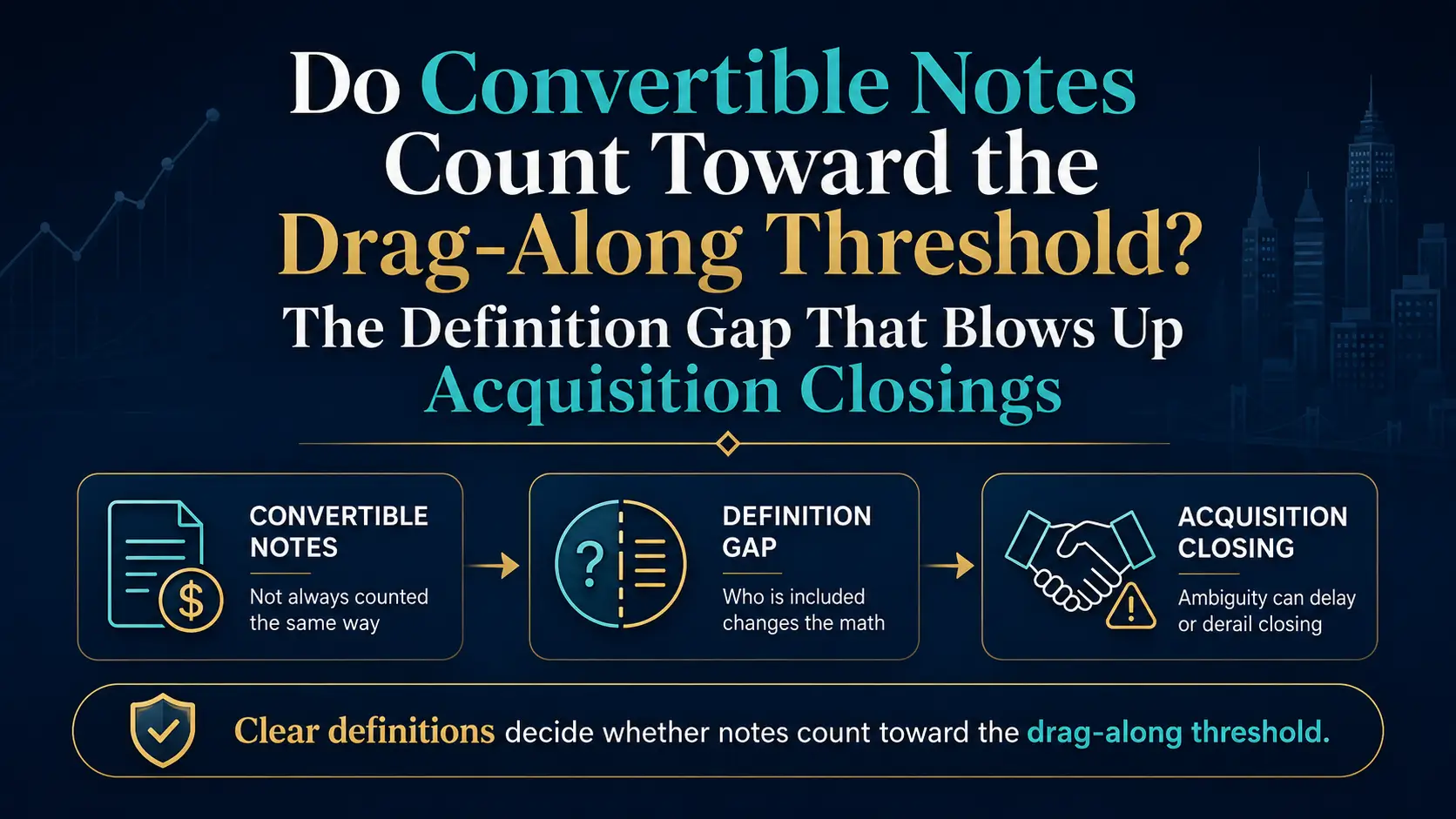
Do Convertible Notes Count Toward the Drag-Along Threshold? The Definition Gap That Blows Up Acquisition Closings
Convertible notes do not automatically count toward a drag-along threshold before they convert into equity - whether they count depends on the exact language in the governing documents: the charter, the stockholders agreement or voting agreement, and the note or SAFE documents themselves. If those documents define the drag-along approval class to include only issued and outstanding stockholders, unconverted noteholders sit outside the threshold calculation entirely. If the documents include as-converted language that counts future equity in the denominator, the math changes. If the notes convert before the approval is measured, the converted holders become stockholders and their shares count directly. The three outcomes are not interchangeable, and the difference between them is not an academic question - it is the question that buyer counsel will ask during acquisition diligence, and it is the question that triggers consent disputes when the answer is unclear.
Three things founders need to know before assuming the drag-along is clean:
- Convertible notes and SAFEs are not equity until conversion. They do not carry stockholder voting rights by default.
- The drag-along threshold can only be tested against the holders the documents actually define as counting.
- Vague or inconsistent definitions across the charter, stockholders agreement, and note documents create a closing risk, not just a cap table cleanup task.
For a foundation on how drag-along provisions work across growth-stage financings. How ambiguous voting calculations in drag-along clauses create a separate layer of approval risk that compounds the instrument definition problem covered here.
What Determines Whether a Convertible Instrument Counts in the Drag-Along Math
Four variables in the governing documents control the answer. Each one is a gate. If any gate is ambiguous, the approval calculation is contestable.
- The stockholder or holder definition. The drag-along clause identifies who must approve a sale. If it covers "holders of Preferred Stock" or "holders of a majority of the outstanding shares," unconverted noteholders are not in that class. They hold debt, not shares. This is the first and most important gate.
- As-converted language. Some drag-along provisions calculate the approval threshold on an as-converted-to-common basis, meaning the denominator includes shares that would exist if all convertible instruments converted today. When that language is present, the note pool changes the math even before conversion occurs. The NVCA model term sheet uses as-converted-to-common calculations in several key voting provisions, which is why founders should check whether their documents follow that convention or diverge from it.
- Conversion timing. There is a meaningful legal difference between conversion at signing, conversion at stockholder approval, and conversion at closing. These are not the same moment. Approval that was valid at signing may need to be re-confirmed if conversion occurs between signing and closing and the newly converted holders are now part of the approval class.
- Approval mechanics across multiple documents. The charter, the stockholders agreement or voting agreement, and the note or SAFE documents may each define holder classes or approval rights differently. When those definitions do not align, the company, lead investor, and noteholders can each read the same transaction and reach different conclusions about whether the threshold was satisfied.
The practical test: If any of these four variables is undefined or inconsistent across the document stack, the drag-along approval is not clean. It is arguable.
Convertible Notes vs. SAFEs vs. Already-Converted Preferred: Not Interchangeable in Drag-Along Analysis
Founders with stacked seed notes, bridge notes, and SAFEs often treat these instruments as roughly equivalent future-equity obligations. For drag-along purposes, they are not. Each instrument sits in a different legal position before conversion, and that position determines whether the holder counts in the approval math.
The common founder mistake is assuming all of these instruments already sit inside the same approval bucket. They do not. A SAFE holder who has not yet converted holds a contractual right, not a share. An unconverted noteholder is a creditor, not a stockholder. Neither carries statutory voting rights under Delaware corporate law until conversion occurs and shares are issued.
Understanding how drag-along rights get buried in your term sheet is part of catching these instrument-level gaps before they become closing-stage problems. For a broader look at what founders actually concede in a Series A drag-along clause, drag-along rights explained covers the five concessions that stay invisible until a buyer appears.
Worked Example: The Same Sale, Three Different Threshold Outcomes
Here is the base case. A company is being acquired. The drag-along requires approval from holders of 75% of the outstanding shares voting together as a single class.
Cap table at the time of sale approval:
- Preferred and common stockholders (clearly voting outstanding shares): 78% of outstanding shares approve the sale
- Founders: hold the remaining 22% and do not approve
- Convertible note pool: would convert into shares representing 18% of the company on an as-converted basis if a qualified financing or sale-trigger conversion occurs
The 78% approval looks sufficient against a 75% threshold. But the outcome changes materially depending on how the note pool is treated.
What the denominator change actually means:
- In Scenario 1, the approval is clean and the threshold is satisfied without the noteholders.
- In Scenario 2, including the note pool on an as-converted basis drops approval from 78% to 66.1%, which fails the 75% threshold. The sale cannot proceed without additional consents.
- In Scenario 3, if notes convert before approval is measured and converted holders vote in favor, the threshold is satisfied again, but the company now needs to document that conversion and confirm the converted holders actually consented.
The numbers are straightforward. The problem is that most founders do not know which scenario their documents create until buyer counsel asks.
Why the Definition Gap Blows Up Acquisition Closings
{{main-cta}}
The worked example above is not a theoretical edge case. It is the kind of problem that buyer counsel surfaces during diligence, often after a letter of intent has been signed and the company is already in exclusivity.
Four ways the definition gap creates closing-stage problems:
- Missing consent documentation. If as-converted language applies and noteholders should have been counted or notified, buyer counsel will flag that the approval was defective. Closing stalls while the company tries to obtain retroactive consents or cure the defect.
- Conflicting holder definitions. When the stockholders agreement says "holders of outstanding shares" and the note documents give noteholders separate consent rights over a sale, parties dispute which document controls. That dispute creates delay and renegotiation pressure.
- Conversion sequencing disputes. If the company argues notes should convert before the approval vote and noteholders argue they retain pre-conversion rights until the closing actually occurs, there is no clean answer without clear document language. Both sides have a colorable position.
- Buyer repricing leverage. A consent defect identified at closing gives a buyer a legitimate basis to request a price reduction, an escrow holdback, or an indemnification for the risk that a noteholder later challenges the transaction.
None of these outcomes require a lawsuit to be damaging. The cost is delay, legal fees, and negotiating leverage lost at exactly the moment the company is most exposed. Reviewing the M&A due diligence documents buyers request shows why consent mechanics and cap table definitions are among the first items on every buyer's checklist.
What Founders Should Review Before the Next Financing or Sale Process
The definition gap is fixable. The right time to fix it is before a new financing round or before M&A preparation begins, not after a buyer's legal team finds it.
Founder review checklist for convertible instrument treatment in drag-along provisions:
- Drag-along holder definition. Does the clause define the approval class to include only current stockholders, or does it extend to as-converted holders of notes and SAFEs? If the answer is unclear, the denominator is unclear.
- As-converted language in voting calculations. Does the drag-along threshold use outstanding shares only, or outstanding shares on an as-converted-to-common basis? Check this in the charter, the stockholders agreement, and the voting agreement separately.
- Note and SAFE conversion triggers. Do the note or SAFE documents include an automatic conversion trigger tied to a sale? Does that trigger occur before or after the approval vote is taken?
- Cross-document consistency. Do the charter, stockholders agreement, voting agreement, and note documents all use the same definition of holders and the same denominator logic? Inconsistency across documents is the source of most disputes.
- Bridge notes issued after Series A. Any bridge note signed after the priced round should be reviewed to confirm it does not inadvertently change the as-converted denominator or create a new consent right over a future sale.
- Cap table model alignment. Does the company's cap table model reflect the correct denominator under each possible interpretation? If the model only shows one scenario, it may be masking a threshold problem.
IRC Partners works with founders before investor outreach, bridge financing, and exit preparation to identify consent mechanics and capital stack issues that create diligence risk. What growth-stage companies need to know about drag-along provisions covers trigger design, voting math, and the protections founders should have in place before the next raise begins. The capital stack explained covers how these instruments interact across a full financing history.
Frequently Asked Questions
Do SAFE holders count in a drag-along vote before they convert into equity?
SAFE holders do not count in a drag-along vote before conversion unless the governing documents explicitly include them. A SAFE is a contractual right to future equity, not an issued share. Until conversion occurs and shares are issued, the SAFE holder is not a stockholder and does not carry statutory voting rights. Whether the drag-along denominator includes SAFEs on an as-converted basis depends entirely on the specific language in the stockholders agreement and charter.
Can a noteholder block a sale if they are not yet a stockholder?
An unconverted noteholder generally cannot vote to block a sale through the drag-along mechanism because drag-along rights apply to stockholders. However, if the note documents include a separate consent right triggered by a sale, change of control, or liquidation event, the noteholder may have a contractual right to object or require conversion before the sale closes. Those consent rights are separate from the drag-along and must be reviewed independently.
What does "as-converted basis" mean when applied to drag-along approval?
As-converted basis means the approval threshold is calculated as if all convertible instruments, including notes and SAFEs, had already converted into the shares they would produce. The denominator expands to include those hypothetical shares even before conversion occurs. This matters because a threshold that looks satisfied using only outstanding shares may fall below the required percentage once the as-converted pool is added to the denominator, as shown in Scenario 2 of the worked example above.
What happens if the note documents and the stockholders agreement define "holders" differently?
When note documents and the stockholders agreement use different definitions of who qualifies as a holder for approval purposes, the company faces a document conflict. Parties can read the same transaction and reach different conclusions about whether required consents were obtained. Resolving the conflict typically requires legal analysis of which document controls, and in some cases, amendment or waiver from the affected holders before closing can proceed.
Can a bridge note signed after Series A change the drag-along math?
Yes. A bridge note issued after a priced round can change the drag-along denominator if the drag-along provision uses as-converted language and the bridge note would convert into shares that are counted in that denominator. It can also introduce new consent rights if the note documents include sale or change-of-control provisions. Founders should review any post-Series A bridge note against the existing drag-along mechanics before signing, not after a sale process begins.
Does buyer counsel typically flag convertible instrument treatment during acquisition diligence?
Yes. Buyer counsel reviews consent mechanics and approval documentation as a standard part of acquisition diligence. This includes confirming which holders were required to approve the sale, verifying that the approval class was correctly defined, and checking whether any convertible instruments created additional consent requirements. A consent defect identified at this stage gives the buyer leverage to delay closing, request price adjustments, or require indemnification for the risk that a holder later challenges the approval.
What is the single most important document to review before the next financing or sale process?
The stockholders agreement or voting agreement is the most important starting point because it typically contains the drag-along clause, the approval threshold, and the definition of the holder class. From there, the charter and each note or SAFE document should be checked for consistency with those definitions. If the documents do not align on who counts, when they count, and on what basis, the drag-along is not clean. IRC Partners reviews these mechanics with founders before investor outreach, bridge financing, and M&A preparation to surface definition gaps before they become closing-stage problems. Book a review before the next financing or sale process.
Continue reading this series:
- How Drag-Along Rights Get Buried in Your Term Sheet
- 51% vs. 75% Drag-Along Threshold
- Why Ambiguous Voting Calculations in Drag-Along Clauses Create Closing Risk
By the time most founders are rehearsing the pitch, the outcome of the raise has already been set by the structure underneath it. IRC Partners advises operators raising $5M to $250M of institutional capital and accepts seven strategic partners per quarter. If you are going to market this year, have the structure reviewed before investors do. Schedule a call with our team here.
Sponsors weighing this decision should first complete a capital raise readiness assessment for sponsors to confirm the raise is investor-ready.
Need guidance on your capital raise?



When Does a Company Need Capital Raising Outcomes and Advisor Success Rates
Limit Quarterly Reporting Burdens When Signing With VCs for $10M Deals

What Key-Person Provisions Do Family Offices Require In a $15M+ Real Estate Joint Venture?
Disclosure
Nothing on this site constitutes an offer to sell, or a solicitation of an offer to purchase, any security under the Securities Act of 1933, as amended, or any applicable state securities laws. Any offering of securities is made only by means of a formal private placement memorandum or other authorized offering documents delivered to qualified investors.
IRC Partners is a capital advisory firm. IRC Partners is not a registered investment adviser under the Investment Advisers Act of 1940 and does not provide investment advice as defined thereunder.
Certain statements in this article may constitute forward-looking statements, including statements regarding market conditions, capital availability, investor demand, and transaction outcomes. Such statements reflect current assumptions and expectations only. Actual results may differ materially due to market conditions, regulatory developments, company-specific factors, and other variables. IRC Partners makes no representation that any outcome, return, or result described herein will be achieved.
References to prior mandates, transaction volume, network credentials, or capital raised are provided for illustrative purposes only and do not constitute a guarantee or prediction of future results. Past performance is not indicative of future outcomes. Individual results will vary. Network credentials and transaction statistics referenced on this site reflect the aggregate experience of IRC Partners' principals and affiliated advisors and are not a representation of assets managed or transactions closed solely by IRC Partners.
Certain data, statistics, and information presented in this article have been obtained from third-party sources. IRC Partners has not independently verified such information and expressly disclaims responsibility for its accuracy, completeness, or timeliness. Readers should independently verify any third-party data before relying on it.
Readers are strongly encouraged to consult qualified legal, financial, and tax professionals before making any investment, capital raising, or business decision.
Schedule A Meeting
You get one shot to raise the right way. If this raise is worth doing, it’s worth doing with precision, leverage, and control.
This isn’t a practice run. Serious capital. Serious strategy. Let’s raise it right.
We onboard a maximum of seven
new strategic partners each quarter, by application only, to maximize your chances of securing the capital you need.
