.svg "CTA Arrow")


.png "Investor Ready Capital decorative background element")

What Supporting Schedules Should Be Included in a Real Estate Capital Raise Model?
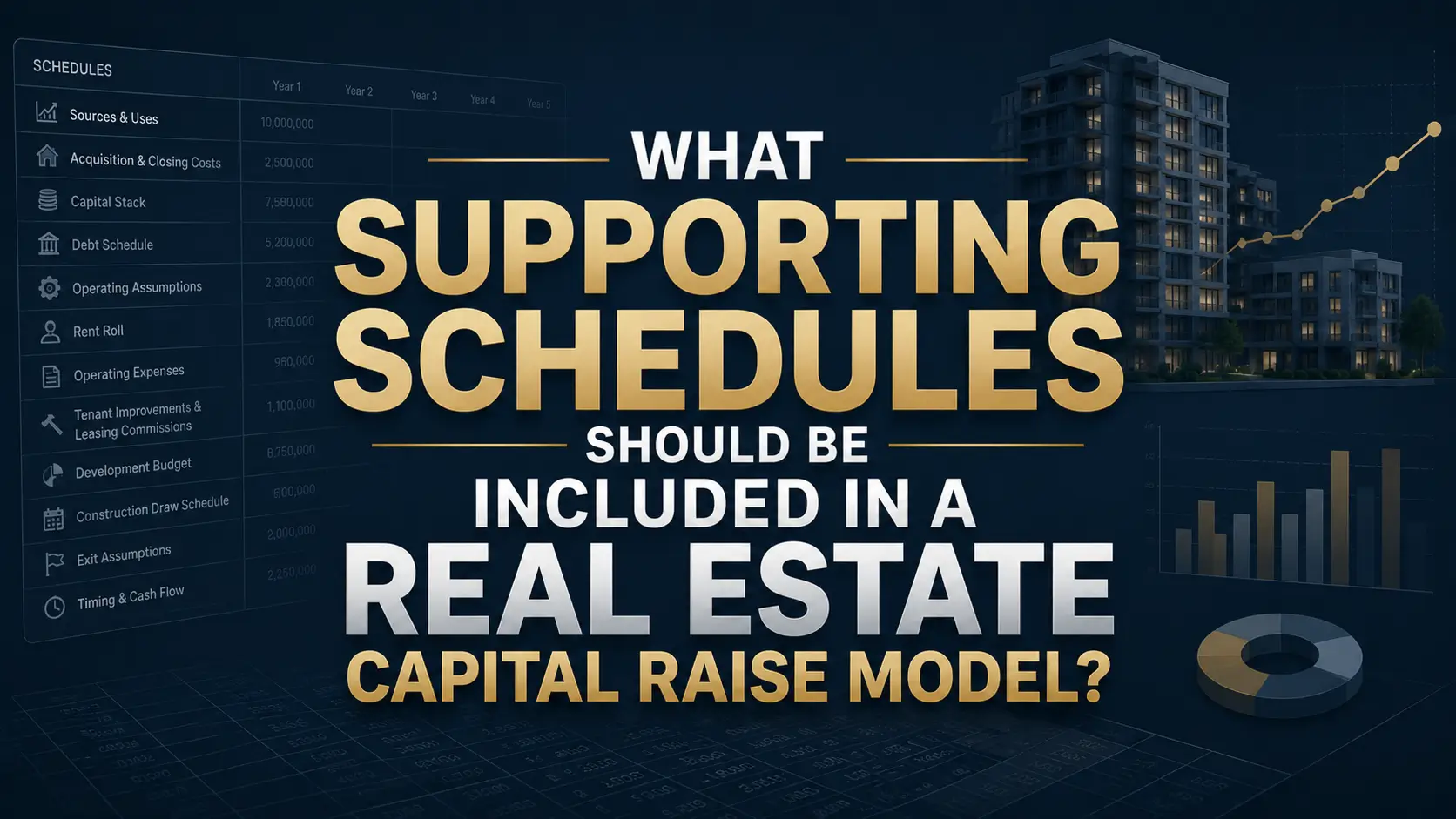
A real estate capital raise model can lose institutional LP credibility when its headline returns cannot be traced to clear, formula-driven supporting schedules. If sources and uses, construction draws, revenue, expenses, debt, capital calls, fees, promote, exit assumptions, or downside cases are missing or disconnected, LPs cannot verify the underwriting and diligence slows. An institutional-grade model solves this with ten supporting schedules that connect every major assumption to the summary, cash flow, capital stack, and waterfall outputs.
This article is part of the series on building an investor-ready materials package for a real estate sponsor. It follows directly from the article on what financial model tabs a real estate sponsor should prepare before institutional LP outreach. The core model tabs are where outputs live. Supporting schedules are where underwriting credibility gets confirmed.
LPs do not open supporting schedules to learn about the deal. They open them to verify it. A model that presents strong summary outputs but cannot trace those outputs back to clean, labeled, formula-driven schedules creates diligence friction before a single investment committee conversation begins. Sponsors raising $5M or more should treat the supporting schedule layer as a required element of the model, not an optional add-on.
Key takeaway: Supporting schedules are the proof layer. If an LP cannot trace a number from the summary tab back to a named schedule with clear inputs and formulas, the underwriting is not yet institutional-grade.
The Minimum Supporting Schedule Set Behind an LP-Facing Model
Supporting schedules fall into five functional groups. Every institutional-grade model should cover all five before outreach begins.
The schedule set should match the asset type and business plan. A stabilized acquisition model does not need a construction draw schedule. A ground-up development model does. What does not change across asset types is the underlying logic: every schedule must bridge assumptions to outputs, and every schedule must carry visible tie-backs to a named core tab. Schedules with hardcoded numbers and no formula trail are the single most common diligence red flag institutional reviewers find during first-pass model review.
Sources and Uses, Construction Draws, and Equity Funding Logic
These three schedules cover how capital enters the deal and how it gets deployed. They must reconcile to each other and to the capital stack tab.
Sources and Uses Schedule
The sources and uses schedule must tie exactly to the summary tab total capitalization figure. Every line item, including land, hard costs, soft costs, financing costs, contingency, and GP fees, should appear as a named row with a formula-driven total. The LP equity line in this schedule must match the equity raise stated in the executive summary and the capital stack tab. Any gap between those figures stops a committee reviewer before they read further.
Construction Draw Schedule
For development deals, the construction draw schedule should show monthly or quarterly funding timing, hard and soft cost phasing by period, contingency release logic, and lender draw assumptions where a construction loan is in place. The draw timing must feed directly into the cash flow tab. If the cash flow tab shows a capital need in month nine but the draw schedule does not support that timing, the model fails its first internal consistency check.
Capital Call and Equity Funding Schedule
The capital call schedule should show who funds what, when, and under which trigger. It should identify LP contributions, GP co-investment, and any preferred equity or mezzanine draws by period. The cash need bridge across the model should be visible here, with each call linked to a corresponding deployment event in the draw or operating schedule.
Lease-Up, Revenue, and Operating Expense Schedules
These three schedules cover the commercial engine of the deal. LPs use them to test whether the cash flow tab reflects a realistic operating picture or an optimistic one.
Lease-Up or Operating Ramp Schedule
This schedule should stage occupancy, rent growth, downtime, concessions, and absorption period by period. For residential assets, it should show unit-level lease-up progression. For commercial assets, it should show pre-lease status and projected absorption. For condo sellout strategies, it should show unit sales pace by period. The stabilization timeline in this schedule must feed directly into the cash flow tab. If the cash flow tab shows stabilized NOI beginning in month eighteen but the lease-up schedule does not reach target occupancy until month twenty-four, the model has an internal inconsistency that an LP will find immediately.
Revenue Schedule
The revenue schedule should break out the actual income drivers of the deal. For multifamily, that means unit mix, average rents, concession treatment, vacancy, and ancillary income. For commercial, it means lease assumptions, reimbursements, and renewal probability. For condo, it means sales pace, pricing by unit type, and absorption timing. Every revenue line should be formula-driven and traceable to a market assumption that the sponsor can defend.
Operating Expense Schedule
The operating expense schedule should separate controllable costs, such as payroll, repairs, and management fees, from non-controllable costs, such as taxes and insurance. It should apply an explicit inflation rate to each category and show how reserves are funded and drawn. The total expense figure in this schedule must match the operating expense line in the cash flow tab exactly.
Debt, Fees, Promote, and Exit Support Schedules
These four schedules cover the financing structure, sponsor economics, and exit logic. Together they allow an LP to trace how capital is returned and how the waterfall distributes proceeds.
Debt Schedule
The debt schedule should show draw mechanics, interest reserve logic, amortization, refinance assumptions, maturity timing, and any covenant visibility that affects cash flow. Federal guidance on interest reserve underwriting in commercial real estate lending confirms that interest expense is a core project budget element that must be carefully estimated and tied to verified draw timing assumptions. The interest reserve line in this schedule must match the interest reserve in the sources and uses schedule. The debt service figures must feed directly into the cash flow tab. Lenders and LPs both review this schedule to confirm that the financing structure is internally consistent and that the debt payoff logic at exit is clearly modeled.
Fee and Promote Support Schedule
The fee and promote schedule should tie each sponsor fee, including development fee, acquisition fee, asset management fee, and disposition fee, to a defined calculation basis, timing assumption, and cash flow impact. Fees that appear in the sources and uses but are not modeled as cash outflows in this schedule create a reconciliation gap. The promote mechanics should tie directly to the waterfall tab, with clear hurdle thresholds and distribution logic that an LP can follow without asking for a separate explanation. The article on how to model fee income, promote economics, and GP participation for investors covers the full standard for this schedule.
Exit Schedule
The exit schedule should bridge sale timing, terminal cap rate, gross sale proceeds, disposition costs, debt payoff, and net proceeds directly into the waterfall tab and investor return outputs. The cap rate assumption in this schedule must be the same figure used in the summary tab return calculations. Disposition costs should be itemized, not estimated as a single percentage. The net proceeds figure must feed the waterfall tab without manual override.
Sensitivity Support Schedule
The sensitivity schedule should isolate the major pressure points in the underwriting: rent growth, occupancy, construction cost, exit cap rate, interest rate, and timing. Each variable should show a range of outcomes, with the downside case tied back to the cash flow and return outputs. A sensitivity schedule that shows only upside and base scenarios signals that the downside has not been seriously modeled. Institutional LPs run their own stress tests. A sponsor whose model already shows the stress results earns credibility before the conversation begins.
How to Order, Label, and Tie Schedules Back to the Core Model
The order in which schedules are presented matters. LPs review models in a predictable sequence, and the schedule structure should follow that sequence rather than force a reviewer to hunt for the logic they need.
A clean institutional review order runs:
- Sources and uses (capitalization foundation)
- Construction draws (deployment timing)
- Capital calls and equity funding (cash need bridge)
- Lease-up or operating ramp (stabilization logic)
- Revenue (income assumptions)
- Operating expenses (cost assumptions)
- Debt (financing mechanics)
- Fees and promote (sponsor economics)
- Exit (disposition and proceeds bridge)
- Sensitivity support (downside and stress cases)
Every schedule tab should carry a consistent naming convention that matches the core model tabs it feeds. If the summary tab calls a line "Total Hard Costs," the construction draw schedule should use the same label. Renaming the same concept across tabs forces a reviewer to reconcile terminology before they can reconcile numbers, and that friction signals weak model discipline.
Each schedule should have a clearly labeled input area, a formula-driven output area, and a visible reference cell or named range that ties back to the core tab it supports. A reviewer should be able to click any output number in the summary tab and trace it back to its source schedule in under thirty seconds.
What Missing or Disconnected Schedules Signal to an Allocator
Institutional reviewers treat missing, hardcoded, or disconnected schedules as signals about the quality of the underwriting process, not just the model file. The financial model red flags that institutional diligence catches in 15 minutes covers the full first-pass review checklist. For supporting schedules specifically, the pattern is consistent:
The same transparency expectation applies at the fund level. SEC rules requiring detailed line-item accounting of fees and performance for private fund investors reflect a broader institutional standard: reviewers expect a traceable, formula-driven record at every layer of the underwriting package.
A sponsor who has built the core tabs but has not yet completed the supporting schedule layer is not ready for institutional outreach. The materials may look presentable at the summary level, but the first LP who opens the model will find the gaps. Completing the schedule layer before outreach begins is the difference between a model that survives diligence and one that creates avoidable friction at the worst possible moment. Sponsors preparing the full financial support layer for their data room should also review what documents should support a real estate financial model in an investor data room.
What to Do Before Outreach If the Schedule Layer Is Incomplete
If the core model tabs exist but the supporting schedules are incomplete, inconsistent, or disconnected from LP review logic, the right move is to tighten the proof layer before the first outreach conversation begins. The schedule review process follows a clear sequence:
- Audit every core tab output and confirm it traces to a named supporting schedule
- Confirm all schedule totals reconcile to the corresponding core tab figures
- Verify that every schedule uses formula-driven logic, with no hardcoded values in output rows
- Check that tab naming is consistent across schedules and core tabs
- Confirm the sensitivity schedule shows a genuine downside case, not a cosmetic one
IRC Partners works with real estate sponsors raising $5M or more to structure financial models and supporting schedules that are built for institutional LP review from the first conversation. If the model exists but the schedule layer needs to be structured, labeled, and tied together before outreach begins, book an IRC strategy call about structuring your financial model for institutional LP review.
Frequently Asked Questions
What is the difference between a supporting schedule and a model tab in a real estate financial model?
A core model tab presents outputs, such as projected returns, cash flows, or capital stack summaries. A supporting schedule is the input and calculation layer behind those outputs. The summary tab shows an IRR. The sources and uses, lease-up, revenue, debt, and exit schedules show how that IRR was derived. LPs use supporting schedules to verify whether the output numbers are traceable and internally consistent.
How many supporting schedules should a real estate capital raise model include before institutional LP outreach?
An institutional-grade model should include at least ten supporting schedules before outreach begins: sources and uses, construction draws where applicable, lease-up or operating ramp, revenue, operating expenses, debt, capital calls and equity funding, fees and promote, exit assumptions, and sensitivity support. The exact set depends on the asset type and business plan, but every model should cover all five functional groups: capital deployment, operating assumptions, financing, sponsor economics, and exit and downside.
What does a hardcoded schedule signal to an institutional LP during diligence?
A hardcoded schedule, one where output rows contain manually entered numbers rather than formulas, signals weak version control and a higher risk of assumption drift between tabs. An LP cannot confirm internal consistency when numbers are hardcoded because there is no formula trail to follow. Reviewers treat hardcoded schedules as a model quality issue, not just a formatting preference.
How should supporting schedules tie back to the core model tabs?
Each supporting schedule should reference the core tab it feeds through named ranges, reference cells, or direct formula links. The total figure in the sources and uses schedule should match the capitalization line in the summary tab exactly. The debt service figure in the debt schedule should feed the cash flow tab directly. The net proceeds figure in the exit schedule should flow into the waterfall tab without manual override. Any break in that chain is a reconciliation gap.
What does a missing supporting schedule signal during first-pass LP review?
A missing schedule signals that a headline output in the core model may have been manually assembled rather than systematically underwritten. When an LP cannot find the schedule that supports a key assumption, they generate a follow-up request. That request pauses the diligence clock and signals that the model was not built with institutional review in mind. Sponsors who complete the full schedule layer before outreach avoid this friction entirely.
Should the sensitivity schedule show a downside case or just a base and upside?
The sensitivity schedule should show a genuine downside case, not just base and upside scenarios. Institutional LPs run their own stress tests regardless of what the sponsor provides. A model that already presents downside sensitivity across key variables, including rent growth, exit cap rate, occupancy, construction cost, and timing, signals that the sponsor has stress-tested the underwriting and is not hiding fragility. A cosmetic sensitivity schedule with minor downside assumptions is one of the most common red flags in first-pass model review.
What is the correct order for presenting supporting schedules in an institutional-grade real estate model?
Supporting schedules should be ordered to match the sequence in which LPs review a model: capitalization first, then deployment, then operating assumptions, then financing, then sponsor economics, then exit, then downside scenarios. That sequence runs: sources and uses, construction draws, capital calls and equity funding, lease-up or operating ramp, revenue, operating expenses, debt, fees and promote, exit, and sensitivity support. Presenting schedules in this order reduces the time a reviewer spends navigating the model and signals that the sponsor understands how institutional diligence works.
Continue reading this series:
- How should a real estate sponsor package project-level financials for LP committee review?
- What should an LP-facing financial model summary include when presenting a single real estate development project?
- What financial materials should be included in a first institutional LP follow-up package?
By the time most founders are rehearsing the pitch, the outcome of the raise has already been set by the structure underneath it. IRC Partners advises operators raising $5M to $250M of institutional capital and accepts seven strategic partners per quarter. If you are going to market this year, have the structure reviewed before investors do. Schedule a call with our team here.
Need guidance on your capital raise?



How to Raise Capital in 2026 for Your Series A Round

When Should a Sponsor Offer a Family Office an Investment Committee Observer Right Rather Than a Voting Seat?

How Do You Set Up a Real Estate Fund GP Entity Before Launching a $100M Raise?
Disclosure
Nothing on this site constitutes an offer to sell, or a solicitation of an offer to purchase, any security under the Securities Act of 1933, as amended, or any applicable state securities laws. Any offering of securities is made only by means of a formal private placement memorandum or other authorized offering documents delivered to qualified investors.
IRC Partners is a capital advisory firm. IRC Partners is not a registered investment adviser under the Investment Advisers Act of 1940 and does not provide investment advice as defined thereunder.
Certain statements in this article may constitute forward-looking statements, including statements regarding market conditions, capital availability, investor demand, and transaction outcomes. Such statements reflect current assumptions and expectations only. Actual results may differ materially due to market conditions, regulatory developments, company-specific factors, and other variables. IRC Partners makes no representation that any outcome, return, or result described herein will be achieved.
References to prior mandates, transaction volume, network credentials, or capital raised are provided for illustrative purposes only and do not constitute a guarantee or prediction of future results. Past performance is not indicative of future outcomes. Individual results will vary. Network credentials and transaction statistics referenced on this site reflect the aggregate experience of IRC Partners' principals and affiliated advisors and are not a representation of assets managed or transactions closed solely by IRC Partners.
Certain data, statistics, and information presented in this article have been obtained from third-party sources. IRC Partners has not independently verified such information and expressly disclaims responsibility for its accuracy, completeness, or timeliness. Readers should independently verify any third-party data before relying on it.
Readers are strongly encouraged to consult qualified legal, financial, and tax professionals before making any investment, capital raising, or business decision.
Schedule A Meeting
You get one shot to raise the right way. If this raise is worth doing, it’s worth doing with precision, leverage, and control.
This isn’t a practice run. Serious capital. Serious strategy. Let’s raise it right.
We onboard a maximum of seven
new strategic partners each quarter, by application only, to maximize your chances of securing the capital you need.
