.svg "CTA Arrow")


.png "Investor Ready Capital decorative background element")

Real Estate Construction Financing: The Complete Data Room $10M+ Developers Need to Close Institutional Construction Lenders
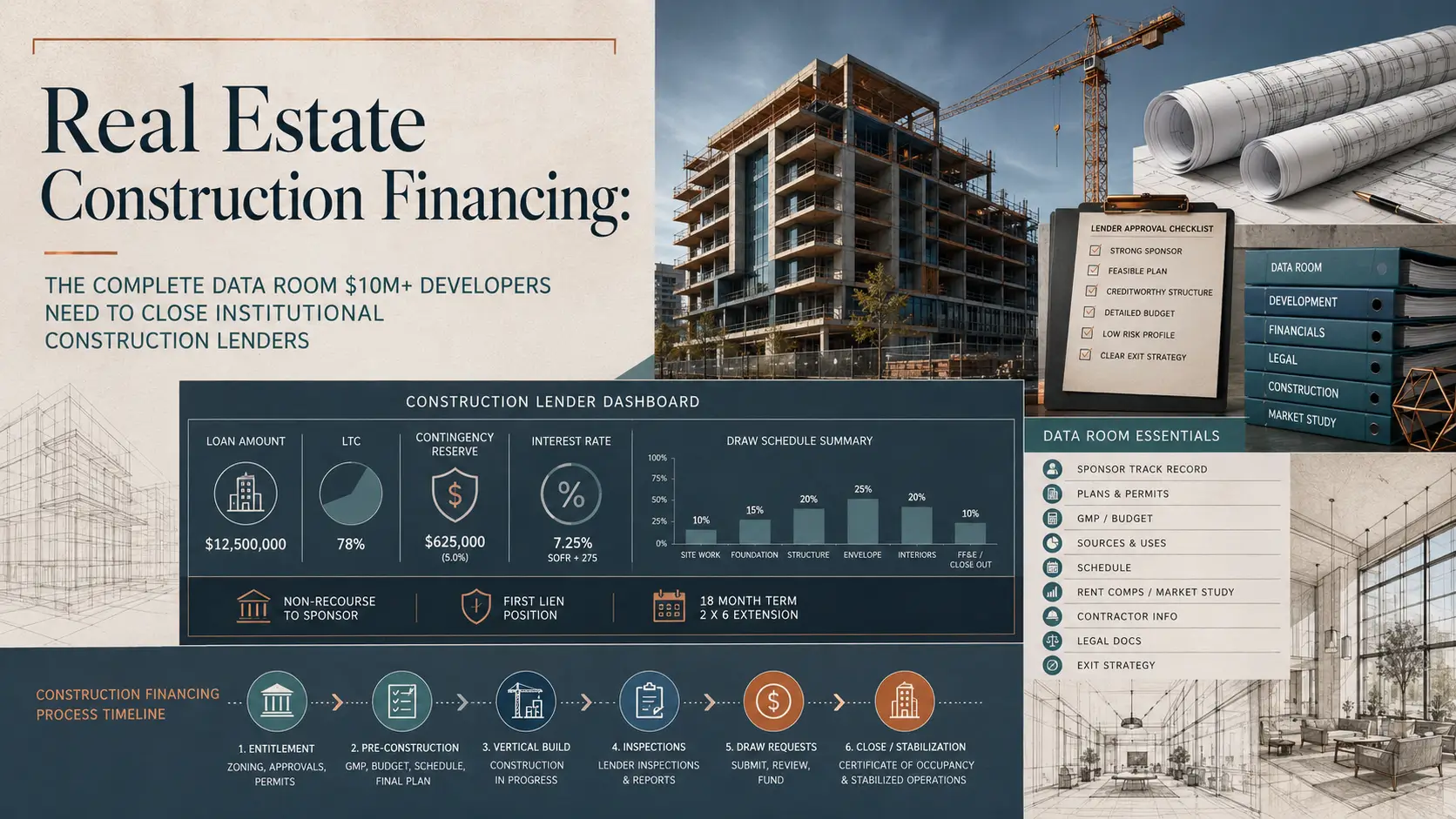
Real Estate Construction Financing: The Complete Data Room $10M+ Developers Need to Close Institutional Construction Lenders
TL;DR: The complete data room $10M+ developers need to close institutional construction lenders - from project economics to sponsor-level materials.
- Project Economics Documentation: What the Lender Is Testing Before They Model the Deal: Before an institutional construction lender opens a financial model, they are asking one question: is this business plan believable?
- Third-Party and Legal Diligence: What the Lender Is Verifying Before They Commit: Project economics tell the lender whether the deal makes sense.
- Construction Execution Evidence: What the Lender Is Stress-Testing Before They Fund: Institutional construction lenders have one risk that keeps credit committees up at night: the project starts and does not finish.
Institutional construction lenders in 2025 and 2026 are not collecting documents. They are running a credibility test. The Federal Reserve's Senior Loan Officer Opinion Survey has shown sustained tightening in construction and land development lending standards, and the OCC's updated Commercial Real Estate Lending handbook makes clear that lenders are expected to evaluate project feasibility, repayment capacity, and sponsor financial condition as part of prudent credit discipline. That shift has real consequences for how a $10M+ ground-up development sponsor should approach the data room.
A scattered or reactive package does not just slow the process. It signals to the lender that the sponsor has not fully stress-tested the deal. Follow-up requests turn into resubmission loops. Resubmission loops create room for repricing, reduced proceeds, added recourse conditions, and late-stage term changes. The developers who move fastest through institutional underwriting are not the ones with the most files. They are the ones whose files answer the lender's questions before the questions are asked.
Three things a complete construction financing data room accomplishes before the first lender meeting:
- It proves the project is feasible under current market conditions, not just sponsor assumptions
- It demonstrates that execution risk is controlled, not just anticipated
- It shows the sponsor has the financial depth to carry the deal through stress without lender intervention
Project Economics Documentation: What the Lender Is Testing Before They Model the Deal
Before an institutional construction lender opens a financial model, they are asking one question: is this business plan believable? Project economics documentation exists to answer that question with evidence, not narrative. Sponsors who treat the pro forma as a pitch tool rather than a credit document tend to build optimistic models that collapse under lender scrutiny. Sponsors who build conservative, well-sourced models move through credit review faster because the underwriter can stress-test the deal without rebuilding it from scratch.
For ground-up development, the project economics package typically includes four core items. Each one answers a specific underwriting question.
A few things lenders check immediately. The pro forma exit cap rate needs a decompression buffer, typically 25 to 75 basis points above current market, to show the sponsor is not underwriting to a best-case exit. The construction budget needs a hard-cost contingency of 5 to 10 percent. Sources and uses must reconcile to the penny, with every funding source identified, sequenced, and tied to a committed position or a clear close timeline.
The capital stack matters as much as the model. In the current environment, conventional multifamily construction deals are typically seeing senior LTC ratios in the 65 to 75 percent range. Industrial and logistics deals often run tighter, closer to 60 to 70 percent LTC. Sponsors who show up with a budget that only works at 80 percent LTC, with no preferred equity or mezzanine bridge identified, are not presenting a capital stack. They are presenting a funding gap. That gap does not get closed during underwriting. It gets priced into the loan structure or used to justify reduced proceeds.
Understanding how institutional lenders evaluate the full capital stack is foundational to structuring a submission that survives credit review. Sponsors building their first institutional package should also review the broader institutional capital stack structuring framework before assembling this section of the data room.
Third-Party and Legal Diligence: What the Lender Is Verifying Before They Commit
Project economics tell the lender whether the deal makes sense. Third-party and legal diligence tells the lender whether the deal can actually be executed as presented. These are not the same question, and lenders evaluate them separately. A compelling pro forma attached to a site with unresolved entitlement issues or a title with undisclosed easements will not survive credit committee.
What each item in the legal and third-party package is answering:
- Title report and ALTA survey: Can the lender actually lend against this site? Are there boundary disputes, access restrictions, undisclosed liens, or easement conflicts that would subordinate the lender's position or complicate a foreclosure?
- Phase I Environmental Site Assessment: Does the site carry contamination, recognized environmental conditions, or remediation liability that could impair value or delay construction? A Phase I is the baseline. A Phase II is triggered when the Phase I identifies conditions requiring further investigation, such as prior industrial use, underground storage tanks, or soil anomalies. Sponsors who wait for the lender to order environmental reports add four to six weeks to the timeline with no upside.
- Plans, permits, and entitlement documentation: Has the project cleared the approvals required to build what the pro forma assumes? Lenders need to see that the design is consistent with the entitlement, that building permits are in hand or on a defined path, and that zoning allows the use, density, and height presented in the model.
- Market study and demand evidence: Is the absorption schedule, lease-up timeline, or exit assumption grounded in current submarket data? Lenders do not accept sponsor-prepared rent comparables as a substitute for a third-party market study on deals of this size.
The OCC's guidance on commercial real estate lending is explicit: lenders are expected to evaluate project feasibility based on realistic assumptions, not sponsor projections. Third-party reports exist to create a credible, independent foundation for those assumptions. Sponsors who deliver current, complete third-party reports at submission remove the lender's primary justification for ordering their own.
Construction Execution Evidence: What the Lender Is Stress-Testing Before They Fund
Institutional construction lenders have one risk that keeps credit committees up at night: the project starts and does not finish. Execution evidence is the part of the data room that addresses completion risk directly. It is not enough to show that the project pencils. The lender needs to see that the build team has the capacity, accountability, and financial structure to deliver the project even when conditions change.
Five documents carry the execution narrative. Each one reduces a specific lender risk.
- GC contract and GMP structure. A guaranteed maximum price contract shifts cost overrun risk from the lender to the contractor. Lenders view a GMP with a well-defined scope, a clear change-order process, and defined contractor accountability as materially different from a cost-plus arrangement. Cost-plus contracts without a hard ceiling trigger additional scrutiny because they leave the lender exposed to budget drift with no contractual backstop.
- Performance and payment bonds. Bonding proves the GC has the financial capacity and bonding company backing to complete the project if the contractor defaults or becomes insolvent. A lender extending $15M or $25M into a ground-up development needs to know that contractor failure does not automatically become a project failure.
- Builder's risk insurance and general liability coverage. These documents show that physical damage, third-party claims, and site incidents are covered during construction. Missing or inadequate coverage is a condition precedent to funding in virtually every institutional construction loan agreement.
- Draw schedule and disbursement logic. The draw schedule in the data room is not the same document used to manage cash flow during construction. In the data room, it is a credit document. It shows the lender how funding will be released, at what project milestones, against what inspections, and in what sequence. A draw schedule that does not match the construction timeline, the budget, or the interest reserve structure creates a reconciliation problem the lender has to solve before funding can begin.
- Subcontractor commitments and key trade agreements. Lenders on larger ground-up deals want to see that critical trades, concrete, steel, MEP, and envelope, are not just intended but contracted or in active negotiation with named firms. Subcontractor depth shows the execution team is real, not assembled on paper.
Sponsors pursuing institutional financing for industrial or logistics development should also review how execution evidence requirements align with asset-class-specific lender standards in the industrial real estate development financing guide.
{{main-cta}}
Sponsor-Level Materials: What the Lender Is Underwriting Beyond the Project
Every construction loan has two credit stories running in parallel. The first is the project. The second is the sponsor. Even a well-underwritten deal with strong project economics can stall or get repriced if the sponsor-level materials raise questions about guaranty capacity, liquidity, or the ability to manage another active development. The OCC's guidance is direct on this point: lenders are expected to evaluate the borrower's financial condition alongside project performance.
Sponsors who are layering preferred equity or mezzanine into the capital stack should also review how preferred equity changes data room requirements and lender positioning before assembling this section. A construction lender and a preferred equity investor are underwriting different risks from the same documents, and the package needs to hold up under both lenses.
Track record attribution deserves particular attention. Lenders are not underwriting the firm's history. They are underwriting the individual or team that will be accountable for this loan. A sponsor who was an associate on a prior development platform and is now presenting that platform's track record as personal experience will face hard questions in credit committee. The attribution needs to be specific: what role, what project, what dollar volume, and what outcome.
How the Four Categories Work Together as a Single Underwriting Narrative
A construction financing data room is not four separate piles of paper. It is one story told four ways. Lenders read it that way. When the four categories are internally consistent, the underwriter can move from feasibility to commitment without a follow-up loop. When they are not, the inconsistency becomes a credit issue regardless of how strong any individual section looks.
The most common narrative breaks that create term erosion or delayed commitment:
The real risk is not that one document is missing. The risk is that two documents tell different stories.
A budget that assumes 18 months to complete paired with a draw schedule that funds out in 14 months creates a reconciliation problem. A pro forma that underwrites a lease-up at current market rents paired with a market study that shows declining absorption in the submarket creates a credibility problem. These disconnects are not fixed by adding more files. They are fixed by building the package around a single execution thesis from the start.
Sponsors who want to understand how this narrative discipline applies to the full institutional capital raise process should review how institutional lenders evaluate ground-up construction submissions.
The Minimum Day-One Data Room Standard Before Outreach Begins
Day-one readiness does not mean the closing checklist is complete. It means the underwriting story is already defensible. Sponsors who contact lenders before the core package is in place invite the lender to set the terms of the conversation, which is rarely in the sponsor's favor.
Before the first serious lender call, the following should be in place and internally consistent:
- Project economics: A current, stress-tested pro forma with a decompression buffer on exit cap rate, a reconciled sources and uses statement, a fully scoped construction budget with 5 to 10 percent hard-cost contingency, and a capital stack that closes without a funding gap
- Third-party and legal diligence: A current Phase I ESA, a preliminary title report, a survey, executed or near-final entitlement documentation, and a third-party market study dated within 12 months
- Construction execution evidence: A signed or substantially negotiated GC contract with GMP pricing, evidence of contractor bonding capacity, a draw schedule aligned with the budget and timeline, and builder's risk insurance in place or binders committed
- Sponsor materials: Two to three years of financial statements, a current liquidity summary, a complete REO schedule, and a track record package with specific project attribution for the individual guarantors
The self-audit question: For each item above, ask whether it changes a lender's credit judgment or just adds detail. If it changes credit judgment, it must be ready before outreach. If it is cosmetic detail, it can follow.
A well-organized folder of incomplete or inconsistent documents does not substitute for a substantive package. The goal is not a clean data room. The goal is a data room that makes the lender's job easier by answering every material underwriting question before it is asked.
A construction data room either clears institutional review or it does not, and a 12-category pass/fail diagnostic tells a developer which before a lender does.
Build the Package Around the Lender's Questions, Not Your File Cabinet
The sponsors who close institutional construction financing fastest are not the ones with the most documents. They are the ones who built the package around the lender's underwriting logic from the start. Every file in a complete data room exists because it answers a specific question the lender will ask before committing capital. When those answers are consistent, current, and internally aligned across all four categories, the underwriting process moves in a straight line instead of in circles.
Speed comes from coherence, not volume. Build the data room as a credit narrative, not a compliance archive, and the terms you negotiate at the start of the process are the terms you close with.
If you are assessing whether your current package meets institutional standards before outreach, IRC Partners works with $10M+ ground-up development sponsors to structure and position data rooms for institutional construction lender review.
Frequently Asked Questions
What is the difference between a construction budget and a construction pro forma in an institutional data room?
The construction budget is a cost document. It itemizes every hard and soft cost required to deliver the project, from site work and structural framing to architectural fees, permits, and financing costs. The pro forma is a revenue and return document. It models rents, absorption, operating expenses, debt service, and exit value over the project's investment horizon. In an institutional data room, they serve different underwriting purposes. The budget tells the lender what it will cost to build. The pro forma tells the lender whether the finished asset can support the loan. Both must be internally consistent with the sources and uses statement and the draw schedule.
How do institutional construction lenders use the sources and uses statement before underwriting begins?
Lenders use the sources and uses statement as the first reconciliation check before they model anything else. It answers three questions immediately: Is every dollar of project cost accounted for? Is every funding source identified and committed, or is there a gap? And does the equity contribution meet the lender's minimum LTC threshold? A sources and uses statement with unidentified funding sources, a gap between total uses and total sources, or equity that relies on a future capital event that has not yet closed will stop underwriting before it begins. Lenders treat funding gaps as credit events, not administrative oversights.
What makes a GC contract acceptable to an institutional construction lender versus one that triggers additional scrutiny?
Institutional lenders strongly prefer a guaranteed maximum price contract because it defines a cost ceiling and assigns overrun responsibility to the contractor rather than the borrower or the lender. A GMP contract with a clearly defined scope of work, a structured change-order process, a completion date tied to the draw schedule, and a contractor with demonstrated bonding capacity is the baseline for most institutional construction submissions. Cost-plus contracts, especially those without a hard ceiling, trigger additional scrutiny because they expose the lender to open-ended cost growth. When a cost-plus arrangement is unavoidable, lenders typically respond by reducing proceeds, adding a contingency holdback, or requiring a completion guaranty with enhanced personal guarantor support.
How does the real estate owned schedule affect a sponsor's credit evaluation for construction financing?
The REO schedule tells the lender how much of the sponsor's capital, attention, and guaranty capacity is already committed elsewhere. A sponsor carrying multiple active construction projects, maturing debt on stabilized assets, or properties with below-market occupancy may face questions about whether they have the bandwidth and liquidity to manage another ground-up development. Lenders look at the REO schedule for concentration risk, contingent liabilities, and any assets that could require capital infusions during the loan term. A clean REO schedule with performing assets, manageable debt service, and no pending maturities supports the sponsor's credit profile. An overloaded or distressed REO schedule can lead to higher recourse requirements or reduced loan proceeds even when the subject project is strong.
What environmental reports are required in a construction financing data room, and when is a Phase II triggered?
A Phase I Environmental Site Assessment is the standard baseline requirement for virtually all institutional construction loans. It identifies recognized environmental conditions based on a review of historical records, regulatory databases, and a site inspection, without any soil or groundwater sampling. A Phase II is triggered when the Phase I identifies conditions that require further investigation, such as evidence of prior industrial use, underground storage tanks, hydraulic lifts, or soil staining. Phase II involves actual sampling and laboratory analysis. Sponsors should not wait for the lender to order environmental reports. Delivering a current Phase I at submission removes one of the most common reasons for a lender-side delay. If a Phase II is likely based on site history, commissioning it before outreach prevents a four to six week hold during underwriting.
How does the draw schedule in the data room differ from the draw schedule used during construction?
The draw schedule submitted in the data room is a credit document, not a project management tool. Its purpose is to show the lender how loan proceeds will be disbursed, in what amounts, tied to what project milestones, and in what sequence relative to the interest reserve and equity contribution. It must reconcile with the construction budget, the sources and uses statement, and the project timeline. The draw schedule used during active construction is a working document that evolves as the project progresses, changes orders accumulate, and subcontractor payment applications are submitted. Submitting a construction-phase draw schedule as a data room document is a common error. Lenders notice the difference because a working draw schedule is not structured around credit controls.
What does track record attribution mean in a construction financing data room, and how is it different from a development resume?
A development resume lists projects associated with a firm or platform. Track record attribution assigns specific roles, responsibilities, and outcomes to the individual guarantors who will sign the loan. Institutional construction lenders are underwriting the people who will be accountable for the debt, not the history of a company they may have left or a fund they participated in as a minority partner. Attribution requires specificity: the project name, the sponsor's role (principal, GP, co-GP, or project manager), the total capitalization, the completion date, and the exit or stabilization outcome. A firm-level resume that cannot be traced to the individuals on the loan documents does not satisfy this requirement and will generate credit committee questions that slow or complicate approval.
Continue reading this series:
- Construction Loan for Real Estate Developers: What Institutional Lenders Require in Your Data Room Before They Fund
- How to Build a Data Room That Closes Institutional Investors in 30 Days Instead of 90
- Real Estate Due Diligence Checklist: The 47 Documents $10M+ Sponsors Must Have Ready
IRC Partners works with operators raising $5M to $250M of institutional capital. The full engagement is for founders at $1M+ ARR who have raised before. The $2,997 Capital Raise Pre-Flight audit is open to earlier-stage companies, including pre-revenue, that are raising $5M+ and have a pitch deck and financial model ready for review. If that's you, schedule a call to discuss HERE.
Need guidance on your capital raise?


Shortlist of Capital Stack Strategy Advisors

What Reporting Cadence and Financial Disclosures Do Family Offices Expect After Investing in a Real Estate Development?

How Investor Consent Rights Turn Your Cap Table Into a Governance Hostage Situation Before Series B
Disclosure
Nothing on this site constitutes an offer to sell, or a solicitation of an offer to purchase, any security under the Securities Act of 1933, as amended, or any applicable state securities laws. Any offering of securities is made only by means of a formal private placement memorandum or other authorized offering documents delivered to qualified investors.
IRC Partners is a capital advisory firm. IRC Partners is not a registered investment adviser under the Investment Advisers Act of 1940 and does not provide investment advice as defined thereunder.
Certain statements in this article may constitute forward-looking statements, including statements regarding market conditions, capital availability, investor demand, and transaction outcomes. Such statements reflect current assumptions and expectations only. Actual results may differ materially due to market conditions, regulatory developments, company-specific factors, and other variables. IRC Partners makes no representation that any outcome, return, or result described herein will be achieved.
References to prior mandates, transaction volume, network credentials, or capital raised are provided for illustrative purposes only and do not constitute a guarantee or prediction of future results. Past performance is not indicative of future outcomes. Individual results will vary. Network credentials and transaction statistics referenced on this site reflect the aggregate experience of IRC Partners' principals and affiliated advisors and are not a representation of assets managed or transactions closed solely by IRC Partners.
Certain data, statistics, and information presented in this article have been obtained from third-party sources. IRC Partners has not independently verified such information and expressly disclaims responsibility for its accuracy, completeness, or timeliness. Readers should independently verify any third-party data before relying on it.
Readers are strongly encouraged to consult qualified legal, financial, and tax professionals before making any investment, capital raising, or business decision.
Schedule A Meeting
You get one shot to raise the right way. If this raise is worth doing, it’s worth doing with precision, leverage, and control.
This isn’t a practice run. Serious capital. Serious strategy. Let’s raise it right.
We onboard a maximum of seven
new strategic partners each quarter, by application only, to maximize your chances of securing the capital you need.
