.svg "CTA Arrow")


.png "Investor Ready Capital decorative background element")
What Is a Private Placement Memorandum for Real Estate: How Developers Use PPMs to Raise Equity from Accredited Investors

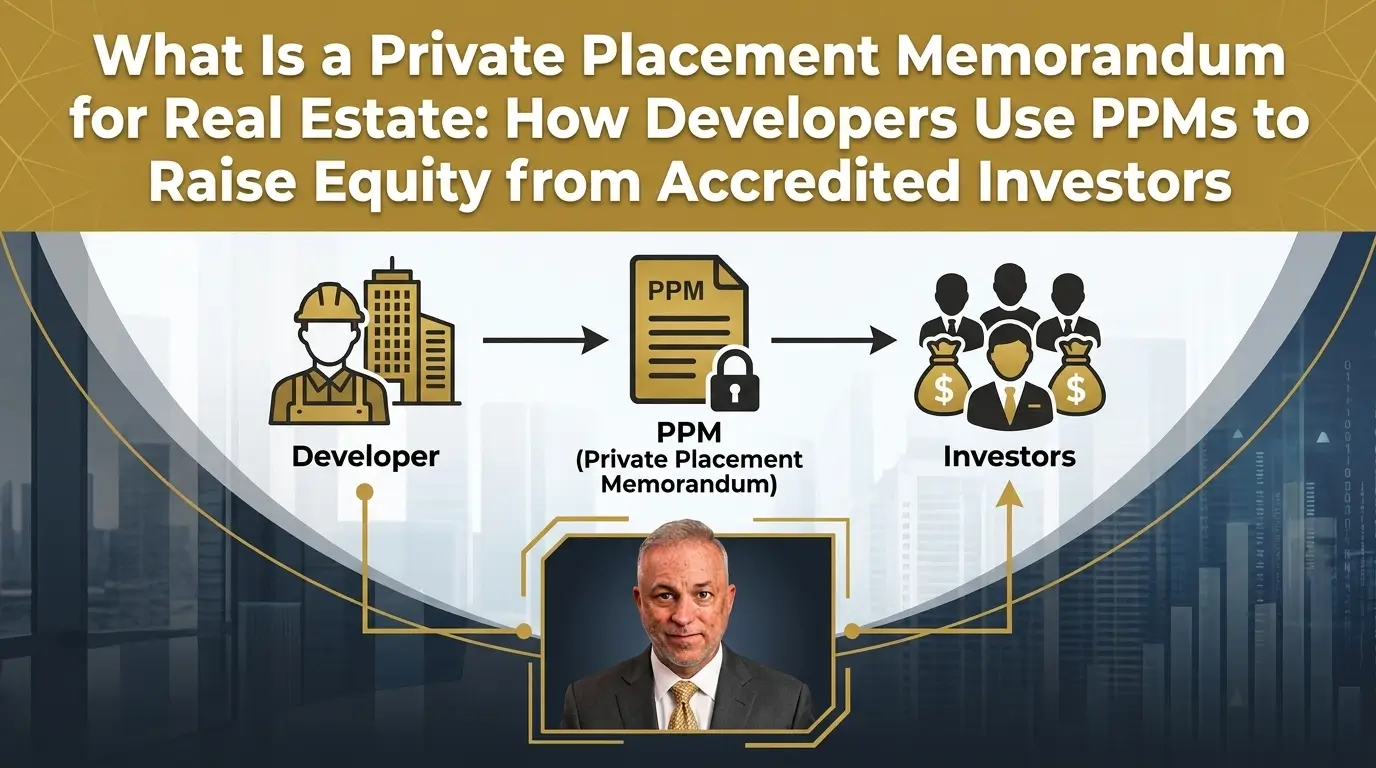
What Is a Private Placement Memorandum for Real Estate: How Developers Use PPMs to Raise Equity from Accredited Investors
A private placement memorandum is not a sales tool. It is the formal disclosure document that frames a private securities offering under Regulation D - and using the wrong document for that job creates compliance gaps, slows LP counsel review, and signals inexperience to institutional capital sources. According to the SEC's investor guidance on private placements, offering documents that are missing, incomplete, or fail to address material risks are a red flag for investors. That guidance applies directly to real estate equity raises conducted under Regulation D, where roughly 32,500 offerings raised approximately $2.1 trillion in 2024 alone. This article covers what the PPM actually does, who reads it, and the five mistakes that stall subscriptions before they close.
A PPM is not a pitch deck with legal language added. It is not a longer version of your investment memorandum. It is the formal disclosure document that frames a private securities offering under Regulation D, defines the terms, risks, conflicts, and investor qualification standards, and gives accredited investors and their counsel a defensible basis to complete their review before subscribing.
The real risk is not that sponsors skip the PPM. It is that they use the wrong document to do the PPM's job.
According to the SEC's investor guidance on private placements, offering documents that are missing, incomplete, or fail to address material risks are a red flag for investors. That guidance applies directly to real estate equity raises conducted under Regulation D, where roughly 32,500 offerings raised approximately $2.1 trillion in 2024 alone.
Before going further, three things to keep in mind:
- A private placement memorandum is a legal disclosure document, not a sales tool. Its job is to define the offering, not to sell it.
- Regulation D provides an exemption from SEC registration. It does not exempt sponsors from antifraud liability or the obligation to disclose material facts.
- The PPM is most relevant when equity is being raised through a private securities exemption. It is not the same as circulating a teaser, a pitch deck, or a preliminary investment summary.
What Is a Private Placement Memorandum in Real Estate?
A private placement memorandum for real estate is the offering document that explains what security is being sold, on what terms, to which qualified investors, and with what disclosed risks. It is the primary legal disclosure document in a Regulation D equity raise, and it serves a function no other document in the offering package is designed to perform.
In practice, the PPM gives accredited investors and their counsel a structured basis to review the economics, governance, conflict disclosures, and downside exposure of the offering before they sign a subscription agreement. It is not designed to persuade. It is designed to inform, disclose, and document that the sponsor fulfilled their disclosure obligations.
For real estate developers raising $10M or more in outside equity, the PPM typically covers:
- Offering summary and terms - the type of security being sold, target raise amount, minimum investment, offering exemption relied upon (Rule 506(b) or 506(c)), and offering period
- Investment strategy and business plan - asset class, geography, deal sourcing approach, hold period, and exit thesis specific to the offering
- Risk factors - tailored disclosures covering market risk, leverage, construction, entitlement, lease-up, liquidity, key person risk, and sponsor conflicts
- Management team and track record - GP biographies, prior deal attribution, and decision-making structure
- Sponsor economics and conflicts - management fees, carried interest, waterfall structure, GP co-invest, and any related-party relationships or competing vehicles
- Use of proceeds - how investor capital will be deployed, in what sequence, and what expenses are charged against the offering
- Investor qualification framework - accredited investor standards, subscription representations, and transfer restrictions
- Regulatory disclosures - Regulation D exemption, Form D filing obligations, blue sky legends, and any applicable ERISA considerations
The PPM is not the pitch deck, and it is not the limited partnership agreement. Each document serves a distinct role. Treating them as interchangeable is one of the most common credibility problems first-time institutional fund sponsors create before a single LP meeting takes place.
Why the PPM Matters in a Regulation D Real Estate Offering
Regulation D, codified under the Securities Act of 1933, creates exemptions from SEC registration that allow real estate developers to raise unlimited capital from accredited investors without going through a public offering process. The two most widely used exemptions for institutional-style real estate raises are Rule 506(b) and Rule 506(c).
What Regulation D does not do is exempt sponsors from antifraud liability. The securities laws' prohibition on material misstatements and omissions applies to every private offering, registered or not. That is the legal foundation for why the PPM matters.
Three legal functions the PPM serves in a Regulation D real estate offering:
- It documents that the sponsor disclosed material facts before subscription. The PPM creates a contemporaneous record of what investors were told about the offering terms, the risks, the use of proceeds, and the sponsor's conflicts of interest. If a dispute arises later, the PPM is the primary evidence of what was disclosed. A thin or generic PPM weakens that defense significantly.
- It satisfies the disclosure standard for non-accredited sophisticated investors in a 506(b) offering. Under Rule 506(b), issuers who include non-accredited sophisticated investors must provide disclosure documents that contain the type of information normally provided in a registered offering. Even when a raise is restricted to accredited investors only, the PPM establishes the same standard of good-faith disclosure.
- It frames the offering's legal structure for investor counsel review. Accredited investors raising $1M or more typically have legal counsel review the offering package before commitment. Counsel looks for consistency between the PPM, the subscription documents, and the LP agreement. A PPM that does not match the other documents creates questions that slow or stop the subscription process.
For real estate specifically, the PPM's risk factor section must address property-level risks that a generic document will not cover: entitlement delays, construction cost overruns, contractor default, lease-up assumptions, financing contingencies, and key-person concentration. Specificity here is not optional. It is the legal standard, and institutional LPs notice when it is missing.
Rule 506(b) vs Rule 506(c): What Changes for the PPM and Investor Qualification Workflow
The choice between Rule 506(b) and Rule 506(c) is one of the first structural decisions a real estate developer must make before drafting the PPM. It is not a minor compliance checkbox. It changes how investors can be solicited, how accredited status must be verified, and how the subscription package should be designed.
What this means in practice for real estate developers:
- Rule 506(b) is used in approximately 90% of Regulation D offerings because verification friction is lower and sponsors with established LP networks can rely on investor representations rather than independent confirmation of accredited status.
- Rule 506(c) is appropriate when a sponsor needs broader marketing reach, such as advertising the offering through a website, social media, or public channels. The tradeoff is a stricter verification workflow that requires documentation beyond a self-certification checkbox.
- The PPM must reflect the chosen exemption. A 506(b) offering that inadvertently includes general solicitation language, or a 506(c) offering that lacks a robust accredited investor verification process, creates compliance exposure that can invalidate the exemption entirely.
- The subscription package design changes between exemptions. Under 506(c), the investor intake process must include steps to independently verify accredited status before accepting a subscription. Under 506(b), a well-drafted investor questionnaire and written representation typically satisfies the reasonable belief standard, per SEC guidance on assessing accredited investors.
For most institutional-style real estate raises targeting family offices, private equity funds, and high-net-worth accredited investors through existing relationships, Rule 506(b) remains the standard path. What changes that calculus is the need to publicly advertise the offering, which triggers the stricter 506(c) verification requirements.
Who Actually Reads the PPM - And What They Are Looking For
The PPM is not a document that sits in a folder. It gets read, and the people reading it are not looking for a compelling narrative. They are looking for omissions, contradictions, and disclosure gaps.
Accredited investors
Accredited investors use the PPM to pressure-test the offering before committing capital. They are specifically looking at:
- Downside exposure - are the risk factors specific to this deal, or are they generic language copied from a template?
- Economics and alignment - does the sponsor's waterfall, promote structure, and fee arrangement make sense given the strategy and risk profile?
- Transfer restrictions - what are the liquidity constraints, and are they consistent with the investment horizon described in the strategy section?
- Governance rights - what can investors actually do if the deal underperforms or the sponsor acts outside the stated mandate?
LP counsel
Attorneys reviewing the PPM on behalf of an investor are running a different process. They are cross-referencing the document against the subscription agreement, the LP agreement, and any side letter positions. Specifically, counsel looks for:
- Internal consistency - do the economics described in the PPM match the LPA? Does the risk factor section address the actual risks of this specific deal?
- Conflict disclosure completeness - are all related-party fees, competing vehicles, and GP-affiliated service providers disclosed?
- Regulatory compliance markers - are the required Regulation D legends present? Is the Form D filing timeline addressed? Are blue sky obligations acknowledged?
Investment committees at institutional sources
For family offices and institutional allocators, the PPM is part of a coordinated review alongside the pitch deck and data room. Understanding how family offices compare to private equity funds as LP sources shapes what the PPM needs to emphasize in its conflict disclosure and governance sections. The short version: institutional-quality review is not looking for hype. It is looking for the gaps a sponsor hoped no one would notice.
What a PPM Does Not Replace: Pitch Deck, Investment Memorandum, Data Room, and Subscription Package
Each document in a real estate offering package has a distinct job. Conflating them is the most common process mistake that creates friction before a subscription closes. The comparison below reflects the roles as they function in an institutional-grade raise. For a deeper breakdown of how these documents interact, see IRC's guide to investment memorandum vs pitch deck vs data room.
The practical implication for real estate developers is this: the PPM must be drafted before any investor is asked to subscribe, not after interest is confirmed. A sponsor who circulates a pitch deck, generates LP interest, and then scrambles to produce the PPM is running the process in reverse. That sequence creates inconsistency between the narrative investors heard and the disclosure document they eventually receive, and it signals to LP counsel that the offering was not properly prepared.
For a full picture of the document stack required at each stage of a $100M institutional raise, including how these documents are sequenced and what LPs evaluate at each phase, see what fund documents you need to raise $100M from institutional investors in real estate.
Common PPM Mistakes That Slow or Derail Subscription Readiness
Most PPM problems are not discovered during drafting. They surface during LP counsel review, and by then they are slow to fix and expensive to ignore. These are the five most common mistakes that create friction before a subscription closes.
1. Using a generic template without deal-specific customization. A PPM that describes a "real estate development strategy" without naming the asset class, geography, leverage assumptions, or specific risk profile of this offering tells counsel the sponsor did not do the work. Generic risk factors, vague use-of-proceeds language, and boilerplate conflict disclosures are not just weak. They create legal exposure if the actual deal diverges from what the template described.
2. Inconsistency between the PPM and the subscription documents or LP agreement. Counsel cross-references every document in the offering package. If the PPM describes a preferred return of 8% and the LP agreement calculates the waterfall differently, that discrepancy becomes a negotiation point or a deal-stopper. Every material term must be consistent across all documents before the offering package goes to investors.
3. Mismatching the PPM to the wrong Regulation D exemption. A 506(b) PPM that includes general solicitation language, or a 506(c) PPM that lacks an accredited investor verification workflow, can invalidate the exemption entirely. Selecting the exemption path early and building the PPM and subscription package to match it is not optional.
4. Missing or delayed Form D filing. The SEC requires a Form D notice filing within 15 days of the first sale of securities in a Regulation D offering. Most states also require separate blue sky notice filings when investors are domiciled in those jurisdictions. Missing these deadlines creates compliance exposure that can surface during LP diligence or at a later capital event.
5. Overstated projections or return assumptions that contradict the risk factors. If the PPM's financial projections assume 20% IRR under a base case but the risk factors acknowledge significant construction cost uncertainty, the inconsistency signals either optimism bias or inadequate disclosure. Both are problems under the antifraud provisions of the securities laws.
{{main-cta}}
How Real Estate Developers Should Use a PPM in Practice
The PPM is a downstream document. It reflects decisions that should already be made. Sponsors who draft the PPM before finalizing their deal terms, GP entity structure, and exemption path produce documents that need to be revised repeatedly during live diligence. The right sequence reduces that friction.
Step 1: Finalize the offering structure and exemption path first. Before engaging securities counsel to draft the PPM, confirm the deal terms, waterfall economics, investor qualification criteria, and whether the raise will proceed under Rule 506(b) or 506(c). These decisions drive every section of the document.
Step 2: Draft the PPM and subscription package in parallel with the LP agreement. The PPM and the LP agreement must be internally consistent. Drafting them sequentially rather than in parallel is one of the most common causes of document mismatches that LP counsel flags during review. Engage qualified securities counsel early, and build in reconciliation time between the two documents before the offering package goes to investors.
Step 3: Align the data room with the PPM's disclosures. The data room should support and corroborate what the PPM discloses. Track record materials should match the management team section. Financial projections in the data room should be consistent with the use-of-proceeds and risk factor language in the PPM. For a detailed list of what needs to be in that room before investors ask, the real estate due diligence checklist covers the 47 documents $10M+ sponsors must have ready. For guidance on building a data room that can withstand institutional diligence, see IRC's resource on real estate due diligence readiness.
Step 4: Distribute the full offering package before asking for subscriptions. The PPM, subscription agreement, and LP agreement should be delivered to investors as a coordinated package. Investors and their counsel need adequate time to review before executing. Rushing this stage creates liability and erodes the institutional credibility the rest of the raise was designed to build.
Legal Clarity Is a Capital-Raising Advantage
Sponsors who treat the PPM as a serious disclosure document look more institutional. They move through counsel review faster. They generate fewer diligence questions. And they avoid the friction that comes from asking the wrong document to do a job it was not designed to do.
The PPM is one piece of an offering package, but it is the piece that legally frames the deal for investor review. Every other document in the stack, the pitch deck, the investment memorandum, the data room, the subscription agreement, either supports it or depends on it.
The next step is not downloading a template. It is making sure the offering terms are locked, the exemption path is chosen, and the PPM, LP agreement, and subscription documents are drafted in coordination before the first investor is asked to subscribe. Sponsors who are still deciding how to frame their capital needs before the offering package is finalized will find a practical starting point in how to present funding needs to family offices.
Frequently Asked Questions
Is a private placement memorandum legally required for a real estate Regulation D offering?
A PPM is not explicitly required by Regulation D for offerings made exclusively to accredited investors. However, the SEC's investor guidance is clear that sponsors who fail to provide adequate information about themselves and the offering create a red flag for investors. More practically, any sponsor raising meaningful equity from accredited investors who have legal counsel will be expected to produce one. The absence of a PPM does not eliminate antifraud liability. It simply leaves the sponsor without a documented record of what was disclosed before subscription.
What is the difference between an accredited investor and a sophisticated investor under Regulation D?
An accredited investor meets specific financial thresholds under SEC Rule 501: individual income exceeding $200,000 in each of the past two years ($300,000 combined with a spouse), or a net worth exceeding $1 million excluding the primary residence. A sophisticated investor is a separate standard used only in Rule 506(b) offerings: an individual who, either alone or with a purchaser representative, has sufficient knowledge and experience in financial and business matters to evaluate the merits and risks of the investment. Sophisticated investors do not need to meet the income or net worth thresholds, but they are subject to a cap of 35 per offering and must receive disclosure documents if they participate.
How does a 506(c) offering change the accredited investor verification process?
Under Rule 506(c), a sponsor cannot rely on an investor's self-certification alone. The issuer must take reasonable steps to actively verify accredited status before accepting a subscription. Acceptable verification methods include reviewing two years of income tax returns or W-2s, obtaining bank or brokerage statements confirming net worth, or receiving written confirmation from a licensed attorney, CPA, or registered broker-dealer. In March 2025, the SEC issued no-action guidance clarifying that minimum investment amounts of at least $200,000 for natural persons may also satisfy the reasonable steps standard under specific conditions. This verification burden is one of the primary reasons roughly 90% of Regulation D issuers still use Rule 506(b).
Can a real estate developer use the same PPM for multiple projects or offerings?
No. A PPM is specific to a single offering. It discloses the terms, risks, use of proceeds, and investor qualification framework for that particular securities transaction. Using a prior PPM for a new offering, even a similar one, without updating the deal-specific disclosures, risk factors, financial assumptions, and sponsor economics creates material misrepresentation risk. Each new Regulation D offering requires its own Form D filing and its own disclosure document tailored to the specific transaction.
What triggers the blue sky filing obligation in a Regulation D real estate offering?
Rule 506 offerings are exempt from state securities registration requirements under federal preemption. However, states retain the authority to require notice filings and collect fees when capital is accepted from investors domiciled in those states. The filing obligation is typically triggered when the first investor from a given state subscribes. Most jurisdictions require notice within 15 days of the first sale, matching the federal Form D deadline. Sponsors who accept capital from investors across multiple states without mapping their blue sky obligations create compliance exposure that can surface during a future LP diligence process or capital event.
How long does it take to draft a PPM for a real estate equity offering?
A properly drafted real estate PPM typically takes 6 to 12 weeks from engagement to final document, assuming the offering terms, GP entity structure, and deal economics are already finalized. If the sponsor is still working through the waterfall structure, resolving conflicts of interest, or finalizing the LP agreement in parallel, that timeline extends. Sponsors who begin PPM drafting before the deal structure is locked typically produce documents that require multiple revision rounds when LP counsel returns comments. The preparation time is the cost of sequencing correctly.
What is the role of the subscription agreement relative to the PPM in a real estate offering?
The subscription agreement is the execution document that closes the individual LP's investment. It captures the investor's capital commitment amount, representations confirming accredited investor status, AML and KYC information, and in many structures, a power of attorney authorizing the GP to execute the LP agreement on the investor's behalf. The PPM precedes the subscription agreement. It is the disclosure document that gives investors the information they need to make an informed decision. The subscription agreement assumes the investor has reviewed the PPM and is now committing capital on the basis of that disclosure. Delivering the subscription agreement without a completed PPM reverses the sequence and creates the legal and credibility problems that sequence is designed to prevent.
Continue reading this series:
- What goes into a private placement memorandum for a real estate closed-end fund
- What fund documents you need to raise $100M from institutional investors in real estate
- SEC filings required to raise a $100M real estate fund
Most founders don't lose the raise because of the pitch. They lose it because the structure was wrong before the first investor call. IRC Partners advises founders raising $5M to $250M of institutional capital. 7 strategic partners per quarter. Start here to schedule a call with our team.
Sponsors weighing this decision should first complete a capital raise readiness assessment for sponsors to confirm the raise is investor-ready.
Need guidance on your capital raise?


Phantom Equity and SARs: How Non-Standard Equity Instruments Create Series B Valuation and Governance Confusion

Best Advisors for Debt Advisory and Venture Debt
What Materials Help Institutional Investors Evaluate a Sponsor's Capital Formation Readiness?
Disclosure
Nothing on this site constitutes an offer to sell, or a solicitation of an offer to purchase, any security under the Securities Act of 1933, as amended, or any applicable state securities laws. Any offering of securities is made only by means of a formal private placement memorandum or other authorized offering documents delivered to qualified investors.
IRC Partners is a capital advisory firm. IRC Partners is not a registered investment adviser under the Investment Advisers Act of 1940 and does not provide investment advice as defined thereunder.
Certain statements in this article may constitute forward-looking statements, including statements regarding market conditions, capital availability, investor demand, and transaction outcomes. Such statements reflect current assumptions and expectations only. Actual results may differ materially due to market conditions, regulatory developments, company-specific factors, and other variables. IRC Partners makes no representation that any outcome, return, or result described herein will be achieved.
References to prior mandates, transaction volume, network credentials, or capital raised are provided for illustrative purposes only and do not constitute a guarantee or prediction of future results. Past performance is not indicative of future outcomes. Individual results will vary. Network credentials and transaction statistics referenced on this site reflect the aggregate experience of IRC Partners' principals and affiliated advisors and are not a representation of assets managed or transactions closed solely by IRC Partners.
Certain data, statistics, and information presented in this article have been obtained from third-party sources. IRC Partners has not independently verified such information and expressly disclaims responsibility for its accuracy, completeness, or timeliness. Readers should independently verify any third-party data before relying on it.
Readers are strongly encouraged to consult qualified legal, financial, and tax professionals before making any investment, capital raising, or business decision.
Schedule A Meeting
You get one shot to raise the right way. If this raise is worth doing, it’s worth doing with precision, leverage, and control.
This isn’t a practice run. Serious capital. Serious strategy. Let’s raise it right.
We onboard a maximum of seven
new strategic partners each quarter, by application only, to maximize your chances of securing the capital you need.
