.svg "CTA Arrow")


.png "Investor Ready Capital decorative background element")

What Fund Documents Do You Need to Raise $100M From Institutional Investors in Real Estate?
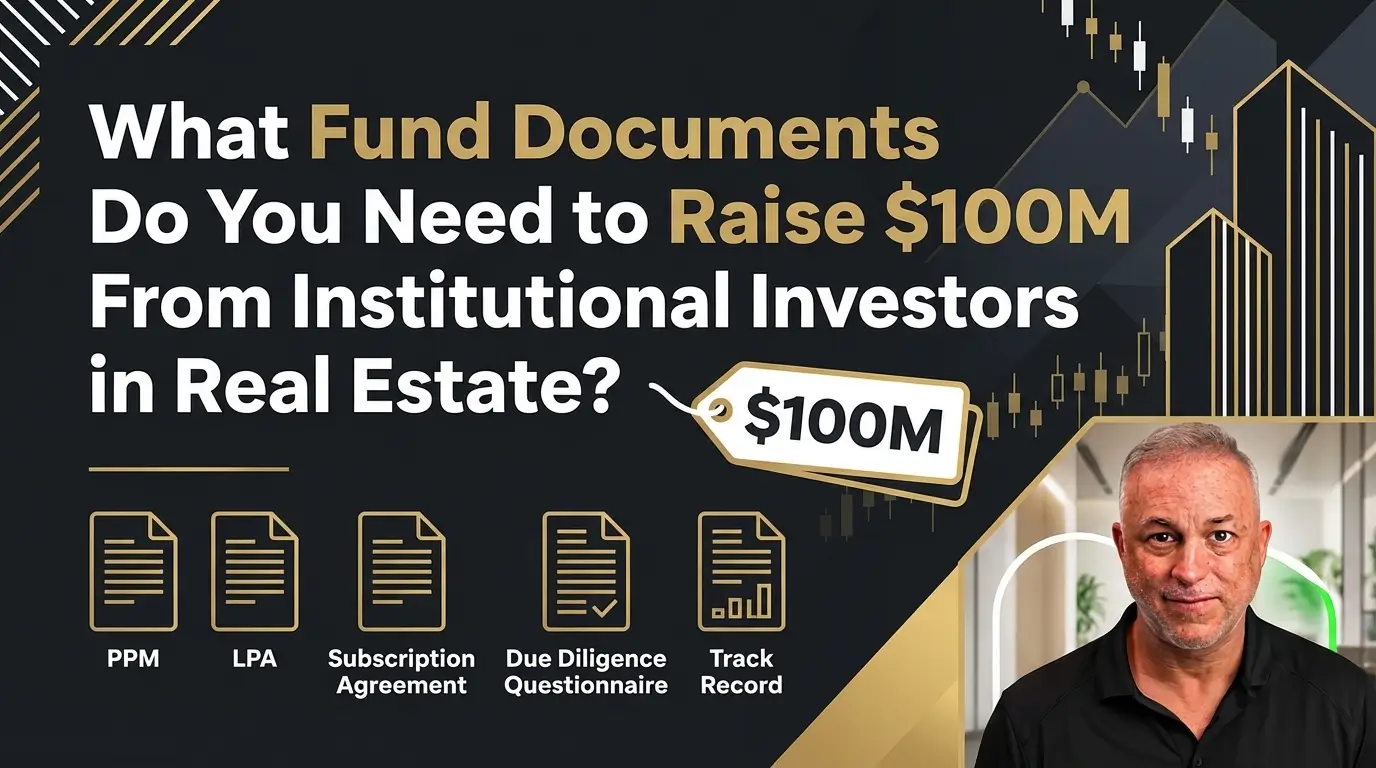
What Fund Documents Do You Need to Raise $100M From Institutional Investors in Real Estate?
To raise $100M from institutional investors in a real estate fund, you need a complete document stack across four stages: pre-marketing materials, legal and diligence documents, closing packages, and post-close reporting. The core set institutional LPs expect includes:
- Fund terms summary (teaser or term sheet, 5-15 pages)
- Pitch deck (investment thesis, strategy, team, track record, target returns)
- Private Placement Memorandum (PPM) (80-200+ pages of legal disclosure)
- Limited Partnership Agreement (LPA) (35-100+ pages governing GP/LP economics and rights)
- Subscription agreement (per-investor commitment, reps, warranties, and onboarding)
- Due Diligence Questionnaire (DDQ) responses (ILPA-standard or custom LP versions)
- Side letter templates (negotiated rights for anchor or institutional LPs)
- Data room materials (track record, team bios, compliance policies, service providers)
- GP and management company entity documents (formation, operating agreements, key-person provisions)
- Regulatory filings (Form D under Regulation D, applicable blue sky notices)
- Post-close reporting templates (quarterly and annual reporting frameworks)
This is not a checklist you complete once and forget. Institutional LPs evaluate documents in sequence, and what they see at each stage shapes whether they take the next meeting, send a DDQ, or pass entirely.
The real credibility test is not whether you have a PPM. It is whether every document in your stack tells the same story.
This article maps the full institutional document stack in the order LPs evaluate it, tied to the specific diligence stage each document serves. It is written for experienced real estate sponsors who have raised deal-by-deal capital before, but now need a fund-grade document structure to compete for $100M in institutional commitments. If you are still building the foundation, start with structuring the capital stack for institutional LP scrutiny before layering in the document requirements covered here.
Why Document Readiness Decides Whether a $100M Raise Gets Taken Seriously
In 2025, the top 10 funds captured 40% of the $172 billion raised in real estate, according to industry fundraising data. That concentration is not just about track record. It is about institutional readiness. When an LP's allocation committee compares a first-time fund manager against an incumbent, documents are the first proxy they use for governance quality.
Roughly 40% of institutional LPs with over $1 billion in private equity allocations maintain formal emerging manager programs, according to Cambridge Associates research. These programs reserve between 5% and 15% of capital for first- and second-time managers. That is the opening. The problem is that 70% of LP commitments in 2024-2025 still went to existing manager relationships. The window is real, but narrow, and first-time managers who arrive without a complete document stack are screened out before the window opens.
Document readiness is not administrative overhead. It is a commercial signal.
Institutional LPs are especially sensitive to four things in real estate fund documents: mandate clarity, fee and expense disclosure, conflict-of-interest treatment, and valuation policy. Gaps in any of these areas generate follow-up questions that slow the process and signal operational immaturity.
The sponsors who close institutional capital fastest are not always those with the best deals. They are the ones whose documents reduce LP uncertainty before the first serious conversation begins. The common mistakes that kill a first institutional raise apply at every capital stage, and real estate fund raises are no exception. As IRC Partners has also documented, sloppy documentation kills deals long before an LP ever reaches the diligence phase.
The Four Document Phases of a $100M Institutional Fundraise
Institutional fundraising does not happen in one document dump. It unfolds across four phases, each with its own document expectations and LP questions. Building the full room takes 2-4 months before active outreach should begin.
Each phase builds on the last. A strong pitch deck earns a DDQ request. A clean DDQ response earns a draft LPA review. A well-structured LPA earns a subscription agreement. And a consistent set of post-close reports earns re-up conversations for the next fund.
The sections below walk through each phase in detail, starting with what you need before the first serious LP conversation and ending with the ongoing obligations that define institutional accountability.
For a deeper breakdown of how this process works in practice, see our video series on institutional fund formation on the IRC Partners YouTube channel.
Phase 1: Documents You Need Before the First Serious LP Conversation
The single most common mistake first-time institutional fund managers make is treating the pitch deck as the fundraising package. It is not. Institutional LPs expect to see a structured set of documents before the first substantive meeting, and what you bring to that meeting signals whether you are ready for a $100M raise or still operating at the deal-by-deal level.
What "Ready for a First Meeting" Actually Means
Institutional LPs do not need your full PPM at the first meeting. They need enough to decide whether a second meeting is worth their time. That means three things must be true before you begin outreach: your fund structure is legally established, your strategy is written down in a form that can be diligenced, and your track record is presented with enough attribution detail that an LP can verify it.
Here is what that looks like in practice:
The GP Entity and Management Company Problem
Many first-time fund managers begin LP conversations before their GP entity is properly formed or before the relationship between the GP and the management company is clearly documented. This creates an immediate credibility problem. Institutional LPs want to know who controls the fund, who earns the management fee, who holds the carried interest, and what happens if a key person leaves. If those answers are not written down, the LP has no basis for underwriting the structure.
The GP entity setup is addressed in detail in our spoke on how to set up a real estate fund GP entity before launching a $100M raise. Getting this right before the first LP conversation is not optional.
Key takeaway: Arriving at a first LP meeting without a fund terms summary, a track record with deal-level attribution, and a legally formed GP entity is the fastest way to be passed over for a manager who did the work first.
Institutional LPs demand narrow, defined mandates with observable sourcing and crisis behavior, according to 2026 LP allocation research. Vague strategy language in a pitch deck tells an LP you have not yet thought through the discipline required to run a fund.
Phase 2: The Legal Core - PPM, LPA, and Subscription Agreement
Once an LP signals real interest, the document stack shifts from marketing to legal. Phase 2 is where most first-time managers lose momentum, not because their deal is weak, but because their legal documents are inconsistent, incomplete, or drafted without the LP's perspective in mind.
The three anchor documents in Phase 2 serve different functions. Confusing them is a sign of inexperience that institutional LPs notice immediately.
The PPM: Disclosure, Not Marketing
The Private Placement Memorandum is the document most GPs underestimate and most institutional LPs read carefully. It is not a marketing document. It is a legal disclosure that describes your fund's strategy, terms, risks, conflicts of interest, and team in enough detail to support investor decision-making and limit GP liability if something goes wrong.
A typical real estate fund PPM covers: investment thesis and strategy, target sectors and geography, deal sourcing and underwriting process, management fees and carried interest structure, GP commitment, fund life and extension provisions, risk factors specific to real estate (including environmental liabilities, leverage risk, and market concentration), conflicts of interest, and tax considerations for different LP types.
The PPM must also align with your chosen Regulation D exemption. The disclosure requirements and solicitation rules differ between Rule 506(b) and Rule 506(c), and your PPM needs to reflect which path you are taking. For a detailed breakdown of what each PPM section should contain, see our spoke on what goes into a private placement memorandum for a real estate closed-end fund.
The LPA: Where Economics and Governance Live
The Limited Partnership Agreement is the contract that governs the relationship between the GP and every LP in the fund. It is where the real economics are defined, including management fee rates, carried interest percentages, hurdle rates, waterfall structures, clawback provisions, and key-person clauses.
Institutional LPs pay close attention to three things in the LPA: whether management fee offsets are clearly defined, whether expense allocation has specific caps, and whether key-person provisions are strong enough to protect LP interests if the GP team changes. Weak language in any of these areas will generate redlines and delay the close.
The Institutional Limited Partners Association publishes model documents and DDQ standards that reflect what institutional LPs expect. Aligning your LPA with ILPA principles is not required, but it signals that you understand the institutional standard.
The Subscription Agreement: Onboarding and Commitment
The subscription agreement is what each LP signs to formally commit capital to the fund. It captures the investor's capital commitment amount, representations and warranties confirming suitability and accredited status, investor questionnaire responses for AML/KYC compliance, and in many funds, a power of attorney allowing the GP to execute the LPA on the LP's behalf.
The most important rule across all three documents: they must be internally consistent. If your pitch deck states a $200M target fund size and your PPM says $250M, institutional LPs will find the discrepancy. If your LPA describes a different waterfall structure than your fund terms summary, the LP's legal counsel will flag it. Institutional allocators cross-reference documents as a matter of standard process, and inconsistencies signal that the GP is not ready to manage a fund at institutional scale.
Phase 2 Extensions: DDQ, Side Letters, Data Room, and Operational Diligence Materials
The PPM, LPA, and subscription agreement are the legal core. But institutional LPs also underwrite the manager's operational infrastructure, and that requires a second layer of diligence materials that many first-time fund managers are not prepared to deliver.
Key takeaway: Operational due diligence now carries equal weight to investment due diligence. A fund with a clean PPM and a weak data room will still lose the allocation.
The Due Diligence Questionnaire (DDQ)
The DDQ is a structured questionnaire that institutional LPs use to underwrite a manager's investment process, team, governance, compliance, and operational controls. The Institutional Limited Partners Association publishes a standardized DDQ framework that 87% of institutional PE and real estate fund managers now reference. Aligning your responses to ILPA DDQ 2.0 standards signals that you are operating at the institutional level.
First-time managers often underestimate how detailed DDQ responses need to be. LPs ask about sourcing methodology, underwriting process, portfolio construction discipline, valuation policy, and how the team has handled prior losses. Prepare these responses before live diligence begins, not during it.
Side Letters
Side letters are negotiated agreements between the GP and a specific LP that modify or supplement the standard LPA terms for that investor. They are not a sign that the LPA failed. They are a normal part of institutional fundraising, especially for anchor LPs, pension funds, and endowments that have specific governance, reporting, or fee requirements.
Common side letter provisions include MFN (most favored nation) clauses, enhanced reporting rights, co-investment rights, fee discounts for early or large commitments, and ERISA compliance language for pension fund investors. For a full breakdown of when institutional LPs require side letters, see our spoke on what a side letter is in a real estate fund LPA and when institutional LPs require one.
{{main-cta}}
Data Room Materials
The data room is where institutional diligence actually happens. A complete data room for a $100M real estate fund includes:
- Team materials - full biographies, organizational chart, key-person CV verification
- Track record - deal-level attribution with sourcing, underwriting, and exit details
- Investment materials - PPM, LPA, subscription agreement, side letter templates, fund terms summary
- Compliance and governance - compliance manual, conflicts policy, valuation policy and procedures
- Operational materials - cybersecurity policy, business continuity plan, insurance documentation (D&O, E&O, cyber)
- Service providers - fund administrator, auditor, legal counsel, prime broker or lender relationships
- Financial materials - fund expense budget, GP commitment structure, financial projections
Building this room reactively, document by document, as each LP requests something, is one of the fastest ways to lose momentum in a live raise. As IRC Partners has noted in its guidance on what institutional investors actually expect from a data room, institutional investors expect immaculate data rooms with 24-hour access. Sloppy organization signals a manager who is not ready to run an institutional platform.
For a detailed guide on how to structure and organize this room, see our spoke on how to organize a data room for a first-time real estate fund manager raising $100M.
Phase 3 and Phase 4: Closing Documents, Filings, and Reporting Obligations
Once soft circles are in place and LPs have completed diligence, the focus shifts to execution. Phase 3 is where commitments become legally binding and regulatory requirements kick in. Phase 4 begins the moment capital closes and never really ends.
Phase 3: From Soft Circle to First Close
The closing process for a $100M institutional real estate fund follows a defined sequence:
- Subscription agreement execution - each LP signs their individual subscription package, confirming capital commitment amount and investor representations
- AML/KYC collection - institutional LPs submit their own compliance documentation, including entity formation documents, ownership structures, and source of funds verification. For a full breakdown of what LPs submit, see our spoke on what KYC and AML documents institutional LPs need to submit when investing in a real estate fund
- Form D filing - under Regulation D of the Securities Act, the fund must file a Form D notice with the SEC within 15 days of the first sale of securities. This is a notice filing, not an approval, but missing the deadline creates compliance exposure
- Blue sky notices - most states require notice filings when a fund accepts capital from investors domiciled in that state. Requirements vary by jurisdiction and LP type, so counsel should map this early
- Capital call notices - the formal mechanism for drawing committed capital from LPs once the first close is documented and the fund begins deploying
The first close is not the finish line. It is the start of institutional accountability.
Phase 4: Post-Close Reporting and Governance
Institutional LPs underwrite what happens after the close just as carefully as they underwrite the fund documents. The reporting and governance framework you put in place after first close determines whether LPs re-up for your next fund.
Post-close obligations include quarterly reports with portfolio updates and financial performance data, annual audited financial statements, fund administrator reports, governance notices for material events, and capital account statements. For a detailed breakdown of what institutional LPs expect in quarterly and annual reporting, see our spokes on quarterly reporting requirements for institutional LPs and how to write an annual report for a real estate closed-end fund.
Key takeaway: Sponsors who treat post-close reporting as an afterthought lose the institutional relationship they spent 18 months building. The document stack does not end at first close.
Common Document Mistakes That Make Institutional LPs Walk Away
Industry research points to an 85% rejection rate for first-time institutional fund managers, and a significant portion of those rejections happen before investment merit is even evaluated. The document stack is where credibility is built or lost.
These are the most common document failures that end a $100M raise before it starts:
- Inconsistent numbers across documents. If the deck says one fund size, the PPM says another, and the LPA defines a different fee structure, institutional LPs will find it. Every discrepancy triggers a question, and too many questions signal a manager who is not ready.
- Generic strategy language. Saying "we focus on value-add multifamily in high-growth markets" is not a mandate. Institutional LPs want observable sourcing criteria, defined geography, specific deal size parameters, and a clear thesis for why this manager wins in this market.
- Weak fee and expense disclosure. Vague expense allocation language, missing management fee offset provisions, and unclear carried interest calculations are among the most common LP redline triggers. Securities attorneys consistently flag this as the area where first-time managers give away the most leverage.
- Missing or soft key-person provisions. If the fund's value is tied to one or two individuals and the LPA does not protect LPs if those people leave, institutional allocators will require it as a condition of commitment.
- No conflicts of interest disclosure. If the GP manages other vehicles, owns assets that could compete with the fund, or has related-party relationships, these must be disclosed in the PPM. Omitting them is a legal and credibility problem.
- Building the stack reactively. Assembling documents during live diligence means every LP gets a slightly different version of the story. Inconsistency at that stage signals the manager is not ready to run an institutional platform.
- Confusing the fund fact sheet with the full diligence package. A one-page teaser is a door-opener, not a fundraising document. Institutional LPs who ask for more and receive only a polished deck will not proceed.
What Institutional-Ready Documentation Looks Like in Practice
The difference between a well-documented fund and a poorly documented one is not always visible from the outside. It becomes visible the moment an institutional LP starts asking questions.
Case snapshot: IRC Partners served as capital advisor on a multifamily development raise in Texas with $150M in total capitalization. The sponsor had a strong track record at the deal level but had never structured a fund-grade document stack. Before outreach began, IRC worked with the sponsor to align the fund terms summary, structure the GP and management company entities, and build a data room that could withstand institutional diligence from day one. The raise moved through LP meetings with fewer friction points because the documents answered questions before they were asked. No inconsistencies between the deck and the PPM. No gaps in the track record attribution. No ambiguity in the fee structure.
That is what institutional readiness looks like in practice. It is not about perfection. It is about preparation. The sponsors who reach first close fastest are the ones who treat the document stack as a fundraising tool, not a compliance obligation.
IRC Partners has also advised on mixed-use development capital structures in Florida at $900M in total capitalization. At that scale, the document stack is not just a legal requirement. It is the primary mechanism through which institutional LPs evaluate whether the GP can manage complexity, governance, and investor relationships at the level the raise demands.
What Developers Should Do Before Launching Institutional Outreach
If you are a real estate sponsor who has raised deal-by-deal capital and now wants to target $100M from institutional LPs, the first step is not outreach. It is a document audit.
Work through this sequence before your first LP conversation:
- Confirm your GP and management company entities are legally formed and that the relationship between them is documented. If this is not done, start here.
- Draft a fund terms summary that defines strategy, target size, fee structure, and carry. This is the document that drives every other document.
- Build your track record presentation with deal-level attribution. Every deal should show your role, the sourcing, the underwriting, and the outcome.
- Engage fund counsel to begin drafting the PPM and LPA. This takes time. Do not start the process after LP interest is confirmed.
- Build your data room with all team, compliance, operational, and governance materials before outreach begins.
- Prepare DDQ responses using ILPA standards so you are not assembling them under diligence pressure.
- Map your regulatory requirements - Form D timing, blue sky state notices, and any ERISA considerations if you plan to accept pension fund capital.
The window for emerging managers is real but narrow. Roughly 40% of large institutional LPs maintain programs for first- and second-time managers. But those programs are competitive, and they favor managers who show up ready.
If you are targeting $10M or more in institutional capital and need help structuring the document stack, aligning your capital economics, and coordinating introductions to institutional allocators, IRC Partners works with a selective group of real estate developers each quarter. The next step in this series covers how real estate developers hire help to launch their first institutional fund, including what a capital advisor does, what it costs, and when to bring one in.
IRC Partners accepts a limited number of new advisory engagements each quarter by application. If you are a real estate developer targeting a $10M+ raise and want to discuss whether your document stack is ready for institutional capital, reach out through investorreadycapital.com.
Frequently Asked Questions
What fund documents are required to raise 100M dollars?
Raising 100M dollars requires an 11 piece core stack. This includes the Fund Terms Summary, Pitch Deck, Private Placement Memorandum (PPM), and Limited Partnership Agreement (LPA). You also need a Subscription Agreement, Due Diligence Questionnaire (DDQ) responses, side letter templates, and a fully organized data room. Missing any of these creates a significant credibility gap during the initial gatekeeping phase.
How long does it take to build a full document stack?
Expect a timeline of 2 to 4 months for preparation. This ensures the disclosure documents and legal contracts are internally consistent and vetted by fund counsel before outreach begins. Attempting to build these documents in the middle of a raise often leads to inconsistencies that kill momentum during active diligence.
What is the difference between a PPM and an LPA?
The Private Placement Memorandum is a disclosure document detailing risks, strategy, and conflicts of interest. The Limited Partnership Agreement is the actual binding contract governing economics and rights. Partners cross reference these to ensure the promises made in the disclosure match the legal mechanics of the contract.
Do first time managers need a DDQ before raising capital?
Yes. Most institutional allocators use the ILPA DDQ 2.0 standards as a baseline for their review. Having these responses ready in advance proves operational maturity. Approximately 87 percent of successful emerging managers use pre filled frameworks to handle the rapid fire requests common in institutional due diligence.
When does a fund need to file Form D with the SEC?
A Form D must be filed within 15 days of the first sale or capital commitment under Regulation D. While it is a notice filing rather than an approval, failing to file creates compliance risks and can trigger state level blue sky issues. This filing is a public record of the capital raise.
What are side letters and do institutional partners require them?
Side letters are supplemental agreements that modify the LPA for a specific investor. Anchor partners and large pensions almost always require them to address fee discounts or enhanced reporting. They also use them to secure Most Favored Nation clauses or to meet specific regulatory requirements like ERISA.
What reporting do institutional partners expect after a fund closes?
Expectations include Quarterly Reports within 45 to 60 days of quarter end and Annual Audited Financials within 90 to 120 days of year end. Most institutional partners now mandate reports that follow the ILPA reporting template to ensure transparency in fees, expenses, and asset performance.
Continue reading this series:
- How do real estate developers hire help to launch their first institutional fund?
- What does a capital advisor charge to help structure and raise a $100M real estate fund?
- How do you set up a real estate fund GP entity before launching a $100M raise?
This isn't for pre-revenue companies or first-time founders. It's for operators at $1M+ ARR, raising $5M to $250M of institutional capital, who've done this before and want the next round architected right. If that's you, schedule a call to discuss HERE.
Need guidance on your capital raise?



What are the Biggest Red Flags in a Series B SaaS Customer Cohort Analysis?
What Is Capital Raising Outcomes and Advisor Success Rates?

Common Mistakes Companies Make in Capital Raising From Sovereign Wealth and Pension Funds
Disclosure
Nothing on this site constitutes an offer to sell, or a solicitation of an offer to purchase, any security under the Securities Act of 1933, as amended, or any applicable state securities laws. Any offering of securities is made only by means of a formal private placement memorandum or other authorized offering documents delivered to qualified investors.
IRC Partners is a capital advisory firm. IRC Partners is not a registered investment adviser under the Investment Advisers Act of 1940 and does not provide investment advice as defined thereunder.
Certain statements in this article may constitute forward-looking statements, including statements regarding market conditions, capital availability, investor demand, and transaction outcomes. Such statements reflect current assumptions and expectations only. Actual results may differ materially due to market conditions, regulatory developments, company-specific factors, and other variables. IRC Partners makes no representation that any outcome, return, or result described herein will be achieved.
References to prior mandates, transaction volume, network credentials, or capital raised are provided for illustrative purposes only and do not constitute a guarantee or prediction of future results. Past performance is not indicative of future outcomes. Individual results will vary. Network credentials and transaction statistics referenced on this site reflect the aggregate experience of IRC Partners' principals and affiliated advisors and are not a representation of assets managed or transactions closed solely by IRC Partners.
Certain data, statistics, and information presented in this article have been obtained from third-party sources. IRC Partners has not independently verified such information and expressly disclaims responsibility for its accuracy, completeness, or timeliness. Readers should independently verify any third-party data before relying on it.
Readers are strongly encouraged to consult qualified legal, financial, and tax professionals before making any investment, capital raising, or business decision.
Schedule A Meeting
You get one shot to raise the right way. If this raise is worth doing, it’s worth doing with precision, leverage, and control.
This isn’t a practice run. Serious capital. Serious strategy. Let’s raise it right.
We onboard a maximum of seven
new strategic partners each quarter, by application only, to maximize your chances of securing the capital you need.
