.svg "CTA Arrow")


.png "Investor Ready Capital decorative background element")
Real Estate Financing Options: The 7 Institutional Capital Sources $10M+ Sponsors Should Know Before Building a Data Room

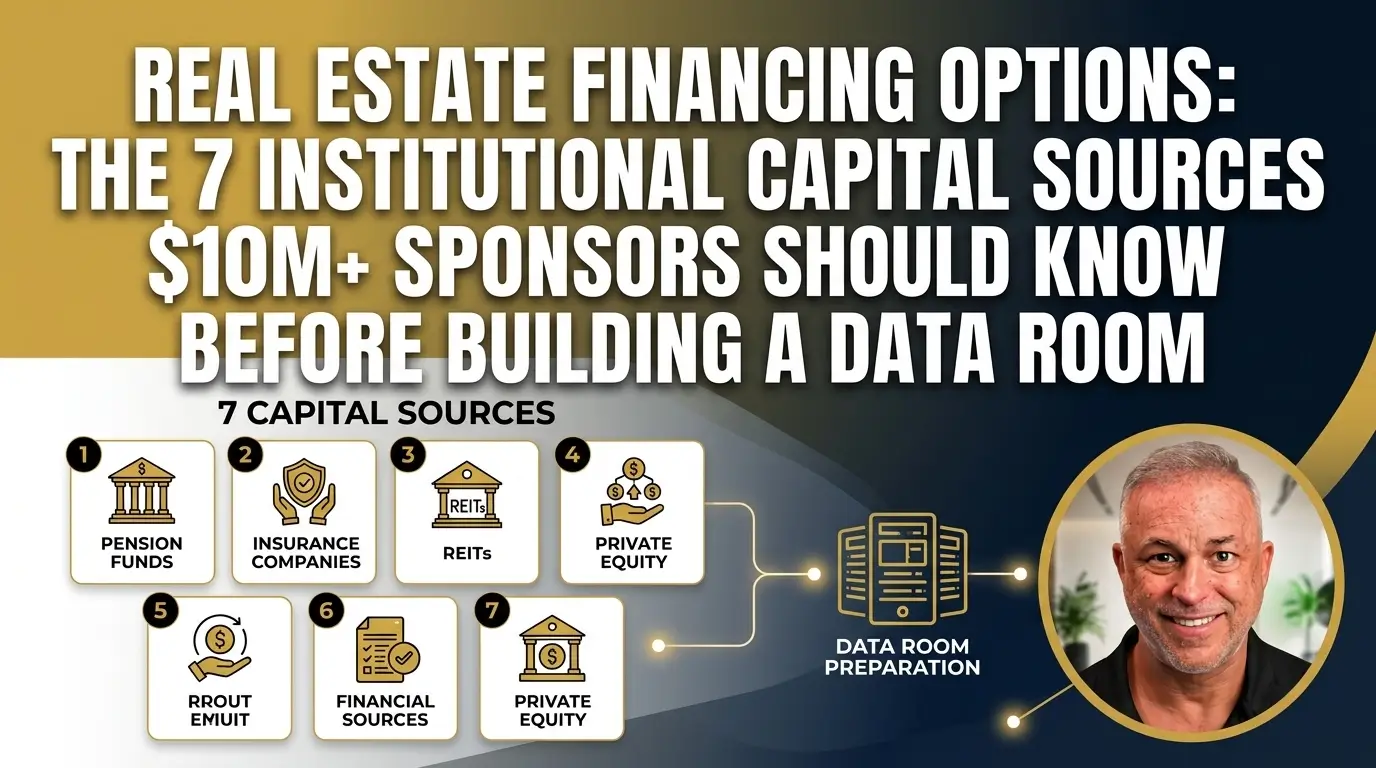
Real Estate Financing Options: The 7 Institutional Capital Sources $10M+ Sponsors Should Know Before Building a Data Room
Most sponsors preparing for an institutional capital raise start the same way. They open a folder, start collecting documents, and build a data room based on what feels complete. Then they send it out and wait. The silence that follows is not always about the deal. It is often about the audience—and securing the right institutional capital for real estate sponsors requires preparing for how that audience actually operates.
Every institutional capital source underwrites risk differently. A senior construction lender is not reading the same room as a life company lender. A debt fund is not asking the same questions as an LP. According to the NAIOP Research Foundation's U.S. Capital Markets Report, H2 2025, liquidity has improved across property types, but underwriting remains disciplined and selective. Capital is available. Getting it requires knowing who you are asking.
The three things this article will help you do:
- Understand how each of the seven institutional capital sources underwrites your deal differently
- Know what each source needs to see in a data room before it takes you seriously
- Sequence your capital stack correctly before outreach begins, so you are not building a polished package for the wrong audience
The Fast Map: The 7 Institutional Capital Sources at a Glance
These seven sources cover the full institutional capital stack available to $10M+ sponsors. They are not substitutes for each other. Each occupies a specific position, prices risk differently, and has a different tolerance for construction exposure, sponsor experience, and deal complexity.
This table is the map. The rest of this article explains what sits behind each row: how each source thinks, what it rejects, and what your data room needs to say before you make the call.
Why the Market Changed: Capital Is Available, but Not on One Set of Terms
The 2025-2026 institutional lending environment is not a credit crisis. It is a selectivity crisis. According to the Deloitte 2026 Commercial Real Estate Outlook, private credit accounted for 24% of U.S. CRE lending volume in 2025, up from a 10-year average of 14%. That shift matters because it means more capital sources are active, but each one is underwriting with a narrower mandate.
Here is what changed by lender type:
The practical implication: Deloitte notes that more than 50% of respondents face property loan maturities within the next year, with approximately $1.7 trillion in commercial mortgages at risk. Lenders are not pulling back. They are filtering harder. Source-fit is now a prerequisite, not a nice-to-have.
How Each Capital Source Underwrites Your Deal
This is where most sponsors lose deals before outreach starts. Each source below has a specific underwriting lens. Knowing it before you build the room changes what you put in and how you frame it.
1. Senior construction debt (55–65% LTC)
Construction lenders underwrite execution risk above all else. They want to see a guaranteed maximum price (GMP) contract, a fully permitted project, a detailed construction budget with contingency, and a sponsor track record that proves you have delivered comparable projects. They also model the stabilized DSCR at loan maturity to confirm the exit is financeable. The disqualifier here is almost always sponsor-side: weak completion history, unresolved permitting, or a budget that has no cushion.
2. Permanent or bridge debt (60–75% LTV)
These lenders underwrite in-place cash flow. They want trailing 12-month financials, a current rent roll, an MAI appraisal, and a market study that supports your rent and occupancy assumptions. Bridge lenders add a business plan for the transition period. The disqualifier is unstable NOI: a rent roll with near-term lease rollover risk, a DSCR that only works at optimistic rents, or an exit assumption that depends on cap rate compression that is not supported by the market study.
3. Debt funds (65–80% LTV/LTC)
Debt funds are solving for certainty, speed, and structural complexity tolerance. They will move faster than a bank and take on more transitional risk, but they price it. Sponsors evaluating whether a debt fund or a bank is the right first call should understand how the debt vs. equity decision affects GP economics at exit before locking in a structure. According to CREFC's 2026 market commentary, institutional lenders are scaling up for larger deals, and debt funds are increasingly active in the $10M–$300M range. The disqualifier is an unclear business plan or a sponsor who cannot articulate the refinance or exit path with specificity.
4. Insurance company lenders (55–65% LTV)
Life company lenders are the most conservative source in this list. They target long-term stabilized assets with strong DSCR, low vacancy, and durable lease profiles. They are not a fit for construction, transitional assets, or deals with near-term lease rollover. They require full financial documentation, an MAI appraisal, a Phase I environmental report, and often a 10-year lease profile. The disqualifier is any material business plan risk: a repositioning story, a single-tenant concentration, or a market with softening fundamentals.
5. Mezzanine financing (70–85% combined LTV)
Mezzanine lenders sit behind the senior loan and underwrite the intercreditor agreement, the collateral package, the sponsor's personal net worth, and the exit strategy. They need to know the senior lender will permit the mezzanine layer and what cure rights they will have if the deal goes sideways. For a deeper breakdown of mezzanine lender types and what each requires, see on the 5 types of mezz lenders and what each requires in a data room. Sponsors newer to mezzanine should also review how mezzanine financing bridges the gap between senior debt and equity before approaching lenders. The disqualifier is a senior loan that restricts subordinate financing or a refinance assumption that cannot survive a 12-month delay.
6. Preferred equity (75–90% combined)
Preferred equity providers are underwriting governance and control, not just collateral. They focus on removal rights, the conditions that trigger them, the waterfall structure, and whether the sponsor's promote is set up in a way that protects the preferred investor's downside. For a full breakdown of how preferred equity is structured and what the data room must include, see on preferred equity in real estate. The disqualifier is a promote structure or operating agreement that limits the preferred investor's ability to act if the deal underperforms.
7. LP equity (equity position, GP/LP split)
LP equity is the most demanding source in the stack. Institutional LPs are underwriting the sponsor's full track record, the business plan's credibility under stress, the alignment of economics, and the quality of the entire data room. According to PwC's Emerging Trends in Real Estate 2026, capital is being deployed selectively, and sponsors need to demonstrate durable demand positioning and institutional-grade preparation. The disqualifier is a thin track record, unclear GP co-invest, or a downside case that has not been modeled honestly.
What Each Source Needs in the Data Room
The data room you build is only as strong as your understanding of who is going to read it. Each capital source screens a different set of documents first. Sending a complete room to the wrong audience does not help. Sending the right documents to the right source does.
The IRC Partners real estate due diligence checklist covers the full 47-document framework across all seven tracks. This table maps which documents each capital source prioritizes in the first screen:
For LP equity outreach especially, a partial or unorganized room is a disqualifier on its own. Institutional equity providers interpret a weak data room as a signal about how the sponsor operates, not just how prepared they are for this raise.
How to Sequence the Stack Before Outreach
Most sponsors think about capital sources in isolation. The smarter approach is to think about them as a stack, because each layer constrains the next one. Sequencing correctly before outreach means you are not negotiating the senior loan and then discovering the mezzanine layer is not permitted.
The right question is not "who will give me the most proceeds." It is "which stack survives if lease-up, exit, or refinance takes six to twelve months longer than planned." Understanding capital stack risk reduction strategies before outreach begins is what separates sponsors who get term sheets from sponsors who get silence.
Step 1: Start with the senior slot. The senior lender sets the leverage ceiling, the recourse structure, the intercreditor constraints, and the list of what it will and will not permit below it. Every other layer in the stack is shaped by what the senior lender agrees to.
Step 2: Test the mezzanine or preferred equity layer before approaching those sources. Ask the senior lender early whether subordinate financing is permitted and under what terms. Approaching a mezzanine lender without that answer wastes time on both sides.
Step 3: Build the LP equity conversation after the debt framework is credible. Institutional equity does not want to be the first call. It wants to see a financeable debt stack before it evaluates the equity position. A deal with no senior commitment or term sheet is a harder LP conversation.
Step 4: Align the data room to the sequenced stack, not to a generic checklist. Once you know which sources you are targeting and in what order, build the room to match each source's first-screen priorities. The full checklist matters, but the sequencing of what you lead with matters more.
Where Sponsors Get Disqualified Before the First Serious Conversation
The biggest hidden disqualifier is not weak documents. It is presenting the wrong documents to the wrong audience. A sponsor can look polished and still look unfinanceable if the stack logic is backwards or the room was built for a different capital source.
- Construction lenders pass when sponsor completions, permits, or budget controls are missing or thin
- Life companies and permanent lenders pass when cash flow is not durable enough for their long-duration mandate
- Debt funds pass when the business plan is vague and the exit path is not modeled with specificity
- Mezzanine providers pass when the senior lender has not confirmed the layer is permitted
- Preferred equity and LP investors pass when governance terms, alignment, and the downside case are unclear or absent
As PwC's Emerging Trends in Real Estate 2026 notes, the current environment requires granular underwriting focused on durable demand. Sponsors who cannot demonstrate that fit for each specific source will not get to the underwriting conversation.
Build the Room for the Capital Source, Not for Yourself
A data room is not a neutral folder. It is an underwriting package built for a specific reader with a specific mandate. Sponsors who map the capital stack first, understand how each source prices risk, and align the room to that audience get better first conversations, stronger term-sheet odds, and fewer months of silence.
This article is the capital source map. The IRC Partners real estate due diligence checklist is the document preparation companion. Used together, they answer both questions a sponsor needs to answer before outreach: who am I building this for, and do I have what they need to see?
IRC Partners works with developers raising $10M to $250M+ across institutional capital structures. With access to a network of family offices managing over $17 billion in assets that actively request deal referrals, the advantage is not just introductions. It is knowing how to align structure, audience, and diligence before the first call is made.
Before your next outreach cycle, answer these questions:
- Have you identified which of the seven capital sources your deal is actually suited for?
- Does your current data room match what that source looks at in the first screen?
- Is your capital stack sequenced in an order that each layer can actually support?
If the answer to any of these is unclear, the room is not ready yet.
{{main-cta}}
Frequently Asked Questions
What is the difference between a debt fund and an insurance company lender for real estate?
Debt funds are private credit vehicles that prioritize speed, structural flexibility, and complexity tolerance. They typically lend at 65–80% LTV or LTC and price transitional or value-add risk into their rate and fee structure. Insurance company lenders, by contrast, target long-term stabilized assets at 55–65% LTV, require durable lease profiles and strong DSCR, and are not a fit for construction or repositioning deals. The two sources serve different stages of the asset lifecycle and require different data room packages.
How does senior construction debt underwriting differ from permanent loan underwriting?
Senior construction lenders underwrite execution risk: the GMP contract, permits, budget contingency, sponsor completion history, and the stabilized DSCR at loan maturity. Permanent lenders underwrite in-place cash flow: the trailing 12-month financials, the rent roll, the appraisal, and the market study. A construction loan is approved based on what the asset will become. A permanent loan is approved based on what the asset is already producing. The documents, the modeling, and the sponsor story are different for each.
Why do institutional LP equity investors require a more complete data room than senior lenders?
LP equity investors are underwriting the sponsor, the business plan, the downside scenario, and the full structure of the deal, not just the collateral. Senior lenders have a lien and a clear recovery path if the deal defaults. LP equity does not. That asymmetry means institutional equity providers need to believe in the sponsor's track record, the alignment of economics, and the credibility of the downside case before they commit. A partial or disorganized data room signals operational weakness, not just preparation gaps.
Can a sponsor approach mezzanine lenders before securing a senior loan commitment?
Technically yes, but practically it creates problems. Mezzanine lenders need to know the senior lender's terms, including whether subordinate financing is permitted, what the intercreditor agreement will look like, and what cure rights the mezzanine lender will have in a default. Without a senior loan term sheet or commitment, a mezzanine lender cannot fully underwrite the deal. Most will engage in early conversations but will not move to a term sheet until the senior position is clear.
What does a preferred equity investor look at that a mezzanine lender does not?
Preferred equity providers focus on governance and control rights rather than collateral. They examine the operating agreement, the conditions that trigger removal rights, the waterfall structure, and the sponsor's promote relative to the preferred investor's return threshold. A mezzanine lender holds a pledge of ownership interests and pursues UCC foreclosure in a default. A preferred equity investor holds an equity position and relies on contractual removal rights. The governance documents and waterfall model are the core of the preferred equity data room in a way they are not for mezzanine.
How do commercial real estate financing rates affect which capital source a sponsor should approach first?
Rate environment shapes which capital sources are viable for a given deal. When rates are elevated and DSCR is compressed, life company and permanent lenders may not pencil at the proceeds level a sponsor needs, making debt funds or bridge lenders a more practical first call. Higher rates also affect mezzanine and preferred equity pricing, which can push combined leverage costs above what the business plan can support. Sponsors should model the full capital stack cost at current rates before deciding which source to approach, not after.
What is the minimum sponsor track record that institutional capital sources typically require?
Requirements vary by source. Senior construction lenders generally want to see at least two to three completed projects of comparable type, size, and complexity. Insurance company lenders and institutional LP equity providers often require a longer track record with stabilized exits or assets under management. Debt funds tend to be more flexible on track record if the business plan is clear and the sponsor can demonstrate strong asset management capability. Preferred equity and mezzanine providers focus less on project count and more on net worth, liquidity, and the sponsor's ability to support the deal if it runs over budget or timeline.
Continue reading this series:
- Real Estate Due Diligence Checklist: The 47 Documents $10M+ Sponsors Must Have Ready
- Capital Stack Risk Reduction Strategies: 5 Ways Developers Can Lower Risk Before a $10M Raise
- Preferred Equity Real Estate: When Sponsors Use It, What It Costs, and What the Data Room Must Include
The wrong structure doesn't just cost you this round. It costs you the next three. IRC Partners advises founders raising $5M to $250M of institutional capital. If you're about to go to market and want the structure reviewed before investors see it, book a call here.
Sponsors weighing this decision should first complete a capital raise readiness assessment for sponsors to confirm the raise is investor-ready.
Need guidance on your capital raise?



Valuation Cap and Discount, What Each One Costs the Founder
RE Sponsor Mode: What Institutional LPs Audit Before the First Call
How to Build a Data Room that Closes Institutional Investors in 30 Days Instead of 90
Disclosure
Nothing on this site constitutes an offer to sell, or a solicitation of an offer to purchase, any security under the Securities Act of 1933, as amended, or any applicable state securities laws. Any offering of securities is made only by means of a formal private placement memorandum or other authorized offering documents delivered to qualified investors.
IRC Partners is a capital advisory firm. IRC Partners is not a registered investment adviser under the Investment Advisers Act of 1940 and does not provide investment advice as defined thereunder.
Certain statements in this article may constitute forward-looking statements, including statements regarding market conditions, capital availability, investor demand, and transaction outcomes. Such statements reflect current assumptions and expectations only. Actual results may differ materially due to market conditions, regulatory developments, company-specific factors, and other variables. IRC Partners makes no representation that any outcome, return, or result described herein will be achieved.
References to prior mandates, transaction volume, network credentials, or capital raised are provided for illustrative purposes only and do not constitute a guarantee or prediction of future results. Past performance is not indicative of future outcomes. Individual results will vary. Network credentials and transaction statistics referenced on this site reflect the aggregate experience of IRC Partners' principals and affiliated advisors and are not a representation of assets managed or transactions closed solely by IRC Partners.
Certain data, statistics, and information presented in this article have been obtained from third-party sources. IRC Partners has not independently verified such information and expressly disclaims responsibility for its accuracy, completeness, or timeliness. Readers should independently verify any third-party data before relying on it.
Readers are strongly encouraged to consult qualified legal, financial, and tax professionals before making any investment, capital raising, or business decision.
Schedule A Meeting
You get one shot to raise the right way. If this raise is worth doing, it’s worth doing with precision, leverage, and control.
This isn’t a practice run. Serious capital. Serious strategy. Let’s raise it right.
We onboard a maximum of seven
new strategic partners each quarter, by application only, to maximize your chances of securing the capital you need.
