.svg "CTA Arrow")


.png "Investor Ready Capital decorative background element")
Mezzanine Financing Funds: The 5 Types of Mezz Lenders and What Each Requires in a Data Room

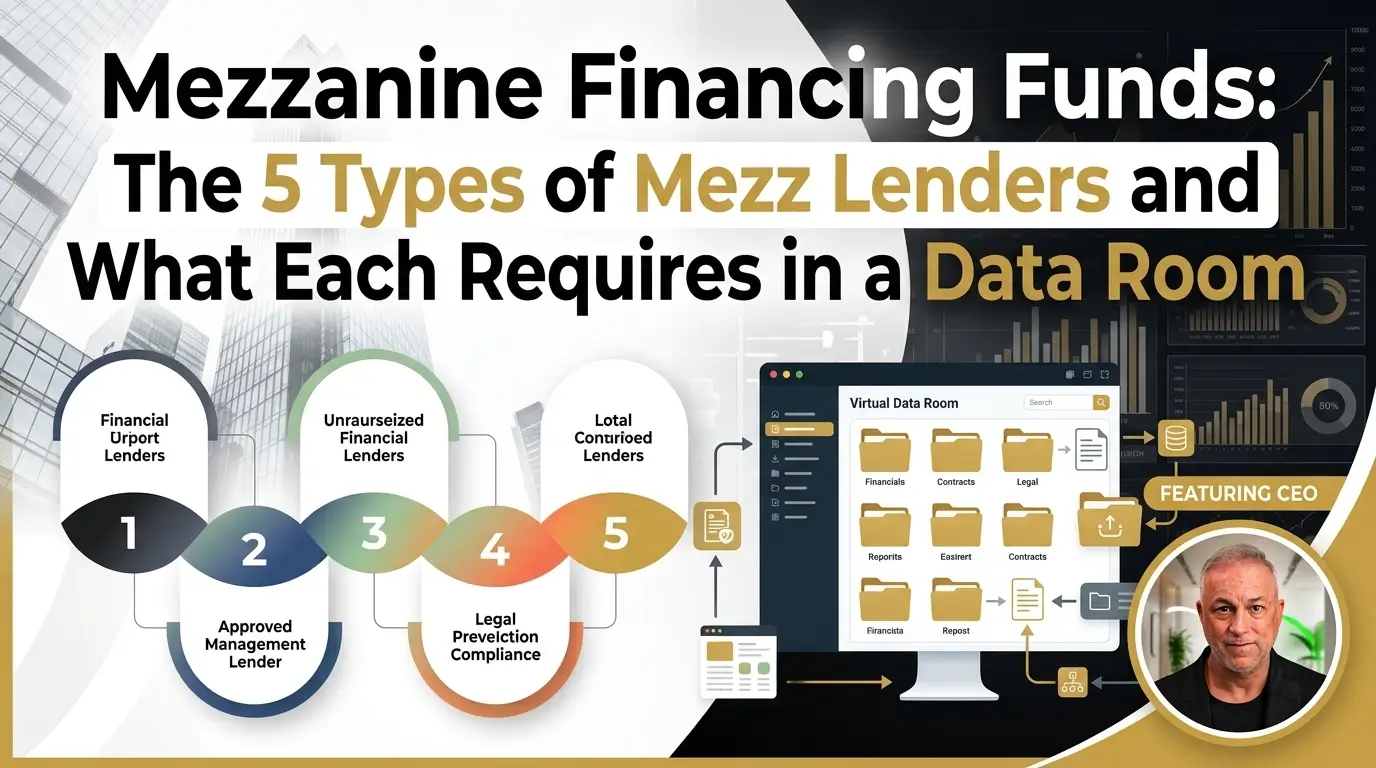
Mezzanine Financing Funds: The 5 Types of Mezz Lenders and What Each Requires in a Data Room
Rate is the wrong filter for a mezzanine outreach list. The five categories of mezz capital active in 2026 have fundamentally different mandates, credit cultures, asset preferences, and stress behaviors. A sponsor who ranks lenders from cheapest to most expensive and starts at the top is not running a process. They are spending 4 to 6 weeks in conversations that were never going to close - and signaling inexperience to the very lenders they are trying to impress. Lender type selection is the first underwriting decision, and getting it wrong costs more than a bad rate.
Lender type selection is the first underwriting decision. The five categories of mezz capital active in 2026 have fundamentally different mandates, credit cultures, asset preferences, and stress behaviors. A sponsor who approaches a conservative life company program with a heavy-transition industrial play is not just unlikely to get a term sheet. They are spending 4-6 weeks in a process that was never going to close.
Why the 2026 market raises the stakes:
- Roughly $875 billion of commercial mortgages mature in 2026, according to the Mortgage Bankers Association, creating real competition for the best mezz capital.
- Alternative lenders now account for 24% of US CRE lending volume, more than double the 10-year average of 14%, per Deloitte's 2026 CRE Outlook.
- Lenders remain selective. Debt yield, cash flow quality, sponsor track record, and capex credibility are the filters. A mismatched outreach package does not survive the first credit committee review.
Sponsors who align with the right institutional capital for real estate sponsors before starting outreach move faster, negotiate tighter terms, and enter the relationship from a position of credibility.
The 5 Types of Mezzanine Lenders Active in 2026
Each of the five mezz lender categories operates under a different mandate. Understanding those mandates before you build your outreach list is what separates a focused process from a scattered one.
What Distinguishes Each Type
Debt funds are structured to deploy capital into deals with complexity or transition risk. They typically underwrite to exit value rather than in-place cash flow, which makes them suitable for ground-up, heavy value-add, or lease-up scenarios.
Life company programs are the most conservative category. They prefer assets with proven income, long lease terms, and low capex exposure. They move slowly but their cost of capital can be among the most competitive when the deal fits.
Bank mezz desks are often tied to existing senior lending relationships. They are policy-constrained, which limits flexibility, but they can offer attractive pricing when the relationship context is right.
Private credit platforms have become the dominant force in middle-market CRE mezz, per the CREFC 2026 conference takeaways. They move fast, can cover multiple capital stack layers, and tolerate more complexity than traditional lenders.
Family office and HNWI capital has grown substantially. According to ULI and PwC's 2026 Emerging Trends report, private wealth is now a material and growing force in real estate capital allocation. These lenders can be creative, but process consistency and reporting standards vary widely. Sponsors targeting this category should understand how family offices structure their commitments before outreach, including whether they prefer deal-by-deal arrangements or a more programmatic approach, which is covered in detail in how family offices structure deal-by-deal vs. blind pool commitments.
How Each Lender Type Underwrites: Speed, Size, Pricing, Asset Class, and Stress Behavior
The practical differences between lender types show up most clearly in five dimensions: how fast they move, what deal size they target, what they charge, what assets they prefer, and how they behave when a deal runs into trouble.
Pricing ranges are market indicators and vary by asset quality, leverage, sponsor profile, and structure. All-in rates include current pay and any PIK component.
Five Underwriting Signals That Separate Lender Types
- Debt funds underwrite to exit cap rate and stabilized value, not in-place NOI. If your business plan has meaningful upside assumptions, a debt fund will stress-test those assumptions harder than any other lender type.
- Life companies anchor on debt service coverage ratio (DSCR) at entry. If your DSCR on day one is below 1.20x, most life company programs will not engage regardless of projected upside.
- Bank desks evaluate relationship context first. If you do not have an existing senior loan with the bank, the mezz desk conversation is often a longer path than sponsors expect.
- Private credit platforms are the fastest category and the most tolerant of complexity, but they price for both. According to MBA CREF 2026 conference findings, lenders at all levels remain focused on debt yield, capex credibility, and realistic stabilization timelines, even as liquidity improves.
- Family office and HNWI lenders place more weight on sponsor reputation, referral context, and downside protection narrative than on deal metrics alone. A strong sponsor with a weaker deal often fares better here than at an institutional credit committee.
The asset class point deserves emphasis. Multifamily and industrial attract the broadest lender appetite across all five categories. Office, heavy hospitality, and speculative construction narrow the field significantly. Understanding where your asset class sits in the 2026 appetite landscape before you build a lender list is not optional.
{{main-cta}}
What Each Lender Type Requires in a Data Room
Every mezz lender wants the same core package: deal summary, financial model, rent roll or lease schedule, sponsor track record, title and ownership structure, and market analysis. What separates a strong data room from a weak one is knowing which materials each lender type weights most heavily.
The Universal Standard Has Risen
As IRC Partners has noted in capital stack risk reduction guidance, provider behavior under stress can matter more than headline pricing. The same is true for data room quality. A disorganized or incomplete data room does not just slow a process. It signals that the sponsor may not be ready to manage the reporting and compliance expectations that come with institutional mezz capital.
For a complete diligence framework, see the IRC real estate due diligence checklist for $10M+ raises. Sponsors who want a practical guide to organizing the data room itself before lender outreach should also review how to organize a data room for a $100M institutional raise. The lender-specific priorities above sit on top of that baseline, not instead of it.
A Lender-Matching Framework for Sponsors
Before building an outreach list, run your deal through five filters. Each filter eliminates lender types that are unlikely to close your deal and surfaces the ones that are.
1. Timeline. If you need to close mezz in under 60 days, life companies and most bank desks are out. Private credit platforms and debt funds are the realistic options. If you have 90 to 120 days, the full field is available.
2. Deal size. Below $5M mezz, the institutional categories narrow significantly. Family office and HNWI capital is often the most accessible at smaller sizes. Above $25M, debt funds, private credit platforms, and life companies all become viable.
3. Asset class and business plan complexity. Stabilized multifamily with strong DSCR? Life companies and bank desks are worth the slower process. Heavy transition, ground-up, or mixed-use with meaningful lease-up risk? Debt funds and private credit platforms are better aligned.
4. Business plan complexity. The more your returns depend on future value creation rather than in-place income, the more you need a lender that underwrites to exit rather than entry. Debt funds and private credit platforms are built for that. Life companies and bank desks are not.
5. Tolerance for lender control under stress. Some lenders will work constructively through a business plan extension. Others move quickly to enforce. If your deal has any execution risk, understanding each lender's amendment culture before you sign is more valuable than a 50-basis-point rate difference.
For a deeper look at how these layers interact within the full capital stack, see how to structure a capital stack for $10M-$50M real estate deals. If your deal sits at the boundary between mezz and preferred equity, preferred equity real estate: when sponsors use it, what it costs, and what the data room must include covers the instrument-level decision in detail.
Common Mistakes Sponsors Make When Approaching Mezz Lenders
Most outreach errors fall into four patterns. Each one is avoidable.
- Treating all mezz lenders as interchangeable. Sending the same teaser to a life company program and a debt fund in the same week signals that the sponsor has not done basic lender research. Credit committees notice. It weakens positioning before diligence even starts.
- Using a single data room for every lender type. A package optimized for a private credit platform (business plan, capex logic, exit comps) is not the same package a life company wants (T-12, rent roll, lease abstracts, DSCR model). Tailoring is not extra work. It is the difference between a serious process and a slow decline.
- Optimizing for rate and ignoring execution certainty. A lender that is 50 basis points cheaper but takes 14 weeks to close and requires three rounds of committee approval may cost more in total than a faster, slightly more expensive option. Rate is one variable. Certainty of close and timeline are the others.
- Not asking about stress behavior before signing. As the NAIOP 2026 Capital Markets Report notes, the current market is still marked by selective underwriting and rate sensitivity. In that environment, a lender's amendment posture, reserve requirements, and reporting expectations under a business plan extension are as important as initial proceeds.
The sponsors who avoid these mistakes are the ones who show up to first meetings having already done the work to match lender type to deal profile.
Conclusion
The best mezz lender for your deal is not the one with the most appealing headline quote. It is the one whose mandate, timeline, asset appetite, and stress behavior align with what your deal actually requires.
Three things to take from this article:
- Lender type selection is an underwriting decision. Get it wrong and you spend weeks in a process that was never going to close.
- Data room tailoring is not optional. Each lender type has a different credit culture and a different set of materials it weights most heavily.
- Institutional readiness starts before the first call. Sponsors who show up with the right package for the right lender type negotiate from a stronger position from the first conversation.
IRC Partners helps sponsors structure institutional-grade capital stacks and build lender-ready data rooms before outreach begins. For context on how mezzanine fits within the broader capital structure, see senior debt vs. mezzanine vs. preferred equity and structuring the capital stack for $10M+ real estate deals. Once you have identified the right lender type, the next step is outreach sequencing - covered in how to identify, approach, and close mezz lenders in 30 days.
Frequently Asked Questions
Does the type of asset class I'm developing eliminate certain mezz lender types before I even reach out?
Yes, and understanding this before outreach saves significant time. Life company programs and bank mezz desks are largely limited to stabilized or near-stabilized multifamily, industrial, and anchored retail. Ground-up construction, heavy value-add, and speculative development plays narrow the field to debt funds and private credit platforms. Office and hospitality further restrict appetite across all categories in 2026.
How much does lender type affect the total cost of mezz capital beyond the stated interest rate?
Significantly. A life company program at 11% that takes 14 weeks to close and requires three committee rounds can cost more in total deal economics than a private credit platform at 13% that closes in 30 days. Extension fees, rate lock costs, and the time value of a delayed close all factor into true cost of capital. Rate is the starting point, not the full picture.
At what mezz loan size does the institutional lender field start to open up meaningfully?
Most institutional debt funds and private credit platforms engage at $10M and above in mezz proceeds. Life company programs typically require $10M or more as well, and often prefer $20M-plus for dedicated mezz programs. Below $5M, family office and HNWI capital is often the most realistic path. The $5M-$10M range is a gray zone where sponsor track record and relationship context carry more weight than deal metrics alone.
What is the single most important thing a sponsor can do to prepare a data room before approaching a private credit platform?
Organize it before sending it. Private credit platforms move fast and their initial credit screens are rapid. A disorganized data room with missing documents or inconsistent numbers slows the screen and signals execution risk. A clean sources-and-uses, a clear business plan, a credible capex budget, and a sponsor bio with project-level attribution will get a faster, more serious response than a larger but messy package.
How do family offices underwrite mezzanine differently from institutional credit funds in 2026?
Family offices and high-net-worth mezz lenders typically place less weight on formal DSCR thresholds and more weight on sponsor credibility, referral context, and the clarity of the downside protection narrative. They are less likely to have a formal credit committee process and more likely to make decisions based on relationship trust. This can work in a sponsor's favor when the deal metrics are borderline but the sponsor track record is strong.
Should a sponsor approach multiple mezz lender types simultaneously, or sequence outreach by type?
Sequencing by type is generally more effective than a simultaneous blast. Approaching five lender types at once with the same materials signals that the sponsor has not done the work to identify fit. A better approach is to shortlist two or three lender types using the five-filter framework, tailor the data room for each, and run parallel processes within that narrower set. This preserves leverage and avoids the credibility cost of mismatched outreach.
How does a sponsor evaluate a mezz lender's behavior under stress before signing a term sheet?
Ask directly during the term sheet negotiation phase. Specifically, ask how the lender has handled business plan extensions in the past 24 months, what triggers a reserve call versus a formal default notice, and what the amendment process looks like if stabilization takes six months longer than projected. Lenders with strong amendment cultures will answer these questions clearly. Those that deflect or become evasive are telling you something important about how they will behave when the deal is under pressure.
Continue reading this series:
- What Is Mezzanine Financing and How Does It Work in a Real Estate Capital Stack
- 5 Capital Stack Risk Reduction Strategies for $10M+ Raises
- How to Structure a Capital Stack for a $10M-$50M Real Estate Development Deal
This isn't for pre-revenue companies or first-time founders. It's for operators at $1M+ ARR, raising $5M to $250M of institutional capital, who've done this before and want the next round architected right. If that's you, schedule a call to discuss HERE.
Sponsors weighing this decision should first complete a capital raise readiness assessment for sponsors to confirm the raise is investor-ready.
Need guidance on your capital raise?


Negotiate Lighter Reporting for Growth-Stage Sponsors Raising $10M+
How Should a Real Estate Sponsor Organize a Data Room Before Institutional Outreach?

How to Compare Real Estate Capital Advisory Firms for a $50M Raise
Disclosure
Nothing on this site constitutes an offer to sell, or a solicitation of an offer to purchase, any security under the Securities Act of 1933, as amended, or any applicable state securities laws. Any offering of securities is made only by means of a formal private placement memorandum or other authorized offering documents delivered to qualified investors.
IRC Partners is a capital advisory firm. IRC Partners is not a registered investment adviser under the Investment Advisers Act of 1940 and does not provide investment advice as defined thereunder.
Certain statements in this article may constitute forward-looking statements, including statements regarding market conditions, capital availability, investor demand, and transaction outcomes. Such statements reflect current assumptions and expectations only. Actual results may differ materially due to market conditions, regulatory developments, company-specific factors, and other variables. IRC Partners makes no representation that any outcome, return, or result described herein will be achieved.
References to prior mandates, transaction volume, network credentials, or capital raised are provided for illustrative purposes only and do not constitute a guarantee or prediction of future results. Past performance is not indicative of future outcomes. Individual results will vary. Network credentials and transaction statistics referenced on this site reflect the aggregate experience of IRC Partners' principals and affiliated advisors and are not a representation of assets managed or transactions closed solely by IRC Partners.
Certain data, statistics, and information presented in this article have been obtained from third-party sources. IRC Partners has not independently verified such information and expressly disclaims responsibility for its accuracy, completeness, or timeliness. Readers should independently verify any third-party data before relying on it.
Readers are strongly encouraged to consult qualified legal, financial, and tax professionals before making any investment, capital raising, or business decision.
Schedule A Meeting
You get one shot to raise the right way. If this raise is worth doing, it’s worth doing with precision, leverage, and control.
This isn’t a practice run. Serious capital. Serious strategy. Let’s raise it right.
We onboard a maximum of seven
new strategic partners each quarter, by application only, to maximize your chances of securing the capital you need.
