.svg "CTA Arrow")


.png "Investor Ready Capital decorative background element")

Real Estate Cash on Cash Return: Why $10M+ Sponsors Must Present This Metric Alongside IRR to Close Institutional Equity Faster
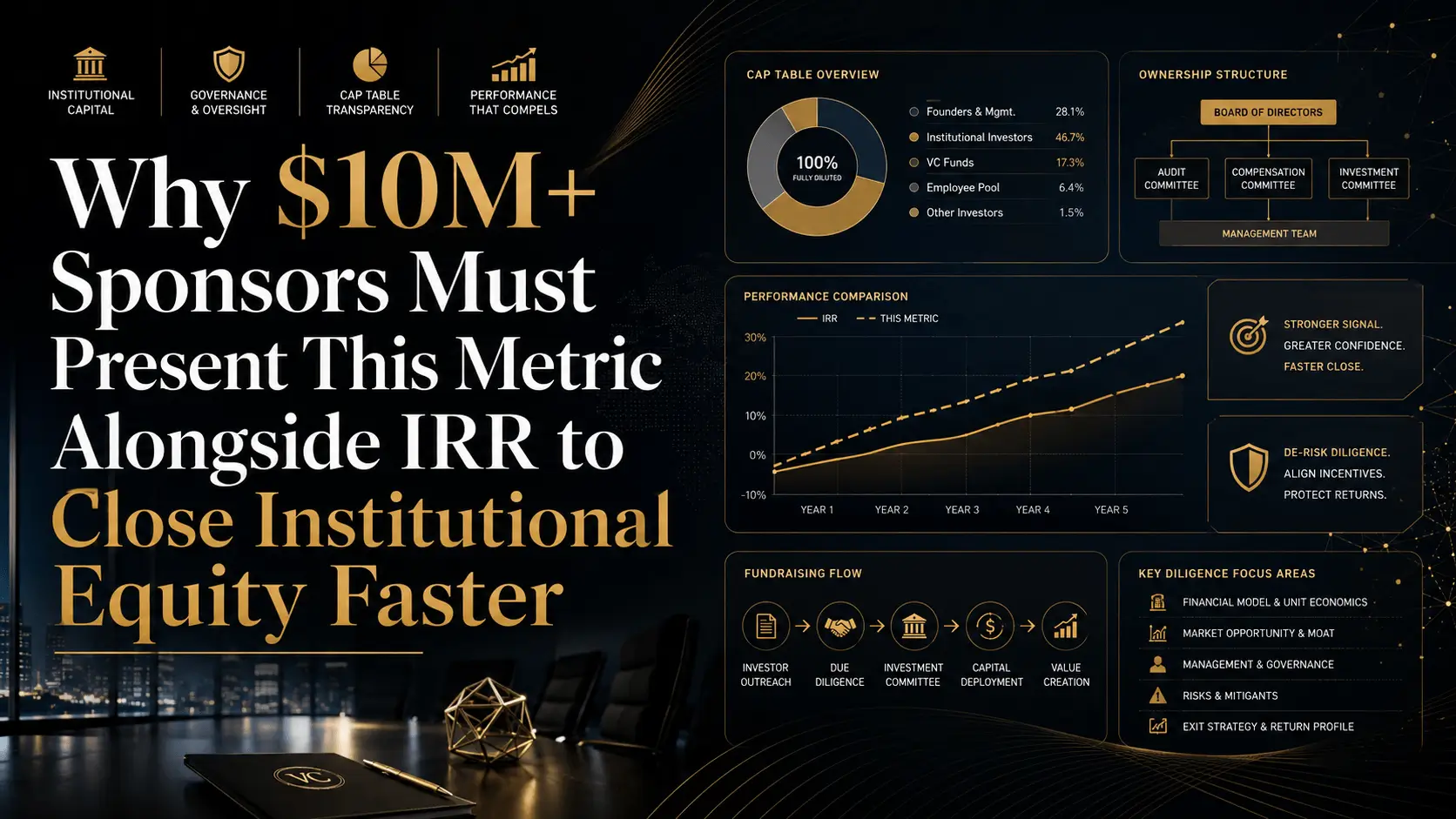
Real Estate Cash on Cash Return: Why $10M+ Sponsors Must Present This Metric Alongside IRR to Close Institutional Equity Faster
While presenting Internal Rate of Return (IRR) as the central return metric remains standard practice when raising institutional real estate equity, relying solely on this time-weighted figure frequently triggers a silent, preventable pass from a vast portion of the allocator landscape. Although an attractive 15% to 17% headline IRR effectively captures full life-of-deal velocity and backend exit appreciation, it fails to outline the year-by-year distributable cash flow required by liability-matching pension funds, insurance companies, and income-focused family offices. In a higher-rate environment where institutional limited partner (LP) due diligence timelines are stretching past twenty months, income-mandate investment committees prioritize predictable current yield and asset-level downside protection before they underwrite total returns. When a sponsor fails to explicitly calculate cash-on-cash metrics using post-debt-service distributable cash flow rather than Net Operating Income (NOI), or neglects to align early-year yield deficits with written preferred return hurdles, the allocation process inevitably grinds to a halt in the data room. To compress avoidable delays and capture active 2026 early-cycle capital, sophisticated operators must cleanly display both metrics on a unified return slide, frame yield ramps explicitly across their specific strategy quadrant, and fully reconcile their financial models before launching external market outreach.
The problem is that IRR alone answers only half the question for a large portion of the institutional LP market.
Pension funds, insurance companies, and income-focused family offices often underwrite current yield before they underwrite total return. When a sponsor cannot explain cash-on-cash return clearly, or does not present it at all, those LPs cannot complete their internal underwriting. The meeting ends. The LP goes quiet. The sponsor assumes the deal was rejected.
Often, the deal was not rejected. The return presentation was incomplete.
Key takeaway: In a higher-rate environment where institutional LP diligence timelines are getting longer, every avoidable gap in your return narrative adds weeks to your raise. Cash-on-cash return is one of the most common gaps, and one of the easiest to close.
This article gives sponsors a clear framework for calculating, contextualizing, and presenting cash-on-cash return alongside IRR in a way that matches how institutional LPs actually underwrite deals.
Cash on Cash Return vs IRR: What Each Metric Measures and What Each Misses
These two metrics are not competitors. They answer different questions, and institutional reviewers use them together for exactly that reason.
What Cash-on-Cash Return Actually Measures
Cash-on-cash return is a simple ratio: annual distributable cash flow to equity divided by total equity invested. It does not care about what happens at exit. It tells the LP what they earn while the deal is in progress.
That makes it the primary lens for any LP whose mandate rewards predictable income. A 15% projected IRR with minimal early cash yield is a different investment than a 15% IRR with a 6% annual distribution. Both can be correct. Only one of them fits an income-mandate LP.
What IRR Misses
IRR is sensitive to timing. A deal that returns most of its value at exit looks excellent on an IRR basis even if it produces little distributable cash for three to five years. For a total-return LP, that is acceptable. For a pension fund managing liability-matching obligations, it may not be.
Sponsors who present only IRR are implicitly asking income-mandate LPs to trust that the back-end return will compensate for the wait. That is a harder ask than showing them the current yield upfront.
How Different LP Mandates Weight Cash Yield vs Total Return
Not every institutional LP underwriting your deal is reading the same return metrics the same way. Mandate drives weighting, and mandate varies significantly across LP types.
Understanding this is not about building separate pitch decks for every allocator. It is about knowing which metric leads the conversation and which one supports it, depending on who is in the room.
LP Mandate Matrix
- Pension funds: Liability-matching obligations require predictable income. Current yield of 4-6% is often a minimum threshold for core and core-plus strategies. A deal that cannot demonstrate income durability from day one will struggle to pass an investment committee review, regardless of projected IRR.
- Insurance companies: Regulatory capital requirements create a strong preference for current income. Insurance allocators often require cash yield that aligns with their actuarial assumptions. A back-weighted return profile creates regulatory friction even when total return is competitive.
- Endowments: Spending-rate requirements (typically 4-5% annually) mean endowments need some current yield, but they can tolerate more back-loading than pension funds or insurers. Total return and risk-adjusted IRR carry more weight in endowment underwriting than in liability-driven mandates.
- Income-focused family offices: According to Hodes Weill's 2025 Institutional Real Estate Allocations Monitor, income-mandate family offices have increasingly shifted toward deal-by-deal structures with explicit current yield requirements. These LPs often screen deals on cash yield before reviewing IRR.
- Total-return family offices and PE-style allocators: These LPs weight IRR more heavily and can accept low or deferred cash yield in value-add and opportunistic strategies, provided the risk-adjusted total return case is well-supported.
The practical implication: A sponsor raising from a mixed LP base needs to be fluent in both metrics and able to explain how they interact. The return narrative should not change by LP type. The framing and emphasis should.
How to Calculate Cash on Cash Return for Institutional Presentation
The formula is straightforward. The execution is where sponsors create confusion.
Cash-on-Cash Return = Annual Pre-Tax Distributable Cash Flow to Equity / Total Equity Invested
The inputs sound simple. In institutional presentation, the details matter significantly.
What Belongs in the Numerator
The numerator should reflect distributable cash flow to equity after all operating expenses and debt service. It should not use net operating income (NOI). NOI does not account for debt service, which means it overstates the cash available to equity investors. Institutional reviewers will catch this immediately and will question whether the sponsor understands the difference.
Include in the numerator:
- Gross rental income and other operating revenue
- Less operating expenses (management fees, taxes, insurance, maintenance, reserves)
- Less debt service (principal and interest on all senior and mezzanine debt)
- The result is distributable cash flow to equity before tax
What Belongs in the Denominator
The denominator should reflect actual cash invested by equity, not total project cost. If the LP is contributing $12M of a $15M equity stack and the sponsor is contributing $3M as co-invest, the denominator for LP-level cash-on-cash should reflect $12M, not $15M. If presenting a blended equity figure, state that explicitly.
Three Presentation Conventions to Define Upfront
- Year-1 cash-on-cash: The return in the first full operating year. Useful for stabilized assets. Can be misleading for value-add deals.
- Stabilized-year cash-on-cash: The return once the asset reaches projected occupancy. More relevant for lease-up scenarios.
- Average hold-period cash-on-cash: The average annual return across the full hold period. Smooths out ramp-up years but can obscure volatility.
State which convention you are using on the slide. An unlabeled cash-on-cash figure is a diligence question waiting to happen.
Sponsors building their financial projections for an institutional LP pitch deck should include all three versions in the data room model, even if only one appears in the deck.
Cash on Cash Return Across the Four Strategy Quadrants
Cash-on-cash return expectations are not uniform across strategies. Institutional LPs calibrate their yield requirements to the risk profile of the strategy. Presenting the wrong yield expectation for your quadrant is a credibility problem.
Why Strategy-Agnostic Yield Claims Lose Credibility
A sponsor raising for a ground-up development deal who projects 6% cash-on-cash in year one is either misstating the business plan or does not understand how distributable cash flow works in a construction phase. Institutional reviewers will flag it.
The inverse is also true. A core asset sponsor who cannot show current yield in the 4-6% range for a stabilized property raises questions about occupancy assumptions or debt sizing.
Sponsors raising across the four strategy quadrants should frame cash-on-cash expectations explicitly in the context of their business plan, not as a standalone number. The PwC/ULI Emerging Trends in Real Estate 2026 report notes that LP interest in income-generating strategies has increased as allocators seek current yield in a higher-rate environment, which makes the core and core-plus yield story more important to get right.
{{main-cta}}
How to Present Both Metrics Together Without Contradicting Your Return Narrative
The goal is one coherent return story. IRR and cash-on-cash return are not competing headlines. They are two parts of the same explanation.
The Dual-Metric Presentation Checklist
- Put both metrics on the same return slide. IRR belongs at the top as the life-of-deal return. Cash-on-cash return belongs directly below it, labeled by year or convention (year-1, stabilized-year, or average hold-period). One sentence connecting the two: "The deal targets a 17% net IRR with a stabilized-year cash-on-cash return of 6.5%, reflecting the value-add lease-up timeline described in the business plan."
- Align cash-on-cash with your waterfall. Most institutional LP agreements include a preferred return of 6-8%. If your projected cash-on-cash return is 4% in year one and the preferred return hurdle is 7%, that gap is not a problem if you explain it. It becomes a problem if the LP discovers it during diligence without context. Sponsors who understand how to structure a capital stack for a $10M-$50M deal know that waterfall mechanics and current yield must tell the same story.
- Show the yield ramp in the data room. A single cash-on-cash figure on a slide is a starting point. The data room model should show year-by-year distributable cash flow to equity so LPs can see how yield evolves across the hold period. This is especially important for value-add and core-plus strategies.
- Address the preferred return interaction directly. If cash-on-cash return in early years falls below the preferred return hurdle, explain whether distributions are accruing, being funded from reserves, or deferred to exit. Leaving that gap unexplained is one of the most common reasons LP diligence stalls. Sponsors who also present asset management fees clearly to institutional LPs close a second common diligence friction point in the same conversation.
- Build a data room that closes institutional LPs faster by making the return model self-explanatory. The deck earns the meeting. The data room closes the capital.
Answer the Yield Question Before It Gets Asked
Cash-on-cash return is not a replacement for IRR. It is the other half of the return conversation that income-mandate LPs need before they can move forward.
Sponsors who present both metrics together, with clear logic connecting them to strategy, hold period, and waterfall mechanics, eliminate a diligence question before it is asked. That is what shortens the path from first meeting to signed commitment.
The LP who goes quiet after your first meeting is not always skeptical about the deal. Sometimes they just needed a current yield number you never gave them.
If your capital stack, return model, or LP presentation needs a structural review before your next raise, IRC Partners works with $10M+ sponsors to close that gap before it costs you momentum.
Frequently Asked Questions
What does cash-on-cash return tell an institutional LP that IRR does not?
Cash-on-cash return tells an LP what they will earn each year while the investment is active. IRR tells them what they will earn in total over the life of the deal, weighted for timing. For income-mandate LPs such as pension funds and insurance companies, the annual yield number is often the first screen. A deal with a strong IRR but no clear current yield may not pass that screen, regardless of total return quality.
Does a 0% cash-on-cash return during a value-add lease-up period automatically disqualify a deal for income-mandate LPs?
Not automatically, but it does narrow the eligible LP pool significantly. Pension funds and insurance companies with strict current yield requirements will typically not invest in a deal with no near-term distributions. Endowments and total-return family offices can accept deferred yield if the risk-adjusted IRR is compelling and the business plan explains the ramp clearly. The key is disclosing the 0% yield upfront and targeting the right LP type, not presenting the deal to income-mandate allocators and hoping they overlook it.
How does the preferred return structure in an LP agreement interact with cash-on-cash return?
Most institutional LP agreements include a preferred return of 6-8% annually. If the deal's projected cash-on-cash return falls below that threshold in early years, the preferred return accrues rather than being paid currently. Sponsors must explain in the deck and data room whether accrued preferred return is paid from operating cash flow, funded from reserves, or settled at exit. Leaving that gap unexplained creates a diligence conflict between the return slide and the operating agreement that stalls capital commitments.
What cash-on-cash return range do institutional LPs typically expect for core and core-plus deals?
Core strategies typically target 4-7% annual cash-on-cash return from stabilized, low-vacancy assets. Core-plus strategies typically target 5-8%, reflecting modest value creation layered onto a stable income base. These ranges reflect the expectation that income is the primary return driver in lower-risk strategies. Sponsors presenting core or core-plus deals with cash-on-cash returns below 4% should be prepared to explain the gap with specific occupancy, debt service, or reserve assumptions, because income-mandate LPs will ask.
Should sponsors include debt service in the cash-on-cash calculation for institutional presentation?
Yes. Distributable cash flow to equity must be calculated after debt service, not before. Using NOI as a proxy for the numerator is a common error that overstates available cash and signals a lack of financial sophistication to institutional reviewers. The correct numerator is gross revenue minus operating expenses minus debt service (principal and interest on all senior and mezzanine debt). The result is the pre-tax cash available for equity distribution, which is what institutional LPs are actually underwriting.
How should a sponsor explain a declining cash-on-cash return in years one and two of a value-add deal without losing LP confidence?
The explanation must be proactive and tied to specific operational milestones. A declining early yield is not a red flag if the sponsor presents a clear timeline showing when lease-up completes, what occupancy rate triggers stabilized distributions, and what the stabilized-year cash-on-cash return looks like. Sponsors who address this in the deck before the LP asks signal that they understand the business plan and have modeled it honestly. Sponsors who let the LP discover the declining yield during data room review without context create avoidable doubt.
What happens when a sponsor's projected cash-on-cash return is inconsistent with the preferred return hurdle in the operating agreement?
It creates a credibility problem that surfaces during diligence. If the deck shows a 6% cash-on-cash return but the operating agreement sets a 7% preferred return hurdle, the LP will ask how the preferred return is being met. If the answer is that it is accruing, that needs to be stated in the deck. If the answer is that reserves are funding it, those reserves need to appear in the model. Inconsistencies between the return presentation and the legal documents are one of the most common reasons LP diligence stalls on otherwise strong deals. Sponsors should review the 47 due diligence documents institutional LPs require to ensure the return narrative is consistent across every document in the data room.
Continue reading this series:
- How to Structure a Capital Stack for a $10M-$50M Real Estate Development Deal
- How to Calculate the Right GP/LP Split for Your Deal
- What Financial Projections Institutional LPs Expect in a Real Estate Fund Pitch Deck
IRC Partners advises founders raising $5M to $250M in institutional capital on structure, positioning, and round architecture. We work with 7 strategic partners per quarter - no placement agent model, no success-only theater. If you want a structural review of your current raise, apply HERE.
Sponsors weighing this decision should first complete a capital raise readiness assessment for sponsors to confirm the raise is investor-ready.
Need guidance on your capital raise?


Secure Better Info Rights Terms in Growth Capital Raises

Key Benefits of Capital Raising From Sovereign Wealth and Pension Funds

How Do You Find Advisors Who Specialize in First-Time Real Estate Fund Formation?
Disclosure
Nothing on this site constitutes an offer to sell, or a solicitation of an offer to purchase, any security under the Securities Act of 1933, as amended, or any applicable state securities laws. Any offering of securities is made only by means of a formal private placement memorandum or other authorized offering documents delivered to qualified investors.
IRC Partners is a capital advisory firm. IRC Partners is not a registered investment adviser under the Investment Advisers Act of 1940 and does not provide investment advice as defined thereunder.
Certain statements in this article may constitute forward-looking statements, including statements regarding market conditions, capital availability, investor demand, and transaction outcomes. Such statements reflect current assumptions and expectations only. Actual results may differ materially due to market conditions, regulatory developments, company-specific factors, and other variables. IRC Partners makes no representation that any outcome, return, or result described herein will be achieved.
References to prior mandates, transaction volume, network credentials, or capital raised are provided for illustrative purposes only and do not constitute a guarantee or prediction of future results. Past performance is not indicative of future outcomes. Individual results will vary. Network credentials and transaction statistics referenced on this site reflect the aggregate experience of IRC Partners' principals and affiliated advisors and are not a representation of assets managed or transactions closed solely by IRC Partners.
Certain data, statistics, and information presented in this article have been obtained from third-party sources. IRC Partners has not independently verified such information and expressly disclaims responsibility for its accuracy, completeness, or timeliness. Readers should independently verify any third-party data before relying on it.
Readers are strongly encouraged to consult qualified legal, financial, and tax professionals before making any investment, capital raising, or business decision.
Schedule A Meeting
You get one shot to raise the right way. If this raise is worth doing, it’s worth doing with precision, leverage, and control.
This isn’t a practice run. Serious capital. Serious strategy. Let’s raise it right.
We onboard a maximum of seven
new strategic partners each quarter, by application only, to maximize your chances of securing the capital you need.
