.svg "CTA Arrow")


.png "Investor Ready Capital decorative background element")

How Does Capital Raising for Real Estate Work?
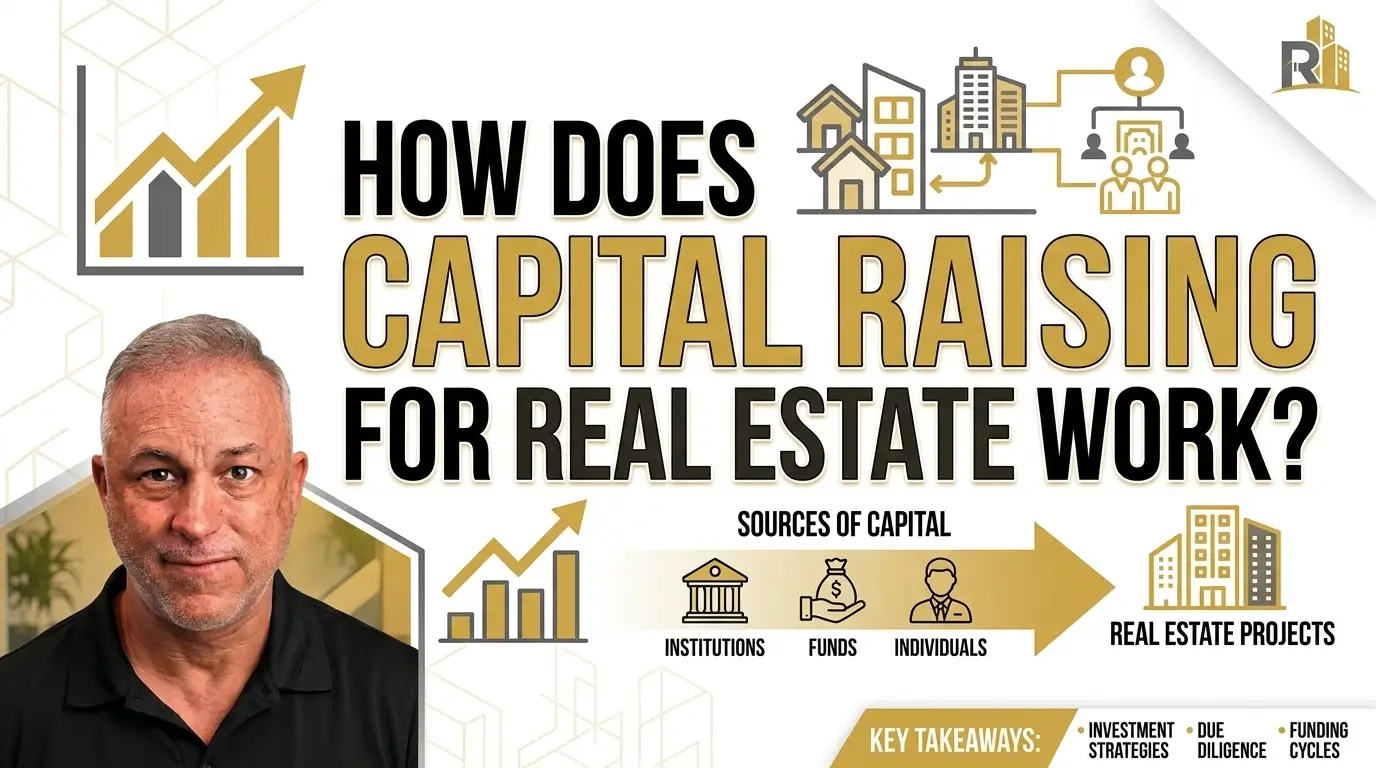
Capital raising for real estate is the process of securing the debt, preferred equity, and LP equity needed to fully capitalize a specific project before construction or acquisition begins. For a seasoned developer raising $10M–$50M on a single deal, the process has five distinct stages:
- Define the deal and build the capital stack
- Package the opportunity for institutional diligence
- Target the right investors for the specific project
- Run the diligence and negotiation process
- Close the raise and protect long-term GP economics
In 2025, private real estate fundraising reached $172 billion globally, a 13% increase over 2024, according to With Intelligence. But the top 10 funds captured 40% of that total. Capital is available. It is not evenly distributed. Developers who close in the current cycle are the ones who make their deals easy to underwrite before outreach begins, not after.
For a deeper orientation to the asset class and fundraising fundamentals, start with What Is Capital Raising for Real Estate from IRC Partners.
Step 1: Define the Deal and Build the Capital Stack
Before a single investor conversation happens, the raise needs a capital stack that is defensible under scrutiny. That means deciding how much of the total project cost belongs in senior debt, how much in mezzanine or preferred equity, and how much in common LP equity, then verifying the resulting economics work for all three layers.
Current market conditions have changed the math. CBRE's 2025–2026 market data shows senior debt now typically covers 50–65% of the capital stack, down from the 70–80% LTV ratios common before 2022. With 10-year Treasury yields above 4.5%, leverage is tighter and preferred equity returns have moved up to 8–12% to compensate. Common equity IRR targets for institutional LPs now run 15–25% or higher depending on risk profile.
The practical consequence: a developer who structured a deal in 2021 and is repricing it in 2026 will likely find the original waterfall no longer works. Equity is more expensive, the senior lender is less aggressive, and the GP promote has to survive in a thinner spread.
For project-specific raises targeting family offices, a deal-by-deal structure consistently outperforms a blind-pool concept. Allocators can underwrite a specific asset, a specific market, and a specific sponsor track record. That lowers the trust barrier significantly compared with asking an LP to commit capital before the deal is identified.
Step 2: Package the Opportunity for Institutional Diligence
Institutional investors and family offices are not evaluating a pitch deck. They are underwriting a package. The difference matters because most deal rejections happen before a serious capital conversation ever begins, not during negotiation.
Key insight: Allocators in 2025–2026 are operating with what ALTSS research describes as "precision-first" mandates. They are not exiting alternatives, but they are cutting anything that looks like sloppy risk. A weak package signals sloppy risk immediately.
A complete raise package for a $10M–$50M project-specific raise should include:
- Investment memo with clear thesis, asset description, market rationale, and competitive positioning
- Uses and sources schedule showing exactly how capital flows in and out at each stage
- Financial model with base case, downside case, and stress test at current rate assumptions
- Sponsor track record with deal-level attribution, not just portfolio-level claims
- Governance and decision rights documentation covering key-person provisions, reporting cadence, and removal rights
- Exit strategy with realistic comps, timing assumptions, and buyer pool analysis
- Legal structure overview including entity structure, waterfall mechanics, and any co-invest requirements
The stress test is not optional in the current environment. Hurdle rates have moved to 12–15% for many institutional LPs, and a model that only shows the base case will be set aside in favor of one that demonstrates the sponsor has thought through the downside. Weak materials are the single most common reason a raise stalls before it gains traction.
For guidance on structuring a capital stack that survives this level of scrutiny, IRC Partners covers the institutional readiness framework in detail across the capital raising resource library.
Step 3: Target the Right Investors for the Specific Deal
Not every institutional allocator is the right fit for a $10M–$50M project-specific raise. Targeting the wrong investor type wastes months of outreach and damages sponsor credibility in a market where word travels fast.
The three most common investor types for this raise size behave very differently:
Family offices managing $5.5 trillion in total AUM globally, according to Institutional Investor, have moved decisively toward deal-by-deal structures over blind pools. That shift is an advantage for project-specific sponsors who can present a fully underwritten deal rather than a fund concept.
The critical filter is mandate alignment. An allocator focused on industrial logistics in the Sun Belt is not the right target for a mixed-use project in the Midwest, regardless of return profile. Broad outreach to misaligned LPs produces soft passes that waste sponsor time and signal poor preparation to the market.
Warm introductions from a trusted intermediary consistently outperform cold distribution in a concentrated capital market where the top 10 funds already captured 40% of 2025 fundraising volume. The right target list for a $10M–$50M project raise is typically 15–30 highly qualified, mandate-aligned allocators, not a mass distribution of 200 contacts.
Understanding whether your deal fits a family office deal-by-deal structure or a more formal fund process is covered in detail in the IRC article on family office deal-by-deal vs. blind pool structures.
Step 4: Run the Diligence and Negotiation Process
Once an investor expresses interest, the raise moves into a structured diligence sequence. This is where most raises either accelerate or stall. The sequence typically runs:
- Initial management call to confirm mandate fit, deal overview, and sponsor background
- Model and materials review with follow-up Q&A on assumptions and stress scenarios
- Site visit or asset review for ground-up development or value-add projects
- Reference checks on sponsor track record, prior LP relationships, and execution history
- Legal review of entity structure, operating agreement, waterfall, and investor rights
- Economics negotiation covering promote structure, preferred return, co-invest requirements, and reporting obligations
- Subscription and closing mechanics, including capital call schedule and closing conditions
Common stall points: Inconsistent answers between the investment memo and the financial model. Weak deal-level attribution in track record materials. Unresolved promote or waterfall terms that differ from what was presented in the initial materials. Any of these can convert a soft yes into a slow no.
Investors in 2025–2026 are paying particular attention to execution risk. They want to understand who specifically managed prior deals, not just which firm completed them. Sponsor attribution at the individual level, not the company level, is now a standard diligence request.
The raise is rarely lost because of insufficient outreach volume. It is usually lost because the deal becomes harder to underwrite as diligence deepens, not easier. Every inconsistency the investor finds adds time and doubt. Every inconsistency that the sponsor resolves proactively before diligence begins shortens the timeline and raises close rates.
{{main-cta}}
Step 5: Close the Raise and Protect Long-Term GP Economics
Closing is not just signing documents. It is finalizing the economics, governance, and investor rights that will govern the project for its full hold period. The terms agreed at close determine whether the raise was worth doing.
The most common economic mistakes at close:
- Accepting a preferred return that consumes most of the GP promote before the hurdle is cleared
- Agreeing to investor approval rights over operating decisions that should belong to the GP
- Giving up key-person flexibility without understanding how it limits future raises
- Setting a capital call schedule that creates liquidity risk if construction timelines slip
Before accepting any term sheet, model the full waterfall at multiple return scenarios. The IRC guide on how to calculate the right GP/LP split for your deal covers preferred return thresholds, promote sizing, and the waterfall mechanics institutional LPs expect in a $10M+ raise.
The advisor question: Developers often decide too late whether they need a capital advisor, a placement agent, or neither. The right answer depends on the actual bottleneck. If the deal is structurally weak, a placement agent cannot fix it. If the deal is strong but the sponsor lacks access to mandate-aligned allocators, distribution support adds real value.
IRC Partners operates on an equity-aligned advisory model, taking 3–5% advisory equity rather than an upfront retainer, which aligns incentives with deal close rather than engagement volume. The distinction between that model and a traditional placement agent fee structure is covered in the IRC article on retainer vs. placement agent models.
A well-structured close does more than fund one project. It builds the institutional credibility and LP relationship foundation that makes the next raise faster, cheaper, and more competitive.
Why This Process Is Harder in 2026 and What Developers Should Do Differently
The five-step process above is not new. What is new is how much less margin for error exists in the current cycle.
PERE News reported a 50% year-over-year decline in private real estate fundraising volume in Q1 2026. PwC's Emerging Trends Global 2026 noted that target allocations to real estate declined for the first time in 13 years. Capital has not disappeared, but it has concentrated. Fewer LPs are writing checks, and the ones who are writing them are doing more diligence, moving more slowly, and requiring more downside protection.
What developers should do differently in 2026:
- Shorten the target investor list and improve mandate fit, rather than increasing outreach volume
- Build the stress case before the base case, not after
- Enter the market with a complete package, not a work-in-progress deck
- Assume a 90–180 day close timeline for institutional capital, not 30–60 days
- Evaluate whether the deal structure would survive a 15–20% cost overrun or a 12-month lease-up delay
The developers who close in this environment are not the ones with the most outreach. They are the ones with the most complete, most defensible packages before the first investor call is scheduled.
For a broader look at when a project-specific raise makes sense and what signals indicate the right timing, see the IRC on when a company needs capital raising for real estate.
Frequently Asked Questions
How long does a real estate capital raise typically take for a $10M–$50M project?
A project-specific raise at this size typically takes 90–180 days from first investor outreach to final close, assuming the deal is fully packaged before outreach begins. Raises that enter the market with incomplete materials or unresolved waterfall terms routinely run 6–12 months or longer. In the current cycle, institutional LPs are moving more slowly due to tighter mandate constraints and deeper diligence requirements, so developers should build at least 120 days into their project timeline before assuming capital is committed.
What is the minimum track record institutional LPs expect from a developer raising $10M or more?
Most institutional LPs and family offices writing checks of $5M or more require a minimum of three completed development projects with realized exits or stabilized assets before they will underwrite a new sponsor. Deal-level attribution matters as much as firm-level history. LPs want to know which specific deals the principal managed, what the actual IRR was versus the projected IRR, and how the sponsor handled problems during execution. Portfolio-level claims without deal-level backup are a common reason institutional interest stalls at the diligence stage.
What percentage of a real estate project does the GP typically retain after a $10M–$50M raise?
GP economics depend heavily on the waterfall structure, but a common arrangement in institutional raises involves a 20% carried interest (promote) above an 8% preferred return hurdle, with the GP contributing 1–5% of total equity as a co-invest. In the current market, some LPs are requiring co-invest of up to 5–10%, up from the 1–2% that was standard before 2022. Developers who give away approval rights over operating decisions or accept unfavorable clawback provisions at close often find the effective GP economics are far lower than the headline promote suggests.
What is the difference between a placement agent and a capital advisor for a real estate raise?
A placement agent typically earns a transaction fee of 1–3% of capital raised, paid at close, with limited ongoing involvement in deal structuring or diligence preparation. A capital advisor like IRC Partners takes an equity-aligned position, typically 3–5% advisory equity, and is involved in capital stack design, materials preparation, and investor targeting before outreach begins. The practical difference is incentive alignment: a placement agent is compensated for distribution volume, while an equity-aligned advisor is compensated only when the deal closes on terms that work for the developer.
What capital stack structure do family offices prefer for project-specific real estate raises?
Family offices have shifted strongly toward deal-by-deal structures over blind-pool fund commitments, particularly for raises under $50M. In a deal-by-deal structure, the family office reviews and approves each specific asset before committing capital, rather than writing a blank check into a fund. This requires the developer to present a fully underwritten deal with clear exit assumptions, downside modeling, and defined governance rights. Family offices managing this structure typically expect 8–12% preferred returns on preferred equity positions and 15–20%+ IRR targets on common equity, with reporting on at least a quarterly basis.
What are the most common reasons a real estate capital raise fails before reaching close?
The most common failure points, in order of frequency, are: (1) weak or incomplete diligence materials that cannot survive LP scrutiny, (2) misaligned targeting where the developer is pitching allocators whose mandate does not match the deal, (3) unresolved waterfall or promote terms that surface late in negotiation and restart the process, (4) inconsistent answers between the investment memo and the financial model, and (5) a sponsor track record that lacks deal-level attribution. Very few raises fail because of insufficient outreach volume. Most fail because the deal was not institutionally ready when outreach began.
How do hurdle rates and preferred returns affect a developer's economics on a $10M–$50M raise?
In 2025–2026, institutional LPs expect hurdle rates of 12–15% before the GP promote begins to accrue, up from the 8–10% hurdles that were common in lower-rate environments. On a $20M equity raise with a standard 20% promote above a 12% hurdle, a developer who underperforms the hurdle by even 200 basis points may receive no promote at all. Preferred equity investors sitting in the mezzanine layer typically require 8–12% current pay or accrued returns before common equity sees any distribution. Developers should model the full waterfall at multiple return scenarios before accepting LP term sheets, not after.
Continue reading this series:
- What Is Capital Raising for Real Estate
- When Does a Company Need Capital Raising for Real Estate
- Key Benefits of Capital Raising for Real Estate
IRC Partners works with operators raising $5M to $250M of institutional capital. The full engagement is for founders at $1M+ ARR who have raised before. The $2,997 Capital Raise Pre-Flight audit is open to earlier-stage companies, including pre-revenue, that are raising $5M+ and have a pitch deck and financial model ready for review. If that's you, schedule a call to discuss HERE.
Sponsors weighing this decision should first complete a capital raise readiness assessment for sponsors to confirm the raise is investor-ready.
Need guidance on your capital raise?


How to Negotiate Information Rights and Reporting Obligations With Institutional Investors Before Signing

How Over-Diluted Founders Trigger Series B Pass Letters Without a Single Meeting
How Equity Grants to Advisors, Contractors, and Strategic Partners Quietly Pollute Your Cap Table Before Series B
Disclosure
Nothing on this site constitutes an offer to sell, or a solicitation of an offer to purchase, any security under the Securities Act of 1933, as amended, or any applicable state securities laws. Any offering of securities is made only by means of a formal private placement memorandum or other authorized offering documents delivered to qualified investors.
IRC Partners is a capital advisory firm. IRC Partners is not a registered investment adviser under the Investment Advisers Act of 1940 and does not provide investment advice as defined thereunder.
Certain statements in this article may constitute forward-looking statements, including statements regarding market conditions, capital availability, investor demand, and transaction outcomes. Such statements reflect current assumptions and expectations only. Actual results may differ materially due to market conditions, regulatory developments, company-specific factors, and other variables. IRC Partners makes no representation that any outcome, return, or result described herein will be achieved.
References to prior mandates, transaction volume, network credentials, or capital raised are provided for illustrative purposes only and do not constitute a guarantee or prediction of future results. Past performance is not indicative of future outcomes. Individual results will vary. Network credentials and transaction statistics referenced on this site reflect the aggregate experience of IRC Partners' principals and affiliated advisors and are not a representation of assets managed or transactions closed solely by IRC Partners.
Certain data, statistics, and information presented in this article have been obtained from third-party sources. IRC Partners has not independently verified such information and expressly disclaims responsibility for its accuracy, completeness, or timeliness. Readers should independently verify any third-party data before relying on it.
Readers are strongly encouraged to consult qualified legal, financial, and tax professionals before making any investment, capital raising, or business decision.
Schedule A Meeting
You get one shot to raise the right way. If this raise is worth doing, it’s worth doing with precision, leverage, and control.
This isn’t a practice run. Serious capital. Serious strategy. Let’s raise it right.
We onboard a maximum of seven
new strategic partners each quarter, by application only, to maximize your chances of securing the capital you need.
