.svg "CTA Arrow")


.png "Investor Ready Capital decorative background element")

How Should a Sponsor Explain Entitlement Risk To a Family Office Considering a Mixed-Use Development Investment?
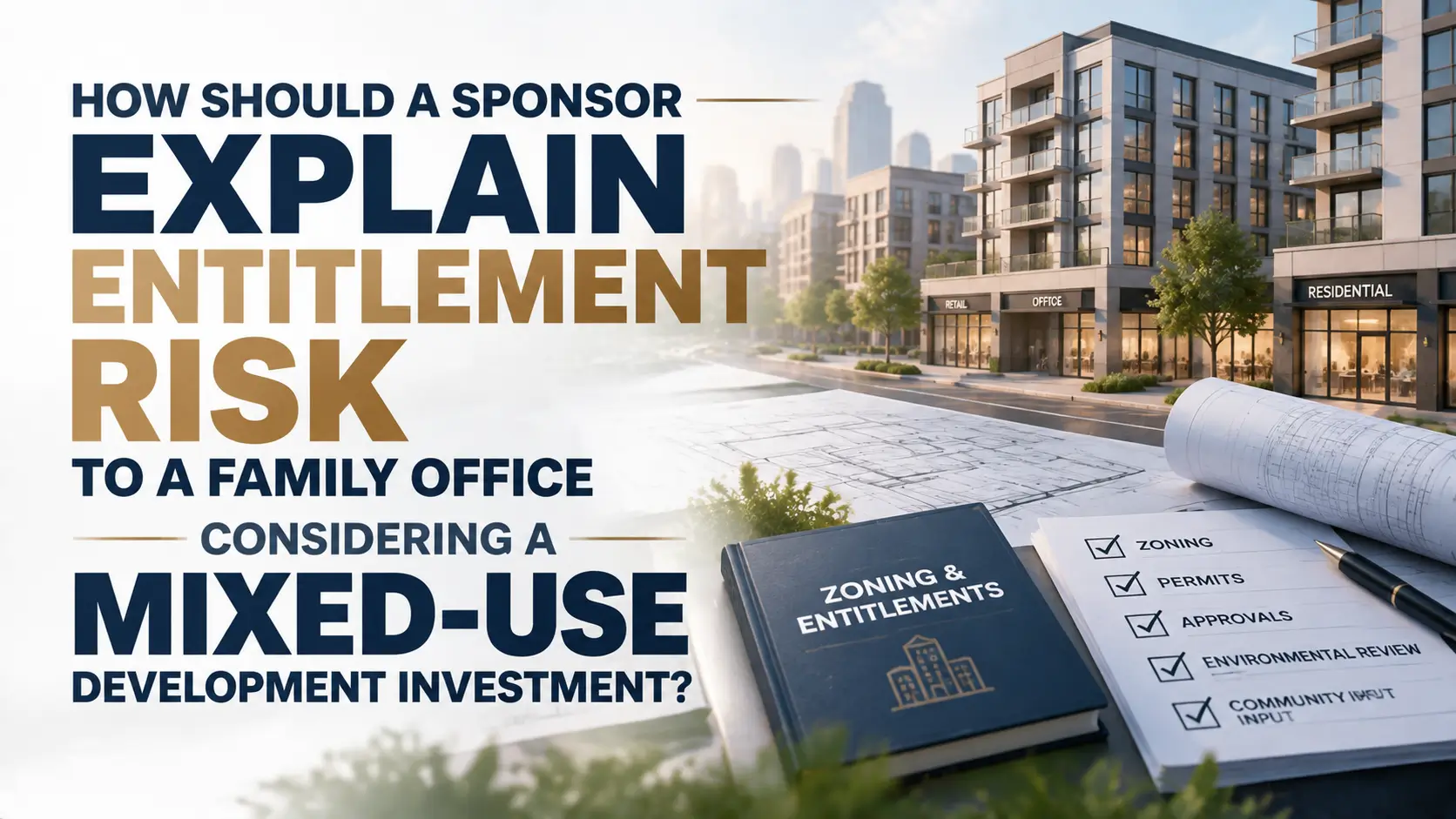
How Should a Sponsor Explain Entitlement Risk To a Family Office Considering a Mixed-Use Development Investment?
TL;DR: Family offices assess mixed-use entitlement risk through approval milestones, timeline scenarios, land control, and contingency protections.
- How Family Offices Define Entitlement Status on a Mixed-Use Deal: Family offices do not treat entitlement as a single approval event.
- How Family Offices Assess Political and Regulatory Timeline Risk: Entitlement timeline risk is the exposure a project carries between the current approval status and the point at which all required approvals are final and the appeal period has ended and all appeals have been resolved .
- Legal Protections and Contingency Structures Family Offices Require: Family offices committing equity to an entitlement-stage or partially-entitled mixed-use deal will require structural protections that reflect the approval risk they are accepting.
Family offices can delay or withhold equity from a mixed-use development when entitlement status, approval timing, or land-control protections are unclear. To earn LP confidence, sponsors must document every completed and pending approval, model base, delay, and denial scenarios, and show that the purchase agreement protects the project through an entitlement contingency and extension rights. For sponsors raising $5M to $250M, presenting this evidence before the first diligence call turns entitlement risk from an open-ended concern into an underwriteable part of the capital stack.
Entitlement risk is the probability that a development project fails to obtain, or obtains only in modified form, the governmental approvals required to build as planned. For a family office evaluating LP equity in a mixed-use ground-up deal, entitlement risk functions as a binary gate: until the sponsor can demonstrate that the project has cleared defined approval milestones, most institutional allocators will commit equity only after defined approval milestones are documented and cleared. Mixed-use entitlement is more complex than single-use residential or industrial because it requires coordinated approvals across multiple use categories, each of which may face separate public hearings, environmental reviews, and zoning overlay conditions. A family office LP underwriting a mixed-use deal will evaluate entitlement status, timeline exposure, and regulatory risk as a distinct risk category before they evaluate capital stack mechanics or return assumptions.
Understanding how mixed-use deals are structured for institutional capital is the foundation. Entitlement risk sits upstream of every other diligence question. Sponsors who present entitlement status in LP language, with documented milestones and contingency protections, move through family office diligence faster.
How Family Offices Define Entitlement Status on a Mixed-Use Deal
Family offices do not treat entitlement as a single approval event. They assess it as a sequence of milestones, each carrying its own timeline risk and political exposure. A sponsor who describes their project as "in the entitlement process" and stops there gives an institutional LP nothing to underwrite.
The milestones family offices typically track in mixed-use entitlement are:
- Zoning compliance or rezoning approval: Whether the project conforms to existing zoning or requires a discretionary rezoning action, which adds political risk and timeline uncertainty
- Use permit approval: Separate conditional use permits may be required for each component, particularly for ground-floor retail, food and beverage uses, or live-work units
- Environmental review completion: CEQA, NEPA, or local environmental review processes, including whether a mitigated negative declaration or full EIR has been required
- Design review and architectural approval: Discretionary design review by a planning commission or architectural review board, which can impose conditions that alter the project's economics
- Subdivision or parcel map approval: Required for condo sellout components or separate parcel conveyances within a mixed-use project
- Development agreement or vesting rights: Whether the sponsor has secured a development agreement that locks in entitlements against future code changes
A family office LP will ask which of these milestones are complete, which are in process, and what the realistic timeline is for each remaining approval. Sponsors who answer that question without documented evidence lose the diligence conversation at the first meeting.
Why Mixed-Use Zoning Complexity Raises the Stakes
Mixed-use projects face a layered approval challenge that single-use developments avoid. A residential-only project typically requires zoning compliance and building permits. A mixed-use project may require separate discretionary land use applications for each commercial use, overlay district compliance for ground-floor activation requirements, affordable housing negotiations tied to density bonuses, and traffic impact studies that address the combined vehicle trip generation of all uses. Each layer adds a hearing, a comment period, and a potential appeal window.
Family offices that have underwritten mixed-use deals before understand that the commercial component often carries more entitlement exposure than the residential component, even when residential is the dominant use. Sponsors should present the entitlement status of each use category separately, with the same component-level discipline that institutional LPs apply to income underwriting.
How Family Offices Assess Political and Regulatory Timeline Risk
Entitlement timeline risk is the exposure a project carries between the current approval status and the point at which all required approvals are final and the appeal period has ended and all appeals have been resolved. Family offices treat timeline risk as a direct driver of equity carry cost and return compression. Every month of entitlement delay is a month of pre-development carrying costs ahead of any revenue, and for a mixed-use project with a condo sellout component, presale momentum can erode during a prolonged approval process.
Sponsors should present entitlement timeline risk using three scenarios:
The denial or condition case is the scenario family offices require and most sponsors omit. A conditional approval that reduces density by 10 to 15 percent, or that requires ground-floor commercial setbacks that reduce leasable area, can materially alter the deal's economics without triggering a full denial. Sponsors who present only the base case have skipped the downside modeling family offices require before opening a data room.
Political Risk in Mixed-Use Zoning
Mixed-use projects that require discretionary approvals are exposed to political risk in a way that by-right residential projects avoid. Neighborhood opposition, city council composition changes, and shifting affordable housing policy can all affect the outcome of a discretionary hearing even when the project is code-compliant. Family offices that understand this risk will ask whether the sponsor has engaged with community stakeholders, whether any appeals are pending or reasonably foreseeable, and whether the jurisdiction has a track record of approving similar projects.
Sponsors should be prepared to document the political environment: prior comparable approvals in the same jurisdiction, any community benefit agreements negotiated, and the status of any pending appeals on similar projects. This sponsor-positioning work belongs in the data room before the initial family office conversation.
For guidance on how family office allocators evaluate sponsor credibility before committing capital, the sponsor's ability to present political and regulatory risk transparently is itself a credibility signal.
Legal Protections and Contingency Structures Family Offices Require
Family offices committing equity to an entitlement-stage or partially-entitled mixed-use deal will require structural protections that reflect the approval risk they are accepting. These protections fall into two categories: legal contingencies in the investment documents and contractual protections in the land control or purchase agreement.
Investment Document Protections
- Entitlement contingency provisions: LP subscription agreements or operating agreements may include provisions that condition the release of equity capital on the achievement of defined entitlement milestones, such as discretionary approval of the use permit or completion of environmental review
- Capital call sequencing tied to milestones: Some family offices structure their equity commitment in tranches, with each tranche released only upon documented entitlement progress, reducing their exposure if the approval process stalls
- GP promote deferral pending entitlement clearance: Promote structures that defer any GP profit participation until the project has cleared all entitlement conditions signal alignment and reduce the LP's concern that the GP will benefit from a deal that never achieves full approval
- Exit rights on entitlement failure: Family offices may negotiate the right to exit the investment at a defined return of capital if the project fails to obtain entitlements within a specified period
Land Control Protections
The sponsor's land control structure is the first place a family office looks to assess entitlement risk management. A purchase and sale agreement with an entitlement contingency period, during which the sponsor can continue to pursue approvals before being obligated to close on the land, is the standard institutional expectation. Sponsors who closed on the land before securing an entitlement contingency have transferred approval risk from the seller to the project. Family offices price that exposure into their required return.
Sponsors raising equity on a mixed-use deal should also be prepared to discuss whether their land control includes a right to extend the contingency period if approvals are delayed, what the cost of extension options is, and whether the seller has any remaining obligations tied to entitlement support. These details belong in the data room. For more on how to present funding needs to family offices in a way that addresses structural risk upfront, the framing principles apply directly to entitlement risk disclosure.
{{main-cta}}
What Belongs in the Data Room Before the First Diligence Conversation
Entitlement risk requires documented evidence rather than verbal explanation. Family offices begin substantive diligence on a mixed-use deal when the sponsor produces a complete entitlement package at or before the initial meeting.
The entitlement data room package for a family office diligence conversation should include:
- Current zoning confirmation or rezoning application status: A letter from the planning department, the application file number, and the hearing schedule if a discretionary action is pending
- Environmental review documentation: The CEQA or NEPA determination, the mitigated negative declaration or EIR if required, and any mitigation monitoring plan
- Conditional use permit applications and any issued permits: Including all conditions of approval attached to any permits already granted
- Land use attorney opinion letter: A written opinion from the sponsor's land use counsel summarizing the entitlement status, remaining approvals required, and any material risks in the approval process
- Entitlement timeline with milestone dates: A documented schedule showing each remaining approval, the responsible agency, the expected hearing date, and the appeal period following each action
- Three-scenario entitlement timeline model: Base, delay, and denial or condition scenarios with carry cost and return impact modeled for each
- Community engagement summary: Documentation of any neighborhood meetings, community benefit negotiations, or public comment responses
- Land control agreement: The purchase and sale agreement, option agreement, or ground lease with entitlement contingency language highlighted
Sponsors who want a step-by-step build sequence can follow the 30-day data room framework for institutional closes before outreach begins.
The data room is where sponsor positioning becomes concrete. A sponsor who arrives at the first family office conversation with this package organized and accessible signals institutional readiness. A sponsor who asks for two weeks to pull it together signals operational immaturity at the moment credibility is most consequential.
Sponsors preparing for family office diligence on mixed-use deals should review what family offices actually look for before committing capital and how to structure a mixed-use deal for institutional LP standards before beginning outreach. IRC Partners works with sponsors to structure the deal, prepare the data room, and position entitlement risk in the language institutional allocators expect before the first conversation begins.
Frequently Asked Questions
What is entitlement risk and why does it gate family office equity commitment on mixed-use deals?
Entitlement risk is the probability that a project fails to obtain the governmental approvals required to build as planned, or receives approvals with conditions that materially alter the project scope or economics. Family offices treat it as a gating condition on equity commitment because an un-entitled or partially-entitled mixed-use project carries an unreliable construction start date, an unbankable capital stack, and an unpredictable return timeline. Most institutional allocators commit equity only after the sponsor demonstrates that defined approval milestones have been cleared and remaining approvals carry documented timelines.
How do family offices evaluate entitlement status differently for mixed-use projects versus single-use residential or industrial deals?
Single-use residential or industrial projects typically require zoning compliance and building permits, with limited discretionary exposure. Mixed-use projects require coordinated approvals across multiple use categories, including separate conditional use permits for each commercial use, environmental review that addresses the combined impact of all uses, and design review that may impose conditions on ground-floor activation, setbacks, or affordable housing. Family offices underwrite each use category's entitlement status separately, applying the same component-level discipline they use for income underwriting. An open or contested commercial use permit carries its own exposure regardless of the residential entitlement position.
What three entitlement timeline scenarios should a sponsor present to a family office LP?
Sponsors should present a base case showing all remaining approvals clearing on the current schedule, a delay case modeling one or more approvals slipping by 3 to 6 months with the resulting carrying cost increase and construction cost escalation, and a denial or condition case modeling an approval that is denied or granted with conditions that reduce density or leasable area. The denial or condition case is the scenario family offices require before committing equity. A conditional approval that reduces density by 10 to 15 percent can materially compress returns, and family offices will model that exposure before committing equity.
What land control protections do family offices expect to see in a mixed-use entitlement-stage deal?
Family offices expect the sponsor's land control agreement to include an entitlement contingency period during which the sponsor can pursue approvals before being obligated to close on the land. The agreement should also include extension rights if approvals are delayed, with documented extension costs. Sponsors who have already closed on the land without an entitlement contingency have transferred approval risk from the seller to the project, and family offices will price that exposure into their required return or equity structure. The land control agreement belongs in the data room before the first diligence conversation.
What legal protections can a family office LP negotiate in an entitlement-stage mixed-use investment?
Family office LPs in entitlement-stage deals commonly negotiate entitlement contingency provisions that condition the release of equity capital on defined approval milestones, capital call sequencing tied to documented entitlement progress, GP promote deferral until all entitlement conditions are cleared, and exit rights at a defined return of capital if the project fails to obtain entitlements within a specified period. These protections reflect the approval risk the LP is accepting at the time of commitment and are standard in institutional-grade entitlement-stage deal structures.
What does a family office LP look for in a land use attorney opinion letter for a mixed-use development?
A land use attorney opinion letter should summarize the current entitlement status across all use categories, identify each remaining approval required, describe the applicable review process and timeline for each, and flag any material risks in the approval process, including pending or foreseeable appeals, neighborhood opposition, or jurisdictional policy changes that could affect the outcome. The letter should be addressed to the project entity and dated within 90 days of the LP conversation. Family offices treat the absence of a current land use opinion as a material data room gap requiring resolution before diligence advances.
How does entitlement risk in mixed-use development differ from the construction-completion risk that family offices evaluate after approvals are in place?
Entitlement risk exists before a shovel goes in the ground and determines whether the project can be built as planned. Construction-completion risk begins after entitlements are secured and reflects the probability that the project will be completed on time and within budget. The two risks operate on different timelines and require different documentation. Entitlement risk is managed through approval milestones, land control contingencies, and regulatory counsel. Construction-completion risk is managed through contractor selection, performance bonds, construction loan draw controls, and completion guarantees. Family offices evaluate each as a separate risk category with its own documentation requirements.
Continue reading this series:
- Family Office Deal-by-Deal vs. Blind Pool: What Real Estate Developers Need to Know
- Family Office vs. PE Fund: Right LP for Your Development
- 5 Capital Stack Risk Reduction Strategies for $10M+ Sponsors
IRC Partners advises operators raising $5M to $250M of institutional capital on structure, positioning, and round architecture. We take seven strategic partners per quarter. No placement agent model. No success-only theater. Capital is raised on the strength of how the deal is built. If you want your current raise reviewed before it reaches the market and silently fails, apply here.
Need guidance on your capital raise?


How Do I Structure an Investment Committee Deck for $20M?
How Can a Startup Obtain Consent From Dispersed Convertible Noteholders Without Delaying a Financing?

How to Calculate the Right GP/LP Split for Your Deal
Disclosure
Nothing on this site constitutes an offer to sell, or a solicitation of an offer to purchase, any security under the Securities Act of 1933, as amended, or any applicable state securities laws. Any offering of securities is made only by means of a formal private placement memorandum or other authorized offering documents delivered to qualified investors.
IRC Partners is a capital advisory firm. IRC Partners is not a registered investment adviser under the Investment Advisers Act of 1940 and does not provide investment advice as defined thereunder.
Certain statements in this article may constitute forward-looking statements, including statements regarding market conditions, capital availability, investor demand, and transaction outcomes. Such statements reflect current assumptions and expectations only. Actual results may differ materially due to market conditions, regulatory developments, company-specific factors, and other variables. IRC Partners makes no representation that any outcome, return, or result described herein will be achieved.
References to prior mandates, transaction volume, network credentials, or capital raised are provided for illustrative purposes only and do not constitute a guarantee or prediction of future results. Past performance is not indicative of future outcomes. Individual results will vary. Network credentials and transaction statistics referenced on this site reflect the aggregate experience of IRC Partners' principals and affiliated advisors and are not a representation of assets managed or transactions closed solely by IRC Partners.
Certain data, statistics, and information presented in this article have been obtained from third-party sources. IRC Partners has not independently verified such information and expressly disclaims responsibility for its accuracy, completeness, or timeliness. Readers should independently verify any third-party data before relying on it.
Readers are strongly encouraged to consult qualified legal, financial, and tax professionals before making any investment, capital raising, or business decision.
Schedule A Meeting
You get one shot to raise the right way. If this raise is worth doing, it’s worth doing with precision, leverage, and control.
This isn’t a practice run. Serious capital. Serious strategy. Let’s raise it right.
We onboard a maximum of seven
new strategic partners each quarter, by application only, to maximize your chances of securing the capital you need.
