.svg "CTA Arrow")


.png "Investor Ready Capital decorative background element")
Private Placement Memorandum vs. Data Room: When You Need Both and How They Work Together

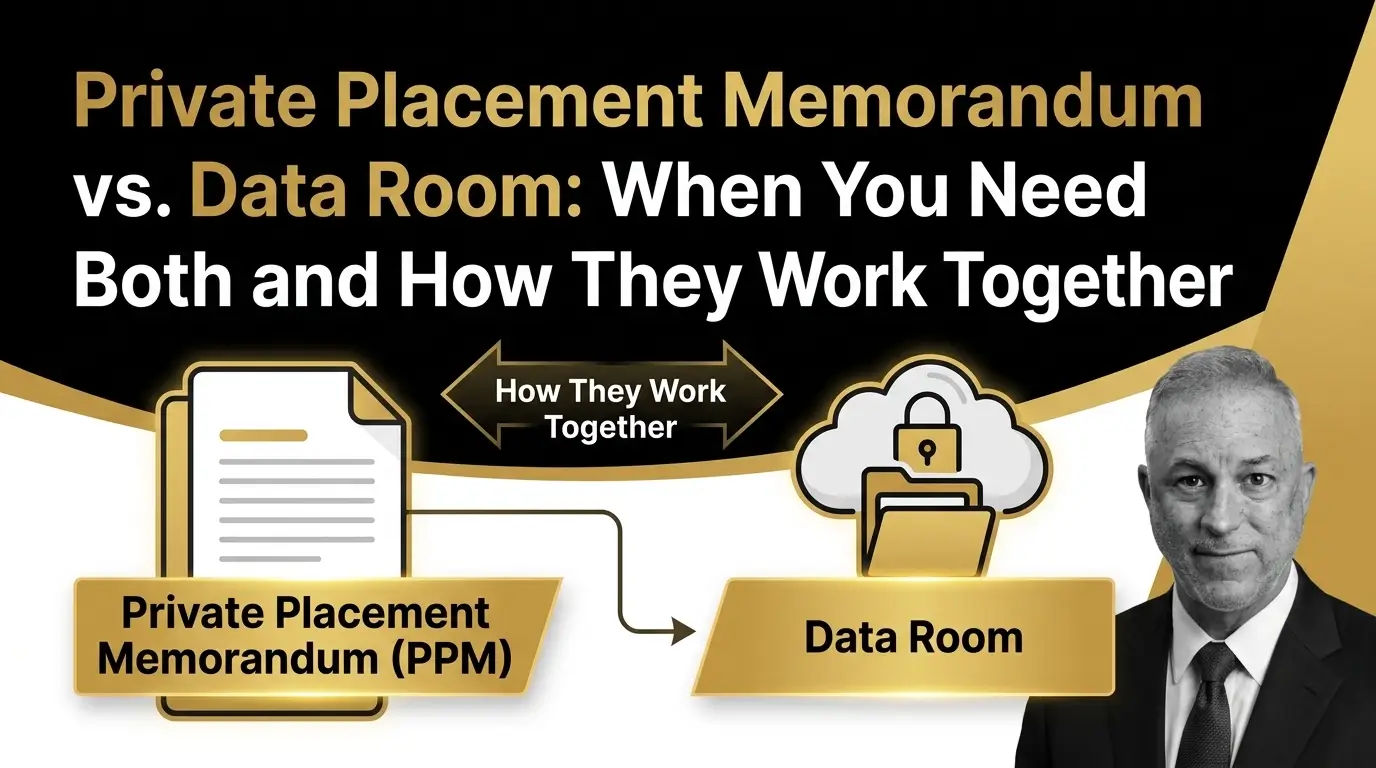
Private Placement Memorandum vs. Data Room: When You Need Both and How They Work Together
A PPM discloses. A data room proves. Sponsors preparing for a $10M to $250M institutional raise often ask whether they need one or the other - but institutional investors do not experience them as alternatives. They experience both at different stages, for different purposes, reviewed by different people. Confusing the two does not just create paperwork problems. It creates compliance gaps, slows LP counsel review, and signals to serious allocators that the sponsor does not fully understand the process they are asking investors to trust.
A private placement memorandum is a legal disclosure document. A data room is a diligence environment. Confusing them does not just create paperwork problems. It creates compliance gaps, slows LP counsel review, and signals to serious allocators that the sponsor does not fully understand the process they are asking investors to trust.
Three things this article will clarify:
- What each document actually does and who reads it
- When you need both in an institutional real estate raise
- How to sequence them so diligence moves faster and subscription closes without friction
What Is a Private Placement Memorandum, and What Job Does It Do?
What is a private placement memorandum? A private placement memorandum (PPM) is the formal legal disclosure document used in an unregistered private offering. It presents the offering terms, risk factors, investor qualifications, conflicts of interest, and economic structure in a format that supports informed investment decisions and satisfies anti-fraud obligations under federal securities law.
Most real estate sponsors raising institutional capital rely on Regulation D exemptions under the Securities Act of 1933, specifically Rules 506(b) or 506(c), to avoid full SEC registration. The PPM is the document that makes that exemption defensible. It is not a marketing tool. It is not a summary of your pitch deck. It is the legal spine of the offering.
What a PPM is designed to do:
- Disclose investment terms, fee structures, distribution waterfalls, and economic rights in legally precise language
- Present material risk factors relevant to the offering, the sponsor, and the asset class
- Establish investor qualification requirements, including accredited investor standards
- Identify conflicts of interest between the GP and LPs
- Define the operating mechanics of the entity and the rights of each investor class
- Support the subscription process by giving LP counsel a complete disclosure record to review before their client commits capital
The primary reader of a PPM is not the investment analyst running diligence. It is LP counsel, the attorney retained by the limited partner to evaluate whether the offering terms are acceptable and whether the disclosure is complete. That distinction matters. Counsel is not looking for property photos or rent rolls. Counsel is looking for coherent, accurate, legally sufficient disclosure. A data room full of operating documents cannot provide that.
The PPM is the legal anchor of the raise. Everything else supports it.
What Is a Data Room, and What Job Does It Do?
A data room is a secure, organized repository of documents that allows investors, lenders, and their advisors to verify the claims a sponsor has made throughout the raise. Its job is not disclosure in a legal sense. Its job is evidence.
The primary audience of a data room is the investment team: the analyst, associate, or portfolio manager who needs to confirm that the numbers in the deck hold up, that the track record is real, that the asset is what the sponsor says it is, and that the entity structure is clean. Lenders and their underwriters are also frequent data room users, particularly in structured or layered capital raises.
What a well-built data room proves:
- Track record: completed projects, realized exits, cost basis, and return history
- Asset-level detail: rent rolls, leases, title, surveys, environmental reports, and zoning
- Financial integrity: audited or reviewed financials, tax returns, pro formas, and debt schedules
- Entity and legal structure: operating agreements, cap tables, litigation history, and regulatory filings
- Team and governance: organizational chart, key person bios, and management agreements
A strong data room does not just contain documents. It is organized to answer the questions an investment committee will ask before approving a capital allocation. As IRC Partners has noted across institutional raise engagements, sloppy data rooms signal sloppy operations. Investors do not separate the quality of your documents from the quality of your business.
The data room is the verification engine. It supports the narrative the PPM establishes.
PPM vs. Data Room: The Cleanest Way to Understand the Difference
The fastest way to understand the distinction is to map each document to the question it answers, the person who reads it, and the moment it appears in the raise.
Why the reviewer distinction matters most
Sponsors sometimes assume that because both documents are reviewed before closing, they serve the same function. They do not. LP counsel and the investment team are asking fundamentally different questions.
Counsel asks: Is this offering legal, complete, and accurate enough for my client to sign a subscription agreement?
The investment team asks: Does the evidence support the story, and is the risk we are taking consistent with what we were told?
A data room full of lease abstracts does not answer counsel's question. A PPM full of risk disclosures does not satisfy an analyst who needs audited financials. Both documents have to exist, and both have to be built for their actual reader.
When Do You Need Both in a Real Estate Raise?
The short answer: if you are raising capital from outside investors in a private offering, you need both. The more institutional the LP, the less flexibility there is on this point.
According to Preqin, global private real estate fundraising reached $44 billion in Q1 2026 alone, with capital concentrating among sponsors who can demonstrate both legal readiness and operational depth. At the same time, PwC's Emerging Trends research found that private real estate debt loan originations rose 47% through Q3 2025, meaning more capital is flowing through structured vehicles that require heavier documentation discipline on both the disclosure and diligence sides.
You need both a PPM and a data room when:
- You are running a Regulation D offering. Any unregistered private offering to outside investors triggers disclosure obligations that a data room alone cannot satisfy.
- Your target LPs include family offices, institutional allocators, or pension-adjacent capital. These investors send counsel to review the PPM before committing. They send analysts to verify the data room. Both processes happen in parallel.
- You are raising $10M or more in a single vehicle. At this scale, investment committees require formal documentation packages. A deck and a shared Dropbox folder are not a documentation package.
- Your raise involves layered capital. Preferred equity, structured debt, or co-invest alongside senior financing means multiple parties with different review needs. Each needs the document that answers their specific question.
- You are building a track record for future institutional raises. Sponsors who run clean, fully documented raises once build the credibility that makes the second raise faster.
For a deeper look at what institutional investors expect inside the diligence environment itself, this guide on building a data room that closes institutional investors covers the full documentation framework.
The Right Sequence: From First Serious Interest to Signed Subscription
The biggest practical gap in most sponsor documentation strategies is not missing documents. It is timing. Sponsors introduce the wrong document at the wrong stage, which slows review and creates friction that should not exist.
Here is how the sequence should work in an institutional real estate raise:
Step 1: Early interest stage (deck and teaser only) Share a concise investment summary or teaser with qualified prospects. This is not the time to open the data room. Flooding early-stage conversations with hundreds of documents signals poor process discipline and can expose confidential materials before you have established serious intent.
Step 2: Qualified interest confirmed (NDA and preliminary materials) Once an investor has expressed genuine interest and signed a non-disclosure agreement, share the executive summary, deal overview, and high-level financial projections. The PPM is being prepared or finalized at this stage, not yet delivered.
Step 3: Serious diligence begins (PPM delivered, data room opened) This is the critical handoff. The PPM is delivered as the formal offering document. The data room is opened simultaneously or shortly after, organized to validate the claims in the PPM. The investment team enters the data room. LP counsel begins reviewing the PPM. These two parallel tracks are the engine of institutional diligence.
Step 4: Investment committee and counsel review (parallel tracks) The investment team works through the data room, submitting questions and requesting supplemental materials. Counsel reviews the PPM, negotiates any side-letter provisions, and prepares the subscription review. Both tracks must reach resolution before closing.
Step 5: Subscription and closing (PPM and subscription package govern) The subscription agreement, operating agreement, and PPM form the legal closing package. The data room is referenced for diligence sign-off but the legal documents govern the transaction. Sponsors who have kept the PPM and data room consistent throughout avoid last-minute contradictions that delay closing.
As IRC Partners has observed across institutional engagements, investors spend weeks inside a data room, and organized materials move diligence faster. The sequence above ensures both documents are doing their job at the right moment rather than competing for attention at the wrong one.
What Goes Wrong When Sponsors Confuse the Two
Treating a data room as a substitute for a PPM, or expecting a PPM to carry the full weight of diligence, creates predictable problems at predictable stages.
The investor psychology cost
The practical risks above are real. But the investor psychology cost is equally damaging and harder to recover from.
When LP counsel receives a data room link instead of a PPM, the message is that the sponsor does not understand the difference between disclosure and evidence. When an investment team receives a PPM with no supporting data room, the message is that the sponsor is asking for trust without providing verification.
Neither position is recoverable in a competitive raise. Institutional allocators, particularly family offices that have shifted to deal-by-deal structures, have more options than ever. What $17B family office allocators look for before committing capital includes exactly this kind of process discipline. Sponsors who demonstrate it move forward. Those who do not are replaced by sponsors who do.
{{main-cta}}
How to Build the Handoff Between Disclosure and Diligence
The PPM and data room are separate environments, but they have to tell the same story. The most common source of late-stage friction is a factual contradiction between the two: a return figure in the PPM that does not match the track record in the data room, or an entity description that conflicts with the operating agreement filed in the diligence folder.
Checklist for a clean PPM-to-data-room handoff:
- Align all financial figures, asset descriptions, and track-record references across both environments before either is shared
- Organize the data room to mirror the major claim categories in the PPM (track record, asset detail, financial integrity, entity structure, team)
- Assign document access by role: counsel sees the PPM and subscription package; the investment team accesses the full data room; lenders see only what is relevant to underwriting
- Maintain a version log for both the PPM and key data room documents so any updates are tracked and communicated
- Review the data room before opening it, not after, because a disorganized or incomplete room signals the same weakness as a disorganized PPM
Consistency is a control. If the PPM says the sponsor has completed six projects with a 1.8x average equity multiple, the data room needs to contain the documentation that supports exactly that claim, not a different number from a different time period. Contradictions do not just confuse investors. They create legal risk because they raise questions about which disclosure was accurate.
With more than 20 U.S. states now carrying comprehensive data privacy laws as of 2026, data room access controls have also become a governance issue. Granting blanket access to all parties without need-to-know discipline exposes sponsors to privacy and confidentiality risks that go beyond the raise itself.
For a practical look at what belongs in each section of a well-structured diligence environment, the real estate due diligence checklist for $10M+ sponsors covers the 47 documents institutional lenders and investors request most often.
The Raise Moves When Each Document Does Its Own Job
The question is not whether to build a PPM or a data room. For any institutional real estate raise, the answer to both is yes. The question is whether each document is built for the right reviewer, introduced at the right stage, and kept consistent with the other throughout the process.
The PPM protects the offering by establishing a complete and accurate legal disclosure record. The data room proves the operation by giving investors and their advisors the evidence they need to confirm what the PPM claims. Institutional raises close faster when both environments are ready before serious diligence begins, not assembled under pressure after an investor has already started asking questions.
Frequently Asked Questions
Does a PPM need to be prepared by a securities attorney, or can a sponsor draft it themselves?
A PPM should be prepared or reviewed by a securities attorney with private placement experience. The document creates legal obligations under federal anti-fraud provisions, and errors or omissions in risk factor disclosure, investor qualification language, or offering terms can expose the sponsor to liability even if the underlying offering is sound. For a $10M to $250M institutional raise, the cost of proper legal preparation is minimal compared to the cost of a deficient disclosure record.
Can a sponsor use the same PPM for multiple investors in the same offering?
Yes. A PPM is an offering document for the vehicle, not a document customized per investor. The same PPM governs the offering for all participating LPs. Individual investors may negotiate side-letter provisions that modify specific economic or governance terms for their allocation, but the PPM itself remains the shared disclosure foundation for the entire investor group.
How long does LP counsel typically take to review a PPM before a client subscribes?
LP counsel review timelines vary based on the complexity of the offering and the investor's internal approval process. For a straightforward Regulation D fund with standard waterfall and governance terms, counsel review often takes two to four weeks. For more complex structures, layered capital stacks, or first-time fund managers, review periods of four to eight weeks are common. Sponsors who deliver a clean, complete PPM with no ambiguities in the risk factors or economic terms tend to move through counsel review faster.
What happens to the data room after the raise closes?
The data room should be maintained as a permanent repository for the life of the asset or fund. Post-closing, it becomes the primary reference environment for ongoing investor reporting, lender covenant compliance, refinancing or sale preparation, and audit support. Sponsors who treat the data room as a closing tool rather than an ongoing governance environment often scramble when a secondary transaction, refinancing, or LP transfer requires document production on short notice.
Is there a minimum raise size at which a sponsor needs a PPM, or does it apply to all private offerings?
There is no minimum dollar threshold that triggers the need for a PPM. The obligation arises from the structure of the offering itself. Any unregistered private offering of securities to outside investors, regardless of size, carries disclosure obligations under federal anti-fraud provisions. A PPM is the most reliable way to satisfy those obligations. Sponsors raising even $2M to $5M from outside investors in a private vehicle benefit from a properly prepared offering document.
How should a sponsor handle a data room request from an investor who has not yet received the PPM?
A sponsor should not open the data room before the PPM has been delivered and the investor has had a reasonable opportunity to review it. The PPM establishes the legal frame for the offering. Allowing investors to review operational and financial documents before they have received the formal offering disclosure creates sequencing problems: the investor may form views about the investment without the benefit of the risk factor disclosure the PPM is designed to provide. Deliver the PPM first, confirm receipt, then open the data room.
What is the difference between a data room and a virtual data room in the context of a real estate raise?
For practical purposes in a $10M+ institutional raise, the two terms are used interchangeably. A virtual data room (VDR) is a cloud-based platform that provides secure, permissioned access to diligence documents, typically with audit logging, watermarking, and access controls by user or user group. Most institutional investors and their advisors expect a VDR rather than a physical room or a shared cloud folder. The platform matters less than the organization, completeness, and access discipline of the documents inside it. For a detailed comparison of platform preferences among institutional allocators, see Virtual Data Room vs. Physical Data Room: What Institutional Investors Actually Prefer in 2026.
Continue reading this series:
- How to Build a Data Room That Closes Institutional Investors in 30 Days Instead of 90
- Real Estate Due Diligence Checklist: The 47 Documents $10M+ Sponsors Must Have Ready Before Institutional Lenders Ask
- Family Office Investment: What $17B Allocators Actually Look for Before They Commit Capital to a Sponsor
The wrong structure doesn't just cost you this round. It costs you the next three. IRC Partners advises founders raising $5M to $250M of institutional capital. If you're about to go to market and want the structure reviewed before investors see it, book a call here
Sponsors weighing this decision should first complete a capital raise readiness assessment for sponsors to confirm the raise is investor-ready.
Need guidance on your capital raise?


Commercial Real Estate Financing Rates: What $10M+ Sponsors Need to Know Before Approaching Institutional Lenders
Debt vs Equity Financing: Which Should You Choose? (Complete Guide for Founders)
Preferred Equity Real Estate: When Sponsors Use It, What It Costs, and What the Data Room Must Include
Disclosure
Nothing on this site constitutes an offer to sell, or a solicitation of an offer to purchase, any security under the Securities Act of 1933, as amended, or any applicable state securities laws. Any offering of securities is made only by means of a formal private placement memorandum or other authorized offering documents delivered to qualified investors.
IRC Partners is a capital advisory firm. IRC Partners is not a registered investment adviser under the Investment Advisers Act of 1940 and does not provide investment advice as defined thereunder.
Certain statements in this article may constitute forward-looking statements, including statements regarding market conditions, capital availability, investor demand, and transaction outcomes. Such statements reflect current assumptions and expectations only. Actual results may differ materially due to market conditions, regulatory developments, company-specific factors, and other variables. IRC Partners makes no representation that any outcome, return, or result described herein will be achieved.
References to prior mandates, transaction volume, network credentials, or capital raised are provided for illustrative purposes only and do not constitute a guarantee or prediction of future results. Past performance is not indicative of future outcomes. Individual results will vary. Network credentials and transaction statistics referenced on this site reflect the aggregate experience of IRC Partners' principals and affiliated advisors and are not a representation of assets managed or transactions closed solely by IRC Partners.
Certain data, statistics, and information presented in this article have been obtained from third-party sources. IRC Partners has not independently verified such information and expressly disclaims responsibility for its accuracy, completeness, or timeliness. Readers should independently verify any third-party data before relying on it.
Readers are strongly encouraged to consult qualified legal, financial, and tax professionals before making any investment, capital raising, or business decision.
Schedule A Meeting
You get one shot to raise the right way. If this raise is worth doing, it’s worth doing with precision, leverage, and control.
This isn’t a practice run. Serious capital. Serious strategy. Let’s raise it right.
We onboard a maximum of seven
new strategic partners each quarter, by application only, to maximize your chances of securing the capital you need.
