.svg "CTA Arrow")


.png "Investor Ready Capital decorative background element")

What Downside-Case Assumptions Do Family Offices Expect In a Multifamily Development Underwriting Model?
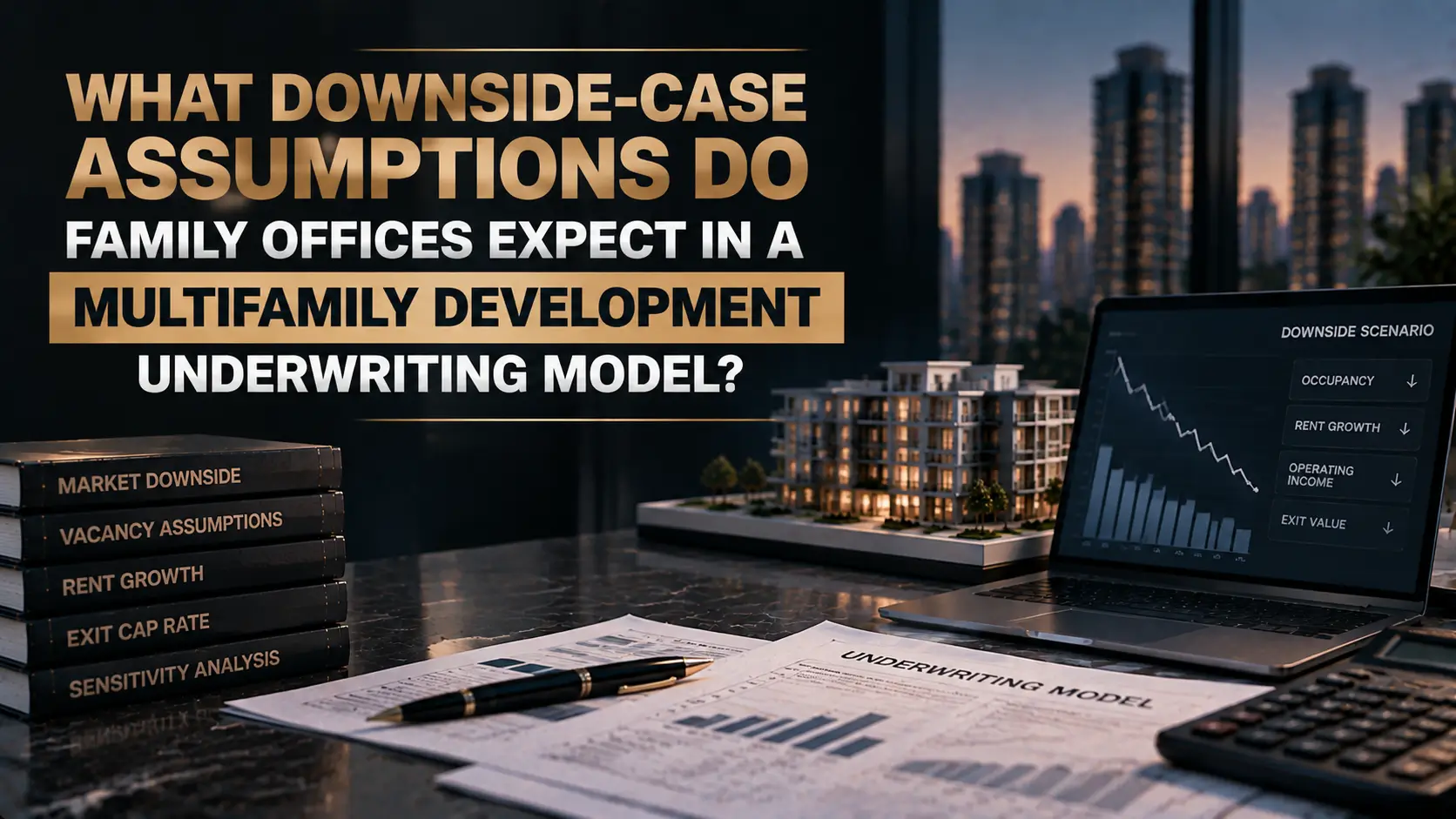
What Downside-Case Assumptions Do Family Offices Expect In a Multifamily Development Underwriting Model?
Family offices expect a downside case that independently stresses vacancy, rent growth, construction costs, and exit cap rate within a live multifamily underwriting model. A credible case also shows DSCR, LP capital return, and the funding source for a construction overrun, with assumptions supported in the data room.
A downside case, in the context of family office LP underwriting of a multifamily development, is a fully modeled bear scenario that stress-tests the four variables most likely to compress returns in a distressed market: stabilized vacancy, annual rent growth, total construction cost, and exit cap rate. Family office investment committees use the downside case to answer one specific question before they review anything else in the model: does this deal survive a bad market, and does the sponsor know what bad looks like?
That question gates equity commitment. A model that presents only a base case tells an LP underwriter that the sponsor lacks experience with adverse conditions or has chosen to hide the risk. Both readings end the conversation.
Sponsors preparing for family office diligence conversations should understand that the downside case functions as a credibility instrument before it functions as a return analysis. The spread between your base case and your downside case is what LPs use to evaluate your underwriting discipline, your market knowledge, and your willingness to show unflattering numbers before being asked. Family offices apply the same discipline standard across every element of the model, from how allocators evaluate sponsor credibility to the downside case itself.
The Four Assumptions Family Offices Stress-Test First
Family office underwriters do not apply a single universal stress multiplier across all assumptions. They stress each variable independently, using market-cycle logic specific to multifamily development. The four assumptions below are the ones that appear in every LP underwriting checklist for ground-up and value-add multifamily deals.
Stabilized Vacancy Rate
Base case models for multifamily development frequently assume 5% stabilized vacancy. Family office underwriters move that number to 10% to 12% in the downside case, reflecting a lease-up environment where absorption slows, concessions increase, and competitive supply enters the market simultaneously.
The LP is testing whether the deal still services its debt and returns LP capital at a higher vacancy band. If the model breaks at 8% vacancy, the underwriter knows the base case has no margin for a soft lease-up. That triggers questions about construction draw timing, interest reserve adequacy, and whether the sponsor has modeled a lease-up extension scenario. Sponsors can cross-reference submarket vacancy and absorption trends using multifamily apartment price and absorption data published by the Federal Reserve Bank of St. Louis.
Annual Rent Growth
Base case rent growth assumptions in multifamily development models typically range from 2.5% to 4% annually across the hold period. Family offices apply a downside scenario of flat rent growth (0%) for the first two years post-stabilization, followed by 1% to 1.5% growth in years three through five.
The LP is measuring whether the deal was underwritten to the market or underwritten to the return target. A model that requires 3.5% annual rent growth to clear the preferred return hurdle signals backward underwriting.
Sponsors should present rent growth assumptions tied to a specific submarket data source. Real estate absorption rate data from providers such as CoStar or CBRE gives LP underwriters the market-level context they need to evaluate whether your growth assumptions are defensible.
Total Construction Cost
Family offices apply a 10% to 15% construction cost overrun in the downside case for ground-up multifamily development. This overrun is modeled as a capital event, meaning the sponsor must show where the additional funds come from: a construction contingency reserve, a GP capital call provision, or a pre-negotiated credit facility.
A downside case that shows a 12% cost overrun but provides no funding source for the gap tells the LP that the sponsor has acknowledged the risk without solving it. That signals awareness without preparation, which weakens LP confidence more than a thin model.
Exit Cap Rate
The exit cap rate assumption is where family office underwriters focus the most attention in a multifamily development model. Base case exit caps for stabilized multifamily assets in primary and secondary markets typically range from 4.5% to 5.5%. Family offices stress-test the downside case at 50 to 100 basis points above the base case exit cap.
At a 100-basis-point expansion, a deal underwritten to a 5.0% exit cap is now modeled at 6.0%. That compression in exit value must still allow LP capital return and, at minimum, a return of invested capital. Historical commercial real estate price index trends tracked quarterly since 1945 illustrate how cap rate cycles have moved across prior market dislocations. If it does not, the underwriter flags the deal as exit-dependent, meaning the sponsor has no margin for a market dislocation at the end of the hold period.
The spread between base case and downside case exit cap is the single number family office investment committees discuss most often. A 25-basis-point spread signals that the sponsor does not believe a real downside is possible. A 75 to 100-basis-point spread signals that the sponsor has modeled a genuine bear scenario and understands how cap rate cycles work.
What a Weak or Missing Downside Case Signals to an Investment Committee
Family office investment committees read the downside case as a proxy for sponsor character as much as sponsor competence. A missing downside case tells the committee that the sponsor either did not build one or chose to omit it. A thin downside case, where the assumptions are only modestly worse than the base case, tells the committee that the sponsor built one to satisfy a checklist.
Both patterns trigger the same response: the LP either passes or restructures the equity terms to compensate for the perceived risk.
Common signals that damage LP confidence during downside review:
- Downside vacancy assumptions within 200 basis points of the base case
- Rent growth in the downside case that remains positive in year one
- Construction cost contingency below 8% of hard costs with no capital call provision
- Exit cap rate spread below 50 basis points versus the base case
- No debt service coverage ratio (DSCR) calculation at downside assumptions
- A downside case delivered as a separate document outside the live model
That last point matters more than sponsors expect. Family office underwriters want to toggle assumptions inside the model and watch the outputs change in real time. A downside case that lives in a separate PDF or slide deck cannot be stress-tested. It can only be read, and reading a static scenario tells the LP nothing about how the model was built.
LP underwriters flag model construction errors in the first fifteen minutes of a diligence review, well before they reach the downside tab.
What Belongs in the Model and Data Room Before the First LP Conversation
The downside case belongs in the model as a live scenario tab, and it belongs in the data room as a documented assumption set with source citations for each stressed variable. These are two separate deliverables with two separate audiences.
{{main-cta}}
Inside the Model
The model's downside tab should include:
- A clearly labeled scenario toggle or input override section
- Downside assumptions for all four primary variables, with the delta from the base case shown explicitly
- A DSCR calculation at downside assumptions across each year of the hold period
- An LP capital return waterfall run at downside assumptions, showing the point at which LP preferred return is impaired
- A construction cost overrun section that identifies the funding source for the gap
Inside the Data Room
The data room's downside case documentation should include:
- A one-page assumption summary showing base case versus downside case for each stressed variable, with the source for each assumption
- A submarket supply pipeline report supporting the vacancy stress assumption
- Rent comp data supporting the flat rent growth scenario
- A GC or cost estimator letter or bid summary supporting the construction cost contingency
- A comparable transaction cap rate table supporting the exit cap rate stress
Sponsors who bring both deliverables to the first LP conversation position themselves as underwriters. That distinction separates sponsors who move through family office diligence in 4 to 9 months from those who stall at the first IC review. The capital stack structure behind institutional multifamily deals and the framing behind presenting funding needs to a family office both shape how the downside case lands in the room.
Frequently Asked Questions
What vacancy rate do family offices use in a multifamily development downside case?
Family office underwriters typically stress stabilized vacancy to 10% to 12% in a multifamily development downside case, compared to a base case assumption of 5%. The higher vacancy band reflects a slow lease-up environment with elevated concessions and new competitive supply entering the submarket simultaneously.
How much should the exit cap rate spread between base case and downside case in a multifamily model?
A credible downside case carries an exit cap rate 75 to 100 basis points above the base case. A spread below 50 basis points signals that the sponsor has modeled a cosmetic downside. Family office investment committees flag thin spreads as a structural risk indicator, particularly for development deals with five-year or longer hold periods.
What construction cost contingency do family offices expect in a ground-up multifamily downside case?
Family offices apply a 10% to 15% hard cost overrun in the downside scenario. The model must also identify the funding source for the gap, whether that is a construction contingency reserve, a GP capital call provision, or a pre-arranged credit facility. A cost overrun without a corresponding funding source is treated as an unresolved risk.
Does a downside case need to be a live tab in the financial model or can it be a separate document?
Family office underwriters expect the downside case to be a live scenario tab inside the financial model so they can toggle assumptions and observe output changes in real time. A static PDF or slide deck presentation of downside assumptions cannot be stress-tested during diligence and signals that the model was built for presentation, not analysis.
What rent growth assumption does a family office LP use in a multifamily development downside case?
Family offices apply flat rent growth (0%) for the first two years post-stabilization in the downside case, followed by 1% to 1.5% annual growth in years three through five. A downside case that shows positive rent growth in year one tells the LP underwriter that the sponsor has modeled a soft scenario, not a genuine bear scenario.
What does a missing downside case signal to a family office investment committee?
A missing downside case signals one of two things to a family office investment committee: the sponsor lacks experience with adverse market conditions, or the sponsor chose to omit unflattering numbers. Both readings produce the same outcome: the LP passes or restructures the equity terms to compensate for the perceived underwriting risk.
What data room documents support the downside case assumptions in a multifamily development raise?
The data room should include a one-page base case versus downside case assumption summary with source citations, a submarket supply pipeline report supporting the vacancy stress, rent comp data supporting flat rent growth, a GC bid or cost estimator letter supporting the construction cost contingency, and a comparable transaction cap rate table supporting the exit cap rate stress.
Continue reading this series:
- How family offices evaluate deal-by-deal vs. blind pool structures
- Capital stack layers that minimize risk for developers
- 47 due diligence documents $10M+ sponsors must have ready
By the time most founders are rehearsing the pitch, the outcome of the raise has already been set by the structure underneath it. IRC Partners advises operators raising $5M to $250M of institutional capital and accepts seven strategic partners per quarter. If you are going to market this year, have the structure reviewed before investors do. Schedule a call with our team here.
Need guidance on your capital raise?


How Partial-Sale Loopholes in Drag-Along Clauses Allow Controlling Blocks to Transfer in Stages and Dodge Tag Rights

What Operating Covenants Do Family Offices Commonly Request From Real Estate Sponsors After Closing?

Fees for Capital Raising Advisory
Disclosure
Nothing on this site constitutes an offer to sell, or a solicitation of an offer to purchase, any security under the Securities Act of 1933, as amended, or any applicable state securities laws. Any offering of securities is made only by means of a formal private placement memorandum or other authorized offering documents delivered to qualified investors.
IRC Partners is a capital advisory firm. IRC Partners is not a registered investment adviser under the Investment Advisers Act of 1940 and does not provide investment advice as defined thereunder.
Certain statements in this article may constitute forward-looking statements, including statements regarding market conditions, capital availability, investor demand, and transaction outcomes. Such statements reflect current assumptions and expectations only. Actual results may differ materially due to market conditions, regulatory developments, company-specific factors, and other variables. IRC Partners makes no representation that any outcome, return, or result described herein will be achieved.
References to prior mandates, transaction volume, network credentials, or capital raised are provided for illustrative purposes only and do not constitute a guarantee or prediction of future results. Past performance is not indicative of future outcomes. Individual results will vary. Network credentials and transaction statistics referenced on this site reflect the aggregate experience of IRC Partners' principals and affiliated advisors and are not a representation of assets managed or transactions closed solely by IRC Partners.
Certain data, statistics, and information presented in this article have been obtained from third-party sources. IRC Partners has not independently verified such information and expressly disclaims responsibility for its accuracy, completeness, or timeliness. Readers should independently verify any third-party data before relying on it.
Readers are strongly encouraged to consult qualified legal, financial, and tax professionals before making any investment, capital raising, or business decision.
Schedule A Meeting
You get one shot to raise the right way. If this raise is worth doing, it’s worth doing with precision, leverage, and control.
This isn’t a practice run. Serious capital. Serious strategy. Let’s raise it right.
We onboard a maximum of seven
new strategic partners each quarter, by application only, to maximize your chances of securing the capital you need.
