.svg "CTA Arrow")


.png "Investor Ready Capital decorative background element")

Which Capital Stack Layers Are Best for Minimizing Risk?
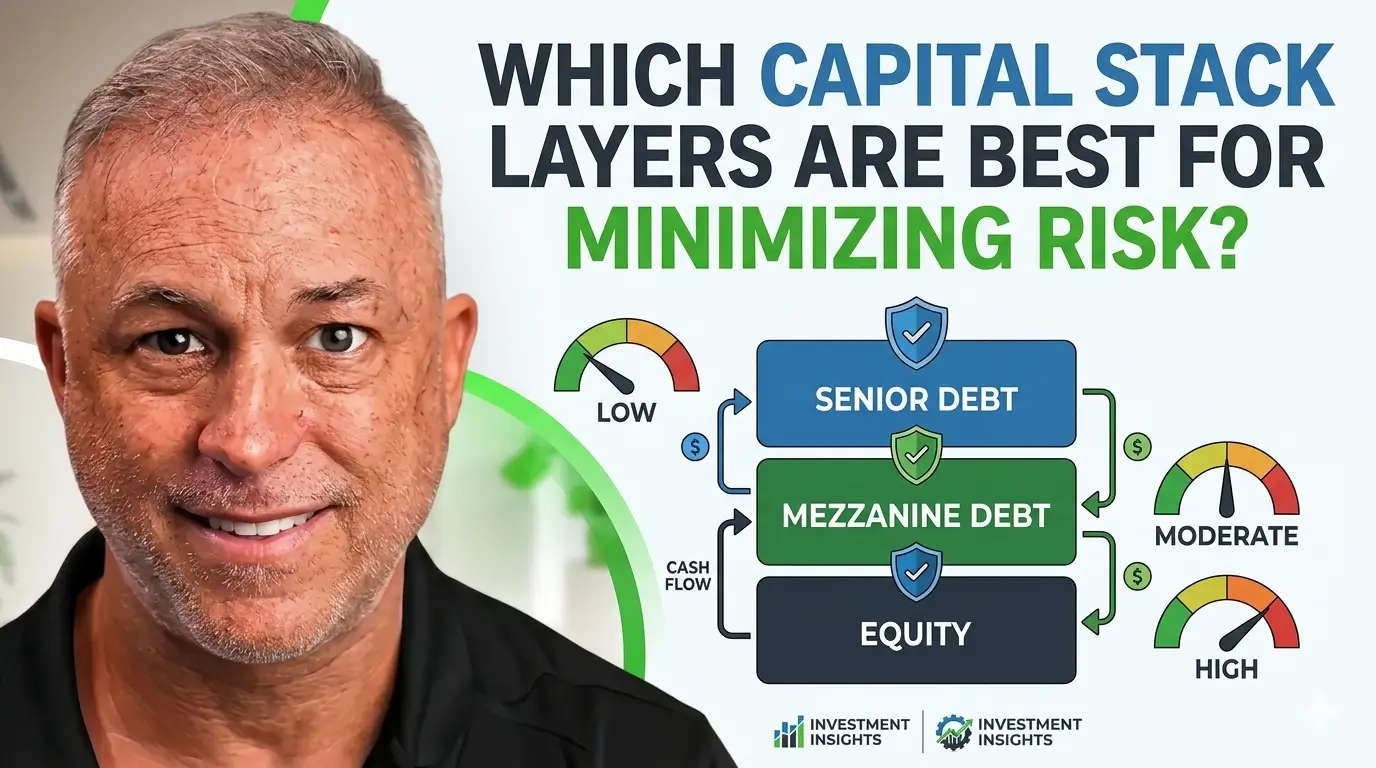
The capital stack layers that best minimize risk for a real estate developer are, in order of GP downside protection: senior debt only, senior debt plus softly structured preferred equity, and senior debt plus common equity. This guide breaks down how each layer behaves under stress, which combinations protect GP economics, and how sequencing determines whether a developer survives a difficult quarter or loses control of the deal.
Securing this precise blend of downside protection requires a strategic approach to sourcing institutional capital for real estate sponsors. Most developers building a capital stack are solving a proceeds problem—they want to minimize equity, maximize leverage, and close at the best blended cost. That logic works well on a proforma. It breaks down fast when a deal underperforms.
Lease-up slows. Construction costs run over. The refinance comes in 15 points light. At that moment, the question is no longer which layer was cheapest. The question is which layers can absorb the pressure, which layers will accelerate, and whether the GP still has enough control to work the deal out.
The full sequencing framework for a $10M+ institutional capital stack lives in our hub guide to structuring the capital stack for real estate deals. This spoke focuses on a narrower and more urgent question: which layers create the most downside risk for the GP, which combinations best protect GP economics under stress, and how sequencing determines whether a developer survives a bad quarter or loses the deal.
Before you go to market on your next raise, four questions should drive your stack design:
- Which layer absorbs losses first, and how much cushion does that leave before senior debt is impaired?
- Which layer has the legal right to accelerate, foreclose, or transfer control when a payment is missed?
- Which layer creates the most friction in a workout, and which gives the GP the most runway to cure?
- Does the incremental capital from each layer actually reduce risk, or does it only delay it at higher cost?
The answers depend less on the type of instrument and more on what the documents actually say.
A Quick Stress Map: Which Layer Gets Hit First, and Which Creates the Most Friction?
Loss absorption order and friction risk are not the same thing. Common equity and GP equity absorb losses first, but they do not necessarily create the most operational friction. That distinction matters when a deal is under stress.
The table below maps each layer across four dimensions that determine real downside exposure for a GP.
Key insight: Mezzanine debt sits in the middle of the stack economically but carries the highest control risk for the GP. A mezzanine lender who holds a lien against pledged equity interests can move faster and with more legal certainty than a preferred equity investor who only holds an ownership stake in the property entity.
The safest layer for GP economics is not the one that absorbs losses last. It is the one that gives the GP the most time and flexibility to cure a problem before control shifts.
How Each Capital Stack Layer Behaves When the Deal Goes Sideways
Understanding how each layer behaves under stress is more useful than knowing its position in the repayment waterfall. Here is what each layer actually does when a deal misses its business plan.
1. Senior Debt
Senior debt is the most protected layer economically. It holds a first lien on the property, gets paid before any other capital, and has recovery rates that often approach par in institutional deals. For the GP, senior debt is usually the least threatening layer to control.
That said, senior debt is not passive. Most institutional senior lenders include:
- Debt service coverage ratio (DSCR) covenants that can trigger a technical default before a payment is missed
- Cash sweep provisions that redirect operating cash flow to debt service once coverage ratios drop
- Extension tests that require the borrower to meet leasing, occupancy, or LTV thresholds to access a loan extension
- Refinance leverage limits that may force the GP to bring fresh equity to the table at maturity
None of these mechanisms transfer control to the lender directly. But they compress GP optionality and create forced decision points at exactly the wrong time in a deal cycle.
2. Mezzanine Debt
Mezzanine debt is where GP control risk concentrates. According to the CAIA curriculum on mezzanine financing, mezzanine capital historically supplies 10 to 40% of a project's capital structure and fills the gap between first mortgage financing and equity. That gap is valuable at closing. It becomes dangerous under stress.
The core risk is legal, not financial. A mezzanine lender holds a lien against the equity interests of the entity that owns the property. On default, the lender can foreclose on those equity interests via a UCC sale rather than a traditional property foreclosure. That process can move in weeks, not months. Cure windows in intercreditor agreements are often short, and the senior lender's consent is required before the mezz lender can pursue most remedies.
The real risk: A springing subordination clause can stop mezzanine interest payments the moment a covenant is violated at the senior level, even before the GP has missed a single payment to the mezz lender. The GP can be technically in default at two levels simultaneously before the deal shows visible distress.
3. Preferred Equity
Preferred equity sits below all debt in the repayment hierarchy but above common and GP equity. Its risk profile is more variable than mezzanine because it depends almost entirely on the operating agreement and the specific rights negotiated.
Preferred equity that is structured with soft remedies, reasonable cure periods, and no removal or dilution rights is meaningfully safer for the GP than mezzanine debt. Preferred equity that includes GP removal rights, forced sale triggers, or automatic dilution on a missed preferred return is functionally as dangerous as mezz, but with fewer legal protections for the GP.
The distinction between hard and soft preferred equity matters here. Hard preferred equity requires payment regardless of cash flow. Soft preferred equity only requires payment when the property generates sufficient income. For development deals with deferred cash flow, the difference between these two structures can determine whether the GP survives a slow lease-up.
4. LP Equity
LP equity is usually the most passive layer in the stack during normal operations. LPs participate in distributions according to the waterfall and typically have limited day-to-day governance rights.
Under stress, LP equity creates two risks for the GP:
- Rescue capital dilution: If the deal needs fresh equity to cure a default or fund a cost overrun, LPs who contribute rescue capital may reset waterfall economics in their favor, reducing or eliminating the GP promote.
- Major decision drag: LPs often hold consent rights over major decisions including refinancing, asset sales, and capital calls. In a workout, those consent rights can slow the GP's ability to respond.
5. GP Equity
GP equity is first-loss capital. The GP's invested equity is the first to be wiped out in any scenario where total proceeds fall short of total capital obligations. That is the explicit trade for the promote and the control position.
The real protection for GP equity is not how much of it is invested. It is how well the layers above it are structured. A GP who has invested 5% of the stack into a deal with aggressive mezzanine terms and poorly negotiated preferred equity is far more exposed than a GP who invested the same 5% into a stack with conservative senior debt and softly structured preferred equity.
Bottom line: GP equity preservation is a function of what sits above it, not what sits within it.
The Real Issue Is Sequencing: Which Combinations Best Protect the GP?
Knowing how each layer behaves is useful. Knowing which combinations to use together is what actually changes outcomes. The right stack for a given deal depends on the business plan, the asset class, and the amount of execution risk the GP is carrying.
According to Paul, Weiss's 2026 Private Credit Outlook, institutional investors are increasingly favoring hybrid capital structures that prioritize downside protection over raw return. That shift matters for developers: the capital providers who write the largest checks are now scrutinizing stack design as a signal of sponsor discipline, not just a financing decision.
The three most common institutional stack combinations, and how they compare on GP downside protection:\
What this means in practice
Senior debt plus common equity is the cleanest structure for GP downside protection when the proceeds math allows it. There is no middle layer to accelerate, no intercreditor complexity, and no consent rights from a third capital provider. The trade-off is lower leverage and more equity required.
Senior debt plus preferred equity is often the right answer for institutional development deals when the pref layer is negotiated correctly. The GP keeps more proceeds flexibility than a common-equity-only stack while avoiding the acceleration risk of mezzanine. The key is ensuring the preferred equity documents do not include removal rights, hard cash-pay requirements during construction, or forced sale triggers tied to a missed preferred return.
Senior debt plus mezzanine makes sense when the business plan has a clear, low-risk path to stabilization and the GP has strong conviction on lease-up timing and refinance proceeds. It is the wrong choice when the deal carries construction risk, market absorption uncertainty, or a refinance that depends on hitting a tight LTV target. In those scenarios, the proceeds efficiency of mezzanine is not worth the control risk it introduces.
{{main-cta}}
An IRC Engagement Example: How Better Layer Sequencing Reduced Downside Exposure
The following is an anonymized example drawn from an IRC Partners advisory engagement on a $10M+ development deal. Client details have been removed.
The situation: A multifamily developer came to IRC with a capital stack that had been structured by a prior advisor around proceeds optimization. The stack included senior construction debt, a mezzanine layer from a private debt fund, and a thin common equity base. On paper, the leverage worked. Under a stress case with a 90-day lease-up delay and a 10% reduction in exit cap rate, the mezzanine lender's cure window would have expired before the GP had a realistic path to recapitalization.
What IRC changed:
- Replaced the mezzanine layer with a softly structured preferred equity tranche from an institutional LP with no removal rights and a 12-month cure period
- Increased the common equity base modestly to satisfy senior lender extension tests under a downside scenario
- Negotiated waterfall language that preserved GP promote above a minimum return threshold even in a partial recovery
The result: The deal closed with comparable proceeds to the original structure, but with meaningfully lower acceleration risk and a GP equity position that survived the modeled downside case intact.
The value was not in finding cheaper capital. It was in structuring before going to market, rather than renegotiating under pressure after a problem surfaced.
What Developers Should Do Before the Next Raise
Use this as an internal diligence checklist before going to market. The goal is to identify structural vulnerabilities before capital providers do.
Stress-test the stack before marketing it:
- Model a downside case with lower NOI, slower absorption, higher construction costs, and a refinance that comes in 10-15 points below projection
- Identify which layer triggers first under each scenario, and whether the GP has a realistic cure path within the document-defined window
Review every document for control risk:
- Who can force a sale, recapitalization, or GP removal, and under what conditions?
- What are the cure periods at each layer, and are they realistic given how long a workout actually takes?
- Does any cash sweep, DSCR covenant, or extension test create a forced decision point that the GP cannot control?
Ask the right question about each layer you add:
- Does this layer reduce risk or only delay it at higher cost and tighter control?
- Would institutional LPs reading the documents see this stack as disciplined or fragile?
For a deeper comparison of how senior debt, mezzanine, and preferred equity differ structurally, see the senior debt vs. mezzanine vs. preferred equity breakdown in this cluster. For guidance on which firms specialize in structuring institutional stacks, the best firms for structuring capital stacks in real estate spoke covers the advisory landscape. Before going to market, it also helps to review the non-negotiables institutional investors check before committing capital, since stack design is one of the first things a sophisticated LP will scrutinize.
Frequently Asked Questions
Which capital stack layer absorbs losses first in a real estate deal?
The loss absorption order follows the reverse of payment priority: developer equity absorbs losses first, followed by limited partner equity, preferred equity, mezzanine debt, and finally senior debt. As the most junior capital, the developer's invested cash is fully at risk before any other capital provider faces a shortfall in a downside scenario.
Is preferred equity safer than mezzanine debt for a developer?
Safety is determined by document terms rather than the instrument type. Preferred equity with soft remedies and no removal rights is generally safer than mezzanine debt. However, preferred equity with forced sale triggers or dilution provisions can be just as risky as mezzanine debt, often with fewer legal protections for the developer.
What is the biggest default risk with mezzanine debt?
The primary risk is the speed of enforcement. Because a mezzanine lender holds a lien against equity interests rather than the real estate itself, they can execute a foreclosure under the Uniform Commercial Code in a matter of weeks. This is significantly faster than a traditional real estate foreclosure, leaving the developer with very little time to cure a default.
How does capital stack sequencing affect downside protection?
Sequencing dictates who controls the workout and how much runway the developer has to resolve issues. A stack structured with conservative senior debt and soft preferred equity offers significantly more flexibility during market volatility than a stack featuring aggressive mezzanine terms that allow for rapid seizure of control.
What is springing subordination in a mezzanine agreement?
Springing subordination is a clause that automatically halts mezzanine interest payments if a covenant is violated at the senior debt level. This can put the developer in technical default on the mezzanine layer even if they are otherwise current on all payments, creating a debt trap during the early signs of project distress.
Can preferred equity investors remove a developer from a deal?
Yes, if removal rights are negotiated into the operating agreement. Many institutional preferred equity providers include bad boy acts or financial performance triggers—such as missing a preferred return payment—that allow them to seize control or dilute the developer interest. These terms must be scrutinized carefully during the term sheet phase.
What is the safest capital stack structure for raising 10M dollars or more?
The most resilient structure for institutional deals in 2026 is typically conservative senior debt paired with softly structured preferred equity. While a senior-debt-and-common-equity stack is the cleanest, it requires significantly more upfront cash. Mezzanine debt should be reserved for projects with high execution certainty and a very clear path to stabilization.
Continue reading this series:
- The capital stack explained: equity, debt, and what investors actually want
- 7 non-negotiables for institutional raises
- 10 mistakes that kill your institutional raise
This isn't for pre-revenue companies or first-time founders. It's for operators at $1M+ ARR, raising $5M to $250M of institutional capital, who've done this before and want the next round architected right. If that's you, schedule a call to discuss HERE.
Sponsors weighing this decision should first complete a capital raise readiness assessment for sponsors to confirm the raise is investor-ready.
Need guidance on your capital raise?



Key Benefits of Venture Capital Fundraising Advisory

How Long Does Real Estate Capital Raising Take?

Industrial Real Estate Investment: How $10M+ Sponsors Structure Warehouse and Logistics Deals That Institutional Capital Funds
Disclosure
Nothing on this site constitutes an offer to sell, or a solicitation of an offer to purchase, any security under the Securities Act of 1933, as amended, or any applicable state securities laws. Any offering of securities is made only by means of a formal private placement memorandum or other authorized offering documents delivered to qualified investors.
IRC Partners is a capital advisory firm. IRC Partners is not a registered investment adviser under the Investment Advisers Act of 1940 and does not provide investment advice as defined thereunder.
Certain statements in this article may constitute forward-looking statements, including statements regarding market conditions, capital availability, investor demand, and transaction outcomes. Such statements reflect current assumptions and expectations only. Actual results may differ materially due to market conditions, regulatory developments, company-specific factors, and other variables. IRC Partners makes no representation that any outcome, return, or result described herein will be achieved.
References to prior mandates, transaction volume, network credentials, or capital raised are provided for illustrative purposes only and do not constitute a guarantee or prediction of future results. Past performance is not indicative of future outcomes. Individual results will vary. Network credentials and transaction statistics referenced on this site reflect the aggregate experience of IRC Partners' principals and affiliated advisors and are not a representation of assets managed or transactions closed solely by IRC Partners.
Certain data, statistics, and information presented in this article have been obtained from third-party sources. IRC Partners has not independently verified such information and expressly disclaims responsibility for its accuracy, completeness, or timeliness. Readers should independently verify any third-party data before relying on it.
Readers are strongly encouraged to consult qualified legal, financial, and tax professionals before making any investment, capital raising, or business decision.
Schedule A Meeting
You get one shot to raise the right way. If this raise is worth doing, it’s worth doing with precision, leverage, and control.
This isn’t a practice run. Serious capital. Serious strategy. Let’s raise it right.
We onboard a maximum of seven
new strategic partners each quarter, by application only, to maximize your chances of securing the capital you need.
