.svg "CTA Arrow")


.png "Investor Ready Capital decorative background element")

The Difference Between Drag-Along and Tag-Along Rights - and Why Confusing Them Costs Founders Millions at Exit
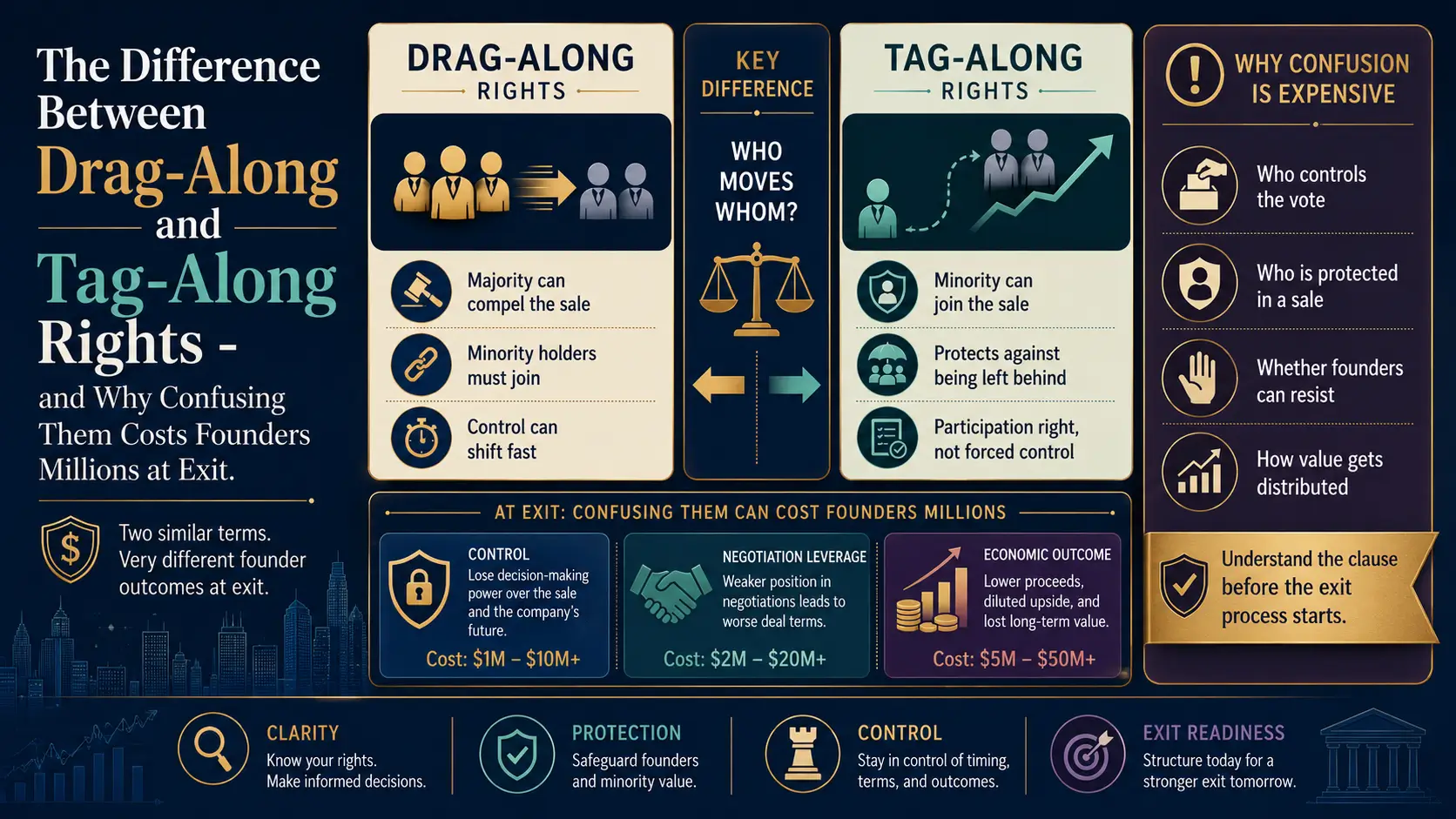
The Difference Between Drag-Along and Tag-Along Rights - and Why Confusing Them Costs Founders Millions at Exit
Drag-along rights force minority stockholders to sell their shares when a required majority approves a company sale. Tag-along rights give minority stockholders the ability to join a sale initiated by another holder, on the same terms. They are not two versions of the same protection - they operate in opposite directions, apply in different situations, and protect different parties. Founders who treat them as interchangeable discover the difference at the worst possible moment: when a buyer is already in the room and negotiating leverage is gone. The confusion is not just a vocabulary problem. It is an economics problem, and the cost shows up at closing.
Both terms appear in sale-rights conversations. Both show up in the same document stack. That proximity is exactly why founders confuse them. But the confusion is not just a vocabulary problem. It is an economics problem. A founder who assumes their tag-along right insulates them from a forced sale is exposed. A founder who does not understand their drag-along obligation may miss the window to negotiate the protective details that determine how much they keep at closing.
This article is part of the series on drag-along provisions for growth-stage companies. It narrows the focus to the structural difference between drag-along and tag-along rights and what that difference costs founders who do not catch it before the round closes.
Drag-Along vs. Tag-Along: Side-by-Side
How Drag-Along Rights Work: The Obligation Side
Drag-along rights are an obligation, not an option. When the required approvals are met, a minority stockholder does not get to decide whether to participate. They are required to vote in favor of the transaction, sell on the approved terms, and sign the necessary closing documents.
The approval structure matters more than most founders realize. Under NVCA model documents, a drag-along provision is typically triggered by a combination of board approval and approval from a negotiated percentage of preferred stockholders, sometimes alongside a common stockholder threshold. Unanimous consent is not required. That means a founder can be in the minority, outvoted, and legally bound to proceed.
What Triggers a Drag-Along
- Board of directors approves the sale
- Required percentage of preferred stockholders consent (often a majority or supermajority of the preferred class)
- In some structures, a separate common stockholder threshold also applies
- Once those thresholds are met, all remaining holders are dragged, regardless of individual objection
The Founder Risk Most People Miss
The practical risk for a founder is not just being outvoted. It is discovering that the document structure removed any meaningful blocking power before the deal was even on the table. By the time a buyer is engaged, the approval math is already done. The founder's ability to influence the outcome depends almost entirely on what was negotiated into the drag-along language before signing, not after.
Key point: Market-standard drag-along protections that founders should negotiate include several liability (not joint), pro rata exposure on indemnification claims, equal treatment on consideration, and reasonable notice and process obligations. If those terms are missing or weak, the drag obligation gets more expensive at closing.
Founders preparing for a $5M+ raise should review these mechanics before the round closes, not during diligence. IRC Partners works with founders at this stage to identify structural exposure before it hardens into final documents.
How Tag-Along Rights Work: The Participation Side
Tag-along rights solve a different problem entirely. They protect minority holders from being left out of liquidity when a controlling or major holder sells shares to a third party. If a founder or lead investor negotiates a private sale of their shares, tag-along rights let other holders join that transaction on the same terms, proportionally.
How a Tag-Along Right Typically Activates
- A major holder (founder, lead investor, or other significant stockholder) receives an offer to sell shares to a third party
- The selling holder must notify other stockholders of the proposed sale terms
- Tag-along holders have a window to elect to participate, selling their own shares at the same price and on the same conditions
- If the buyer is unwilling to purchase the full combined amount, the sale is scaled back proportionally among all participating holders
Tag-along rights appear most often in the ROFR and co-sale agreement, which is a separate document from the voting agreement where drag-along typically lives. That separation is one structural reason founders misread the scope of each right.
What Tag-Along Does Not Do
- It does not stop a drag-along from being triggered
- It does not give a minority holder the power to block a company-wide sale
- It does not guarantee liquidity, only the right to participate if a qualifying transfer occurs
- It does not apply to most M&A transactions, which are company-level events governed by drag-along mechanics, not co-sale rights
The core confusion: Founders sometimes read their tag-along right as a general exit protection. It is not. It protects against being excluded from a specific type of holder-level transfer. A drag-along event is a different trigger, governed by different documents, and tag-along language does not neutralize it.
The Four Ways Confusing These Rights Costs Founders Money at Exit
This is where vocabulary confusion becomes an economics problem. Each of the four scenarios below represents a real negotiating failure that plays out at the closing table, not in a term sheet review session.
- Assuming tag-along protects you from a forced sale. A founder who believes their co-sale right shields them from a drag event will not scrutinize the drag threshold, the approval composition, or the sale-process protections. When two preferred investors holding a majority of the preferred class approve a sale, the drag-along triggers. The founder's tag-along right is irrelevant. They are compelled to sell, on the approved terms, with whatever indemnification exposure the document contains.
- Ignoring the approval threshold math. Drag-along thresholds are negotiated numbers. If two investors collectively hold enough preferred to clear the consent threshold without a single founder vote, the founder has no practical blocking power regardless of their common ownership percentage. Founders who do not model this math before signing often discover the exposure only when a sale process begins. Understanding how to negotiate information rights and protective provisions in $10M+ term sheets is part of the same pre-round review that should include drag thresholds.
- Accepting weak protective language inside the drag obligation. Drag-along rights are not all identical. A drag provision without several liability, pro rata indemnification exposure, or equal consideration treatment can cost a founder real dollars at closing through disproportionate rep and warranty exposure or unequal deal economics. These terms are negotiable before the round closes. They are nearly impossible to reopen once a buyer is engaged.
- Waiting until diligence to review the clause. The most expensive mistake is timing. Founders who first read their drag-along language during a live sale process are negotiating from the weakest possible position. Buyers know the documents. Investors know the documents. The founder who reviews their capital stack structure and equity mechanics before the round closes has options. The founder who reviews them during diligence has almost none.
{{main-cta}}
What to Review in Your Documents Before the Round Closes
Most founders treat document review as a legal task. It is also a negotiation task. These are the specific items to locate and confirm before your round closes, not after your first board meeting.
Pre-Closing Document Review Checklist
Drag-along mechanics
- Locate the drag-along provision: it typically lives in the voting agreement, with possible references in the charter
- Identify the approval threshold: what percentage of preferred is required, and does a common or founder class have any separate consent right
- Confirm who counts toward the threshold: all preferred as a single class, or series-by-series
- Check whether the founder or common holders have any blocking right, consent carve-out, or minimum price protection
Protective terms inside the drag obligation
- Several liability confirmed (not joint and several)
- Indemnification exposure is pro rata and capped, not uncapped or disproportionate
- All holders receive equal treatment on form and timing of consideration
- Notice and process obligations are defined and reasonable
Tag-along and co-sale mechanics
- Locate the co-sale agreement: confirm which transfers trigger tag-along rights and which are exempt
- Confirm tag-along does not create a false assumption of protection against a drag-along event
- Check that ROFR and co-sale mechanics are consistent with drag-along language across documents
Cross-document consistency
- Drag-along, protective provisions, board rights, and co-sale language should be read together, not in isolation
- Inconsistencies between documents can create false assumptions about what protection you actually hold
If you are preparing for a $5M+ raise and have not reviewed these mechanics with an advisor before outreach begins, you are negotiating with incomplete information. Buyers arrive at diligence with your documents already mapped. Reviewing the 47 documents buyers request in M&A due diligence before a process begins tells you exactly where your governance gaps are while you still have time to fix them. Founders who want to understand how debt and equity structures interact with exit rights before committing to a capital structure are in a significantly stronger position at the term sheet stage.
Frequently Asked Questions
Do tag-along rights give a founder any power to stop a company sale?
Tag-along rights do not give a founder the ability to stop a company sale. They are a participation right, not a veto. A tag-along right applies when another holder sells their individual shares to a third party, not when a company-wide sale is approved through a drag-along mechanism. If a drag-along triggers, tag-along language in the co-sale agreement does not override it.
Can a founder be dragged even if they vote against the sale?
Yes. Once the required approval thresholds are met under the drag-along provision, a minority stockholder who votes against the transaction is still legally obligated to sell, sign closing documents, and accept the approved terms. The drag-along removes the individual veto. The only practical protection is negotiating meaningful thresholds or consent rights before the round closes, not after a sale process begins.
Where exactly do drag-along and tag-along rights appear in a deal's document stack?
Drag-along rights typically appear in the voting agreement, sometimes with corresponding references in the amended and restated certificate of incorporation. Tag-along rights appear in the ROFR and co-sale agreement, which is a separate document. Because they live in different agreements, founders reviewing only one document can easily miss the full picture of what each right actually covers.
What is the minimum approval threshold that can trigger a drag-along?
There is no universal minimum. Thresholds are negotiated deal by deal. In many NVCA-style structures, the drag-along triggers on board approval plus consent from a majority or supermajority of preferred stockholders voting as a single class. Some deals include a separate common stockholder threshold. The number matters because a low preferred-only threshold can allow two or three investors to approve a sale without a single founder vote counting toward the trigger.
Does a tag-along right guarantee that a minority holder gets the same price as the selling holder?
Yes, in most structures. A tag-along right entitles the participating holder to sell at the same price, on the same terms, and at the same time as the transferring holder. The protection is parity of economics on that specific transfer. It does not, however, apply to a drag-along event, where the consideration terms are set by the approved transaction documents rather than the co-sale agreement.
Can founders negotiate to have their shares excluded from a drag-along obligation?
Founders can negotiate consent carve-outs, minimum price floors, or founder-class approval requirements that add friction to a drag-along trigger. Full exclusion is uncommon in institutional rounds. What is more achievable is ensuring that the protective terms inside the drag obligation are strong: several liability, capped indemnification, equal consideration, and defined process timelines. These terms do not remove the drag obligation, but they significantly reduce the economic downside of being dragged.
How does a drag-along provision interact with liquidation preferences at exit?
Drag-along rights govern whether a founder must participate in a sale. Liquidation preferences govern how the proceeds are distributed once the sale closes. Both matter at exit, but they operate independently. A founder dragged into a sale at a valuation below the preferred liquidation stack may receive little or no proceeds even after being compelled to sell. Reviewing both the drag mechanics and the liquidation waterfall before signing is essential for any founder modeling realistic exit scenarios.
Continue reading this series:
- Drag-Along Rights Explained: What Growth-Stage Founders Actually Sign Away at Series A and Forget Until Exit
- How Drag-Along Rights Get Buried in Your Term Sheet and Activated at the Worst Possible Moment
- The 51% vs. 75% Drag-Along Threshold: How One Number Determines Whether Two Investors Can Force Your Exit Without a Single Founder Vote
The structure you carry into your first investor meeting sets the terms for every round that follows it. Founders who get it wrong spend the next three rounds negotiating from behind. IRC Partners advises operators raising $5M to $250M of institutional capital. The Capital Raise Pre-Flight runs your deal through the twelve gates institutional investors screen for, before any of them see it. Book your Capital Raise Pre-Flight consult here.
Sponsors weighing this decision should first complete a capital raise readiness assessment for sponsors to confirm the raise is investor-ready.
Need guidance on your capital raise?



What Asset-Management Fees are Acceptable To Family Offices in a $10M+ Real Estate Equity Raise?

How to Choose an Advisor for Capital Raising Outcomes and Success Rates

The Right of First Refusal Problem: How ROFR Provisions on Your Cap Table Block Secondary Sales and Complicate Series B Closing
Disclosure
Nothing on this site constitutes an offer to sell, or a solicitation of an offer to purchase, any security under the Securities Act of 1933, as amended, or any applicable state securities laws. Any offering of securities is made only by means of a formal private placement memorandum or other authorized offering documents delivered to qualified investors.
IRC Partners is a capital advisory firm. IRC Partners is not a registered investment adviser under the Investment Advisers Act of 1940 and does not provide investment advice as defined thereunder.
Certain statements in this article may constitute forward-looking statements, including statements regarding market conditions, capital availability, investor demand, and transaction outcomes. Such statements reflect current assumptions and expectations only. Actual results may differ materially due to market conditions, regulatory developments, company-specific factors, and other variables. IRC Partners makes no representation that any outcome, return, or result described herein will be achieved.
References to prior mandates, transaction volume, network credentials, or capital raised are provided for illustrative purposes only and do not constitute a guarantee or prediction of future results. Past performance is not indicative of future outcomes. Individual results will vary. Network credentials and transaction statistics referenced on this site reflect the aggregate experience of IRC Partners' principals and affiliated advisors and are not a representation of assets managed or transactions closed solely by IRC Partners.
Certain data, statistics, and information presented in this article have been obtained from third-party sources. IRC Partners has not independently verified such information and expressly disclaims responsibility for its accuracy, completeness, or timeliness. Readers should independently verify any third-party data before relying on it.
Readers are strongly encouraged to consult qualified legal, financial, and tax professionals before making any investment, capital raising, or business decision.
Schedule A Meeting
You get one shot to raise the right way. If this raise is worth doing, it’s worth doing with precision, leverage, and control.
This isn’t a practice run. Serious capital. Serious strategy. Let’s raise it right.
We onboard a maximum of seven
new strategic partners each quarter, by application only, to maximize your chances of securing the capital you need.
