.svg "CTA Arrow")


.png "Investor Ready Capital decorative background element")

The 51% vs. 75% Drag-Along Threshold: How One Number Determines Whether Two Investors Can Force Your Exit Without a Single Founder Vote
The 51% vs. 75% Drag-Along Threshold: How One Number Determines Whether Two Investors Can Force Your Exit Without a Single Founder Vote
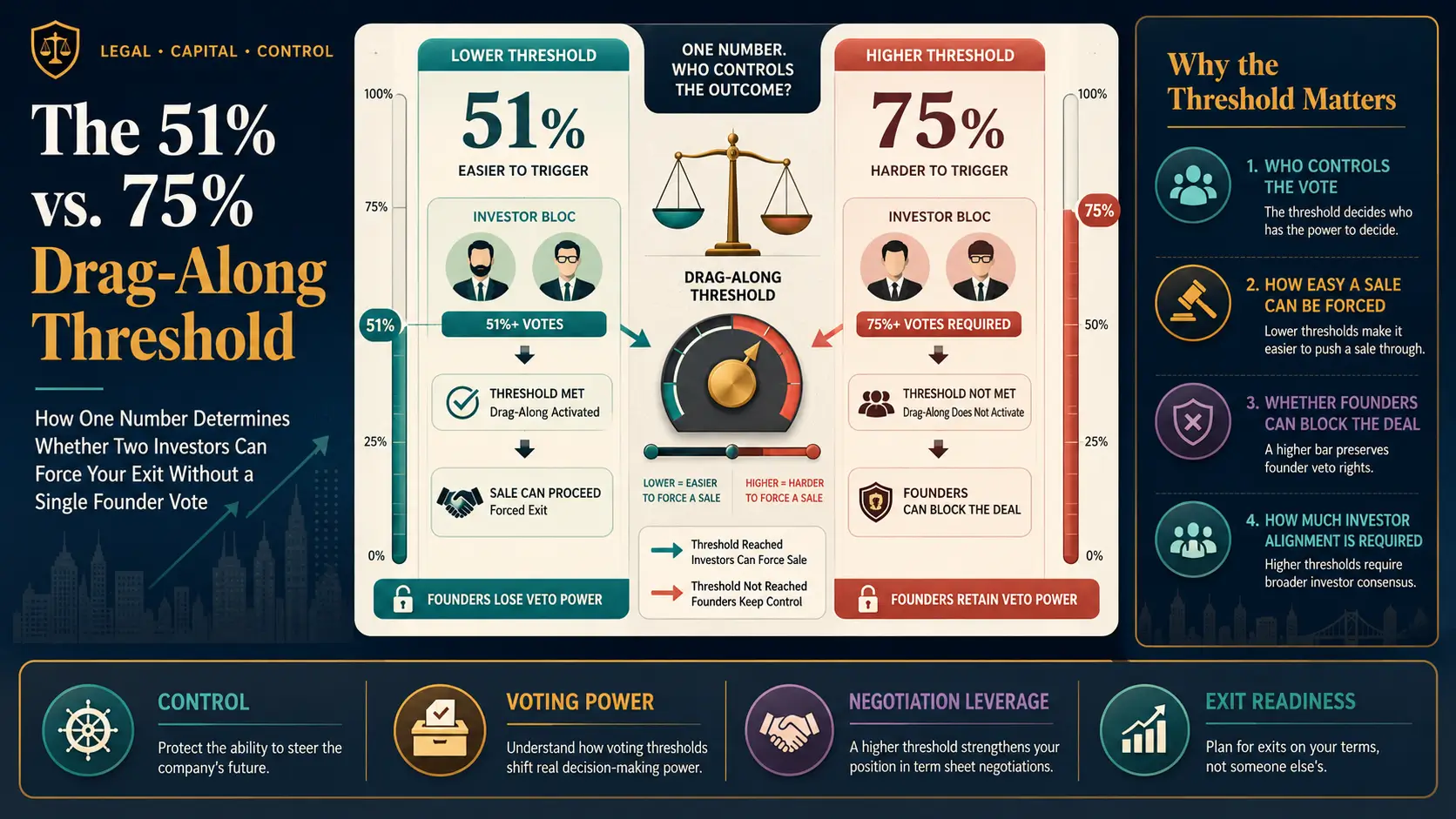
A drag-along approval threshold has two components: the percentage required and the stockholder class being counted - and most founders read the percentage and stop there. That is the wrong stopping point. A 51% preferred-only threshold can let two investors force a compelled sale without a single founder vote if those investors hold enough preferred stock on an as-converted basis. A 75% preferred-only threshold raises the coordination bar, but it still excludes founder consent entirely if founders are not part of the required voting group. The only structure that gives founders a genuine seat in the exit decision is dual approval: a preferred-holder threshold combined with a separate founder or common-class consent requirement - and understanding the difference between those structures is what separates a protective drag-along clause from one that looks protective until a buyer appears.
This spoke goes deeper on the approval-threshold lever introduced in breakdown of the three outcome-driving clauses inside a drag-along provision. For the full drag-along framework, start with What Growth-Stage Companies Need to Know About Drag-Along Provisions Before They Become a Problem.
Key takeaways:
- The percentage in a drag-along threshold tells you the coordination bar. The voting group definition tells you whether founders are inside or outside the approval math.
- A preferred-only threshold at any percentage level excludes founder consent by design.
- Dual approval is the negotiating target, not a higher percentage alone.
How a 51% Preferred-Only Threshold Works in Practice
When a drag-along clause defines the approval threshold as a majority of preferred holders voting as a separate class, founders are structurally outside the vote. The clause does not need to say "founders excluded." It just needs to define the required group as preferred stockholders only, and the exclusion follows automatically.
Here is how it plays out at a real cap table.
Worked Example: The Two-Investor Scenario
| Stockholder | Ownership (as-converted to common) |
|---|---|
| Series A lead | 35% |
| Series B lead | 28% |
| Founders | 30% |
| Others (employees, angels) | 7% |
In this cap table, preferred holders collectively control 63% of the company on an as-converted basis (35% + 28% = 63%, assuming all preferred converts to common). If the drag-along threshold is 51% of preferred holders, the Series A lead and Series B lead can clear that threshold between them. They hold 63% of preferred. The founders hold 30% of the company and zero percent of the required vote.
The result: two investors approve the drag-along. Every stockholder, including the founders, is compelled to support the sale.
What This Scenario Proves
- Founders do not need to vote against a deal to be overruled. They simply are not in the voting group.
- The 51% number is not the problem on its own. The preferred-only class definition is what removes founder consent.
- A deal that founders oppose can still proceed if the preferred-only threshold is reachable by two investors acting together.
- As-converted math, not abstract percentages, determines whether this scenario is live at your company right now.
Why 75% Is Better, But Still Not Founder-Protective on Its Own
A 75% preferred-only threshold is a stronger coordination requirement than 51%. It means more investors need to agree before the clause activates. That is better for founders in the sense that a single large investor cannot unilaterally trigger the provision.
But "better than 51%" is not the same as "founder-protective." If the voting group is still defined as preferred holders only, founders remain outside the required consent. A 75% threshold with a preferred-only class definition still lets a coalition of investors force an exit without a single founder vote, as long as they can assemble 75% of the preferred.
The right question is not "is 75% safer than 51%?" The right question is "can investors reach 75% of the required group without me?"
| Threshold Type | Voting Group | Founder Consent Required | Founder Risk Level | Typical Negotiation Position |
|---|---|---|---|---|
| 51% preferred-only | Preferred stockholders only | No | High | Common in early-stage term sheets, pushback is expected |
| 75% preferred-only | Preferred stockholders only | No | Moderate | Better, but still excludes founders from the vote |
| 51% all stockholders | All stockholders (as-converted) | Indirectly | Lower | Rare, usually only in founder-friendly structures |
| Dual approval | Preferred majority + separate founder/common consent | Yes | Low | The target structure for founders with negotiating leverage |
The table makes the pattern clear. Voting group architecture, not the percentage alone, is what determines whether founders have a seat in the decision. A founder who negotiates from 51% to 75% without changing the class definition has improved one variable and left the more important one untouched.
What Dual Approval Actually Looks Like
Dual approval means the drag-along clause requires two separate consent elements before it can be activated. The first is a preferred-holder threshold, typically 50% or more of preferred stock. The second is a separate approval from founders, common stockholders as a class, or the board.
Both elements must be satisfied. If either fails, the drag-along does not activate.
This structure preserves drag-along's legitimate purpose. The provision exists to prevent a small minority of holdout stockholders from blocking a transaction that the majority genuinely wants. Dual approval keeps that function intact. It just adds a requirement that the exit decision cannot be made entirely over founder objection.
Why Dual Approval Changes the Negotiating Dynamic
Without dual approval, a preferred-only threshold gives investors the ability to compel a sale that founders oppose. With dual approval, investors retain the ability to override a small holdout minority, but they cannot force an exit if founders are aligned against it.
The NVCA Model Legal Documents provide a standard reference point for how these consent mechanics are typically drafted in venture-backed company agreements. Founders reviewing term sheets should compare proposed drag-along language against that baseline before accepting a preferred-only structure as standard.
The goal in negotiation is not to remove drag-along rights. Sophisticated investors expect drag-along to be in the agreement, and removing it entirely signals friction that can slow a round. The goal is to redesign the approval mechanics so that founders are not written out of the outcome.
- Dual approval is achievable at Series A and Series B when founders have negotiating leverage before the term sheet is signed
- The leverage point is pre-term-sheet, not post-signing
- A founder who raises the issue after the term sheet arrives is negotiating from a weaker position every time
For context on how drag-along rights get buried in term sheet language before founders have a chance to evaluate them, that spoke covers the drafting patterns to watch for.
Why As-Converted Math Decides Whether Your Threshold Is Real
As-converted math translates preferred stock ownership into common-equivalent voting power. It is the only way to know whether investors can clear your drag-along threshold without founder participation at your current cap table composition.
A threshold that felt protective when you raised your Series A may no longer be protective after a Series B dilutes your common position. The clause does not automatically update. The math does.
Three Steps to Test Your Threshold
- Identify the required group. Pull the drag-along clause and confirm whether the approval group is preferred-only, all stockholders, or a hybrid. If it is preferred-only, proceed to step two.
- Map preferred ownership on an as-converted basis. Convert each preferred series to common-equivalent shares. Add up the totals. Identify which investors, individually or in combination, can reach the required percentage.
- Test the scenario without founder participation. If two or three investors can clear the threshold without a single common or founder vote, the clause is reachable by investors alone. That is your live exposure.
Recheck this after every round. Each new preferred issuance changes the as-converted math. A threshold that required three investors to coordinate after Series A may only require two after Series B. Run the test before you begin investor outreach for the next raise, not after.
Understanding the difference between drag-along and tag-along rights is also relevant here, because the two provisions interact at exit and affect how different stockholder classes are treated when a compelled sale proceeds.
{{main-cta}}
How to Evaluate and Negotiate Your Threshold Before the Next Raise
Founders who understand the two-component structure of a drag-along threshold can negotiate it. Founders who only know the percentage cannot.
Before your next investor outreach, work through this checklist.
Founder Threshold Checklist
- Read the full clause, not just the percentage. Identify the exact stockholder group, any board approval overlay, and whether common or founder consent appears anywhere in the required approvals.
- Map the approval math to your current cap table. Run the three-step as-converted test from the section above. Know whether two investors can reach your threshold today.
- Model the post-round scenario. If a new preferred series is issued in the next raise, rerun the test. A threshold that is safe today may not be safe after new dilution.
- Push for dual approval language. If your current agreement lacks it, flag it as a negotiating point before the next term sheet arrives. Leverage drops sharply once a term sheet is in hand.
- Review control terms before outreach, not after. IRC Partners works with founders on capital structure review before investor outreach begins, specifically because the terms that matter most are the ones that get locked in before the deal is done. Founders preparing for a $5M+ raise can explore IRC's full library of institutional capital raising research and term sheet guides to pressure-test their structure before the first investor conversation.
For a broader look at what buyers examine when a compelled sale is triggered, the M&A due diligence checklist covering the 47 documents buyers request is a useful companion resource. Delaware merger approval requirements, including stockholder consent mechanics under Delaware General Corporation Law Section 251, also govern how drag-along consents interact with formal merger approval at the state level.
Frequently Asked Questions
What is the difference between a drag-along threshold and a drag-along voting group?
The threshold is the percentage required to activate the provision. The voting group is the stockholder class whose votes are counted toward that percentage. Both must be evaluated together. A 75% threshold applied only to preferred holders is a fundamentally different protection level than a 75% threshold applied to all stockholders on an as-converted basis.
Can a drag-along clause be activated without a founder vote if founders only hold common stock?
Yes. If the drag-along approval group is defined as preferred holders only, founders who hold common stock are outside the required consent entirely. The clause can be activated by preferred investors alone, regardless of how much of the company founders own on a percentage basis.
What does "as-converted" mean in the context of a drag-along threshold?
As-converted means preferred shares are translated into their common-stock equivalent for voting purposes. This calculation determines the actual ownership percentages within the approval group. A preferred holder with 35% as-converted ownership controls 35% of the preferred vote in a preferred-only threshold structure, not a smaller pro-rata share.
Is a 75% drag-along threshold standard in Series A and Series B term sheets?
Thresholds vary. The NVCA Model Legal Documents provide a baseline reference, but individual investors negotiate thresholds based on their ownership position and exit preferences. 51% preferred-only thresholds appear frequently in early-stage term sheets. 75% thresholds are more common as investor concentration increases. Neither is automatically founder-protective without a dual approval structure.
What is dual approval in a drag-along provision, and how is it different from a higher threshold?
Dual approval requires two separate consents: a preferred-holder majority and a separate approval from founders, common stockholders as a class, or the board. A higher threshold only raises the coordination bar within the same voting group. Dual approval changes the architecture by adding a second required consent that investors cannot satisfy on their own.
Does a drag-along provision override a founder's right to vote on a merger under Delaware law?
Drag-along provisions work alongside Delaware merger approval requirements, not in place of them. Delaware General Corporation Law Section 251 governs formal merger approval mechanics at the state level. A drag-along clause contractually obligates stockholders to support an approved transaction, but the interaction between contractual drag-along consent and statutory merger voting rights is a legal question that requires qualified counsel to evaluate for a specific agreement.
When is the right time to negotiate drag-along threshold terms?
Before the term sheet is signed. Once a term sheet is in hand, the leverage dynamic shifts toward the investor. Founders who identify preferred-only threshold structures, model the as-converted math, and raise dual approval as a negotiating point before investor outreach begins are in a materially stronger position than founders who raise the issue after terms are already proposed.
Continue reading this series:
- How Drag-Along Rights Get Buried in Your Term Sheet
- Drag-Along Rights Explained: What Growth-Stage Founders Actually Sign Away at Series A and Forget Until Exit
- Why 95% of VC Term Sheets Include Drag-Along Rights and the Three Clauses Inside Them That Actually Determine Your Outcome
IRC Partners advises operators raising $5M to $250M of institutional capital on structure, positioning, and round architecture. We take seven strategic partners per quarter. No placement agent model. No success-only theater. Institutional capital follows a deal built to institutional standard. If you want your current raise reviewed before it reaches the market and silently fails, apply here.
Sponsors weighing this decision should first complete a capital raise readiness assessment for sponsors to confirm the raise is investor-ready.
Need guidance on your capital raise?


Mezzanine Financing Funds: The 5 Types of Mezz Lenders and What Each Requires in a Data Room
How Long Does a Capital Stack Advisory Engagement Take? A Realistic Timeline From Kickoff to Close

What Are The Most Common Family Office Objections To a Preferred-Equity Layer In a Real Estate Capital Stack?
Disclosure
Nothing on this site constitutes an offer to sell, or a solicitation of an offer to purchase, any security under the Securities Act of 1933, as amended, or any applicable state securities laws. Any offering of securities is made only by means of a formal private placement memorandum or other authorized offering documents delivered to qualified investors.
IRC Partners is a capital advisory firm. IRC Partners is not a registered investment adviser under the Investment Advisers Act of 1940 and does not provide investment advice as defined thereunder.
Certain statements in this article may constitute forward-looking statements, including statements regarding market conditions, capital availability, investor demand, and transaction outcomes. Such statements reflect current assumptions and expectations only. Actual results may differ materially due to market conditions, regulatory developments, company-specific factors, and other variables. IRC Partners makes no representation that any outcome, return, or result described herein will be achieved.
References to prior mandates, transaction volume, network credentials, or capital raised are provided for illustrative purposes only and do not constitute a guarantee or prediction of future results. Past performance is not indicative of future outcomes. Individual results will vary. Network credentials and transaction statistics referenced on this site reflect the aggregate experience of IRC Partners' principals and affiliated advisors and are not a representation of assets managed or transactions closed solely by IRC Partners.
Certain data, statistics, and information presented in this article have been obtained from third-party sources. IRC Partners has not independently verified such information and expressly disclaims responsibility for its accuracy, completeness, or timeliness. Readers should independently verify any third-party data before relying on it.
Readers are strongly encouraged to consult qualified legal, financial, and tax professionals before making any investment, capital raising, or business decision.
Schedule A Meeting
You get one shot to raise the right way. If this raise is worth doing, it’s worth doing with precision, leverage, and control.
This isn’t a practice run. Serious capital. Serious strategy. Let’s raise it right.
We onboard a maximum of seven
new strategic partners each quarter, by application only, to maximize your chances of securing the capital you need.
