.svg "CTA Arrow")


.png "Investor Ready Capital decorative background element")

Drag-Along Rights Explained: What Growth-Stage Founders Actually Sign Away at Series A and Forget Until Exit
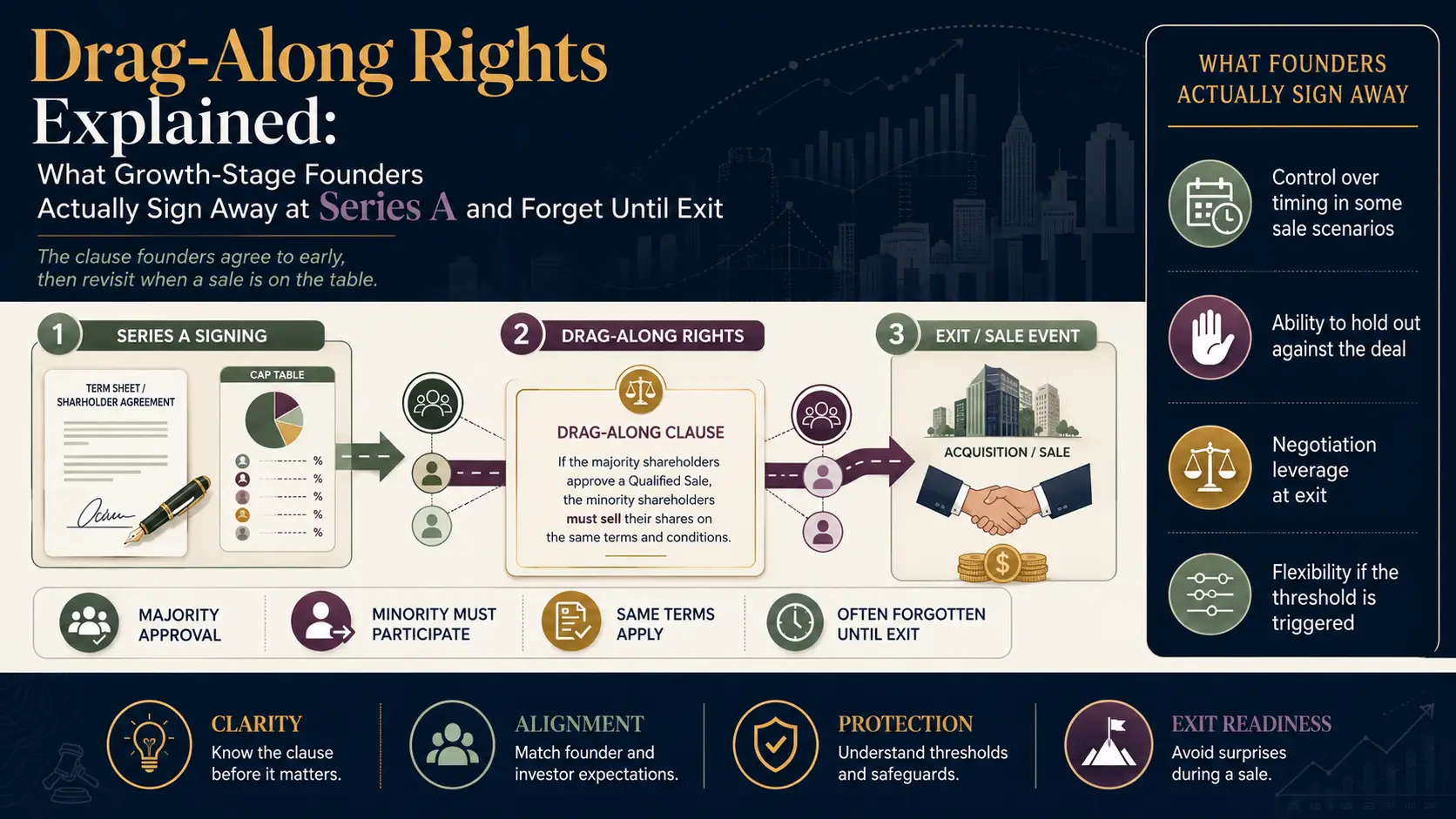
Drag-Along Rights Explained: What Growth-Stage Founders Actually Sign Away at Series A and Forget Until Exit
At Series A, a drag-along clause means founders are pre-committing to future exit behavior - specifically, if a defined approval group later votes to sell the company, founders typically must vote in favor of the transaction, refrain from blocking or delaying it, sign sale documents they may not have reviewed, and accept limits on their ability to object to price, timing, or process. Most founders treat this as standard paperwork. It is not. It is a pre-signed cooperation agreement for a future sale, drafted before anyone knows what that sale will look like, who the buyer will be, or whether the founder will agree with the decision - and it sits in the voting agreement from the moment the round closes, governing founder behavior at exit years before that exit is visible.
Most founders treat the drag-along clause as standard paperwork. It is not. It is a pre-signed cooperation agreement for a future sale, drafted before anyone knows what that sale will look like, who the buyer will be, or whether the founder will agree with the decision.
The broader governance picture is covered in the series on drag-along provisions. This spoke focuses on one specific question: what are founders actually signing away at Series A, and why does it matter at exit?
This article covers:
- The five specific concessions founders commonly make without fully understanding them
- Why Series A is the moment these terms become binding and durable
- Where the obligations actually live in the document stack
- What to review before you sign
The Five Things Founders Commonly Give Up Without Realizing It
Most founders know a drag-along clause exists. Very few know what it actually does to their position at exit. Here are the five concessions that surface most often in practice.
1. Practical blocking rights disappear once the threshold is met
A drag-along clause requires founders to support a sale if the "electing holders" approve it. The electing holders are typically a combination of preferred stockholders, board members, and sometimes common stockholders voting together. Once that threshold is crossed, a founder's individual objection carries no legal weight. The sale proceeds regardless.
The part founders miss: they often assume they have a blocking right based on their ownership percentage. They do not. The drag-along threshold can be structured so that preferred investors, voting as a class, can satisfy it without founder support.
2. Objection rights to timing and process are narrowed
Once the drag is triggered, founders typically cannot delay the transaction by raising procedural objections. The voting agreement usually requires them to vote against any proposal that could "reasonably be expected to delay or impair" the company's ability to close the sale. That language, drawn directly from the NVCA model voting agreement, is broader than it looks.
3. Founders must sign transaction documents
A drag-along clause does not just require a favorable vote. It typically requires founders to execute whatever documents are needed to complete the sale: merger agreements, joinders, consent forms, support agreements, and related exhibits. Founders who have not reviewed these documents in advance may be signing representations and warranties about the business, indemnification obligations, and post-closing restrictions at the same time they are processing the deal itself.
4. Appraisal rights may be waived or limited
Delaware law gives stockholders the right to seek judicial appraisal of their shares in certain transactions. Drag-along clauses often include a waiver of this right as a condition of the drag. The NVCA revised its model voting agreement in January 2024 specifically to update the language around appraisal rights waivers, reflecting how contested this provision had become in practice.
5. Post-closing obligations can follow founders out
Indemnification obligations, escrow holdbacks, and representation and warranty exposure do not always end at closing. Drag-along agreements often require founders to accept the same post-closing terms as other sellers, subject to caps and carve-outs. If those caps are set in the definitive documents, founders may not see them until the deal is already moving.
| Concession | What it means at exit |
|---|---|
| Blocking rights | Founder objection carries no vote once threshold is met |
| Timing objections | Cannot raise procedural delays once drag is triggered |
| Document signing | Must execute merger docs, joinders, and support agreements |
| Appraisal rights | May be waived as a condition of drag compliance |
| Post-closing obligations | Indemnity, escrow, and rep exposure can survive closing |
Key takeaway: These are not edge cases. They are standard provisions in institutional-grade Series A documents. The question is not whether they exist but whether founders understand what they agreed to before a buyer is in the room.
Why Series A Is the Moment This Becomes Real
Seed documents are often informal. SAFEs and convertible notes do not typically include drag-along provisions. Series A is different. This is when the company signs a full suite of institutional governance documents: a certificate of incorporation, a stock purchase agreement, an investors' rights agreement, and a voting agreement. The voting agreement is where drag-along rights live, and it is binding from the moment it is signed.
That shift matters for three reasons founders frequently underestimate.
First, new investor classes change the approval math. At Series A, preferred stockholders enter the cap table with dedicated governance rights. Their votes count separately, and the drag-along threshold often requires only a majority of preferred, not a majority of all outstanding shares. A founder who holds 40% of the company can still be dragged along by a preferred vote they had no part in.
Second, board composition shifts. Series A investors typically receive at least one board seat. Board approval is often one of the conditions required to trigger the drag. Once the board tilts toward investor representation, the conditions for triggering the drag become easier to satisfy.
Third, these documents are durable. Unlike early-stage agreements that get superseded at the next round, voting agreements tend to carry forward and be amended rather than replaced. The drag-along terms signed at Series A often remain in the document stack through Series B, Series C, and into a sale process.
Why founders miss it at Series A:
- Attention is on valuation, dilution, and option pool mechanics
- Legal counsel review time is compressed in competitive rounds
- Drag-along language reads as standard and rarely generates redlines
- The consequences are invisible until a buyer appears, years later
Understanding how your capital structure and equity layers interact before the round is the clearest way to anticipate where control actually sits once the voting agreement is signed.
Where These Obligations Actually Live: Term Sheet vs. Voting Agreement
Most founders first encounter drag-along language in the term sheet. That version is a summary. The binding version is in the voting agreement, and the two are not always consistent.
The term sheet might say something like: "Drag-along rights: investors holding a majority of Series A preferred may require all stockholders to vote in favor of a sale." That sentence is short enough to read in ten seconds. The voting agreement version runs several pages and includes the approval threshold mechanics, the specific obligations each stockholder must perform, the conditions that must be satisfied before the drag can be triggered, the appraisal rights waiver, the irrevocable proxy grant, and the post-closing obligations.
Founders who review only the term sheet often miss the mechanics entirely.
| What the Term Sheet Says | What the Voting Agreement Actually Governs |
|---|---|
| "Majority of preferred may approve a sale" | Exact class composition and vote threshold required |
| "Stockholders must support the transaction" | Specific obligations: vote, sign, execute, refrain from objecting |
| "Standard drag-along provisions apply" | Appraisal rights waiver, irrevocable proxy, post-closing indemnity |
| "Subject to board approval" | Which directors count, what quorum looks like, conflict carve-outs |
The NVCA model voting agreement is the most widely used template in institutional venture deals. It includes an optional drag-along section that can be structured with varying thresholds and conditions. Founders should compare the term sheet summary against the long-form document before signing, not after.
Separately, understanding what information rights and access provisions look like in the same document stack can help founders see the full picture of what governance they are agreeing to. The IRC article on negotiating information rights in $10M VC term sheets covers the parallel set of obligations founders often overlook in the same round.
The same document gap shows up in threshold mechanics. Understanding how the 51% vs. 75% drag-along threshold determines whether two investors can force your exit without a single founder vote is the natural next read once the term-sheet-vs-voting-agreement distinction is clear.
{{main-cta}}
What Founders Should Review Before Signing
The right time to understand your drag-along exposure is before you sign the voting agreement, when you still have leverage to negotiate. Once the round closes, the terms are set.
This is not about refusing standard provisions. It is about knowing exactly what you are agreeing to, so there are no surprises when a buyer appears three or five years later.
Founders who work with advisors before investor outreach, rather than after term sheet delivery, tend to enter negotiations with a clearer picture of which governance terms are market-standard and which are worth pushing back on. IRC Partners works with founders at this stage specifically because pre-round positioning is where leverage actually exists.
Founder review checklist before signing the voting agreement:
- Who can trigger the drag? Identify the exact approval group: is it a majority of preferred voting as a class, a board majority, or a combination? Can the threshold be met without any founder support?
- What are you required to do? Confirm whether the obligation extends beyond voting to signing documents, executing proxies, and accepting post-closing obligations.
- Is equal treatment guaranteed? Check whether the clause requires all dragged stockholders to receive the same form and amount of consideration as the electing holders.
- What are the indemnity caps? Review whether founder indemnification exposure is capped at proceeds received, or whether it can exceed that amount.
- Are appraisal rights waived? Confirm whether you are waiving statutory appraisal rights as a condition of the drag, and whether any carve-outs apply.
- Does board composition affect the trigger? Map out whether the board majority condition can be satisfied if your investor takes their contractual seat.
The goal is not to block every provision. The goal is to understand the mechanics before they apply to you.
Founders who want a broader picture of how governance terms interact with capital structure across a full raise can start with the IRC guide on debt vs. equity financing decisions for founders, which covers how the choice of instrument shapes the control terms that follow.
Frequently Asked Questions
What is a drag-along right in a Series A term sheet?
A drag-along right is a provision that requires all stockholders to support a sale of the company if a specified approval group votes in favor of it. At Series A, it typically appears in the voting agreement and obligates founders to vote for the transaction, sign required documents, and refrain from blocking or delaying the sale once the threshold is met.
Can a founder block a sale if they have a drag-along clause in their voting agreement?
Once the drag-along threshold is satisfied, a founder generally cannot block the transaction through a vote. The voting agreement usually includes an irrevocable proxy that allows the company or a designated party to vote the founder's shares in favor of the sale if the founder refuses or votes inconsistently with the agreement.
Does a drag-along clause mean founders have to accept any sale price?
Not exactly, but the practical protections are limited. Most drag-along clauses require equal treatment, meaning founders receive the same form and per-share consideration as other sellers. However, they do not give founders the right to veto a price they consider too low. If the electing holders approve the deal, the drag applies regardless of the founder's view on valuation.
What is an appraisal right and why does it matter in a drag-along context?
Appraisal rights under Delaware law allow stockholders to seek a court determination of the fair value of their shares instead of accepting the deal consideration. Many drag-along clauses require stockholders to waive this right as a condition of the drag. The NVCA updated its model voting agreement language on appraisal rights waivers in January 2024 after the provision became a recurring point of dispute in venture transactions.
Where exactly does the drag-along obligation appear in Series A documents?
The binding drag-along obligation lives in the voting agreement, not the term sheet. The term sheet typically summarizes the right in one or two sentences. The voting agreement contains the full mechanics: the approval threshold, the specific obligations, the irrevocable proxy grant, the appraisal rights waiver, and the post-closing indemnification structure.
Can drag-along terms be negotiated before Series A closes?
Yes. Founders have the most leverage before the round closes, not after. Negotiable elements include the approval threshold composition, whether board approval is required in addition to stockholder approval, indemnification caps, equal treatment protections, and whether appraisal rights are fully waived or only partially limited. Once the voting agreement is signed, these terms are fixed until the next financing or a separate amendment.
How do drag-along rights interact with founder vesting and equity at exit?
Drag-along rights govern the obligation to support a sale. They operate separately from vesting schedules, but the two interact at exit. If a founder is dragged into a sale while still partially unvested, they typically receive proceeds only on vested shares unless the deal documents include acceleration provisions. Reviewing both the drag-along terms and any acceleration triggers in the option plan before signing is important for founders with significant unvested equity at the time of the round.
Continue reading this series:
- What Growth-Stage Companies Need to Know About Drag-Along Provisions Before They Become a Problem
- How to Negotiate Information Rights in $10M+ VC Term Sheets
- Give Me 12 Minutes and I'll Teach You How to Raise $100M
IRC Partners advises operators raising $5M to $250M of institutional capital on structure, positioning, and round architecture. We take seven strategic partners per quarter. No placement agent model. No success-only theater. Institutional capital follows a deal built to institutional standard. If you want your current raise reviewed before it reaches the market and silently fails , apply here.
Sponsors weighing this decision should first complete a capital raise readiness assessment for sponsors to confirm the raise is investor-ready.
Need guidance on your capital raise?


Quarterly vs Annual Reporting: Negotiate for $10M+ Growth Rounds

The Critical-Gate Override: Why One Failed Category Zeroes Out a Strong Deal

Top Firms for Investor Relations Management
Disclosure
Nothing on this site constitutes an offer to sell, or a solicitation of an offer to purchase, any security under the Securities Act of 1933, as amended, or any applicable state securities laws. Any offering of securities is made only by means of a formal private placement memorandum or other authorized offering documents delivered to qualified investors.
IRC Partners is a capital advisory firm. IRC Partners is not a registered investment adviser under the Investment Advisers Act of 1940 and does not provide investment advice as defined thereunder.
Certain statements in this article may constitute forward-looking statements, including statements regarding market conditions, capital availability, investor demand, and transaction outcomes. Such statements reflect current assumptions and expectations only. Actual results may differ materially due to market conditions, regulatory developments, company-specific factors, and other variables. IRC Partners makes no representation that any outcome, return, or result described herein will be achieved.
References to prior mandates, transaction volume, network credentials, or capital raised are provided for illustrative purposes only and do not constitute a guarantee or prediction of future results. Past performance is not indicative of future outcomes. Individual results will vary. Network credentials and transaction statistics referenced on this site reflect the aggregate experience of IRC Partners' principals and affiliated advisors and are not a representation of assets managed or transactions closed solely by IRC Partners.
Certain data, statistics, and information presented in this article have been obtained from third-party sources. IRC Partners has not independently verified such information and expressly disclaims responsibility for its accuracy, completeness, or timeliness. Readers should independently verify any third-party data before relying on it.
Readers are strongly encouraged to consult qualified legal, financial, and tax professionals before making any investment, capital raising, or business decision.
Schedule A Meeting
You get one shot to raise the right way. If this raise is worth doing, it’s worth doing with precision, leverage, and control.
This isn’t a practice run. Serious capital. Serious strategy. Let’s raise it right.
We onboard a maximum of seven
new strategic partners each quarter, by application only, to maximize your chances of securing the capital you need.
