.svg "CTA Arrow")


.png "Investor Ready Capital decorative background element")
Mezzanine Financing Funds: How to Identify, Approach, and Close Mezz Lenders in 30 Days

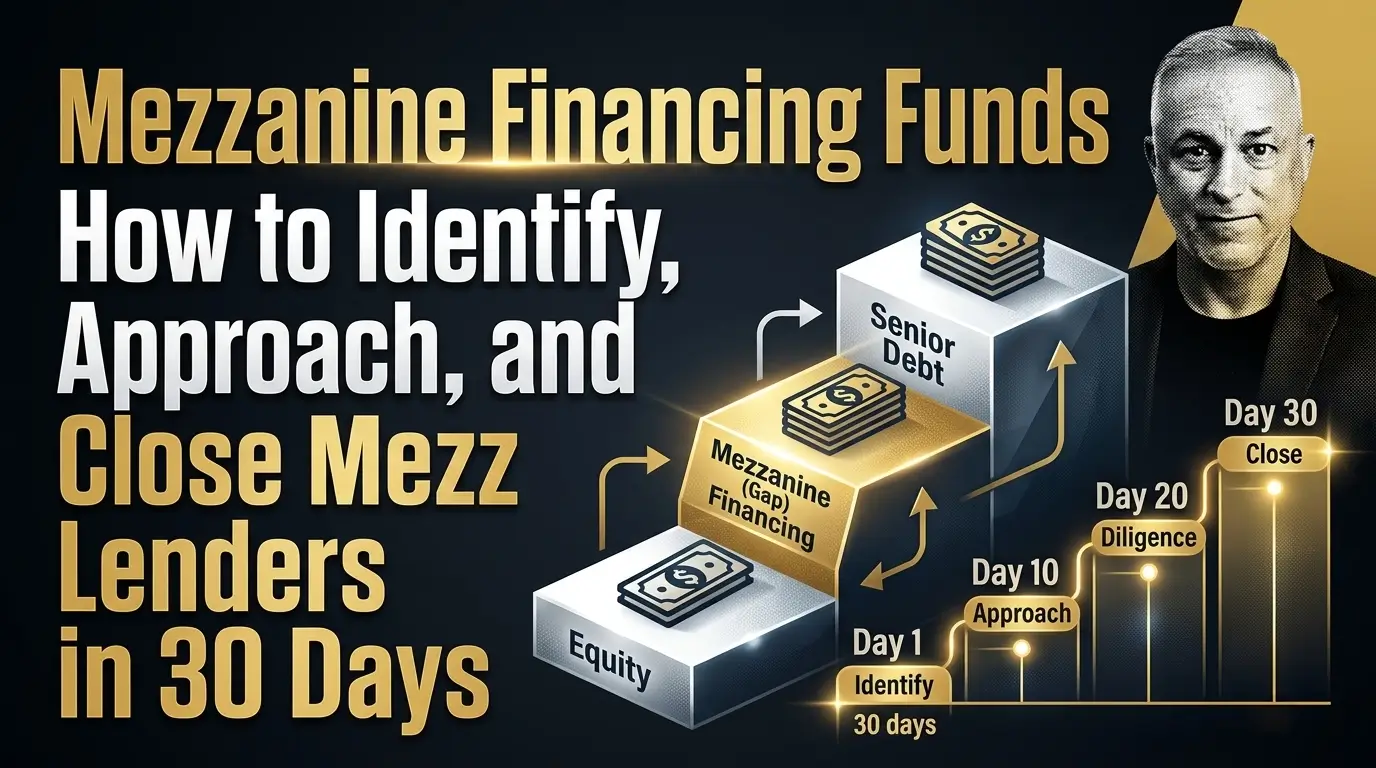
Mezzanine Financing Funds: How to Identify, Approach, and Close Mezz Lenders in 30 Days
The capital is available. According to the Mortgage Bankers Association, commercial real estate mortgage originations reached $633 billion in 2025 and are projected to hit $805 billion in 2026. Non-bank lenders, debt funds, and private credit platforms are actively deploying into the mezz layer. What separates a 30-day close from a 90-day close is not market access. It is process design - and sponsors who approach mezzanine financing funds one at a time, waiting for each lender before moving to the next, are building a 90 to 120-day timeline by default.
The market does not require that timeline. According to the Mortgage Bankers Association, commercial real estate mortgage originations reached $633 billion in 2025 and are projected to hit $805 billion in 2026. Non-bank lenders, debt funds, and private credit platforms are actively deploying capital into the mezz layer. The capital is available. What separates a 30-day close from a 90-day close is process design, not market access.
The real problem is not finding mezz lenders. It is running a process that creates options, preserves leverage, and signals institutional readiness from the first contact.
This article gives sponsors a phase-by-phase execution framework for the full 30-day arc:
- Pre-outreach preparation and lender shortlisting
- First contact, teaser delivery, and initial screening
- Staged data room access and lender management
- Term sheet negotiation, competitive tension, and closing mechanics
The 30-Day Mezz Timeline at a Glance
Every phase of the process has a defined action, a deliverable, and a common mistake that kills momentum. The table below is the framework. The sections that follow explain each phase in detail.
The 30-day window is tight but achievable when sponsors enter Phase 1 with materials ready and a clear lender screen already built. Sponsors who start Phase 1 with nothing prepared effectively start the clock 10 to 14 days late.
Phase 1, Days 1-7: Prepare the Package and Build the Right Shortlist
Before a single outreach message goes out, two things must be complete: the lender shortlist and the first-contact package. Sponsors who skip this step spend the first two weeks of outreach answering basic questions that a well-prepared teaser would have resolved in advance.
Build the Shortlist Around Fit, Not Volume
A shortlist of 6 to 10 lenders that genuinely match the deal is stronger than a broadcast to 30. Screen each lender against six criteria before adding them to the list:
- Asset type and geography - Does the lender actively finance this property type in this market?
- Check size - Does the lender's typical mezz tranche match the capital need?
- Leverage tolerance - What combined loan-to-cost does the lender underwrite to?
- Structure fit - Does the lender prefer current-pay mezz, PIK, or hybrid structures?
- Execution track record - Has the lender closed comparable deals in the last 12 months?
- Intercreditor flexibility - Will the lender work within the senior lender's intercreditor requirements?
If you are still selecting the right lender type for your capital stack, the five types of mezz lenders and what each requires in a data room is the right starting point before building this shortlist. Sponsors who are also evaluating debt fund capital alongside mezz should review how real estate debt funds differ in structure, speed, and intercreditor requirements before finalizing the shortlist.
Prepare the First-Contact Package
The teaser is not the full pitch. It is a screening document designed to generate a qualified yes or a fast no. It should include:
- A one-page deal summary with asset type, location, total capitalization, and mezz ask
- Uses and sources table with the full capital stack shown
- Sponsor track record summary (completed projects, relevant asset class experience)
- Proposed deal timeline with key milestones
- A clean ask: how much mezz, at what position in the stack, and on what timeline
Key point: Decide before outreach what information lives in the teaser, what opens after a signed NDA or initial call, and what stays in the full data room. Oversharing too early removes the information advantage that creates leverage later.
Structuring the capital stack before lender outreach ensures the uses and sources table and leverage ratios are defensible before the first lender sees them.
Phase 2, Days 8-14: First Contact, Teaser Delivery, and Initial Screening
Phase 2 is where most sponsors make the mistake that kills their leverage before the process really starts. They contact lenders one at a time, wait for a response, and then move to the next. By the time three lenders have reviewed the deal, the first lender's feedback has already shaped the narrative.
Run Outreach as a Controlled Wave
Launch all outreach within a 48-hour window. This keeps indications of interest coming back on a similar timeline, which is what creates a real competitive dynamic. Staggered outreach creates a staggered market, and a staggered market means one lender at a time.
Each outreach message should be lender-specific. It should reference why this lender is on the shortlist, what part of the deal fits their mandate, and what the process timeline looks like. Generic outreach reads as desperation. Specific outreach reads as preparation.
Outreach sequencing for Days 8-14:
- Day 8-9: Send teaser to all shortlisted lenders simultaneously
- Day 10-11: Follow up on non-responses, field inbound questions
- Day 12-13: Conduct initial screening calls with interested lenders
- Day 14: Log engagement quality, advance serious lenders to Phase 3, remove non-fits
Gate Data Room Access by Engagement Level
Do not open the full data room on Day 8. Gate access in two steps: the teaser goes to everyone on the shortlist, and the data room link goes only to lenders who have confirmed interest after the initial call.
According to CREFC market commentary entering 2026, non-bank lenders are actively deploying into the mezz layer, but they remain selective on sponsorship quality and deal structure. Private credit platforms and direct lenders have become a primary source of mezz liquidity in 2025-2026, which means a well-prepared sponsor has more qualified options than at any point in the prior cycle. Lenders who receive a well-organized teaser and a clear process timeline respond faster than lenders who receive a document dump with no context.
Track three things from every initial call: how quickly the lender responded, what questions they asked, and how they described their own process timeline. Execution behavior in Phase 2 is a reliable preview of closing behavior in Phase 4.
Phase 3, Days 15-21: Stage the Data Room, Manage Follow-Up, and Protect Momentum
Phase 3 is where most 30-day processes fall apart. The sponsor has multiple lenders engaged, questions are multiplying, and the data room is not organized to handle a parallel process. One lender asks for a document that does not exist. Another goes quiet. A third sends a 40-item diligence list that takes a week to answer. The process stretches.
The Three-Tier Data Room Structure
Open the data room in tiers based on lender engagement level, not on calendar date.
This sequencing matters for two reasons. First, it keeps closing-sensitive documents out of the hands of lenders who may not close. Second, it signals process control. Lenders who see a well-organized, staged data room treat the sponsor differently than lenders who receive a disorganized folder dump on day one.
A properly organized data room for institutional lenders follows a numbered folder structure with version control and document reconciliation before any lender gets access.
Manage the Process Calendar, Not Just the Documents
Run one shared process calendar across all active lenders. Set hard deadlines for follow-up questions, management calls, and indication of interest updates. When lenders know the process has a clock, they move faster.
Momentum killer: Allowing one slow lender's review cycle to set the pace for everyone else. If a lender has not engaged by Day 18, remove them from the active list. Carrying dead weight delays the process and dilutes competitive tension.
Answer questions once and distribute answers consistently to all lenders at the same stage. No lender should feel another received information they did not. That perception ends the process faster than a bad credit.
Phase 4, Days 22-30: Negotiate Term Sheets, Create Competitive Tension, and Get to Close
By Day 22, the sponsor should have two or three lenders in the final lane with term sheets either received or imminent. This is where competitive tension either works for the sponsor or backfires.
How to Compare Term Sheets Without Chasing the Wrong Number
Rate is not the only variable that matters. A term sheet with a 50-basis-point lower rate but tighter consent rights, heavy reserves, and a slow closing track record often costs more than a higher-rate term sheet from a lender who closes in 21 days.
Compare every term sheet across these dimensions before selecting a finalist:
Create Competitive Tension Without Commoditizing the Deal
Competitive tension works when it is credible and tied to a process milestone. It fails when sponsors bluff, over-share competing terms, or signal they are willing to go to anyone who says yes.
The right approach is process-based, not disclosure-based. Tell each finalist that you are in final discussions with a limited number of lenders and that you expect to select a preferred lender by a specific date. Do not share rate details from competing term sheets. Let the deadline do the work.
Five closing discipline rules for Days 22-30:
- Set a hard preferred-lender selection date and communicate it to all finalists
- Engage transaction counsel before term sheets arrive, not after
- Confirm intercreditor alignment between the senior lender and mezz lender before signing
- Run KYC, OFAC, and organizational chart preparation in parallel with negotiations
- Do not extend the process for a lender who cannot confirm their closing timeline
Capital stack risk reduction strategies covers how to structure the mezz layer to minimize closing risk before you reach the term sheet stage.
{{main-cta}}
What Kills Momentum at Each Stage and How to Avoid It
Each phase has a predictable failure mode. Most of them are avoidable with preparation and process discipline.
A real estate due diligence checklist helps sponsors identify missing items before lenders do.
Fast Closings Come From Process Control, Not Urgency
A 30-day mezz close is not about moving fast. It is about running a process that signals preparation, creates real options, and preserves leverage at every stage. Sponsors who build a qualified shortlist, stage information deliberately, and manage deadlines consistently close with better terms than sponsors who simply start calling lenders.
As Deloitte's commercial real estate outlook notes, capital is available to credible sponsors with strong fundamentals. The differentiator in 2026 is execution quality, not access.
The same discipline that closes mezz financing in 30 days also strengthens every other layer of the capital stack. When sponsors force clarity around materials, sequencing, and lender fit before outreach, the entire deal moves faster.
Next steps for sponsors ready to run this process:
- Review your capital stack structure before shortlisting lenders
- Audit your data room for completeness before Day 8
- Engage transaction counsel before term sheets arrive
Frequently Asked Questions
How many mezzanine lenders should a sponsor contact in a 30-day process?
A shortlist of 6 to 10 qualified lenders is the right range for a structured 30-day process. Contacting fewer than 6 limits competitive tension. Contacting more than 10 creates a process that is too wide to manage and signals to lenders that the sponsor is shopping broadly rather than running a disciplined outreach. The goal is a curated market, not a broad broadcast.
At what point in the capital stack process should mezz outreach begin?
Mezz outreach should begin when the senior debt terms are at least at the letter of intent stage, not after senior debt is fully closed. Starting mezz outreach too late compresses the timeline and removes negotiating leverage. Starting too early, before the senior terms are clear, creates structural uncertainty that mezz lenders will use to slow or reprice the deal.
What is the difference between current-pay mezz and PIK mezz from a lender screening perspective?
Current-pay mezz requires cash interest payments during the loan term, typically in the 10% to 13% range in 2025-2026 market conditions. PIK mezz accrues interest and adds it to the principal balance, which preserves cash flow during the construction or lease-up phase but increases the total payoff. When shortlisting lenders, confirm which structure each lender prefers before outreach, since some institutional mezz lenders will not quote PIK structures on ground-up development deals.
How does a sponsor create competitive tension between lenders without disclosing competing term sheet details?
Competitive tension is created through process discipline, not disclosure. Tell each finalist that you are in final discussions with a limited number of lenders and that you will select a preferred lender by a specific date. Do not share rate details, structure specifics, or lender names from competing term sheets. The deadline creates urgency. Disclosure creates leverage for the lender, not the sponsor.
What diligence items most commonly cause delays in a mezz closing?
The four items that most commonly delay mezz closings are incomplete organizational charts, missing or outdated environmental Phase I assessments, unresolved KYC and beneficial ownership documentation, and intercreditor conflicts between the senior lender and mezz lender. All four should be resolved or in active preparation before Phase 3 begins on Day 15. Lenders who surface these items late in the process often use the delay to reprice or restructure the deal.
How should a sponsor handle a mezz lender who goes quiet after the initial call?
A lender who does not respond within 5 business days of the initial call is a signal, not a coincidence. Send one follow-up with a clear process deadline. If there is still no response by Day 18, remove the lender from the active list and move forward with engaged lenders. Carrying a non-responsive lender dilutes competitive tension and gives the impression that the process has no real deadline.
When should transaction counsel be engaged in a 30-day mezz process?
Transaction counsel should be engaged before term sheets arrive, not after. The intercreditor agreement between the senior lender and mezz lender is often the longest-lead document in the closing process, and counsel needs time to review the senior loan documents, identify any consent requirements, and flag structural conflicts. Sponsors who wait until a term sheet is signed before engaging counsel routinely lose 10 to 14 days of closing time.
Continue reading this series:
- How to Structure a Capital Stack for a $10M-$50M Real Estate Deal
- Capital Stack Risk Reduction Strategies for Developers
- Senior Debt vs. Mezzanine vs. Preferred Equity: Which Layer Do You Actually Need
IRC Partners advises founders raising $5M to $250M in institutional capital on structure, positioning, and round architecture. We work with 7 strategic partners per quarter - no placement agent model, no success-only theater. If you want a structural review of your current raise, apply HERE.
Sponsors weighing this decision should first complete a capital raise readiness assessment for sponsors to confirm the raise is investor-ready.
Need guidance on your capital raise?


What Happens When a Family Office Requests Stronger Downside Protection Than The Sponsor's Original Term Sheet Provides?
What Family Office Concerns Arise When a Real Estate Sponsor Has Multiple Projects Competing For The Same Team and Liquidity?

Real Estate Due Diligence Checklist: The 47 Documents $10M+ Sponsors Must Have Ready Before Institutional Lenders Ask
Disclosure
Nothing on this site constitutes an offer to sell, or a solicitation of an offer to purchase, any security under the Securities Act of 1933, as amended, or any applicable state securities laws. Any offering of securities is made only by means of a formal private placement memorandum or other authorized offering documents delivered to qualified investors.
IRC Partners is a capital advisory firm. IRC Partners is not a registered investment adviser under the Investment Advisers Act of 1940 and does not provide investment advice as defined thereunder.
Certain statements in this article may constitute forward-looking statements, including statements regarding market conditions, capital availability, investor demand, and transaction outcomes. Such statements reflect current assumptions and expectations only. Actual results may differ materially due to market conditions, regulatory developments, company-specific factors, and other variables. IRC Partners makes no representation that any outcome, return, or result described herein will be achieved.
References to prior mandates, transaction volume, network credentials, or capital raised are provided for illustrative purposes only and do not constitute a guarantee or prediction of future results. Past performance is not indicative of future outcomes. Individual results will vary. Network credentials and transaction statistics referenced on this site reflect the aggregate experience of IRC Partners' principals and affiliated advisors and are not a representation of assets managed or transactions closed solely by IRC Partners.
Certain data, statistics, and information presented in this article have been obtained from third-party sources. IRC Partners has not independently verified such information and expressly disclaims responsibility for its accuracy, completeness, or timeliness. Readers should independently verify any third-party data before relying on it.
Readers are strongly encouraged to consult qualified legal, financial, and tax professionals before making any investment, capital raising, or business decision.
Schedule A Meeting
You get one shot to raise the right way. If this raise is worth doing, it’s worth doing with precision, leverage, and control.
This isn’t a practice run. Serious capital. Serious strategy. Let’s raise it right.
We onboard a maximum of seven
new strategic partners each quarter, by application only, to maximize your chances of securing the capital you need.
