.svg "CTA Arrow")


.png "Investor Ready Capital decorative background element")
Private Credit Lending: How $10M+ Sponsors Use Direct Lending to Fill Capital Stack Gaps Without Giving Up Equity

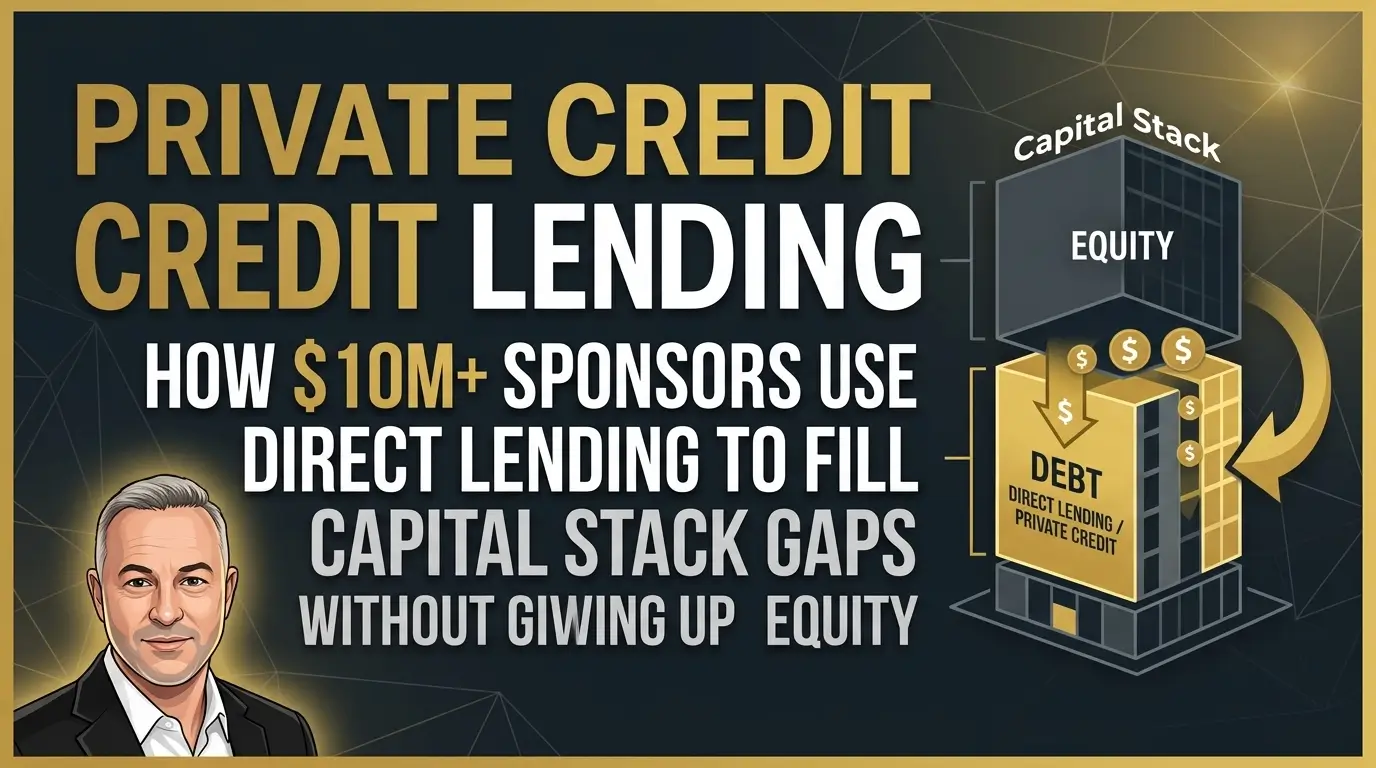
Private Credit Lending: How $10M+ Sponsors Use Direct Lending to Fill Capital Stack Gaps Without Giving Up Equity
Private credit is a precision tool, not a default. According to CREFC, real estate debt accounted for 19% of all private debt fundraising in the first half of 2025 - the highest share in five years. That availability is real, but availability is not the same as fit. Sponsors who reach for direct lending when the bank falls short, when mezzanine is too expensive, or when preferred equity feels like too much governance to give up are using the instrument as a catch-all rather than a deliberate structural choice. The real question is which instrument fills the gap without creating unnecessary dilution, intercreditor drag, or governance concessions that serve no structural purpose.
Real estate private credit has grown fast. According to CREFC, real estate debt accounted for 19% of all private debt fundraising in the first half of 2025, the highest share in five years. More capital is available than at any point in recent memory. But availability is not the same as fit.
Most sponsors treat private credit as a catch-all for gap capital. They reach for it when the bank falls short, when mezzanine is too expensive, or when preferred equity feels like too much governance to give up. That framing misses the point. Private credit and direct lending are a specific instrument with distinct economics, underwriting criteria, and documentation requirements.
The real question is not whether to use alternative capital. It is which instrument fills the gap without creating unnecessary dilution, intercreditor drag, or governance concessions you did not need to make.
This article focuses on three things:
- When private credit is the right decision at the margin versus mezzanine or preferred equity
- What direct lending actually costs in 2025-2026 conditions
- What the data room must include before a direct lender will issue serious paper
If you are still building the foundational layer of your stack, start with the capital stack structuring framework for $10M-$50M deals. This article picks up where that one ends.
When Private Credit Makes Sense and When It Does Not
Private credit is not the right answer for every gap. It is the right answer for a specific set of sponsor situations. Getting that decision wrong costs time, money, and sometimes the deal.
When Private Credit Is the Right Tool
1. Senior proceeds are capped by debt-service constraints, not asset quality. PGIM Real Estate's 2025 private credit spotlight notes that senior lenders remain bound by debt-service coverage requirements even as asset fundamentals have improved. When the shortfall between senior proceeds and total project cost is a structural lending constraint rather than a sponsor credibility problem, private credit fills that gap cleanly without requiring equity dilution.
2. Speed and execution certainty matter more than blended cost optimization. Direct lenders can move from term sheet to close faster than a syndicated structure or a multi-party preferred equity negotiation. When a sponsor is under time pressure on a site control deadline, a recapitalization, or a competitive acquisition, the execution premium of private credit is real.
3. The sponsor wants debt treatment without intercreditor friction. A unitranche or whole-loan structure from a single direct lender eliminates the intercreditor negotiation entirely. As Latham & Watkins notes in the Chambers Private Credit 2026 guide, many larger private credit transactions are now structured as unitranche deals with the waterfall mechanics embedded directly in the credit agreement, removing the need for a separate intercreditor arrangement.
When Private Credit Is the Wrong Tool
- The asset is too speculative for debt-style underwriting. Direct lenders still underwrite to repayment, not equity upside.
- The business plan requires true risk capital with no current or near-term debt service capacity.
- The senior lender has already prohibited any subordinate debt instrument.
- The gap is small enough that preferred equity is cheaper on a total-economics basis.
For a broader view of how layer selection connects to execution risk, see the IRC guide on capital stack layers that minimize risk for developers.
What Private Credit Costs in 2025-2026
Headline rate is the least useful number when pricing private credit. Real cost includes origination fees, exit fees, rate floors, PIK toggles, extension economics, and the governance or consent terms that come with some structures. The table below reflects current market conditions based on data from PwC's real estate deals outlook, Calamos/Aksia's 2025 private credit outlook, and CREFC market reporting.
Key insight: Private credit maintained roughly a 200 basis point premium over public credit markets after post-COVID normalization, according to the Calamos/Aksia database. That premium reflects illiquidity and structure, not necessarily higher risk than a well-underwritten deal warrants.
What Shapes Real Cost Beyond the Rate
Three variables move the real cost of private credit more than the stated coupon:
- Fees and floors. A 1.5% origination fee on a 12-month loan adds roughly 150 bps to annualized cost. A SOFR floor at 4.5% matters when forward rates move.
- PIK optionality. Some direct lenders offer PIK elections during construction or lease-up. This reduces cash-pay burden but compounds the principal balance. Model the exit distribution, not just the current coupon.
- Extension economics. Many direct lending term sheets include extension fees of 25-50 bps per option period. On a two-year loan with two six-month extensions, that is real cost the base-case model often ignores.
Mezzanine typically carries the highest stated return because it accepts subordinate risk with tighter enforcement rights. Preferred equity can look cheaper on headline current pay but often carries higher total economics once accrued return, participation, governance rights, and consent fees are included.
{{main-cta}}
Private Credit vs. Mezzanine vs. Preferred Equity: The Dimensions That Actually Matter
The comparison most sponsors run is coupon versus coupon. That misses the variables that actually determine whether a deal closes cleanly, survives a stress scenario, and protects GP economics through exit. Sponsors who want to anchor the dilution question specifically should also read the IRC guide on how sponsors raising $10M+ decide which capital structure protects the most equity at exit.
The table below compares all three instruments across eight dimensions that matter at the decision margin. For a deeper look at how mezzanine and preferred equity compare on the senior lender approval question specifically, see the IRC article on choosing between senior debt, mezzanine, and preferred equity.
Why Intercreditor Friction Is the Deciding Factor
Intercreditor friction is the variable sponsors most consistently underestimate. Lowenstein Sandler's analysis of intercreditor agreements identifies enforcement rights, standstill periods, and payment blockages as the primary friction points between senior and junior creditors. In a classic mezzanine structure, the senior lender and mezz lender each have rights that must be negotiated and documented before closing. That process adds weeks and legal cost.
A direct lender offering a unitranche facility eliminates that friction entirely. The waterfall mechanics are embedded in the credit agreement. One lender. One set of documents. One closing process.
That structural advantage is not captured in a coupon comparison.
What Direct Lenders Underwrite Differently
Direct lenders underwrite to repayment, not upside. That sounds obvious, but it changes what they scrutinize compared to senior lenders, mezz funds, and preferred equity investors.
Compared to Senior Lenders
Senior lenders focus on debt-service coverage, LTV, and regulatory capital treatment. Direct lenders accept more structural complexity but demand sharper visibility into:
- Business-plan credibility. Lease-up timelines, pre-leasing thresholds, construction draw controls, and stabilization milestones must be supported by market data, not just sponsor assumptions.
- Liquidity support. Direct lenders want to see interest reserves, completion guaranties, and sources of capital for cost overruns before they issue a term sheet.
- Amendment and extension scenarios. Unlike a bank that extends on a relationship basis, a direct lender underwrites the extension path at origination. If the deal runs six months long, what does the capital structure look like?
Compared to Mezzanine Funds
Mezz funds focus heavily on enforcement rights and cure period mechanics. Direct lenders operating in a whole-loan or unitranche structure care less about enforcement sequencing (because they control the whole loan) and more about:
- Covenant design. What triggers a default? What gives the lender amendment leverage before a default occurs?
- Documentation leverage. Latham & Watkins' 2026 private credit guide notes that direct lenders are increasingly proactive about engaging with borrowers on potential problems before they materialize, including through pre-negotiated amendment frameworks and PIK flexibility provisions.
Compared to Preferred Equity Investors
Preferred equity investors underwrite governance and control rights as part of their return. Direct lenders underwrite collateral and cash flow. That means:
- Less focus on sponsor promote structure and waterfall economics
- More focus on collateral path, refinance or sale takeout viability, and downside recovery
- Greater emphasis on guaranty package, completion risk, and recourse carve-outs
The practical implication: sponsors who prepare a debt-specific underwriting package rather than a repurposed equity pitch deck move faster with direct lenders and generate better terms.
What the Data Room Must Include Before a Private Credit Raise
A direct lender's data room is not a pitch deck with attachments. It is a credit underwriting package. Sponsors who send a fundraising data room to a direct lender create friction, slow the process, and often get passed over for sponsors who understand what the lender is actually trying to answer.
The checklist below is organized by the four files a direct lender needs to move from screening to term sheet. This structure is distinct from the general data room framework in IRC's data room organization guide for real estate fund managers and from the preferred equity data room requirements covered separately in the IRC cluster. For a speed-focused build framework, see the IRC guide on how to build a data room that closes institutional investors in 30 days instead of 90.
The most common data room mistake: over-investing in the executive summary and investor narrative while leaving the debt-specific files incomplete. A direct lender does not need to be sold on the market opportunity. They need to underwrite the downside.
For context on how the capital stack risk reduction framework connects to lender preparation, see the IRC guide on five capital stack risk reduction strategies for $10M+ raises.
Use Private Credit as a Precision Tool, Not a Default
Private credit is not the answer when the bank says no. It is the answer when a sponsor needs gap capital without equity dilution, intercreditor friction, or governance concessions that serve no structural purpose.
Three rules to carry forward:
- Choose based on stress-case behavior, not headline coupon. The instrument that looks cheapest on paper often carries the most friction in a workout.
- Prepare a debt-specific data room. A direct lender underwrites to repayment. Your materials should reflect that.
- Get the layer decision right before outreach. Rebuilding the structure after term sheets are in motion costs time, legal fees, and sometimes the deal.
Ready to evaluate private credit for a live deal? IRC Partners works with seasoned developers raising $10M+ to structure the capital stack before going to market. Book a capital stack review with IRC to get the layer decision right the first time.
Frequently Asked Questions
What is the minimum deal size for a private credit or direct lending raise in real estate?
Most institutional direct lenders focus on transactions of $10M or more in total loan exposure, with a practical sweet spot of $15M-$75M for middle-market CRE. Below $10M, the lender's underwriting cost relative to loan size makes execution inefficient. Sponsors with smaller gaps often find that preferred equity or a regional bank mezz product is more accessible than a dedicated private credit fund.
How long does it take a direct lender to issue a term sheet after receiving a data room?
A well-prepared, debt-specific data room typically generates a preliminary term sheet within 7-14 business days from a direct lender who has already confirmed deal-type fit. Incomplete packages, missing stress scenarios, or unclear collateral documentation can push that timeline to 30-45 days or stall the process entirely. Speed is one of private credit's primary advantages, but only when the sponsor's materials are ready to underwrite on day one.
Do direct lenders require personal recourse on real estate private credit loans?
Most institutional direct lenders structure loans as non-recourse with standard carve-outs, commonly called "bad boy" guaranties, covering fraud, misrepresentation, environmental liability, and voluntary bankruptcy. Completion guaranties are common on ground-up construction. Full recourse is rare at the institutional level but may appear in smaller or higher-risk transactions where the lender has limited collateral coverage.
Can a sponsor use private credit alongside a senior loan from an agency lender?
It depends on the agency program. Fannie Mae and Freddie Mac typically prohibit subordinate debt instruments, which rules out most direct lending structures. Some agency programs permit preferred equity in the equity layer, but that is a different instrument. Sponsors pursuing agency senior debt should confirm subordinate capital restrictions in writing before approaching any private credit provider. Misalignment at this stage can unwind a deal after term sheets are signed.
What covenants should a sponsor expect in a private credit term sheet for real estate?
Direct lending term sheets for real estate typically include debt yield covenants tested at each draw or quarterly, minimum liquidity covenants tied to interest reserve coverage, construction milestone covenants with cure periods of 30-60 days, and leasing progress benchmarks for lease-up assets. Covenant-lite structures exist in larger transactions but are less common in the $10M-$75M middle market. Sponsors should negotiate cure periods before signing, not after a technical default.
How does PIK interest work in a direct lending structure, and when should a sponsor request it?
PIK, or payment-in-kind, interest allows the borrower to add unpaid interest to the principal balance rather than paying it in cash. It is most useful during construction or early lease-up when cash flow is insufficient to cover debt service. Not all direct lenders offer PIK optionality, and those that do typically charge a spread premium of 50-150 bps for the PIK election. Sponsors should model the compounding effect on exit distributions before electing PIK, as the higher principal balance reduces net proceeds at sale or refinance.
What is the difference between a whole loan and a unitranche in private credit real estate lending?
A whole loan is a single first-lien mortgage loan covering the full debt amount, typically originated by one lender who holds the entire position. A unitranche is a blended first-lien and subordinate structure packaged as a single loan by one lender, with the internal economics split between first-out and last-out positions behind the scenes. Both eliminate intercreditor friction for the borrower. The practical difference is that whole loans are typically used for stabilized or near-stabilized assets, while unitranche structures are more common in construction and transitional lending where the lender is stretching on proceeds.
Continue reading this series:
- How to Structure a Capital Stack for a $10M-$50M Real Estate Deal
- Senior Debt vs. Mezzanine vs. Preferred Equity: Which Layer Do You Actually Need?
- 5 Capital Stack Risk Reduction Strategies for $10M+ Raises
Most founders don't lose the raise because of the pitch. They lose it because the structure was wrong before the first investor call. IRC Partners advises founders raising $5M to $250M of institutional capital. 7 strategic partners per quarter. Start here to schedule a call with our team.
Sponsors weighing this decision should first complete a capital raise readiness assessment for sponsors to confirm the raise is investor-ready.
Need guidance on your capital raise?


What Should Founders Negotiate If Bridge Financing Investors Request Board-Observer Rights?
How SAFE Note Structuring Engagements Are Scoped

Real Estate Asset Management Fees: What $10M+ Sponsors Charge and How to Present Fee Structure to Institutional LPs
Disclosure
Nothing on this site constitutes an offer to sell, or a solicitation of an offer to purchase, any security under the Securities Act of 1933, as amended, or any applicable state securities laws. Any offering of securities is made only by means of a formal private placement memorandum or other authorized offering documents delivered to qualified investors.
IRC Partners is a capital advisory firm. IRC Partners is not a registered investment adviser under the Investment Advisers Act of 1940 and does not provide investment advice as defined thereunder.
Certain statements in this article may constitute forward-looking statements, including statements regarding market conditions, capital availability, investor demand, and transaction outcomes. Such statements reflect current assumptions and expectations only. Actual results may differ materially due to market conditions, regulatory developments, company-specific factors, and other variables. IRC Partners makes no representation that any outcome, return, or result described herein will be achieved.
References to prior mandates, transaction volume, network credentials, or capital raised are provided for illustrative purposes only and do not constitute a guarantee or prediction of future results. Past performance is not indicative of future outcomes. Individual results will vary. Network credentials and transaction statistics referenced on this site reflect the aggregate experience of IRC Partners' principals and affiliated advisors and are not a representation of assets managed or transactions closed solely by IRC Partners.
Certain data, statistics, and information presented in this article have been obtained from third-party sources. IRC Partners has not independently verified such information and expressly disclaims responsibility for its accuracy, completeness, or timeliness. Readers should independently verify any third-party data before relying on it.
Readers are strongly encouraged to consult qualified legal, financial, and tax professionals before making any investment, capital raising, or business decision.
Schedule A Meeting
You get one shot to raise the right way. If this raise is worth doing, it’s worth doing with precision, leverage, and control.
This isn’t a practice run. Serious capital. Serious strategy. Let’s raise it right.
We onboard a maximum of seven
new strategic partners each quarter, by application only, to maximize your chances of securing the capital you need.
