.svg "CTA Arrow")


.png "Investor Ready Capital decorative background element")

Investment Committee Deck vs Investor Presentation Deck Comparison
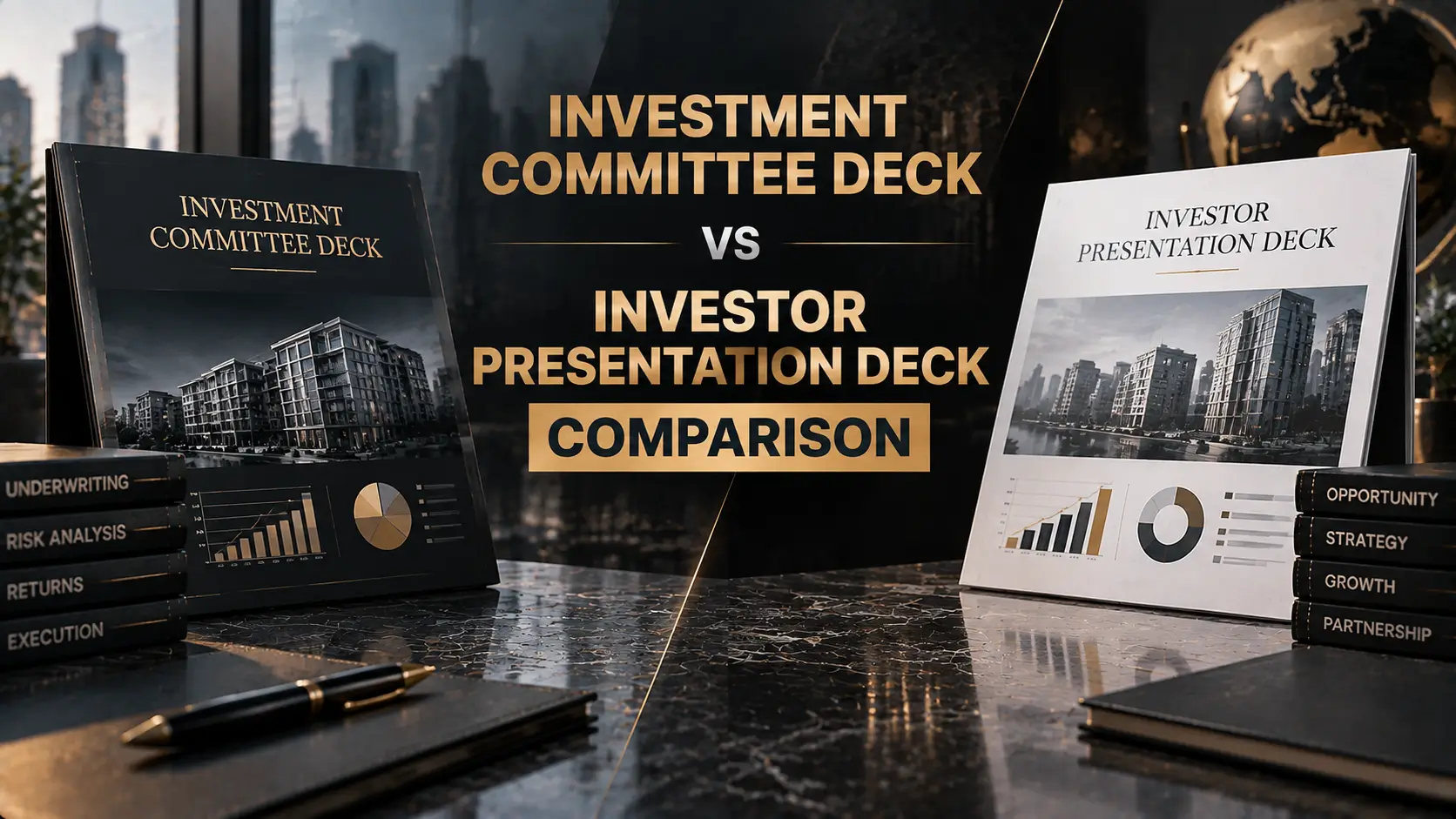
Investor presentation decks earn the next LP conversation; investment committee decks support a capital allocation decision. Both draw from the same model, but the committee version must add reconciled assumptions, stress testing, governance terms, and deal-specific risk mitigants.
The investor presentation deck and the investment committee deck are two different documents with two different jobs. The private placement memorandum guide for a real estate closed-end fund covers the broader legal architecture of an institutional raise package. This article focuses on one specific distinction: what separates these two documents, why that distinction matters, and what happens when sponsors treat them as interchangeable.
The core problem: A presentation deck built for a first LP meeting carries mismatched content density, misaligned framing, and insufficient assumption disclosure for a committee room. Sending it there signals that the sponsor misreads how institutional capital decisions get made.
What Each Document Is Actually For
The confusion between these two documents comes from surface similarity. Both are slide-based. Both cover the deal, the sponsor, and the returns. Both circulate during a raise. The similarity ends there.
The Investor Presentation Deck
The investor presentation deck is a relationship-building document. Its job is to earn the next conversation. A sponsor uses it in early LP meetings, introductory calls, and first-pass screenings. The audience is a single LP contact, a portfolio manager, or a business development officer who is deciding whether to bring the deal internally for further review.
At this stage, the LP has no obligation to the deal. The deck should answer four questions quickly:
- Does this opportunity match our mandate?
- Does the sponsor have the track record to execute?
- Are the return targets consistent with our thresholds?
- Is this worth spending more time on?
A well-built presentation deck typically runs 12 to 18 slides for a single deal and 15 to 22 slides for a fund, based on standard institutional formatting guidance. It leads with the opportunity and the ask. It closes with a clear invitation to deeper review. Narrative and credibility carry the weight here. Granular financial detail belongs in the follow-up package, covered in depth in the five LP financial exhibits that sit behind a real estate pitch deck.
The Capital Raise Pre-Flight is IRC Partners' fixed-fee diagnostic that scores a raise against the same twelve institutional gates a deal must clear before IRC Partners takes it into a strategic partnership.
The Investment Committee Deck
The IC deck is a decision document. Its audience is a committee of multiple decision-makers, often including analysts, portfolio managers, risk officers, and principals, who are voting on whether to allocate capital. They have already seen the presentation deck or a summary of it. They are past the question of fit. They are now asking whether the deal holds up under scrutiny.
The IC deck must answer a different set of questions:
- Can the sponsor defend every assumption under direct questioning?
- Does the capital stack survive adverse scenarios?
- Are the return projections consistent with current market conditions?
- Is there a clear path to exit and distribution?
- What are the specific risks, and what are the named mitigants?
The committee has no patience for narrative. They want traceable numbers, reconciled structures, and defensible assumptions. A presentation deck sent to a committee reads as underprepared. The committee moves on. They pass.
How the Content Requirements Differ
The structural differences between the two documents map directly to the questions each audience is asking. The table below shows where the emphasis shifts.
What the IC Deck Must Include That the Presentation Deck Does Not
The IC deck carries content that has no place in a first-meeting presentation. Adding it to the presentation deck overloads the presentation. Leaving it out of the IC deck creates committee questions the sponsor will be unable to answer on the spot.
Fully reconciled financial model outputs. The IC deck should include the summary tab, the waterfall mechanics, and the year-by-year cash flow timing. Every number must trace back to the model. Committees assign analysts to verify this before the meeting. Gaps surface immediately.
Detailed assumption disclosure. Exit cap rate assumptions, vacancy assumptions, expense load, debt terms, and deployment pace must all be stated explicitly with the basis for each. Committees in 2026 are underwriting against current market conditions, and expense load assumptions require explicit disclosure with the basis for each input stated in the deck. An assumption slide that uses round numbers without basis reads as retail-grade.
Named risk mitigants. A presentation deck can say "construction cost risk is mitigated by our general contractor relationships." An IC deck must name the GC, describe the contract structure (fixed-price, GMP, or cost-plus), and explain what happens if costs run over the budget. Vague mitigants are a committee red flag.
Governance and LP protection terms. The committee is approving a legal and economic structure. Key-man provisions, removal rights, reporting obligations, and distribution timing must appear in the IC deck, consistent with FINRA's guidance on private placement disclosure obligations. These are decisions, and committees need to see them in writing.
Stress case scenario. A presentation deck typically shows a base case and a downside. The IC deck needs a stress case: a scenario where multiple adverse inputs hit simultaneously, a standard expectation in institutional real estate reporting and performance standards. If the stress case still shows acceptable returns, the committee gains confidence. If the sponsor has not modeled it, the committee will ask, and the answer "we haven't run that" ends the conversation.
Sponsors who have already completed a pitch deck audit for institutional raises will recognize many of these elements. The audit process surfaces the same gaps that committees find. The difference is that finding them in an audit is recoverable. Finding them in a committee room is not.
Where Sponsors Lose Momentum
The most common failure pattern looks like this: a sponsor has a strong first LP meeting, the presentation deck lands well, and the LP contact expresses interest in bringing it to their committee. The sponsor, encouraged by the response, sends the same deck with a few slides added. The committee meets, raises questions the deck does not address, and the deal goes quiet.
The sponsor follows up. The LP contact says the committee "had some concerns" or "wanted more detail." The sponsor revises the deck again, adds more slides, and resubmits. The process drags. By the third round, the committee has moved on to other deals.
This is a document architecture problem, and it is entirely avoidable.
The Three Specific Failure Points
Sending the presentation deck to the committee. The presentation deck is built for persuasion. The committee is past persuasion. They are in verification mode. A deck heavy on narrative and light on reconciled numbers signals that the sponsor does not understand the committee's job.
Sending a presentation deck with IC content bolted on. Adding a 15-page appendix to a presentation deck creates a hybrid document that fails both audiences. The committee has to hunt for the information they need. The presentation logic interrupts the analytical flow. Committees read documents in a specific sequence, and a hybrid deck breaks that sequence.
Failing to reconcile numbers across documents. Discrepancies between the deck, the model, and the operating agreement are among the most common reasons committees table a deal for further review. A discrepancy between the IC deck and the model is a committee flag. A discrepancy between the IC deck and the PPM is a legal concern. Sponsors who build the two documents separately, with separate financial inputs, create these gaps without realizing it.
What Committees Actually Do With the IC Deck
Understanding the committee's process clarifies why the document requirements are what they are. Before the committee meeting, an analyst reviews the IC deck against the data room. They are checking three things: are the numbers internally consistent, do the assumptions match current market conditions, and are the risks adequately disclosed.
During the meeting, committee members ask questions by section. The return section, the assumption section, and the risk section generate the most questions. A sponsor who prepared a presentation deck for this environment will not have the supporting detail to answer them.
After the meeting, the committee votes. Deals that generate too many unanswered questions get tabled. Tabled deals rarely come back.
{{main-cta}}
Building the Two Documents as a Coordinated System
The solution is to treat the investor presentation deck and the IC deck as two documents built from the same financial foundation, with different levels of disclosure and different structural logic.
The Shared Foundation
Both documents draw from the same underlying model, the same track record schedule, and the same capital stack structure. The numbers must be identical across both. The assumptions must be consistent. The risk disclosures in the IC deck must not contradict anything in the presentation deck.
Building from a shared foundation means building the financial model and the capital stack structure before either document is drafted. Sponsors who design the presentation deck first and reverse-engineer the model from it create reconciliation problems that surface at the worst possible time.
The Presentation Deck Layer
The presentation deck takes the key conclusions from the model and presents them at summary level. Gross and net IRR. Equity multiple. Hold period. Preferred return rate. Target raise size. The sponsor's track record overview. The business plan in plain terms. The deck does not include the full assumption set, the waterfall mechanics, or the stress case. Those belong in the IC deck and the data room.
The IC Deck Layer
The IC deck takes the same financial foundation and adds the full disclosure layer. Every assumption is named and supported. The waterfall mechanics are presented in full. The stress case is modeled. The governance terms are stated. The risk section names specific scenarios with probability framing and named mitigants.
The IC deck is typically prepared after the sponsor has had at least one substantive LP conversation and knows the deal is moving toward a committee meeting. Preparing it before that point is premature. Preparing it after the committee meeting is requested is too late.
Practical checkpoint: Before submitting to any committee, a sponsor should be able to answer these five questions from the IC deck alone, without referring to any other document: What is the net IRR under the stress case? What happens to LP returns if the exit cap rate widens by 75 basis points? What are the key-man provisions? What is the distribution sequence in the waterfall? What is the basis for the vacancy assumption?
If any of those answers require pulling up the model or the operating agreement separately, the IC deck is incomplete.
Frequently Asked Questions
What is the difference between an investment committee deck and an investor presentation deck?
An investor presentation deck is a first-meeting document. Its purpose is to earn continued interest from an LP contact by presenting the opportunity, the sponsor's track record, and the return thesis at summary level. An investment committee deck is a decision document prepared for a formal vote. It carries fully reconciled financial model outputs, complete assumption disclosure, a stress case scenario, and governance terms. The two documents serve different audiences at different stages of the same raise.
When should a sponsor prepare an IC deck?
Prepare the IC deck after at least one substantive LP conversation confirms the deal is moving toward a committee meeting. Building it too early wastes preparation time on a deal that may not advance. Building it after a committee meeting is requested creates a timing problem. Most institutional LPs expect to receive the IC deck ahead of the scheduled committee date to allow analyst review.
Can a sponsor send the same deck to both the LP contact and the committee?
Sending a presentation deck to a committee is one of the most common reasons deals stall after a promising first meeting. The committee is in verification mode. A deck built for persuasion does not carry the assumption disclosure, reconciled model outputs, or stress case analysis the committee needs to vote. The result is a round of questions the sponsor cannot answer from the document, which leads to tabling.
How long should an IC deck be?
An IC deck for a single-deal institutional raise generally runs 25 to 40 pages including appendices, based on standard committee submission formats. The appendix section carries the detailed model outputs, the full track record schedule, and the supporting diligence materials the committee references during review. A presentation deck, by comparison, runs 12 to 18 slides for a single deal. Length alone is a signal to the committee about whether the sponsor understands the format.
What financial content does an IC deck require that a presentation deck does not?
The IC deck requires the full waterfall mechanics including tranche sizes, preferred return rate, promote percentage, hurdle threshold, and distribution sequence. It requires a stress case scenario showing LP returns under a combination of adverse inputs such as exit cap rate widening, lease-up extension, and cost overrun. It requires year-by-year distributable cash flow to equity. It requires the full assumption set with named bases for each input. All of these elements belong in the IC deck and the data room, reserved for committee-stage review.
What happens if the numbers in the IC deck do not match the financial model?
Before the committee meeting, an analyst checks the IC deck figures against the data room. A discrepancy between the IC deck and the model is flagged before the sponsor walks in. A discrepancy between the IC deck and the operating agreement or PPM raises a legal concern. Either type of gap gives the committee grounds to table the deal pending correction. Sponsors who build the presentation deck and the IC deck from separate financial inputs create these gaps without realizing it. Both documents must draw from the same reconciled model.
Does the IC deck replace the data room?
The IC deck serves as a structured summary of the deal's financials, structure, and risks at a level that allows a committee to vote. The data room carries the full model, the operating agreement, the PPM, the track record schedule with attribution, the due diligence materials, and any legal or regulatory disclosures. The IC deck references the data room and directs committee members to specific sections for verification. Sponsors raising $5M to $250M from institutional allocators typically maintain both documents as separate but reconciled components of the same raise package.
Continue reading this series:
- What financial projections do institutional LPs expect in a real estate fund pitch deck
- How to structure a capital stack for a $10M+ real estate deal
- The real estate developer's guide to raising institutional capital without losing control of your deal
The structure you carry into your first investor meeting sets the terms for every round that follows it. Founders who get it wrong spend the next three rounds negotiating from behind. The Capital Raise Pre-Flight is IRC Partners’ fixed-fee diagnostic that scores a raise against the same twelve institutional gates a deal must clear before IRC Partners takes it into a strategic partnership. IRC Partners advises operators raising $5M to $250M of institutional capital. Book your Capital Raise Pre-Flight here.
Need guidance on your capital raise?



Fees for Debt Advisory and Venture Debt

Which Advisory Firms Offer Comprehensive Capital Raising Services for Real Estate Developers?

Real Estate Investment Network: How $10M+ Sponsors Use Warm Introductions to Access Institutional Capital 60 Days Faster
Disclosure
Nothing on this site constitutes an offer to sell, or a solicitation of an offer to purchase, any security under the Securities Act of 1933, as amended, or any applicable state securities laws. Any offering of securities is made only by means of a formal private placement memorandum or other authorized offering documents delivered to qualified investors.
IRC Partners is a capital advisory firm. IRC Partners is not a registered investment adviser under the Investment Advisers Act of 1940 and does not provide investment advice as defined thereunder.
Certain statements in this article may constitute forward-looking statements, including statements regarding market conditions, capital availability, investor demand, and transaction outcomes. Such statements reflect current assumptions and expectations only. Actual results may differ materially due to market conditions, regulatory developments, company-specific factors, and other variables. IRC Partners makes no representation that any outcome, return, or result described herein will be achieved.
References to prior mandates, transaction volume, network credentials, or capital raised are provided for illustrative purposes only and do not constitute a guarantee or prediction of future results. Past performance is not indicative of future outcomes. Individual results will vary. Network credentials and transaction statistics referenced on this site reflect the aggregate experience of IRC Partners' principals and affiliated advisors and are not a representation of assets managed or transactions closed solely by IRC Partners.
Certain data, statistics, and information presented in this article have been obtained from third-party sources. IRC Partners has not independently verified such information and expressly disclaims responsibility for its accuracy, completeness, or timeliness. Readers should independently verify any third-party data before relying on it.
Readers are strongly encouraged to consult qualified legal, financial, and tax professionals before making any investment, capital raising, or business decision.
Schedule A Meeting
You get one shot to raise the right way. If this raise is worth doing, it’s worth doing with precision, leverage, and control.
This isn’t a practice run. Serious capital. Serious strategy. Let’s raise it right.
We onboard a maximum of seven
new strategic partners each quarter, by application only, to maximize your chances of securing the capital you need.
