.svg "CTA Arrow")


.png "Investor Ready Capital decorative background element")

How to Negotiate an Escalating Price Floor in a Drag-Along Clause: 1x in Years 1-2, 2x in Years 3-4, 3x in Year 5 and Beyond
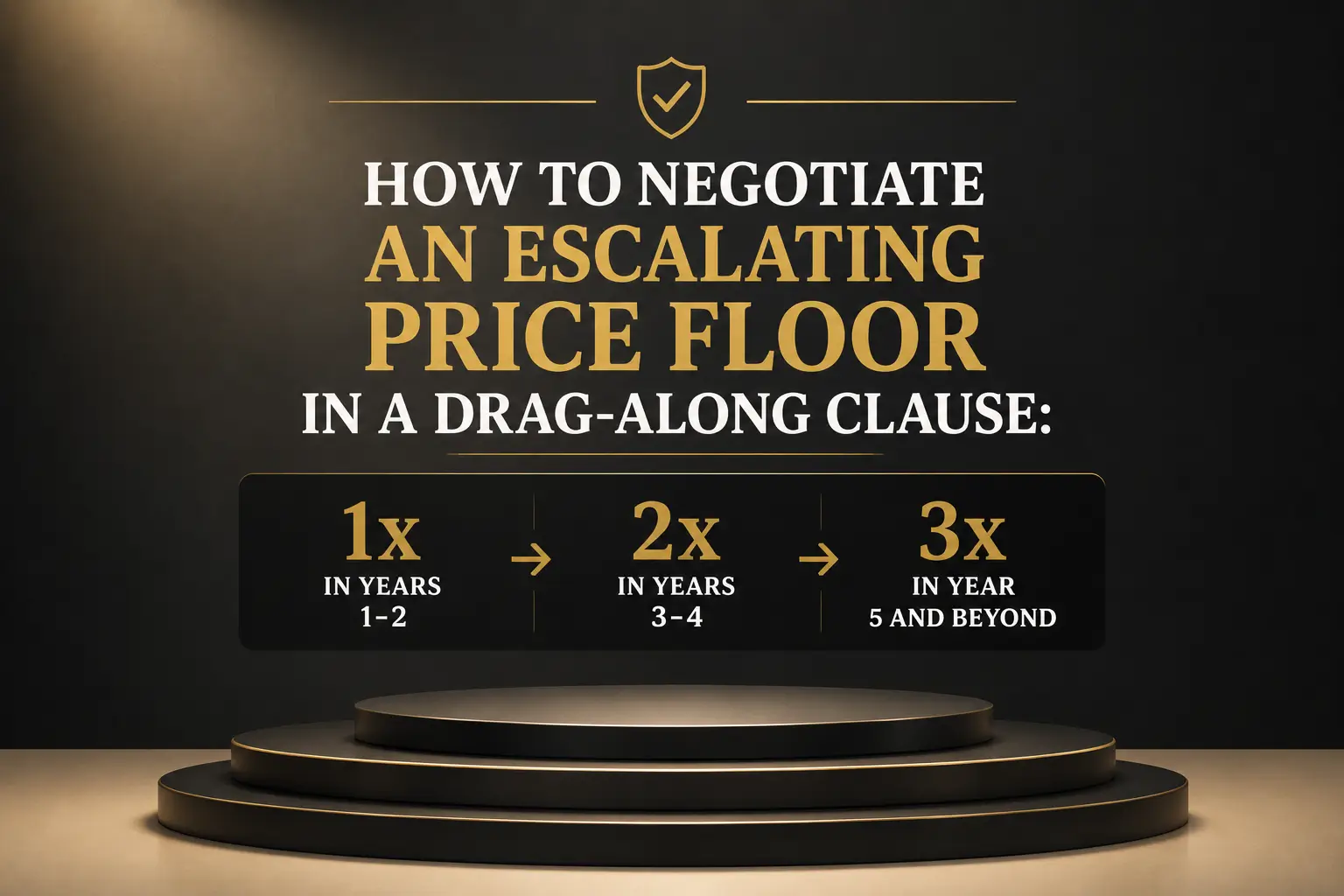
How to Negotiate an Escalating Price Floor in a Drag-Along Clause: 1x in Years 1-2, 2x in Years 3-4, 3x in Year 5 and Beyond
An escalating price floor is a minimum acceptable sale price written into a drag-along clause that rises automatically as the company ages. Instead of locking in a single fixed threshold at the time of financing, the floor steps up on a defined schedule: 1x of an agreed capital base in years one and two, 2x in years three and four, and 3x in year five and beyond. This structure gives founders a self-adjusting economic veto on low-price forced exits without requiring a full time-based lockout, and it is more negotiable with investors because it preserves a clear path to early liquidity at any tier if a buyer meets the threshold. The time to negotiate it is before the next round closes, not after a buyer is already at the table.
Key takeaways:
- A static price floor set at Series A does not rise with the value the company builds between rounds. By Series B or Series C, it may be technically present but economically irrelevant.
- An escalating floor tied to a defined capital base and a time-indexed step-up schedule protects the value founders actually create, not just the value the company had at the moment of financing.
- The measurement base matters as much as the multiple. A vague or manipulable base can hollow out the floor at any tier before a single investor vote is cast.
Why a Static Price Floor Loses Protective Value as the Company Grows
Most founders negotiate a price floor during their first institutional round and assume it will hold. It does not, and the reason is structural, not legal. A static floor reflects one financing moment. It does not update when the company raises more capital, hits revenue milestones, or builds real enterprise value between rounds.
Here is how the protection erodes in four steps:
- The floor is set at Series A. Assume a 1x floor on $10M of invested capital. The minimum sale price is $10M. At that moment, the protection feels meaningful relative to the company's valuation.
- The company raises a Series B. Total invested capital is now $25M. The company's implied value has grown. But the drag-along document still references the original $10M floor unless it was expressly updated in the new financing, which most founders do not think to negotiate.
- The floor becomes economically irrelevant. A $10M minimum sale price on a company worth $40M or $60M does not block a low-value forced exit. Any buyer willing to clear the old threshold can satisfy the clause even if the price is far below what the company has actually built.
- Founders have false comfort. The floor still appears in the document. Founders assume it protects them. It does not, because the threshold no longer reflects the company's current value or the capital at risk.
This is the core problem that an escalating floor solves. The drag-along provisions framework for growth-stage companies covers the broader mechanics, but the static-floor failure is a specific structural gap that requires its own fix.
How the 1x, 2x, 3x Escalating Structure Works in Practice
The escalating floor replaces a single fixed threshold with a schedule that rises automatically based on elapsed time from a defined start date. No board approval is needed to trigger the step-up. The passage of time does it automatically.
Each tier works as follows:
- Years 1-2 (1x tier): The minimum sale price equals the agreed capital base. Investors retain a reasonable path to early liquidity if a strategic buyer appears quickly. The floor is protective but not prohibitive.
- Years 3-4 (2x tier): The floor doubles. This reflects the expectation that a company still operating and growing in year three has created real value beyond the initial financing. A sale at 1x no longer reflects what the company is worth.
- Year 5 and beyond (3x tier): The floor triples. At this stage, the company has had enough time to compound value meaningfully. A forced sale below 3x of invested capital would represent a significant economic failure relative to the time and capital deployed.
Comparison: Static Floor vs. Escalating Floor on a $10M Capital Base
The protection gap starts at zero and grows to $20M by year five on a $10M base. On a $25M base reflecting a Series A plus a seed round, the gap at year five reaches $50M. That is the difference between a floor that blocks a low-value forced exit and one that does not.
The trigger for each step-up should be defined precisely in the document. The most defensible formulation ties the clock to the closing date of the financing round in which the drag-along clause was executed, not to the date of any future amendment or restatement. Founders should also confirm whether the clock resets if a new round amends the drag-along document, because a reset provision can eliminate the escalation benefit entirely.
The NVCA Model Legal Documents include a Voting Agreement template that defines "Sale of the Company" and the mechanics of drag-along consent. That template does not include an escalating floor by default, which is exactly why founders need to negotiate it as a modification before the round closes.
How to Define the Measurement Base So the Floor Cannot Be Hollowed Out
The multiple is the visible part of an escalating floor. The base is the part that determines whether the floor actually works. A 3x floor on a poorly defined base can be worth less than a 1x floor on a clean, unambiguous one.
These are the four most common base definitions and what founders should know about each:
- Invested capital (recommended): The total capital actually invested in the company by the relevant investor group, measured at the time the drag-along clause was executed. This is the cleanest base. It is verifiable, hard to manipulate, and directly tied to the economic exposure the clause is designed to protect. Founders should push to define exactly which instruments count: preferred shares, SAFEs converted before the round, convertible notes, and whether bridge financing is included or excluded.
- Post-money valuation: The implied company valuation after the financing closes. This base sounds intuitive but creates problems. Post-money valuations are negotiated numbers, not cash invested. They can be inflated, restated, or disputed. Using post-money as the base gives investors room to argue the floor was already satisfied at a price below what founders expected.
- Liquidation preference stack: The total liquidation preference held by all preferred stockholders at the time of the sale. This base shifts as later rounds add new preferred. It can be significantly higher than invested capital if participating preferred or stacked preferences are in play, which makes the floor harder to trigger and easier for investors to argue around.
- Undefined or blended formulations: Any language that references "fair market value," "board-determined value," or a combination of metrics without a fixed calculation methodology is dangerous. Ambiguous bases produce disputes at exactly the moment founders need clarity, when a buyer is at the table and time pressure is high.
Recommended position: Define the base as total invested capital in the preferred financing round in which the drag-along clause is executed, with a schedule of included instruments attached as an exhibit. If later rounds amend the drag-along, the base should update to reflect the cumulative invested capital at that point, not reset to a lower number.
Ambiguous base definitions are one of the most common ways drag-along rights get buried in term sheets and only surface when a sale is already in motion.
An Escalating Floor and a Time-Based Restriction Are Not the Same Protection
These two protections are often confused because both involve time. They solve different problems.
A time-based drag-along restriction limits when the clause can be used. It blocks a forced sale entirely during a defined window, regardless of price. An escalating floor limits the economic terms under which a drag-along sale can proceed, at any time. One is a gate. The other is a price condition.
The distinction matters in negotiation:
- A pure time-based lockout is harder for investors to accept because it removes all exit optionality for a fixed period, even if a genuinely strong offer arrives.
- An escalating floor is more negotiable because it still allows a sale at any time if a buyer meets the threshold. Investors retain early liquidity at 1x in years one and two, which is a meaningful concession that makes the structure easier to agree on.
- Together, the two protections cover both dimensions: the escalating floor handles low-price economic risk at any time, and a time-based restriction handles premature exit risk before the company has had a fair chance to build value.
Founders reviewing time-based drag-along restrictions should treat the escalating floor as a complement, not a substitute. Relying on one without the other leaves a gap.
What Happens Without an Escalating Floor in a Compressed-Multiple Market
When market conditions weaken, investor pressure for liquidity tends to rise. A static floor that was set at 1x of $10M provides no real protection against a sale at $11M on a company that has built $40M in enterprise value. The floor is satisfied on paper. The founder's economic outcome is not.
The consequences stack quickly:
- The approval group that can satisfy the drag trigger gains leverage, especially if the voting math is already founder-unfriendly.
- A buyer who knows the floor is stale can anchor negotiations at a number just above the threshold.
- Founders who have not reviewed how clause variations favor investors over founders may not realize the floor is the only economic protection standing between them and a below-market forced exit.
The absence of an escalating floor in a down-round environment is not a theoretical risk. It is a structural gap that shifts exit economics away from the people who built the company.
{{main-cta}}
What Founders Should Ask to Include Before the Next Round Closes
The negotiation window for an escalating price floor is narrow. Once the financing closes and the voting agreement is signed, the terms are set until the next round, and the next round may bring new investors who have no incentive to improve the existing floor. These are the five points to raise before the close:
- Request a defined escalating schedule with a fixed start date. The document should name the closing date of the current financing as the start of the clock, and it should set out the 1x, 2x, and 3x thresholds in plain numerical terms, not by reference to a formula that requires later interpretation.
- Define the capital base with a schedule of included instruments. Specify which instruments count toward the base: preferred shares issued in the current round, SAFEs converted at or before closing, convertible notes included in the round, and whether any bridge financing is in or out. Attach the schedule as an exhibit so there is no ambiguity later.
- Confirm whether the clock resets on amendment or restatement. If a later round amends the drag-along clause, does the escalation clock restart from the new closing date? If yes, the entire escalation benefit can be eliminated by a simple amendment. Founders should push for language that preserves the original start date or, at minimum, requires a new negotiation of the floor as a condition of any amendment.
- Ask how later rounds affect the base. If a Series B adds $15M to the capital stack, does the escalating floor base update to include that capital? It should, because the floor should reflect total invested capital at risk, not just the initial round. If the base stays static while the capital stack grows, the escalation multiple becomes less meaningful over time.
- Coordinate the floor with threshold design and voting mechanics. A well-designed escalating floor can be undermined by a low drag-along trigger threshold or ambiguous voting calculations. Founders should review how voting threshold design affects drag-along outcomes alongside the price floor negotiation, not separately.
IRC Partners works with growth-stage founders to review these structures before the next financing closes, when the leverage to negotiate them still exists. The right time to address a stale or static price floor is before a new round locks in the terms, not after drag-along leverage has already been used.
Frequently Asked Questions
What is an escalating price floor in a drag-along clause?
An escalating price floor is a minimum acceptable sale price written into a drag-along clause that rises automatically on a defined schedule as the company ages. Unlike a static floor, which fixes a single threshold at the time of financing and never changes, an escalating floor steps up at defined intervals, typically 1x of an agreed capital base in years one and two, 2x in years three and four, and 3x in year five and beyond. The result is a price condition that tracks value creation rather than freezing it at the moment of the original financing.
How is an escalating price floor different from a static price floor?
A static price floor sets one fixed minimum sale price and holds it there regardless of how much value the company builds after the financing closes. An escalating floor sets a rising schedule that increases the minimum threshold automatically with the passage of time. On a $10M capital base, a static 1x floor stays at $10M in year five. An escalating 3x floor at year five requires a minimum sale price of $30M. That $20M difference is the economic protection gap that a static floor cannot close.
What does the 1x, 2x, 3x tier structure mean in practice?
Each tier represents a multiple of the agreed capital base that the sale price must meet or exceed before the drag-along can be used to force a sale. At 1x in years one and two, the minimum sale price equals total invested capital, for example $10M on a $10M base. At 2x in years three and four, it doubles to $20M. At 3x in year five and beyond, it reaches $30M. No board vote or investor consent is needed to move between tiers. The step-up triggers automatically when the elapsed time from the defined start date crosses the threshold.
What should the measurement base be defined as in an escalating floor?
The measurement base should be defined as total invested capital in the preferred financing round in which the drag-along clause is executed, with a written schedule of included instruments attached as an exhibit to the agreement. Founders should confirm whether SAFEs converted at closing, convertible notes included in the round, and bridge financing are counted in or out, and whether the base updates when later rounds add capital to the stack. A base defined as post-money valuation or fair market value is significantly more vulnerable to dispute and manipulation than a base tied to actual cash invested.
Can investors push back on an escalating price floor, and what is the counterargument?
Investors typically argue that an escalating floor reduces exit flexibility and could prevent a legitimate sale if market conditions shift. The counterargument is that the escalating structure is more founder-friendly than a full time-based lockout precisely because it preserves investor liquidity at every tier. A buyer who meets the 1x floor in year one can still close a deal. A buyer who meets the 2x floor in year three can still close a deal. The floor does not eliminate exit options; it sets a rising economic condition for them. That distinction makes the escalating floor meaningfully more negotiable than a hard lockout provision.
How does an escalating price floor interact with a time-based drag-along restriction?
An escalating price floor and a time-based restriction operate on different dimensions and are designed to work together, not as substitutes. A time-based restriction limits when a drag-along can be triggered, blocking a forced sale entirely during a defined window regardless of price. An escalating floor limits the economic terms under which a drag-along sale can proceed at any time. Founders who rely only on the escalating floor remain exposed to a below-threshold forced sale if the voting mechanics allow it. Founders who rely only on a time-based restriction remain exposed to a low-price sale once the restriction period expires. Both protections together close the gap on timing risk and price risk simultaneously.
What happens to the escalating floor if the company raises a new round at a higher valuation?
A new financing round at a higher valuation does not automatically update the escalating floor unless the drag-along clause is expressly amended as part of that round. If the floor is not updated, the base stays fixed at the original invested capital figure, which means the escalating multiple applies to a smaller number than the company's actual capital at risk. Founders should negotiate at each new round to update the base to reflect cumulative invested capital, and they should confirm whether the escalation clock resets from the new closing date or continues from the original start date. A clock reset provision can eliminate years of escalation benefit in a single amendment.
Continue reading this series:
- Why your drag-along threshold from your seed round no longer protects you at Series A
- How drag-along consent structures can let a minority investor force a majority outcome
- What happens to drag-along rights when you layer a Series B
IRC Partners advises operators raising $5M to $250M of institutional capital on structure, positioning, and round architecture. We take seven strategic partners per quarter. No placement agent model. No success-only theater. Capital is raised on the strength of how the deal is built. If you want your current raise reviewed before it reaches the market and silently fails , apply here.
Sponsors weighing this decision should first complete a capital raise readiness assessment for sponsors to confirm the raise is investor-ready.
Need guidance on your capital raise?


What Supporting Schedules Should Be Included in a Real Estate Capital Raise Model?

How Long Does Sovereign Wealth and Pension Capital Take

Top Firms for Investor Pitch Deck Preparation
Disclosure
Nothing on this site constitutes an offer to sell, or a solicitation of an offer to purchase, any security under the Securities Act of 1933, as amended, or any applicable state securities laws. Any offering of securities is made only by means of a formal private placement memorandum or other authorized offering documents delivered to qualified investors.
IRC Partners is a capital advisory firm. IRC Partners is not a registered investment adviser under the Investment Advisers Act of 1940 and does not provide investment advice as defined thereunder.
Certain statements in this article may constitute forward-looking statements, including statements regarding market conditions, capital availability, investor demand, and transaction outcomes. Such statements reflect current assumptions and expectations only. Actual results may differ materially due to market conditions, regulatory developments, company-specific factors, and other variables. IRC Partners makes no representation that any outcome, return, or result described herein will be achieved.
References to prior mandates, transaction volume, network credentials, or capital raised are provided for illustrative purposes only and do not constitute a guarantee or prediction of future results. Past performance is not indicative of future outcomes. Individual results will vary. Network credentials and transaction statistics referenced on this site reflect the aggregate experience of IRC Partners' principals and affiliated advisors and are not a representation of assets managed or transactions closed solely by IRC Partners.
Certain data, statistics, and information presented in this article have been obtained from third-party sources. IRC Partners has not independently verified such information and expressly disclaims responsibility for its accuracy, completeness, or timeliness. Readers should independently verify any third-party data before relying on it.
Readers are strongly encouraged to consult qualified legal, financial, and tax professionals before making any investment, capital raising, or business decision.
Schedule A Meeting
You get one shot to raise the right way. If this raise is worth doing, it’s worth doing with precision, leverage, and control.
This isn’t a practice run. Serious capital. Serious strategy. Let’s raise it right.
We onboard a maximum of seven
new strategic partners each quarter, by application only, to maximize your chances of securing the capital you need.
