.svg "CTA Arrow")


.png "Investor Ready Capital decorative background element")

How to Choose an Advisor for Sovereign Wealth and Pension Capital
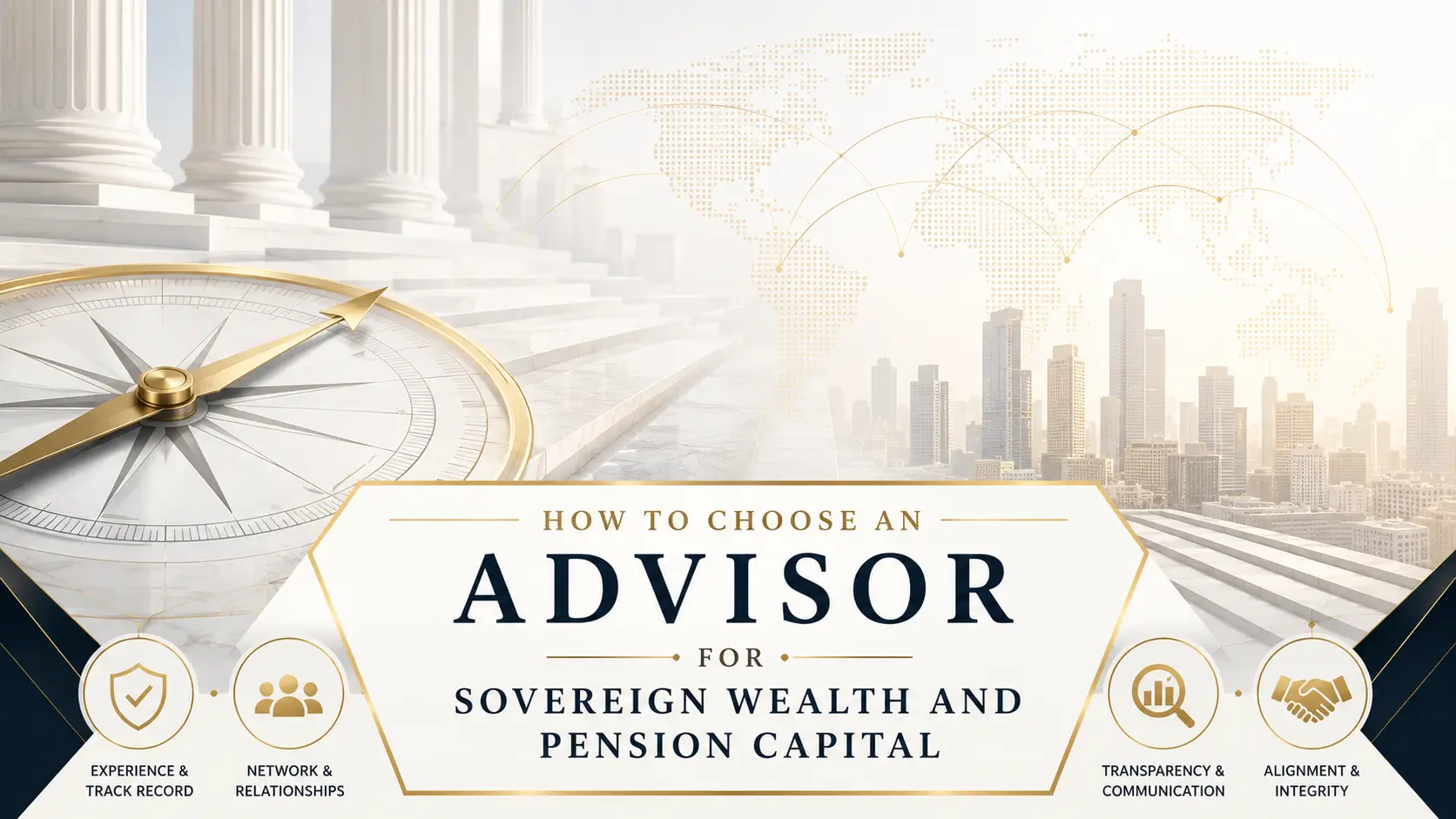
Choosing the right advisor for a sovereign wealth or pension fund raise starts with one principle: this channel is not interchangeable with others. The advisor you need has documented relationships with specific allocators, understands how institutional investment committees work, and can position your firm before the first introduction happens. They manage diligence on the LP's timeline, not yours. A generalist placement agent with a broad LP list is not a substitute - and in this channel, the wrong advisor does not just underperform; they can damage your credibility with a narrow universe of allocators you may not get a second chance to approach.
Three things to verify before signing any advisory agreement:
- Whether the advisor has documented relationships with sovereign or pension allocators that match your strategy, geography, and check size
- Whether they can manage institutional diligence cadence, including IC timing, consultant influence, and reporting expectations
- Whether their engagement structure aligns their incentives with your outcome, not just with their fee trigger
Why Advisor Selection Is Different for This LP Type
In softer capital channels, a well-connected advisor can open conversations through sheer volume. Broad outreach, narrative selling, and a large LP contact list are enough to generate interest. Sovereign wealth funds and pension funds do not work that way.
These allocators run formal screening processes. They have investment committees, external consultants who pre-filter manager candidates, and governance requirements that shape every step of the diligence cycle. According to the Invesco 2025 Global Sovereign Asset Management Study, sovereign investors are increasingly selective about external manager relationships, prioritizing long-term alignment and process credibility over short-term return projections.
A sponsor who enters this channel through the wrong advisor signals institutional inexperience before the first meeting. The LP universe is concentrated. Word travels. A failed or poorly managed approach does not disappear. It becomes part of how those allocators think about your firm the next time your name comes up.
Understanding how institutional LP due diligence actually works before you hire an advisor is not optional. It is the baseline for evaluating whether any advisor can actually execute in this channel. Knowing when does a company need capital raising from sovereign wealth and pension funds is equally important: entering this channel before you are ready compounds every advisor selection risk described above.
The 5 Criteria That Actually Matter
Most advisor evaluations focus on brand name and claimed LP network size. Neither tells you whether the advisor can execute in a sovereign or pension fund raise. These five criteria do.
- Verified allocator relationships by LP type, geography, and strategy fit. Ask for specific examples: which sovereign or pension fund profiles has the advisor engaged for real estate strategies comparable to yours, at what check size, and in what geography? A general claim of "institutional LP relationships" is not verification. If the advisor cannot name LP categories and ticket ranges relevant to your raise, they do not have the access they are implying.
- Pre-outreach positioning capability. The advisor must be able to shape how your firm is presented before any introduction happens. This includes narrative framing, data room sequencing, and anticipating the institutional objections that will arise at the screening stage. Advisors who skip this step and move straight to outreach are operating as brokers, not institutional advisors.
- Diligence cadence management. Sovereign and pension fund processes run on LP timelines, not sponsor timelines. The advisor needs to understand IC meeting cycles, the role of external investment consultants, and the reporting standards these LPs require. ILPA reporting guidance sets a widely used baseline. Verify that the advisor is fluent in it.
- LP targeting discipline. An advisor who proposes a long outreach list without a clear mandate-fit filter will weaken your signal quality in a concentrated market. The right advisor runs a narrow, qualified list. Volume outreach in this channel is not a strategy. It is a liability.
- Engagement alignment. Review how the advisor's economics are structured. Are their incentives tied to your close, or to their activity? Does the engagement cover post-introduction support through diligence and close, or does it end at the first meeting? An advisor who disappears after the introduction has no stake in whether the raise succeeds.
Red Flags That Disqualify an Advisor for This Channel
These are not caution signals. They are disqualifiers. If you see any of them, do not proceed.
- They talk about LP appetite in broad terms but cannot describe specific allocator process realities. If an advisor cannot explain how a sovereign wealth fund's investment committee works or how pension fund consultant relationships affect manager selection, they have not operated in this channel. Vague LP language is a tell.
- They lead with volume outreach tactics. Teaser blasts, broad email campaigns, and high-volume LP lists are appropriate for some channels. In a concentrated institutional market where allocators know each other and talk to each other, mass distribution signals that your advisor does not understand the environment. It can precede your firm's name into rooms you cannot recover from.
- They cannot explain what happens after the first introduction. An advisor who describes their role as making introductions and then stepping back is not built for this LP type. Sovereign and pension fund raises require active management through screening, diligence, consultant review, and IC presentation. If the advisor's process ends at the first meeting, the raise is not being managed.
- They cite family office success as proof of sovereign or pension fund capability. These are different channels with different process requirements, timelines, governance standards, and decision-making structures. Success in one does not transfer to the other. An advisor who conflates them does not understand the distinction that matters most to your raise.
One of the most common mistakes sponsors make in institutional capital raising is treating advisor selection as a formality rather than a diligence process in its own right.
{{main-cta}}
Questions to Ask Before Signing
Put these directly to any advisor you are evaluating. Weak or evasive answers are data.
- Which sovereign or pension fund profiles have you engaged in the last 24 months for real estate strategies comparable to mine, and at what check size?
- How do you validate LP mandate fit before outreach begins?
- How do you position a sponsor before the first introduction, and what materials do you require to do it?
- What is your process after the first meeting? How do you manage follow-up, diligence requests, and consultant review?
- Where do you usually lose momentum in a sovereign or pension fund raise, and how do you handle it?
- How is exclusivity structured, and what happens if your LP relationships do not convert to commitments?
- How are your economics tied to close, and what does the engagement cover after introductions are made?
- Can you provide anonymized references from sponsors you have represented in this specific LP channel?
What the Engagement Structure Should Look Like
The structure of an advisory engagement tells you more about an advisor's actual capability than anything they say in a pitch meeting. Compare the two models below before you sign anything.
Sponsors raising in the sovereign and pension fund channel need the institutional advisory model. The engagement model you agree to before outreach begins sets the terms for everything that follows. Do not let fee headline be the deciding factor.
How to Verify Access Before Committing
Do not take access claims at face value. These steps let you verify independently before signing.
- Ask for anonymized examples tied to LP type, strategy, geography, and raise size. Broad tombstones are not verification. LP-type-specific examples are.
- Request a process map showing how introductions are qualified, sequenced, and advanced after first contact. An advisor who cannot produce this does not have a repeatable process.
- Listen to how the advisor describes LP decision-making. Do they reference IC timing, consultant influence, and governance requirements? Or do they speak in general relationship terms? The language reveals the experience level.
- Ask whether they have worked with sponsors at your exact stage and raise size in this channel. A track record with $250M fund raises does not automatically transfer to a $25M raise with a different LP audience.
- Check whether their materials, data room expectations, and positioning language match institutional standards or still mirror family office and broker-channel norms.
The Most Common Advisor Selection Mistake
The most common mistake is choosing the advisor with the largest claimed network instead of the one with the most relevant, verifiable fit for the sovereign and pension fund channel specifically. A large LP list built on family office and high-net-worth relationships is not an institutional LP network. It is a different product.
The correction is straightforward: run a structured diligence process on the advisor before allowing any outreach under your name. Treat it the same way you would evaluate a key hire. Ask for evidence, not claims. Require specifics, not categories. And make sure the engagement structure aligns their incentives with your close before you sign.
Timing matters here too. Sponsors who approach this channel before their capital stack and materials are institutionally ready compound the advisor selection problem. Even the right advisor cannot overcome a sponsor who is not ready for this LP type. If you are still deciding whether to engage at all, how to hire an advisor for sovereign wealth and pension capital covers the full engagement decision from first contact through mandate signing.
Frequently Asked Questions
Can a generalist capital advisor execute effectively in the sovereign and pension fund channel?
Rarely. Generalist advisors are built for broader distribution channels where narrative quality and relationship warmth drive outcomes. Sovereign and pension fund raises require formal process management, IC-ready positioning, and active diligence support through consultant review stages. An advisor without specific experience in this LP type will typically stall after the first introduction because they do not know how to manage what comes next.
How do I verify that an advisor actually has relationships at specific funds versus a general LP network?
Ask for anonymized examples tied to LP type, geography, strategy, and check size for raises completed in the last 24 months. Then ask how those relationships were developed and maintained. An advisor with real sovereign or pension fund access can describe the process, the LP's decision-making structure, and the outcome. An advisor with a general LP list cannot.
Are advisor fees negotiable for sovereign and pension fund raises?
Fee structures in institutional advisory engagements are negotiable, but the more important variable is how fees are structured, not just the rate. Success fees tied to close align incentives correctly. Fees triggered by introductions or activity do not. Before negotiating the rate, confirm that the fee trigger and scope of work match the institutional advisory model, not a transactional placement model. A full breakdown of how capital raising advisor fees are structured across retainer, success fee, and equity models can help you compare proposals before signing.
What does equity alignment in an advisory engagement look like, and why does it matter for this LP type?
Equity alignment means the advisor holds a stake in your outcome beyond a one-time success fee. In practice, this can take the form of advisory equity, a carried interest participation, or milestone-gated fees tied to capital close. For sovereign and pension fund raises, which run long cycles and require sustained advisor involvement, equity alignment keeps the advisor engaged through the full process rather than moving on after the first introduction.
How long does a typical advisory engagement run for a sovereign or pension fund raise?
These raises do not close quickly. Institutional LP diligence for sovereign and pension funds typically runs 9 to 18 months from first introduction to commitment, depending on the fund's IC cycle, consultant review requirements, and co-investment or separate account structuring. An advisor engagement for this channel should be scoped accordingly. Any engagement structured around a 90-day window is not designed for this LP type. For a full breakdown of what drives timeline in an institutional real estate raise.
Can a sponsor run a parallel process with multiple advisors simultaneously?
Running parallel advisors in a concentrated institutional market is high-risk. If two advisors approach the same sovereign or pension fund with the same sponsor, it signals poor process control and damages credibility with both the LP and the advisors. Most institutional advisory agreements include exclusivity provisions for specific LP channels precisely because of this risk. If you are considering parallel processes, define LP-type and geography exclusivity clearly in each agreement before outreach begins.
What happens if the advisor's LP relationships do not convert to commitments?
This is the question most sponsors do not ask before signing. The answer depends entirely on how the engagement was structured. If the advisor's fee is tied to introductions rather than closes, they have no financial stake in whether the LP converts. If the engagement includes milestone gates and close-linked economics, the advisor remains accountable through the full process. Before signing, define in writing what constitutes a failure scenario, how the engagement terminates, and what tail provisions apply if an LP introduced during the engagement commits after the term ends.
Continue reading this series:
- How Capital Raising from Sovereign Wealth and Pension Funds Works
- Common Mistakes to Avoid When Raising Capital from Sovereign Wealth and Pension Funds
- Key Benefits of Capital Raising from Sovereign Wealth and Pension Funds
IRC Partners advises operators raising $5M to $250M of institutional capital on structure, positioning, and round architecture. We take seven strategic partners per quarter. No placement agent model. No success-only theater. Capital is raised on the strength of how the deal is built. If you want your current raise reviewed before it reaches the market and silently fails , apply here.
Sponsors weighing this decision should first complete a capital raise readiness assessment for sponsors to confirm the raise is investor-ready.
Need guidance on your capital raise?


Option Pool Shuffle Explained: How Investors Use Your Pre-Money Valuation to Quietly Dilute You Before the Round Closes
How Long Does Debt Advisory and Venture Debt Take
Co-Sale Rights and Tag-Along Provisions: The Cap Table Clauses That Force Institutional Investors to Share Their Deal With Your Seed Angels
Disclosure
Nothing on this site constitutes an offer to sell, or a solicitation of an offer to purchase, any security under the Securities Act of 1933, as amended, or any applicable state securities laws. Any offering of securities is made only by means of a formal private placement memorandum or other authorized offering documents delivered to qualified investors.
IRC Partners is a capital advisory firm. IRC Partners is not a registered investment adviser under the Investment Advisers Act of 1940 and does not provide investment advice as defined thereunder.
Certain statements in this article may constitute forward-looking statements, including statements regarding market conditions, capital availability, investor demand, and transaction outcomes. Such statements reflect current assumptions and expectations only. Actual results may differ materially due to market conditions, regulatory developments, company-specific factors, and other variables. IRC Partners makes no representation that any outcome, return, or result described herein will be achieved.
References to prior mandates, transaction volume, network credentials, or capital raised are provided for illustrative purposes only and do not constitute a guarantee or prediction of future results. Past performance is not indicative of future outcomes. Individual results will vary. Network credentials and transaction statistics referenced on this site reflect the aggregate experience of IRC Partners' principals and affiliated advisors and are not a representation of assets managed or transactions closed solely by IRC Partners.
Certain data, statistics, and information presented in this article have been obtained from third-party sources. IRC Partners has not independently verified such information and expressly disclaims responsibility for its accuracy, completeness, or timeliness. Readers should independently verify any third-party data before relying on it.
Readers are strongly encouraged to consult qualified legal, financial, and tax professionals before making any investment, capital raising, or business decision.
Schedule A Meeting
You get one shot to raise the right way. If this raise is worth doing, it’s worth doing with precision, leverage, and control.
This isn’t a practice run. Serious capital. Serious strategy. Let’s raise it right.
We onboard a maximum of seven
new strategic partners each quarter, by application only, to maximize your chances of securing the capital you need.
