.svg "CTA Arrow")


.png "Investor Ready Capital decorative background element")

What Growth-Stage Companies Need to Know About Drag-Along Provisions Before They Become a Problem
What Growth-Stage Companies Need to Know About Drag-Along Provisions Before They Become a Problem
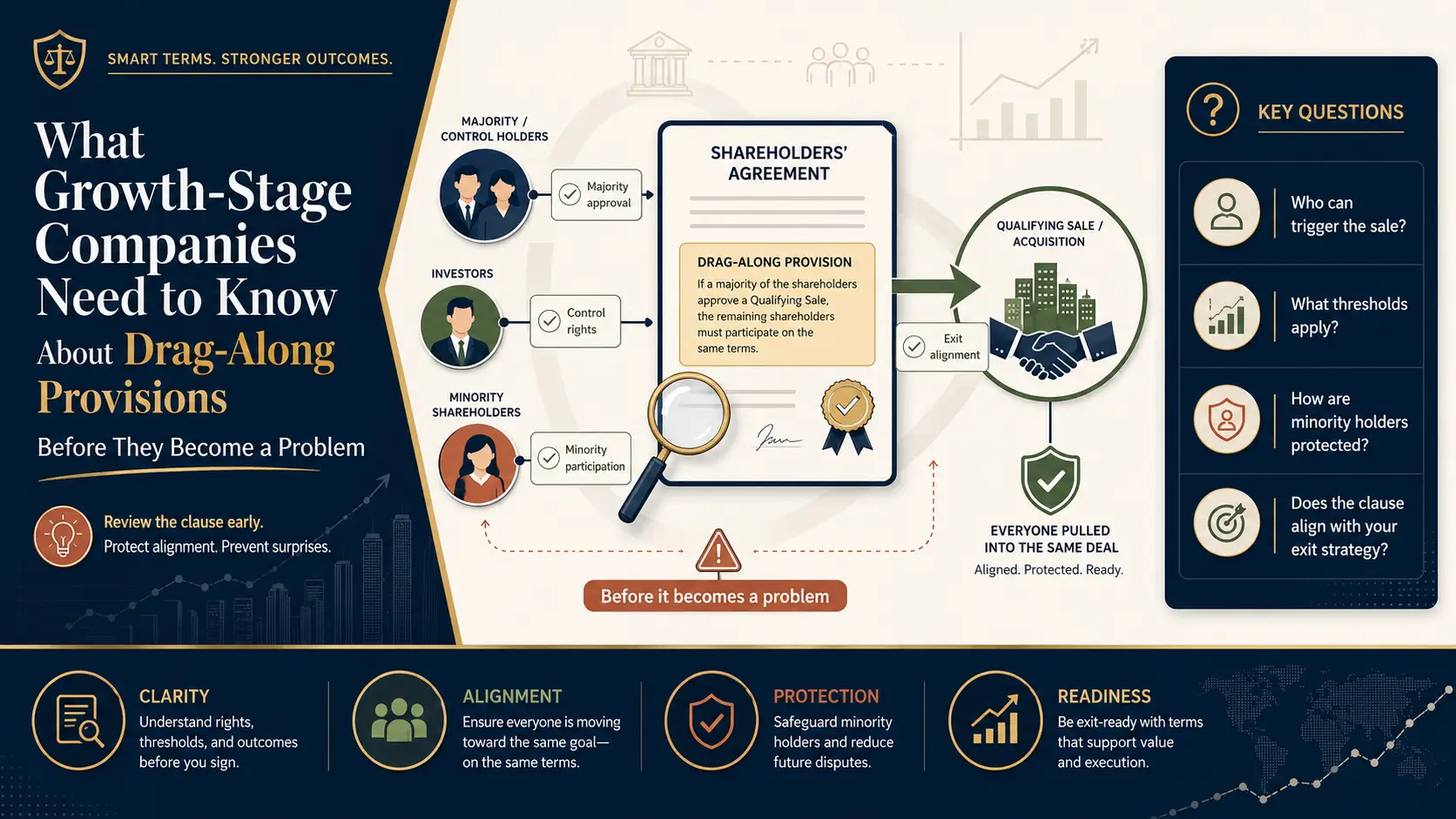
A drag-along provision gives a qualifying group of stockholders the contractual right to compel all other stockholders to approve and participate in a sale of the company on the same terms - and once the trigger is met, dissenting shareholders cannot block the transaction. At Series A, drag-along rights are almost always present. The real question is not whether they exist, but who controls the trigger, what voting threshold activates it, and what price and process protections are attached for founders and common stockholders. Founders who treat drag-along language as routine legal cleanup are making a capital-strategy mistake: these clauses are drafted before the company has a buyer, before anyone knows what the exit price will be, and before the post-round cap table is fully understood - which is exactly the moment when leverage is highest and review costs the least.
Founders who treat drag-along language as routine legal cleanup are making a capital-strategy mistake. These clauses are drafted before the company has a buyer, before anyone knows what the exit price will be, and before the post-round cap table is fully understood. That is exactly the moment when leverage is highest and review costs the least.
The core risk in plain terms: A drag-along clause drafted with an investor-only trigger, a low threshold, no price floor, and broad waiver language can allow a minority preferred stockholder to initiate a forced sale, compel founder cooperation, and override common stockholder objections, all without a single founder vote in favor of the deal.
Key takeaways before reading further:
- Drag-along rights are a control term, not a cleanup clause. They allocate exit authority before a buyer exists.
- The trigger design, voting math, and attached protections matter more than whether the clause exists at all.
- Founders lose leverage on these terms after the term sheet is signed, not before.
- A governance review before investor outreach is the highest-leverage moment to fix drag-along risk.
- The clause lives in the voting agreement, not just the term sheet, and carries real enforcement mechanics including proxy language and cooperation obligations.
The sections below break down where the risk concentrates, what the three most consequential clause components look like in practice, and what founders raising in the next 90 days should review before outreach begins.
Why This Clause Becomes More Dangerous the Moment You Stop Being the Majority
At the seed stage, drag-along provisions often feel harmless. Founders still own the majority of common stock, and the practical reality is that no investor can force a sale without founder support. The clause looks like a future administrative tool, not a live control risk.
That math changes fast.
A typical institutional Series A brings a new preferred class with its own consent rights, board representation, and often a separate approval prong in the drag-along itself. If the clause was drafted at seed with a simple "majority of all shares on an as-converted basis" trigger, the math after a 20-25% Series A dilution round may still favor founders. But if the Series A investor negotiates a separate preferred-class approval requirement, the trigger now includes a prong that founders cannot satisfy or block on their own.
The problem compounds at Series B. A second preferred class, additional dilution, and potentially a new lead investor with their own consent rights can push founders below the threshold needed to block a drag-along trigger, even when they still hold significant equity.
How Dilution Shifts Drag-Along Control
The table below illustrates how the same clause language produces very different control outcomes at each stage:
| Stage | Founder Ownership (Fully Diluted) | Drag-Along Trigger | Founder Can Block? |
|---|---|---|---|
| Post-Seed | 70% | Majority of all shares (as-converted) | Yes |
| Post-Series A | 50% | Majority of preferred + majority of common | Depends on common pool |
| Post-Series B | 35% | Majority of preferred (any class) | No |
| Post-Series B | 35% | Majority of all voting shares | Borderline |
These are illustrative scenarios, not universal standards. Actual outcomes depend entirely on how the trigger is drafted and which classes hold approval rights.
The deeper mistake is reviewing drag-along terms as isolated legal text rather than mapping them against the post-round cap table and board structure. A clause that looked neutral at seed can become investor-favorable the moment preferred holders gain separate class approval rights or accumulate enough board leverage to drive a sale process independently.
For founders who are already thinking about how their cap table structure affects institutional investor decisions, drag-along review belongs in the same pre-raise conversation, not after the term sheet is on the table.
The governance documents that matter most here are the voting agreement and the amended and restated certificate of incorporation, not the term sheet summary. By the time founders are reviewing the full definitive document set, the clause structure has usually been agreed to in principle and the window to restructure it without friction has narrowed significantly.
The Three Drag-Along Clause Components That Actually Determine Founder Outcomes
Every drag-along provision has the same basic function: force stockholder participation in a sale. But the terms that sit inside the clause determine whether that function operates as a neutral exit mechanism or as an investor-controlled override. Three components carry most of the risk.
1. Trigger Design: Who Can Start the Clock
The trigger is the approval structure that activates the drag-along obligation. Some clauses require approval from all three constituencies: a majority of preferred stockholders, a majority of common stockholders, and the board. That three-prong structure gives founders meaningful blocking power because they typically hold common stock and often hold board seats.
Other clauses require only preferred stockholder approval, or only board approval, or a combined majority of all shares on an as-converted basis. Each of these can produce a drag-along trigger that founders cannot block even when they own significant equity.
The NVCA model voting agreement uses a three-prong consent structure as its standard, but that standard is a starting point, not a guarantee. Investors frequently negotiate modifications, and founders who do not review the trigger language against their expected post-round cap table may not realize what they agreed to until an acquisition offer arrives.
2. Voting Math: How the Threshold Is Calculated
Even when the trigger structure looks balanced, the voting calculation can produce unexpected outcomes. Common formulations include:
- Majority of preferred shares (by class or combined)
- Majority of common shares
- Majority of all voting shares (as-converted basis)
- Supermajority of a specific class (67% or 75%)
The difference between "majority of voting shares" and "majority of preferred shares" can be the difference between a founder-controlled outcome and an investor-controlled one, depending on the cap table. Ambiguous definitions, such as whether convertible notes or SAFEs count toward the threshold calculation, create additional risk. That definitional gap is one of the most common sources of closing-stage disputes in venture-backed acquisitions.
3. Protection Terms: What Limits the Drag
Even a broadly triggered drag-along clause can be made materially safer with the right protection terms. The most important ones to negotiate include a minimum price floor (expressed as a multiple of invested capital or a specific dollar threshold), a bona fide third-party buyer requirement, a minimum notice period before the drag obligation activates, indemnity caps that limit post-closing founder exposure, and treatment parity provisions ensuring common stockholders receive proportional proceeds.
Without these protections, a drag-along clause can legally compel founders to support a sale at a price below their preference stack, to a buyer they did not approve, on a timeline they cannot influence.
Clause Evaluation Framework
| Component | Founder-Favorable | Neutral | Investor-Favorable |
|---|---|---|---|
| Trigger | Three-prong (preferred + common + board) | Two-prong (preferred + board) | Preferred-only or board-only |
| Threshold | Supermajority of all shares | Majority of all shares (as-converted) | Majority of preferred class alone |
| Price floor | Explicit multiple (e.g., 2x invested capital) | Liquidation preference only | None |
| Notice period | 30+ days written notice | 15-20 days | None or discretionary |
| Indemnity cap | Capped at proceeds received | Capped at a fixed amount | Uncapped or joint and several |
| Treatment parity | Explicit equal treatment language | Silent (implied) | Carve-outs for preferred |
Founders reviewing a term sheet should evaluate each component against this framework before agreeing to any drag-along language in principle. For a deeper breakdown of how these mechanics interact with the broader term sheet, see our video on drag-along provisions and exit control on the IRC Partners YouTube channel.
The reason this matters before the raise rather than after is simple: once the lead investor's legal team has drafted the voting agreement, the clause structure reflects their standard, not a negotiated one. Asking for a three-prong trigger or an explicit price floor at that stage is a harder conversation than raising it during term sheet negotiation, and a harder conversation still than surfacing it before outreach begins.
Where Founders Get Blindsided: The Term Sheet Is Short, the Voting Agreement Is Where the Power Lives
Term sheets are designed to be readable. They summarize key economics and control terms in a few pages, and most founders spend the majority of their review time on valuation, liquidation preference, and board composition. Drag-along provisions often appear as a single line: "Drag-along rights: customary."
That word "customary" is doing a lot of work.
When definitive documents are drafted, the drag-along clause moves from a term sheet summary into the voting agreement, and the voting agreement is where the real mechanics live. Proxy language gives the triggering group the authority to vote dragged stockholders' shares directly. Power-of-attorney provisions can make that proxy irrevocable. Sale cooperation obligations require founders to execute documents, provide representations, and refrain from actions that could interfere with the transaction, even if they personally oppose the deal.
Delaware courts have addressed the enforceability of advance waivers tied to drag-along clauses, and the general principle is that stockholders can contractually agree in advance to support a future sale if the trigger and process conditions are met. That means the clause is not just aspirational language. It is a binding commitment made before anyone knows what the exit will look like.
Why Momentum Reduces Leverage
The timing dynamic compounds the problem. By the time definitive documents are circulating, the founder and lead investor have usually announced the round internally, term sheet exclusivity may have expired, and both sides are under pressure to close. Asking to restructure the drag-along trigger at that stage creates friction, signals distrust, and risks the relationship. Most founders accept the language rather than reopen the negotiation.
The window to negotiate these terms without that friction is during term sheet review. The window to surface issues without any friction at all is before outreach begins.
Pre-Raise Drag-Along Review Checklist
Before launching a $5M+ raise, founders should confirm the following:
- Locate the current drag-along clause: Is it in the charter, the voting agreement, or a stockholder agreement from a prior round?
- Identify the trigger: Does it require founder, preferred, and board approval, or can preferred holders act alone?
- Map the threshold against the post-round cap table: Will founders retain blocking power after the new round closes?
- Check for proxy or power-of-attorney language in any existing voting agreement.
- Identify whether existing SAFEs or convertible notes count toward the threshold calculation.
- Review protection terms: Is there a price floor, a notice period, an indemnity cap, and treatment parity language?
- Confirm whether any prior investor side letters modify drag-along rights or add separate consent requirements.
Founders who have already worked through negotiating information rights and governance terms in $10M+ term sheets will recognize this pattern: the terms that matter most are rarely the ones that get the most attention during the raise.
What a Pre-Raise Governance Review Should Flag Before Investor Outreach
A governance review before a $5M+ raise is not a legal exercise. It is a capital-strategy exercise. The goal is not to produce a clean memo for counsel. The goal is to understand what control and economics risks are already baked into the company's existing documents before a new investor sees them, asks about them, or drafts around them.
Drag-along review is one component of that. But it does not sit in isolation.
The Five Document Sets That Matter
A complete drag-along review requires reading across five document sets simultaneously:
- Certificate of Incorporation (as amended): This is where preferred stock rights, class voting mechanics, and protective provisions live. Drag-along triggers that operate at the charter level can be harder to modify than those in a separate agreement.
- Voting Agreement: This is where the drag-along clause typically lives in venture-backed companies, along with proxy language, cooperation obligations, and any carve-outs for specific stockholder classes.
- ROFR and Co-Sale Agreement: Right of first refusal and co-sale rights interact with drag-along mechanics at exit. A drag-along trigger that bypasses co-sale rights creates a separate class of risk for common stockholders and option holders.
- SAFEs and Convertible Notes: Outstanding instruments that have not yet converted affect the threshold calculation in ways that are often not reflected in the current cap table. Whether they count toward the drag-along trigger is a definitional question that should be answered before the next round adds more complexity.
- Existing Side Letters: Prior investors may hold separate consent rights, information rights, or drag-along modifications that are not visible in the main documents. These can create blocking positions or additional approval requirements that surface only when an acquisition offer arrives.
Red Flags to Prioritize
Not all governance issues carry equal weight. The following items represent the highest-risk drag-along configurations for growth-stage founders:
- Investor-only trigger with no founder or common stockholder approval prong
- Threshold defined as majority of preferred shares, without reference to common or total voting shares
- No minimum price floor or liquidation preference floor
- Broad waiver language covering future claims related to the sale process
- Uncapped indemnity obligations post-closing
- Ambiguous definitions of "shares" that could include or exclude SAFEs, notes, or option pool shares
- No notice period before the drag obligation activates
For founders comparing how governance risk compounds across rounds, the relationship between debt and equity financing structures is a useful reference point for understanding how layered capital instruments affect control dynamics.
The audit framework above is designed to be completed before investor outreach, not during it. Founders who surface these issues early can negotiate from a position of preparation. Founders who surface them after a term sheet is signed are negotiating from a position of momentum pressure, and the outcome is usually less favorable.
The practical standard: If you cannot answer all seven items on the pre-raise checklist in the previous section without reviewing documents, the review has not been done yet.
What Structured Capital Advisory Looks Like Before a $5M+ Raise
The founders who navigate institutional fundraising most effectively are not the ones with the best story. They are the ones who arrive structurally prepared. That means the cap table is clean, the governance documents have been reviewed, the control mechanics are understood, and the known risks have been addressed before the first investor conversation.
This is not a legal standard. It is an advisory standard.
The pattern that shows up repeatedly: Founders who treat governance review as a post-term-sheet task spend the back half of their raise fixing problems that were visible before outreach began. Founders who address governance before outreach use those same issues as negotiating leverage, not as closing friction.
The same institutional-readiness logic applies across capital structures. In large-scale real estate financing, capital stack design, governance alignment, and investor economics are structured before the first institutional LP conversation. The principle translates directly: institutional capital allocators at any scale run diligence on governance and control mechanics. Surprises at that stage do not close well.
For growth-stage companies, the equivalent preparation includes:
- Drag-along trigger and threshold review against the post-round cap table
- Board rights and protective provision mapping
- Dilution modeling that accounts for outstanding SAFEs, notes, and option pool expansion
- Identification of any existing investor consent rights that could affect the new round's terms
- A clear understanding of what the new investor's standard voting agreement looks like before it is drafted
Founders who want to understand how this preparation connects to the broader institutional fundraising process can find a detailed breakdown in our video series on capital readiness and governance on the IRC Partners YouTube channel. For a parallel look at securing favorable terms before a $10M institutional close, the same pre-close window logic applies to drag-along provisions as it does to information rights.
The advisory value is not in telling founders what the law says. It is in surfacing the structural issues that affect negotiating leverage before the raise begins, and positioning the company to close on terms that reflect its actual strength.
{{main-cta}}
What Founders Should Do Next If They Are Raising in the Next 90 Days
If a $5M+ raise is on the horizon, the governance review window is now. Not after the first investor meeting. Not after the term sheet. Now.
Here is a practical 90-day sequence for founders who want to enter investor outreach with drag-along risk understood and addressed:
Days 1-15: Document audit Pull the current versions of the certificate of incorporation, voting agreement, ROFR and co-sale agreement, any outstanding SAFEs or convertible notes, and all investor side letters. Confirm which document contains the drag-along clause and read the trigger, threshold, and protection terms in full.
Days 16-30: Cap table mapping Model the post-round cap table at the expected raise size and valuation range. Map the drag-along trigger against the modeled ownership percentages. Identify whether founders retain blocking power under the existing clause after the new round closes.
Days 31-45: Issue identification Flag every red-flag item from the list in the previous section. Prioritize by severity: investor-only triggers and missing price floors are higher risk than notice period gaps. Identify which issues require a charter amendment (harder) versus a voting agreement amendment (easier) to fix.
Days 46-60: Advisory alignment Work with a capital advisor to understand which issues are worth raising in term sheet negotiation versus which should be addressed before outreach. Not every governance issue is a dealbreaker, but every issue should be a known quantity before investor conversations begin.
Days 61-90: Outreach preparation Enter investor outreach with a clean governance summary, a modeled cap table, and a clear position on drag-along terms you will and will not accept. Investors respect founders who understand their own documents. It signals operational maturity and reduces the risk of late-stage friction.
Founders who want to pressure-test their governance and capital readiness before the next round are the right fit for an IRC advisory conversation. The goal is not to replace company counsel. It is to make sure the structural issues that affect fundraising leverage are identified and addressed before they become closing-stage problems.
For a broader view of how governance preparation connects to institutional investor expectations, the IRC Partners resource on what institutional investors look for before committing capital is a useful next read. Founders also benefit from understanding how to control what investors access before a term sheet is signed, since data room sequencing and governance review operate on the same pre-raise timeline.
Frequently Asked Questions
Can a drag-along provision be enforced against a founder who votes against the sale?
Yes. Once the trigger conditions are met, a properly drafted drag-along clause is a binding contractual obligation. Delaware courts have upheld advance waivers tied to drag-along mechanics, meaning a founder's objection to a specific sale does not override the contractual commitment made when the voting agreement was signed. Proxy and power-of-attorney language in the voting agreement can allow the triggering group to vote the founder's shares directly if cooperation is withheld.
What is the difference between a drag-along right and a tag-along right?
A drag-along right compels minority stockholders to participate in a sale initiated by the majority or a qualifying group. A tag-along right protects minority stockholders by giving them the right to join a sale initiated by a controlling stockholder on the same terms. The two rights serve opposite functions: drag-along rights protect acquirers and controlling stockholders by ensuring clean deal execution; tag-along rights protect minority holders by preventing a controlling block from selling at a premium while leaving others behind.
What threshold is typically used to trigger a drag-along at Series A?
There is no universal standard. The NVCA model voting agreement uses a three-prong consent structure requiring approval from a majority of preferred stockholders, a majority of common stockholders, and the board. In practice, investors frequently negotiate modifications. Some clauses require only a majority of preferred shares, which can represent a minority of total fully diluted shares if the option pool and common stock are large. Founders should model the threshold against the expected post-round cap table before agreeing to any formulation.
Does a price floor provision make a drag-along clause safer for founders?
Materially, yes. A price floor provision sets a minimum transaction value below which the drag-along cannot be triggered. Without one, a drag-along clause can legally compel founders to support a sale at any price once the trigger threshold is met, including a price that returns little or nothing to common stockholders after the liquidation preference stack is paid. A floor expressed as a multiple of invested capital, such as 2x or 3x, gives common stockholders meaningful downside protection that a liquidation preference alone does not provide.
What happens to employee option holders when a drag-along is activated?
Option holders who have not yet exercised their options are typically not bound by the voting agreement and do not have drag-along obligations. However, the sale terms may include a vesting acceleration provision or a net exercise mechanism that affects their economic outcome. The more significant risk is that drag-along clauses without explicit treatment parity language for common stockholders can produce waterfall outcomes where preferred liquidation preferences absorb most of the proceeds before common and option holders receive anything. Founders negotiating drag-along terms should confirm that treatment parity applies to all common equity, not just the classes explicitly named in the clause.
Can existing drag-along provisions be amended before a new round?
Yes, but the amendment process depends on how the clause is structured. Drag-along provisions in the voting agreement typically require the consent of the stockholder classes that are parties to that agreement, which usually includes existing investors. Charter-level provisions require a stockholder vote with class approval thresholds. The practical window to propose amendments is before a new investor is introduced, because adding a new party to the negotiation increases complexity. Founders who identify problematic provisions before outreach have the most flexibility to propose amendments without creating friction in the new round.
What should a capital advisor flag in a drag-along review before a $5M+ raise?
A capital advisor reviewing drag-along provisions before a raise should flag six items: whether the trigger requires founder or common stockholder approval or can be activated by preferred holders alone; whether the threshold is defined against total voting shares or a preferred-only subset; whether a price floor exists and how it is calculated; whether proxy or power-of-attorney language in the voting agreement makes the drag obligation self-executing; whether outstanding SAFEs or convertible notes are included or excluded from the threshold calculation; and whether any existing side letters modify the drag-along rights in ways that are not visible in the main documents. These six items determine whether the clause is a neutral exit mechanism or an investor-controlled override.
Continue reading this series:
- Why Your Drag-Along Threshold From Your Seed Round No Longer Protects You at Series A
- How Drag-Along Consent Structures Can Let a Minority Investor Force a Majority Outcome
- Drag-Along Provisions and Founder Exit Timing: Who Actually Controls When You Sell
The structure you carry into your first investor meeting sets the terms for every round that follows it. Founders who get it wrong spend the next three rounds negotiating from behind. The Capital Raise Pre-Flight is IRC Partners’ fixed-fee diagnostic that scores a raise against the same twelve institutional gates a deal must clear before IRC Partners takes it into a strategic partnership. IRC Partners advises operators raising $5M to $250M of institutional capital. Book your Capital Raise Pre-Flight here.
Sponsors weighing this decision should first complete a capital raise readiness assessment for sponsors to confirm the raise is investor-ready.
Need guidance on your capital raise?


How to Choose an Advisor for Capital Stack Strategy
How SAFE Note Structuring Engagements Are Scoped

What Operating Metrics Should Be Reconciled Before Sharing Them With Institutional Investors?
Disclosure
Nothing on this site constitutes an offer to sell, or a solicitation of an offer to purchase, any security under the Securities Act of 1933, as amended, or any applicable state securities laws. Any offering of securities is made only by means of a formal private placement memorandum or other authorized offering documents delivered to qualified investors.
IRC Partners is a capital advisory firm. IRC Partners is not a registered investment adviser under the Investment Advisers Act of 1940 and does not provide investment advice as defined thereunder.
Certain statements in this article may constitute forward-looking statements, including statements regarding market conditions, capital availability, investor demand, and transaction outcomes. Such statements reflect current assumptions and expectations only. Actual results may differ materially due to market conditions, regulatory developments, company-specific factors, and other variables. IRC Partners makes no representation that any outcome, return, or result described herein will be achieved.
References to prior mandates, transaction volume, network credentials, or capital raised are provided for illustrative purposes only and do not constitute a guarantee or prediction of future results. Past performance is not indicative of future outcomes. Individual results will vary. Network credentials and transaction statistics referenced on this site reflect the aggregate experience of IRC Partners' principals and affiliated advisors and are not a representation of assets managed or transactions closed solely by IRC Partners.
Certain data, statistics, and information presented in this article have been obtained from third-party sources. IRC Partners has not independently verified such information and expressly disclaims responsibility for its accuracy, completeness, or timeliness. Readers should independently verify any third-party data before relying on it.
Readers are strongly encouraged to consult qualified legal, financial, and tax professionals before making any investment, capital raising, or business decision.
Schedule A Meeting
You get one shot to raise the right way. If this raise is worth doing, it’s worth doing with precision, leverage, and control.
This isn’t a practice run. Serious capital. Serious strategy. Let’s raise it right.
We onboard a maximum of seven
new strategic partners each quarter, by application only, to maximize your chances of securing the capital you need.
