.svg "CTA Arrow")


.png "Investor Ready Capital decorative background element")

How Should a Sponsor Address Concentration Risk When One Family Office Could Fund More Than Half of a Real Estate Equity Raise?
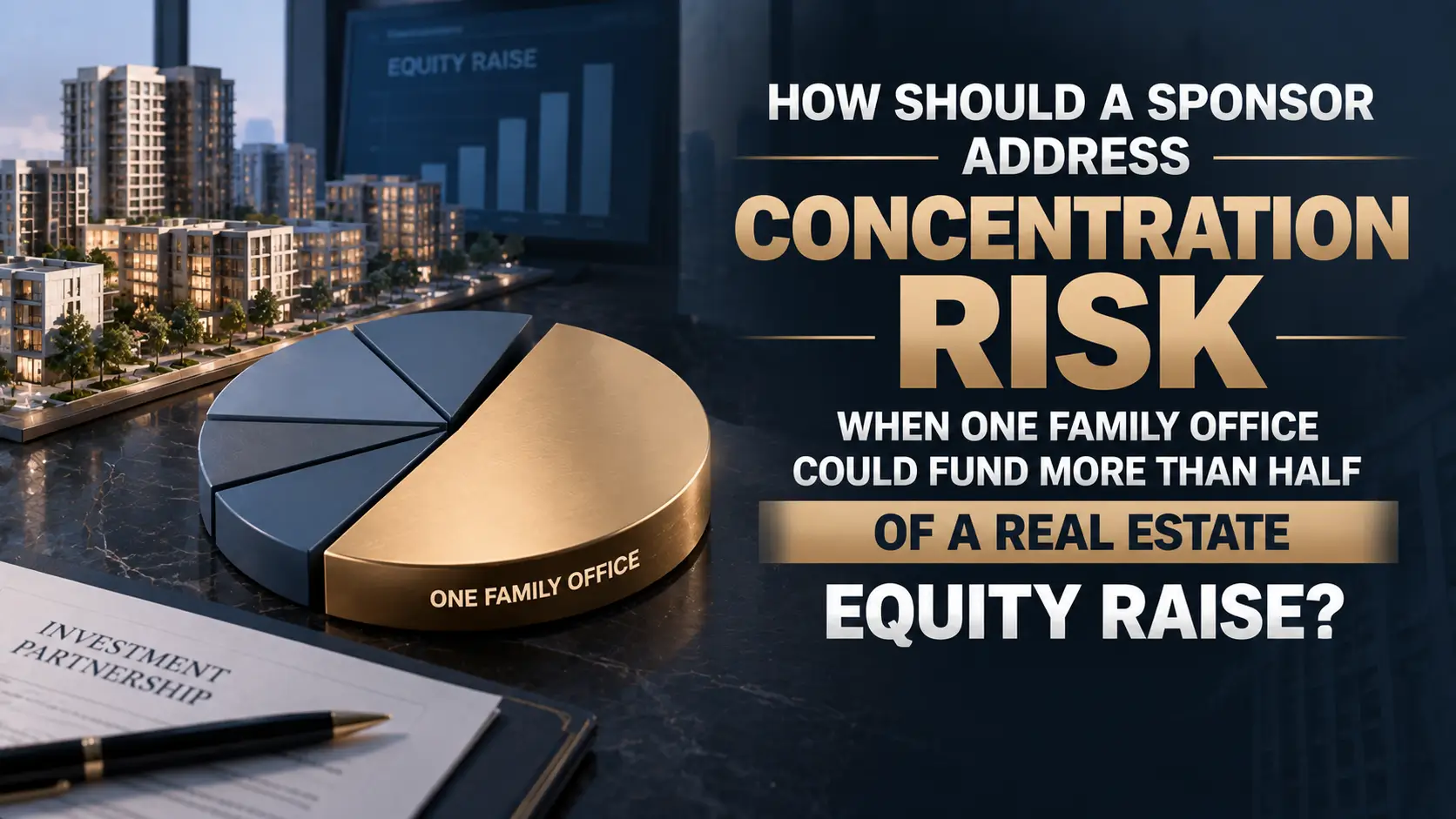
How Should a Sponsor Address Concentration Risk When One Family Office Could Fund More Than Half of a Real Estate Equity Raise?
TL;DR: How sponsors can manage single-LP concentration risk in real estate equity raises before a dominant family office becomes a dependency.
- What Threshold Triggers Single-LP Concentration Risk in an Institutional Raise: The threshold that changes the sponsor's structural position is 50%.
- How Family Offices with Internal Concentration Limits Evaluate a Dominant Position: Family offices with formal governance structures evaluate large LP positions differently than individual allocators do.
- How to Structure the LP Stack to Reduce Single-Source Dependency Before Outreach: The LP stack structure is the sponsor's primary tool for managing concentration risk.
Treat a family office commitment of 50% or more of a real estate equity raise as single-source dependency risk, not simply an anchor investment. Sponsors should begin diversifying the LP stack at 33%, set position ceilings, disclose the risk, define governance boundaries, and document replacement capital before the first LP call.
When one family office offers to fund more than half of a real estate equity raise, sponsors often treat it as a win. The structural reality is more complicated. A single LP holding a majority equity position gives that LP negotiating leverage at every stage of the deal: at closing, during the hold, and especially if the business plan runs long. The sponsor's exposure is dependency. If that LP reprices, delays, or withdraws, the raise fails regardless of how strong the deal is. Addressing concentration risk before the LP call is a structural obligation.
This guide covers the decisions sponsors control: how to evaluate the threshold, how to structure the LP stack, what to disclose, how to respond to governance demands, and how to protect the raise if the dominant LP exits.
Sponsors raising institutional equity should understand how the GP/LP split and waterfall structure interact with position size before any LP conversation reaches the term sheet stage. A dominant LP's leverage over economics is directly tied to the structure the sponsor brings to the table.
What Threshold Triggers Single-LP Concentration Risk in an Institutional Raise
The threshold that changes the sponsor's structural position is 50%. Below that level, a single LP holds a minority position and the sponsor retains practical control over the raise and the LP stack. At 50% or above, the LP's decision to proceed, pause, or withdraw becomes a binary event for the entire deal.
Institutional allocators apply their own internal concentration limits by manager, by asset class, and by single investment. Many family offices operating formal investment policy statements cap single-investment exposure at 10% to 20% of their real estate allocation. A family office writing a check that represents 50% or more of a sponsor's raise may itself be approaching an internal limit, which means the commitment is more fragile than it appears.
The sponsor's concentration risk exists independently of the LP's comfort level. A family office that is comfortable with a large position may still create a structural problem for the sponsor if no other LP can absorb the deal if the dominant LP steps back. The relevant question is: can this raise close without this LP? If the raise requires this LP to close, concentration risk is already present regardless of the LP's stated comfort level.
The practical threshold for action:
- Below 33%: Standard LP position. Normal PPM risk factors apply.
- 33% to 49%: Elevated concentration. Sponsors should begin structuring for LP stack diversification and include concentration language in the term sheet.
- 50% or above: Majority concentration. Requires proactive disclosure, LP stack restructuring before outreach, and a contingency plan documented before the LP call.
How Family Offices with Internal Concentration Limits Evaluate a Dominant Position
Family offices with formal governance structures evaluate large LP positions differently than individual allocators do. Before committing to a position that represents 50% or more of a sponsor's raise, a well-governed family office will assess whether the position creates concentration risk on their own balance sheet and whether the sponsor has already addressed the structural implications on the deal side.
The questions a family office investment committee will ask about a dominant position include:
- Does the sponsor have other LPs confirmed or in diligence, or is this a single-source raise?
- What is the sponsor's contingency plan if this position is reduced or withdrawn before close?
- Has the sponsor disclosed this concentration in the term sheet and PPM?
- What governance rights does the family office receive commensurate with the position size?
A family office that has to ask these questions has already identified a gap. Sponsors who arrive without answers to each of these points signal that they have not thought through the structural exposure. That gap slows diligence, creates negotiating leverage for the LP, and in some cases causes a committee to reduce the position or decline entirely.
According to family office portfolio management standards, well-governed offices set concentration limits by asset class, manager, geography, and single investment, and require written investment memos documenting risks and recommendations at each approval gate. A sponsor who has already addressed these dimensions in their materials reduces the LP's diligence burden and shortens the approval cycle.
Sponsors should prepare a concentration risk summary before the LP call. It should cover the LP stack composition, the plan for filling the remaining equity, and the disclosure language already incorporated into the term sheet.
How to Structure the LP Stack to Reduce Single-Source Dependency Before Outreach
The LP stack structure is the sponsor's primary tool for managing concentration risk. A raise that depends on one LP to close is structurally fragile regardless of how strong the relationship is. Sponsors should design the stack before outreach begins, with a target LP count and position-size ceiling that prevents any single source from controlling the raise.
Position-Size Ceilings
A position-size ceiling sets the maximum percentage of the equity raise any single LP can hold. For raises where institutional LP standards apply, a ceiling of 25% to 33% per LP is a defensible starting point. This ensures that no single LP withdrawal can collapse the raise and that the sponsor retains negotiating leverage with each LP individually.
If a family office expresses interest in a position above the ceiling, the sponsor has two options:
- Hold the ceiling and direct the excess to a co-investment structure alongside the main raise, keeping the LP's total exposure high while protecting the primary stack.
- Accept the oversized position with documented contingency covering how the sponsor would replace that capital within a defined timeline.
Parallel LP Outreach
Sponsors who treat the dominant LP as the anchor and run parallel outreach to fill the remainder are better positioned than those who close the dominant LP first and then seek smaller positions. Parallel outreach signals to each LP that the raise has competitive interest and reduces the negotiating leverage any single LP holds.
Structuring the LP stack for a $5M to $250M raise requires knowing which LP types write checks at each position size and what their governance expectations are at different ownership percentages. The guide to presenting funding needs to family offices covers how to frame the raise structure for different allocator types.
Minimum LP Count by Raise Size
| Raise Size | Recommended Minimum LP Count | Max Single-LP Position |
|---|---|---|
| $5M to $20M | 3 to 5 LPs | 40% |
| $20M to $75M | 5 to 8 LPs | 30% |
| $75M to $250M | 8 or more LPs | 25% |
These are structural guidelines, not hard rules. The appropriate ceiling depends on the LP type, the deal structure, and whether the sponsor has existing LP relationships that can absorb a larger position without creating governance friction.
What Governance Rights a Dominant LP Will Push For and How to Respond
A family office holding 50% or more of a raise will typically seek governance rights proportionate to their position. Sponsors should expect these requests and have a response prepared before they arrive.
Common governance demands at majority LP positions:
- Major decision consent rights: approval required for refinancing, capital expenditure above a defined threshold, or sale of the asset
- Removal rights: the right to remove the GP under defined trigger events, including performance thresholds or timeline extensions
- Enhanced reporting: monthly or quarterly financial reporting beyond the standard LP cadence
- LP Advisory Committee (LPAC) seat: formal representation on a committee with approval authority over conflicts and major decisions
- Side letter terms: preferred economic treatment, MFN clauses, or co-investment rights on future deals
Not all of these are unreasonable. A sponsor who has structured a clean deal with defined triggers and limited consent rights is in a better position to negotiate. The audit rights and investor reporting framework covers how to define inspection and reporting rights before they become open-ended obligations.
The sponsor's response framework:
- Accept: LPAC seat, defined major decision consent tied to specific dollar thresholds, quarterly reporting
- Negotiate: removal rights (limit to material, uncured payment defaults or fraud), MFN clauses (cap the scope), co-investment rights (define the timeline and notice period)
- Decline: operational consent rights over routine decisions, open-ended audit access, removal triggers tied to timeline extensions alone
How to Disclose Concentration Risk Proactively in the Term Sheet and PPM
Proactive disclosure serves the sponsor's interests. A term sheet or PPM that identifies concentration risk before the LP raises it signals structural awareness and reduces the LP's ability to use undisclosed risk as negotiating leverage after diligence begins.
The term sheet should include a concentration risk disclosure that states the anticipated LP stack composition, the maximum single-LP position the sponsor will accept, and the contingency plan if the raise does not reach full subscription from multiple sources.
The PPM risk factor section should address single-LP concentration specifically. The private placement memorandum framework for real estate covers the standard risk factor structure. A concentration risk factor should include:
- The possibility that a significant portion of the equity may be held by one LP
- The impact on the raise timeline if that LP reduces or withdraws its commitment
- The sponsor's plan for managing that scenario, including timeline and alternative LP outreach
Proactive disclosure strengthens the sponsor's position. A sponsor who discloses concentration risk and presents a plan is more credible than one who avoids the topic. LPs conducting diligence will identify the concentration regardless. Proactive disclosure frames it as a managed risk rather than an oversight.
{{main-cta}}
What to Do If the Dominant LP Withdraws After Committing More Than 50%
A dominant LP withdrawal after a soft commitment or signed term sheet is a raise-threatening event. The sponsor's response depends on how far the raise has progressed and whether the contingency plan was prepared in advance.
Immediate Steps
If the dominant LP withdraws before the final close:
- Assess the hard commitment status. A soft commit or LOI carries only informal intent and creates no enforceable closing requirement. A signed subscription agreement may carry obligations depending on the LPA terms and the withdrawal timing.
- Activate the backup LP list. Sponsors who have run parallel outreach will have LPs in various stages of diligence. Prioritize the backup list by check size and stage of conversation before the withdrawal occurs.
- Evaluate a partial close. If enough committed equity exists to close on a reduced basis, a partial close preserves the deal and buys time to fill the remainder. This requires the LPA to permit partial closes and the senior lender to accept a reduced equity stack.
- Reassess the timeline. The raise plan assumes normal LP outreach and diligence cycles. A dominant LP withdrawal mid-raise compresses the remaining timeline and may require an extension of the closing date.
What the Contingency Plan Must Cover
Sponsors who document a contingency plan before the LP call are better positioned to execute quickly if a withdrawal occurs. The plan should identify:
- The minimum equity required to close the deal
- The LP sources that could absorb the withdrawn position within 60 to 90 days
- The communication protocol for existing LPs if the dominant LP exits
- Whether the deal can proceed at a reduced equity raise or requires a full restart
What a Concentration Risk Response Package Should Include Before the LP Call
Sponsors who prepare a concentration risk response package before the first LP call arrive with answers to the questions a well-governed family office will ask. The package consists of direct internal documentation designed to demonstrate that the sponsor has already addressed structural exposure.
A complete concentration risk response package includes:
- LP stack summary: the target number of LPs, the position-size ceiling, and the current status of each LP conversation
- Concentration disclosure draft: the specific language the sponsor intends to include in the term sheet and PPM risk factor section
- Governance response framework: the sponsor's position on each governance right the dominant LP is likely to request, with the accept, negotiate, and decline boundaries defined
- Contingency plan: the backup LP list, the minimum equity required to close, and the timeline for replacing the dominant LP if they withdraw
- Waterfall and economics summary: confirmation that the GP/LP economics are structured to survive a governance negotiation without giving away promote or preferred return thresholds
IRC Partners advises sponsors raising $5M to $250M in equity on LP stack structure, disclosure preparation, and contingency planning before the first LP call. Sponsors who want to assess their current raise structure before entering LP conversations can apply to work with IRC Partners directly.
Frequently Asked Questions
At what percentage does a single LP position become a concentration risk for the sponsor?
The structural risk threshold is 50%. At that level, one LP's decision to delay, reprice, or withdraw becomes a binary event for the entire raise. Sponsors should begin addressing concentration at 33%, when a single LP holds enough of the raise to materially affect the closing timeline if they step back.
Do family offices have internal limits on how large a single LP position they can take?
Many family offices operating formal investment policy statements cap single-investment exposure at 10% to 20% of their real estate allocation. A position that represents 50% or more of a sponsor's raise may push the family office close to or beyond its own internal limit, making the commitment more conditional than it appears at first contact.
Should a sponsor disclose single-LP concentration risk in the PPM?
Proactive disclosure in the PPM risk factor section is the correct approach. The disclosure should state the possibility that a significant portion of the equity may be held by one LP, the impact on the raise timeline if that LP reduces its commitment, and the sponsor's plan for managing that scenario. Sponsors who disclose this before diligence begins control how it is framed.
What governance rights can a sponsor reasonably accept from a dominant LP?
An LPAC seat, quarterly reporting, and major decision consent rights tied to defined dollar thresholds are reasonable for a majority LP position. Sponsors should negotiate removal rights limited to material, uncured payment defaults, and decline operational consent rights over routine decisions or removal triggers tied to timeline extensions alone.
How many LPs should a sponsor target to avoid single-source dependency?
For raises between $5M and $20M, a minimum of 3 to 5 LPs with a maximum single-LP position of 40% is a reasonable structure. For raises between $20M and $75M, 5 to 8 LPs with a 30% ceiling is more appropriate. Raises above $75M should target 8 or more LPs with a 25% maximum per position.
What should a sponsor do immediately if the dominant LP withdraws mid-raise?
Assess whether the LP's commitment was a soft indication or a signed subscription agreement, activate the backup LP list prepared before outreach began, evaluate whether a partial close is feasible under the LPA, and reassess the closing timeline. The raise plan assumes normal outreach cycles. A mid-raise withdrawal compresses that window and may require a formal extension.
How does single-LP concentration risk differ from LP credibility risk?
Single-LP concentration risk is a structural problem for the sponsor. One source holding majority equity creates dependency that affects the raise outcome regardless of the LP's credibility. LP credibility risk is a screening question about whether the LP can actually fund the commitment they have expressed. Both require evaluation before the term sheet is signed.
Continue reading this series:
- Capital stack layers that minimize risk for real estate developers
- What goes into a real estate closed-end fund PPM
- What LP removal rights do institutional real estate LPs demand
IRC Partners advises operators raising $5M to $250M of institutional capital on structure, positioning, and round architecture. We take seven strategic partners per quarter. No placement agent model. No success-only theater. Institutional capital follows a deal built to institutional standard. If you want your current raise reviewed before it reaches the market and silently fails, apply here.
Need guidance on your capital raise?


Pitch Deck Audit: The Slides Institutional Investors Use to Disqualify You First
Capital Stack Risk Reduction Strategies: 5 Ways Developers Can Lower Risk Before a $10M+ Raise

Commercial Real Estate Appraisal: How $10M+ Sponsors Get an Institutional-Grade Valuation That Lenders Accept Without Dispute
Disclosure
Nothing on this site constitutes an offer to sell, or a solicitation of an offer to purchase, any security under the Securities Act of 1933, as amended, or any applicable state securities laws. Any offering of securities is made only by means of a formal private placement memorandum or other authorized offering documents delivered to qualified investors.
IRC Partners is a capital advisory firm. IRC Partners is not a registered investment adviser under the Investment Advisers Act of 1940 and does not provide investment advice as defined thereunder.
Certain statements in this article may constitute forward-looking statements, including statements regarding market conditions, capital availability, investor demand, and transaction outcomes. Such statements reflect current assumptions and expectations only. Actual results may differ materially due to market conditions, regulatory developments, company-specific factors, and other variables. IRC Partners makes no representation that any outcome, return, or result described herein will be achieved.
References to prior mandates, transaction volume, network credentials, or capital raised are provided for illustrative purposes only and do not constitute a guarantee or prediction of future results. Past performance is not indicative of future outcomes. Individual results will vary. Network credentials and transaction statistics referenced on this site reflect the aggregate experience of IRC Partners' principals and affiliated advisors and are not a representation of assets managed or transactions closed solely by IRC Partners.
Certain data, statistics, and information presented in this article have been obtained from third-party sources. IRC Partners has not independently verified such information and expressly disclaims responsibility for its accuracy, completeness, or timeliness. Readers should independently verify any third-party data before relying on it.
Readers are strongly encouraged to consult qualified legal, financial, and tax professionals before making any investment, capital raising, or business decision.
Schedule A Meeting
You get one shot to raise the right way. If this raise is worth doing, it’s worth doing with precision, leverage, and control.
This isn’t a practice run. Serious capital. Serious strategy. Let’s raise it right.
We onboard a maximum of seven
new strategic partners each quarter, by application only, to maximize your chances of securing the capital you need.
