.svg "CTA Arrow")


.png "Investor Ready Capital decorative background element")

How Do I Structure an Investment Committee Deck for $20M?

A $20M institutional IC deck should establish sponsor credibility before moving to the investment thesis, capital structure, returns, and governance. Use a 20-slide sequence that gives each section a clear job and keeps supporting detail in the data room.
Deck structure at this level is a sequencing decision. Every slide placement signals something about how the sponsor thinks. The ILPA due diligence framework places governance and alignment review ahead of return verification. A deck that opens with the opportunity and buries the governance terms tells the reviewer the sponsor prioritizes the sale over the structure. That order gets deals killed.
This guide gives you the exact slide sequence for a $20M institutional raise, the content standard for each slide, and the logic behind each placement decision. The goal is a deck that moves a committee from screening to diligence.
The institutional screening standard applies at $20M. ILPA principles require governance, transparency, and alignment-of-interest terms to be specific and documented. Those standards do not scale with deal size. A $20M raise is reviewed against the same framework as a $200M raise. The deck structure has to reflect that.
Developers raising at this scale for the first time should also review the broader context in The Real Estate Developer's Guide to Raising $10M-$50M in Institutional Capital Without Losing Deal Control, which covers capital stack structure, waterfall mechanics, and LP targeting before the first outreach.
Why Deck Structure Is a Filtering Signal
Investment committees run a first-pass review on every deck before any number gets verified. In that review, a committee member is answering one question: does this sponsor understand the institutional process?
The answer comes from structure, sequence, and density, before any number is verified.
Opening with the market opportunity places the deal ahead of the sponsor's credentials and governance terms. The ILPA due diligence framework evaluates manager alignment and governance before it evaluates deal-level returns. A deck sequenced in the opposite order misaligns with that framework from the first slide.
Key insight: At $20M, the deck serves as a credibility filter to earn a first conversation rather than close the deal directly.
The sequence below is built around what institutional reviewers look for in the first pass, in the order they look for it. Each slide placement reflects a deliberate signal about sponsor sophistication.
The Capital Raise Pre-Flight is IRC Partners' fixed-fee diagnostic that scores a raise against the same twelve institutional gates a deal must clear before IRC Partners takes it into a strategic partnership.
The Institutional IC Deck Sequence for a $20M Raise
The standard institutional deck for a $20M real estate raise runs 20 to 30 slides. Every slide has a job. The table below maps the full sequence with the placement logic for each section.
Why This Order
The sequence above is built around how institutional reviewers process information, from credibility check to deal evaluation to structure review to risk assessment.
Slides 1 through 4 answer the first question every committee asks: who is this sponsor and have they done this before? A reviewer who cannot answer that question from the first four slides has no basis to proceed to the financial section.
Slides 5 through 8 answer the deal question: what is being built, where, and why does the thesis hold. This section earns attention for the financial section that follows.
Slides 9 through 15 are the structural core. Capital stack, waterfall, returns, and fees must be consistent with each other and with any supporting documents in the data room. Inconsistency between the deck and the model creates a diligence flag that requires resolution before a committee can proceed.
Slides 16 through 20 address governance, rights, and process. Vague governance terms, missing reporting commitments, and undefined exit triggers are immediate flags in a first-pass review.
Slide Density Standards
Each slide should carry one primary message. Supporting data lives in the data room. A slide that tries to prove everything proves nothing.
- Executive summary: Maximum seven data points. Raise size, deal type, target return, hold period, GP commitment, preferred return, and projected close date.
- Return summary: Gross and net IRR side by side. Equity multiple. One-line methodology disclosure. No embedded pro forma tables.
- Waterfall mechanics: Flow diagram preferred. Committees need to see the sequence visually.
- Risk factors: Minimum five named risks. Each paired with a specific mitigant. Generic language ("market conditions may change") fails the institutional standard.
The financial projections institutional LPs expect to see in a real estate fund pitch deck covers the return summary and scenario analysis slides in detail, including the three-slide projection standard and the assumptions disclosure format institutional committees require.
{{main-cta}}
The Four Structural Errors That Kill Deals at Screening
Most decks that fail at the screening stage fail for the same four reasons. Each one reflects a structural gap in how the deck was assembled.
1. Mismatched Slide Order
Opening with the market opportunity or the property overview before establishing sponsor credibility is the most common error. Committees evaluate the manager before they evaluate the deal. A deck that reverses that order signals the sponsor has optimized for selling.
Fix: Slides 1 through 4 must establish who the sponsor is and what they have completed. The deal comes after.
2. Missing or Vague Governance Terms
A deck with no governance slide, or one that describes governance in general terms without defining approval thresholds, decision-making authority, and removal triggers, tells the committee the sponsor has no experience running an institutional LP relationship.
The ILPA Principles require governance terms to be specific and documented. Vague governance language in the deck signals an LPA that will require extensive negotiation before a committee can proceed.
Fix: Slide 16 must name the decisions that require LP approval, the vote threshold for each, and the GP removal mechanism. One slide. Specific language.
3. Inconsistency Between the Deck and Supporting Materials
Numbers in the deck that do not match the financial model, the sources and uses statement, or the draft LPA create immediate diligence flags. Committees cross-reference these documents as a standard step. Any inconsistency signals that the materials were assembled without a package review.
For a detailed breakdown of how the five financial exhibits behind the deck must reconcile with the deck itself, see what financial exhibits should sit behind a real estate development pitch deck for LP follow-up.
Fix: Before any LP receives the deck, run a cross-reference check. Every number in the deck must trace to an identical figure in the model, the sources and uses, and the LPA draft.
4. No Downside Scenario
A return summary with only a base case gives the committee no basis to evaluate downside exposure. ILPA governance standards require that return assumptions be documented and that risk factors be disclosed with specific mitigants.
Institutional reviewers expect to see what happens when exit cap rates widen, when lease-up extends beyond the base case timeline, and when construction costs run over budget.
Fix: Slide 12 must show at least two adverse scenarios with net IRR and equity multiple for each. The gap between base and downside should be explainable.
Frequently Asked Questions
How many slides should an investment committee deck have for a $20M real estate raise?
A $20M institutional IC deck should run 20 to 30 slides. Fewer than 20 slides typically means governance, reporting, and LP rights sections are missing or compressed. More than 30 slides usually signals the sponsor is using the deck as a data room substitute. The deck is a screening tool. Supporting detail belongs in the financial exhibits and the data room.
What should the executive summary slide include?
The executive summary slide should contain seven data points: raise size, deal type, asset class, target return, hold period, GP co-investment amount, and projected close date. Committees read this slide first to decide whether the rest of the deck warrants their time. If any of those seven elements are missing or vague, the slide fails its purpose.
Where does the GP commitment appear in the deck?
GP commitment should appear on both the executive summary slide and the capital stack slide. Showing it in two places confirms the number is real and deliberate. Institutional LPs treat the GP commitment as the primary alignment signal. A low GP commitment relative to total equity raises active scrutiny regardless of how strong the deal looks otherwise.
Do institutional LPs want pro forma tables in the deck?
Institutional LPs do not want full pro forma tables embedded in the deck. The return summary slide should show gross IRR, net IRR, and equity multiple with a one-line methodology disclosure. The full financial model and pro forma belong in the data room. A deck loaded with financial tables signals the sponsor is substituting volume for clarity.
What is the correct placement for governance terms in an IC deck?
Governance terms belong in their own dedicated slide, positioned after the fee and carry disclosure and before the reporting slide. That placement reflects the logical sequence a committee follows: returns first, then fees, then how decisions are made, then how the sponsor reports back. Governance buried in an appendix or merged with the LP rights slide gets missed in a first-pass review.
How should the scenario analysis slide be formatted?
The scenario analysis slide should show a minimum of two adverse scenarios alongside the base case. Each scenario should display net IRR and equity multiple. Label the inputs that change between scenarios. Exit cap rate, lease-up timeline, and construction cost variance are the three inputs institutional committees most commonly want to see stress-tested. Each scenario should fit on one slide. A committee should be able to read it in under two minutes.
What is the difference between an IC deck and an investor presentation for a $20M raise?
An investment committee deck is a structured screening document built for a formal committee review process. It follows a defined sequence, covers governance and LP rights explicitly, and includes scenario analysis. An investor presentation is typically a shorter, narrative-led document designed for an introductory meeting. At $20M, sending an investor presentation to an institutional LP instead of a proper IC deck is one of the fastest ways to get screened out before the first call.
Continue reading this series:
- How to Structure LP Removal Rights When Raising Capital from a Family Office
- Single-LP Concentration Risk: When One Family Office Could Fund More Than Half Your Raise
- Real Estate Investment Strategy: What Each Strategy Requires in the Institutional Data Room
The structure you carry into your first investor meeting sets the terms for every round that follows it. Founders who get it wrong spend the next three rounds negotiating from behind. The Capital Raise Pre-Flight is IRC Partners’ fixed-fee diagnostic that scores a raise against the same twelve institutional gates a deal must clear before IRC Partners takes it into a strategic partnership. IRC Partners advises operators raising $5M to $250M of institutional capital. Book your Capital Raise Pre-Flight here.
Need guidance on your capital raise?



Raise Strategy Sequencing: How Founders Burn Their Market in the First 30 Days
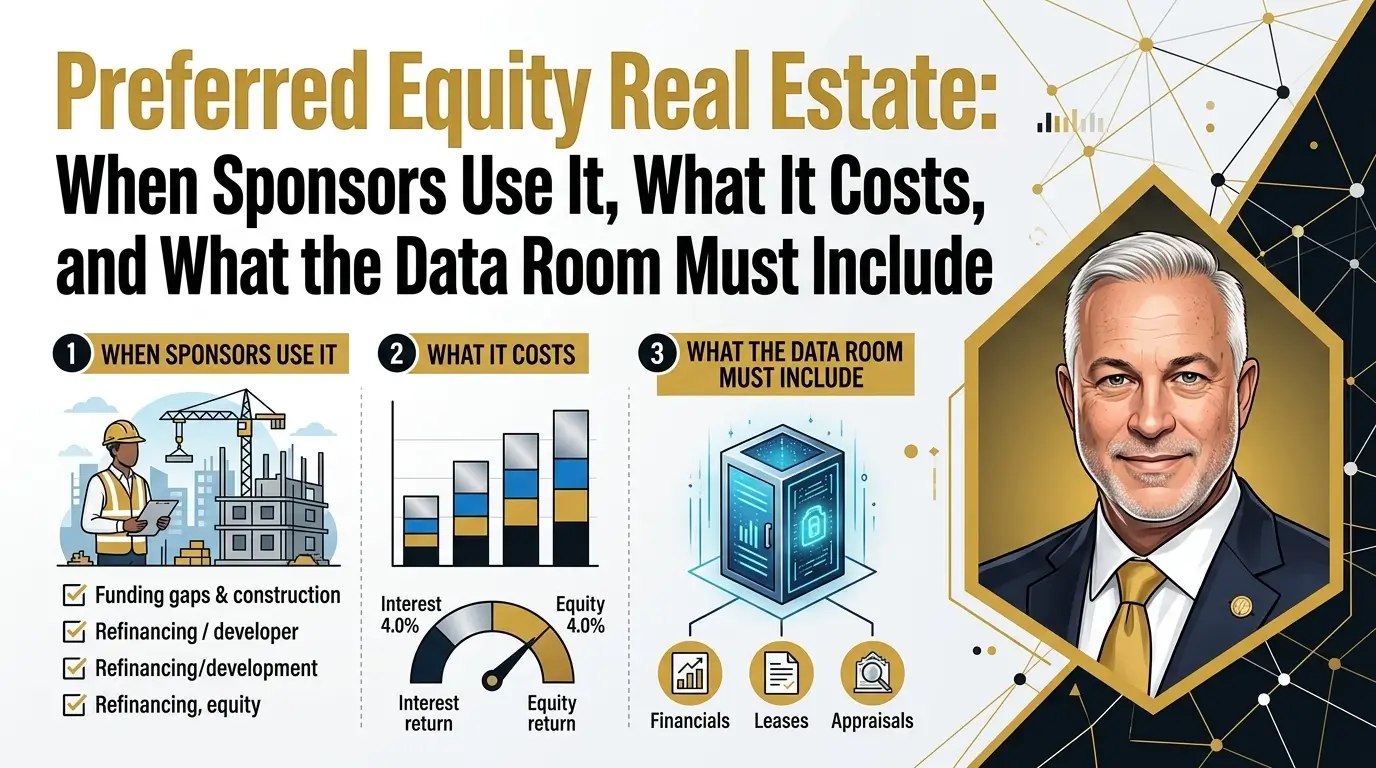
Preferred Equity Real Estate: When Sponsors Use It, What It Costs, and What the Data Room Must Include
How Should a Startup Document a Convertible Note Transfer From the Original Investor To a New Holder?
Disclosure
Nothing on this site constitutes an offer to sell, or a solicitation of an offer to purchase, any security under the Securities Act of 1933, as amended, or any applicable state securities laws. Any offering of securities is made only by means of a formal private placement memorandum or other authorized offering documents delivered to qualified investors.
IRC Partners is a capital advisory firm. IRC Partners is not a registered investment adviser under the Investment Advisers Act of 1940 and does not provide investment advice as defined thereunder.
Certain statements in this article may constitute forward-looking statements, including statements regarding market conditions, capital availability, investor demand, and transaction outcomes. Such statements reflect current assumptions and expectations only. Actual results may differ materially due to market conditions, regulatory developments, company-specific factors, and other variables. IRC Partners makes no representation that any outcome, return, or result described herein will be achieved.
References to prior mandates, transaction volume, network credentials, or capital raised are provided for illustrative purposes only and do not constitute a guarantee or prediction of future results. Past performance is not indicative of future outcomes. Individual results will vary. Network credentials and transaction statistics referenced on this site reflect the aggregate experience of IRC Partners' principals and affiliated advisors and are not a representation of assets managed or transactions closed solely by IRC Partners.
Certain data, statistics, and information presented in this article have been obtained from third-party sources. IRC Partners has not independently verified such information and expressly disclaims responsibility for its accuracy, completeness, or timeliness. Readers should independently verify any third-party data before relying on it.
Readers are strongly encouraged to consult qualified legal, financial, and tax professionals before making any investment, capital raising, or business decision.
Schedule A Meeting
You get one shot to raise the right way. If this raise is worth doing, it’s worth doing with precision, leverage, and control.
This isn’t a practice run. Serious capital. Serious strategy. Let’s raise it right.
We onboard a maximum of seven
new strategic partners each quarter, by application only, to maximize your chances of securing the capital you need.
