.svg "CTA Arrow")


.png "Investor Ready Capital decorative background element")

Real Estate Investment Strategy: Core vs. Core-Plus vs. Value-Add vs. Opportunistic — What Each Strategy Requires in the Institutional Data Room
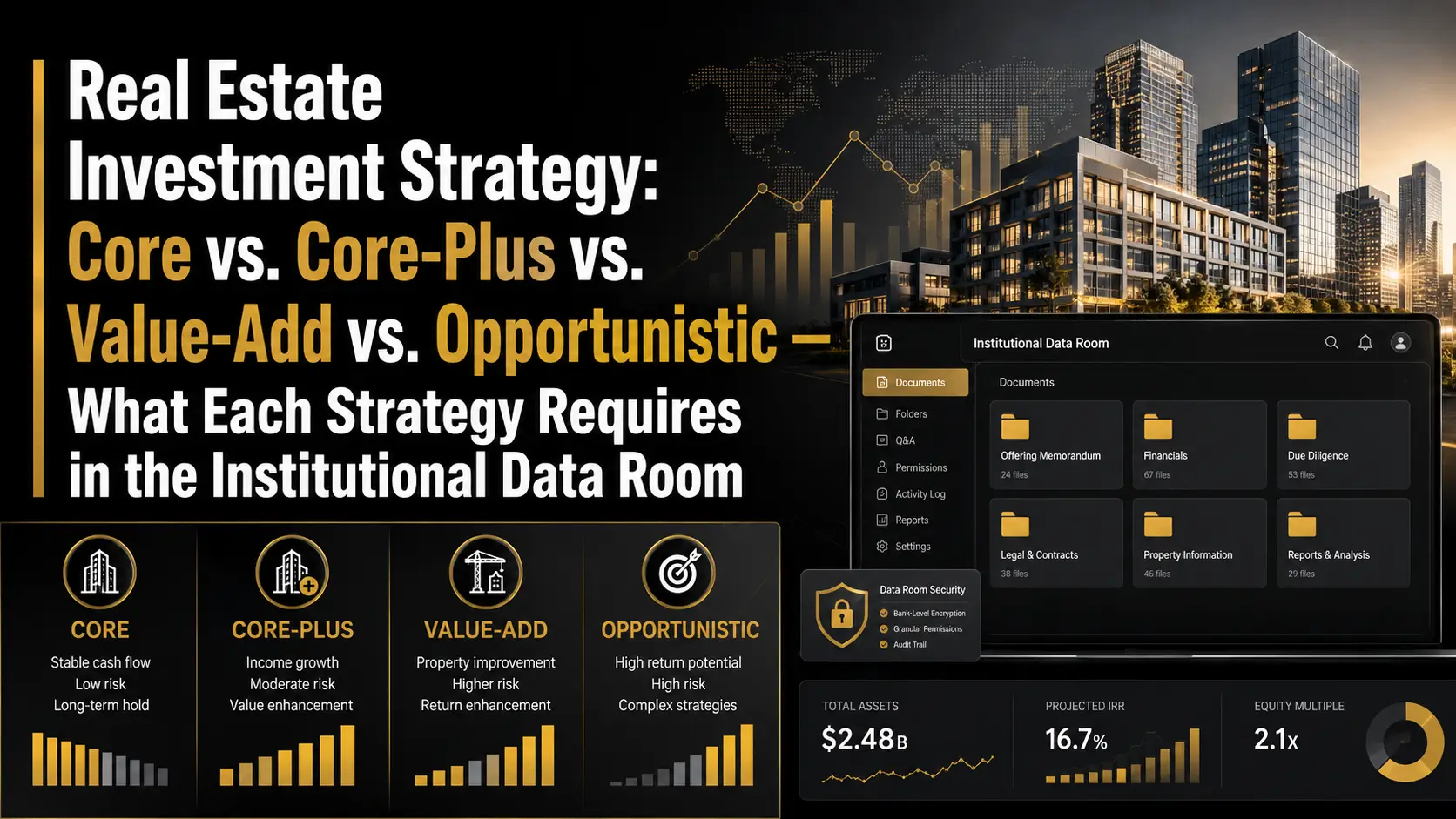
Real Estate Investment Strategy: Core vs. Core-Plus vs. Value-Add vs. Opportunistic — What Each Strategy Requires in the Institutional Data Room
TL;DR: Strategy labels dictate institutional data room depth. Learn to align your IRR, LTV, and track record files before limited partners pre-screen.
- The Four Quadrants: What Each Strategy Means to an Institutional Reviewer: Institutional reviewers do not evaluate the four strategies on a single risk axis.
- How Institutional LPs and Lenders Underwrite Each Strategy Differently: Strategy label changes the questions reviewers ask.
- What the Data Room Must Include for Each Strategy: Every institutional data room starts with the same foundation: a sponsor track record, an offering memorandum, a financial model, a capital stack summary, and entity documents.
When an institutional limited partner opens a real estate offering memorandum, their initial focus bypasses raw return projections to critically evaluate the sponsor's designated strategy label. Institutional reviewers treat categories like Core, Core-Plus, Value-Add, and Opportunistic not as loose marketing descriptions, but as rigid, highly specific underwriting frameworks that dictate distinct internal rate of return (IRR) expectations, loan-to-value (LTV) limits, structural hold periods, and track record parameters. In a sophisticated 2026 early-cycle recovery market characterized by tighter investor mandate constraints and deeper credit-like diligence, any structural contradiction within a data room will instantly erode allocator confidence before a first call is even scheduled. For example, presenting a Value-Add asset without a fully detailed line-item capex budget, or projecting an Opportunistic $17\%+$ IRR without explicit ground-up development or distressed resolution precedent, flags a sponsor as operationally unsophisticated. Because senior lenders face compounding refinance and collateral risks as up to $2 trillion in commercial real estate loans mature through the end of 2026, capital stacks must be perfectly sequenced with appropriate mezzanine or preferred equity layers to clear investment committees. Ultimately, sophisticated real estate operators must understand that strategy alignment is fundamentally a data room verification challenge rather than a positioning exercise, requiring comprehensive internal consistency checks across financial models, debt metrics, and asset files long before initiating external market outreach.
Most sponsors treat Core, Core-Plus, Value-Add, and Opportunistic as marketing categories. Institutional reviewers treat them as underwriting frameworks. Every label carries a specific set of expectations, and your job is to make sure your data room, financial model, and capital stack meet all of them.
The three consistency tests every institutional LP applies before the first call:
- Return-to-strategy fit: Does your projected IRR fall within the range appropriate for the strategy you claimed? The financial projections institutional LPs expect in a real estate fund pitch deck are benchmarked directly against strategy type, not just deal-level performance.
- Leverage-to-risk fit: Does your LTV and debt structure match the risk profile of that strategy?
- Track record-to-execution fit: Have you actually done what this strategy requires before?
A sponsor who labels a deal Value-Add but models Core-level returns fails the first test. A sponsor who claims Opportunistic upside without a ground-up development track record fails the third. Either way, the LP loses confidence before the numbers are ever debated.
This article breaks down what each strategy quadrant means to institutional reviewers, how LP and lender underwriting differs across the four, what your data room must prove for each one, and how to spot a mismatch before it costs you a commitment. Sponsors who understand how to structure a capital stack for institutional capital will recognize that strategy alignment is not a pitch problem. It is a data room problem.
The Four Quadrants: What Each Strategy Means to an Institutional Reviewer
Institutional reviewers do not evaluate the four strategies on a single risk axis. They evaluate whether the sponsor's profile, asset condition, return assumptions, and capital structure are appropriate for the quadrant they claim to occupy. The table below captures how each strategy is benchmarked at the institutional level.
What each label signals to the reviewer
Core tells a reviewer the asset is already performing, leverage is conservative, and the sponsor's job is to protect and report income. It is the lowest-risk quadrant, but it also carries the highest institutional reporting standard. Generic core exposure is under pressure in 2025-2026, and LPs are increasingly selective about what qualifies.
Core-Plus signals a stable income base with a defined path to modest upside. The reviewer is looking for downside protection first. If the income floor is thin or the upside depends on assumptions that look aggressive, the deal drifts toward value-add in the LP's mind, even if the sponsor did not intend it.
Value-Add shifts the entire case to execution. The reviewer wants to see that the sponsor has done this before, that the capex plan is credible, and that the bridge-to-stabilization path is realistic. Return assumptions in this quadrant have come under pressure as preferred return hurdles have shifted from 8% toward 6-7% in a higher debt cost environment.
Opportunistic carries the heaviest burden of proof. The return depends on something that does not yet exist: a completed building, a repositioned asset, or a resolved distress situation. Reviewers expect sponsors to demonstrate direct precedent, not adjacent experience.
How Institutional LPs and Lenders Underwrite Each Strategy Differently
Strategy label changes the questions reviewers ask. LP equity reviewers focus on return consistency, hold period logic, and sponsor fit. Senior lenders focus on debt service resilience, collateral quality, and exit visibility. Both groups apply different tolerance thresholds depending on where the deal sits on the risk spectrum.
LP equity underwriting by strategy
- Core: LPs stress-test the income durability. They want to see long-term leases, creditworthy tenants, low vacancy history, and a reporting track record that matches institutional standards. A sponsor with a strong operating history but limited institutional reporting capability will face friction here even if the asset qualifies.
- Core-Plus: LPs want the income base confirmed before they evaluate the upside. The business plan must show a credible path to the appreciation component without relying on market tailwinds. Downside scenarios matter more in this quadrant than sponsors often expect.
- Value-Add: LPs underwrite the business plan as carefully as the asset. They want comparable renovations, lease-up comps, cost-per-unit capex benchmarks, and a bridge lender already identified or in place. Track record in the same asset class and geography carries significant weight.
- Opportunistic: LPs apply the most rigorous sponsor-capability review. They are funding execution, not just an asset. Sponsors need demonstrated precedent in the same type of development, repositioning, or distressed resolution. J-curve expectations have stretched in 2025-2026, with stabilization timelines on some deals pushing from two to three or four years.
Senior lender underwriting by strategy
- Core and Core-Plus: Lenders underwrite to in-place income with low debt service coverage ratios (DSCR) of 1.25x or higher and conservative exit cap assumptions. Refinance risk is manageable because the asset is already stabilized.
- Value-Add: Lenders require a detailed draw schedule, a construction or renovation budget with contingency, and a realistic stabilization timeline. Bridge loans in 2025-2026 carry longer extension assumptions and higher all-in yields than prior cycles. Lenders want a de-risked exit path before they commit.
- Opportunistic: Lenders face the highest collateral risk. Preferred equity and mezzanine layers are common because senior debt alone often cannot support the return structure. With up to $2 trillion in commercial real estate loans maturing by end of 2026, lenders are requiring clearer exit visibility than at any point in the past decade.
The practical takeaway: A value-add deal with no bridge lender identified and no capex comparables in the data room will stall with both the LP and the lender. The data room must answer the questions each reviewer type will ask before those questions are raised.
What the Data Room Must Include for Each Strategy
Every institutional data room starts with the same foundation: a sponsor track record, an offering memorandum, a financial model, a capital stack summary, and entity documents. What changes by strategy is the depth and emphasis of the supporting evidence. Sponsors who want to understand the full 47-document baseline should review the real estate due diligence checklist for $10M+ raises. The quadrant-specific requirements build on top of that foundation.
Core data room priorities
- Rent rolls with lease expiration schedules and tenant credit summaries
- Historical operating statements (3 years minimum, audited preferred)
- Property condition assessment from a qualified third party
- Long-term management track record with occupancy history
- Institutional-grade reporting samples showing quarterly or annual LP reporting capability
- Low-leverage debt summary with DSCR confirmation
Core-Plus data room priorities
- All core documentation above, plus:
- Business plan showing the defined upside path with timeline and cost assumptions
- Downside scenario model with income floor analysis
- Comparable transactions supporting the appreciation assumption
- Evidence of light repositioning or lease-up capability in prior deals
Value-Add data room priorities
- Detailed capex budget with line-item breakdown and contingency reserve
- Renovation or lease-up comparables from same asset class and market
- Bridge financing term sheet or lender commitment letter
- Pro forma with before-and-after NOI and stabilized value support
- Sponsor track record showing completed value-add exits with documented returns
- Lease-up timeline with absorption assumptions tied to market data
Opportunistic data room priorities
- All of the above where applicable, plus:
- Entitlement status, permits, and zoning documentation (development deals)
- Construction contract or GC LOI with budget and schedule
- Contingency logic showing how cost overruns and timeline delays are managed
- Distressed asset resolution history (if repositioning or note purchase)
- Preferred equity and mezzanine term sheets showing capital stack layering
- J-curve model with realistic stabilization milestones and sensitivity analysis
- Key point: The data room is not just a document repository. It is the physical proof that your strategy label is accurate. If an LP asks for the capex plan on a value-add deal and you cannot produce one, the strategy label becomes a liability rather than a positioning choice. Sponsors using real estate investment analysis software to build their models should ensure the outputs are organized to match the strategy-specific evidence requirements above.
Strategy-Label Mismatches: The Fastest Way to Lose LP Credibility
A strategy mismatch is not just a positioning error. It is a trust problem. When the label, the model, and the documents tell three different stories, institutional reviewers assume one of two things: the sponsor does not understand the asset class well enough, or the sponsor is trying to attract LP capital they would not otherwise qualify for. Either conclusion ends the conversation.
The most common mismatches sponsors present without realizing it:
Why mismatches compound
A single mismatch raises a question. Multiple mismatches raise a pattern. When an LP notices that the return assumption, the leverage structure, and the track record all point to a different strategy than the one labeled on the cover page, they stop evaluating the deal on its merits. They start evaluating whether the sponsor can be trusted to run the capital.
Sponsors who build their data rooms with the strategy label as the organizing principle avoid this problem. Every document in the room should answer the question: "Does this prove we can execute the strategy we claimed?" If the answer is no for any document, the data room is not ready. Understanding how to build a data room that closes institutional investors means understanding that every file serves the strategy narrative, not just the deal.
{{main-cta}}
2025-2026 Market Context: Where LP Appetite Is Moving Across the Four Quadrants
Institutional LP sentiment toward real estate shifted in 2025. According to PwC/ULI Emerging Trends in Real Estate 2026, target allocations to real estate among institutional investors declined for the first time in 13 years. But the story is more nuanced than a headline pullback suggests.
What the allocation data actually shows:
- The Hodes Weill 2025 Allocations Monitor found institutions remain roughly 90 basis points under-allocated to their real estate targets. Capital is available. It is being repositioned, not withdrawn.
- Institutions plan to grow allocations by approximately 10 basis points over the next 12 months, effectively reversing the 2025 cut.
- 45% of institutional LPs surveyed by PERE expect to invest more capital in private real estate in 2026 than they did in 2025.
Where the capital is moving:
- Traditional open-end core funds remain under pressure. ODCE fund redemption queues, while improving from a peak of 19.3% of NAV in early 2024, still stood at approximately 12% of NAV in 2026. Net outflows for ODCE funds were -$1.5 billion in Q1 2026. LPs are rethinking whether illiquid open-end core vehicles match their liquidity needs.
- New commitments are concentrating in high-conviction core-plus and selected value-add strategies. According to PGIM Real Estate's 2026 U.S. Outlook, incremental capital is moving up the risk curve toward core-plus, value-add, and opportunistic, but with a clear preference for sponsors who can demonstrate thesis clarity and sector expertise.
- In 2024, CalSTRS rebalanced nearly $2 billion from traditional core funds into value-add vehicles focused on last-mile logistics and life sciences, a signal of where large institutional allocators are finding conviction.
- Opportunistic capital remains available, but it is increasingly reserved for sponsors with proven execution history. J-curve timelines are stretching, and LPs are pricing that into their commitment decisions.
The practical implication for sponsors: generic positioning in any quadrant is harder to fund in 2025-2026. LPs want to know why your specific deal, in your specific market, executed by your specific team, justifies the strategy label you chose. That answer lives in the data room, not the pitch deck.
Strategy Alignment Is What Gets You Through First-Round Diligence
Institutional capital moves when the strategy label, return assumptions, capital stack, and data room all point in the same direction. When they do not, the LP's confidence erodes before the deal is evaluated on its merits.
Before your next LP call, run a three-step internal consistency check:
- Label check: Does your stated strategy match your IRR target, LTV, hold period, and return driver?
- Track record check: Does your sponsor history include direct precedent for what this strategy requires you to execute?
- Data room check: Does every document in your room prove you can deliver what the strategy label promises?
If any of these three checks surfaces a gap, the data room is not ready. Sponsors raising $10M+ should also review the 7 institutional capital sources most relevant to their strategy quadrant before approaching LPs, and understand how capital stack layers affect risk for each type of deal they bring to market.
Frequently Asked Questions
Can a sponsor label a deal Value-Add if the going-in occupancy is already above 90%?
High going-in occupancy does not automatically disqualify a Value-Add label, but it raises an immediate question from institutional reviewers: where does the upside come from? If the business plan depends on rent bumps through renovation, lease restructuring, or below-market rents rolling to market, the label can hold. If the asset is already fully stabilized at market rents with no credible operational upside, the deal belongs in Core or Core-Plus regardless of what the cover page says.
What return metrics do institutional LPs expect to see by strategy type?
Institutional LPs use return expectations as a consistency filter, not just a performance benchmark. Core deals are typically expected to target 6-9% IRR with income as the dominant driver. Core-Plus deals should show 8-11% IRR with a defined appreciation component. Value-Add deals are expected to target 12-16% IRR driven by execution. Opportunistic deals are benchmarked at 17% or higher, with the return case tied to development, distress resolution, or major repositioning. A projection outside these bands requires a clear explanation or it signals a mismatch.
How do lenders size LTV differently for value-add versus core assets?
Core assets typically support 50-60% LTV with permanent or agency debt because the income is in place and refinance risk is low. Value-add deals are typically financed at 65-75% LTV using bridge debt, which carries higher interest rates, shorter initial terms of 12-36 months, and extension provisions tied to leasing or renovation milestones. In 2025-2026, bridge lenders are requiring more conservative extension assumptions and clearer stabilization timelines than in prior cycles, which directly affects the capital stack structure a sponsor must present.
Do opportunistic sponsors need a different track record than value-add sponsors to access institutional LP capital?
Yes, and the difference is significant. Value-add sponsors need documented experience in repositioning, lease-up, and bridge-to-stabilization execution in the same asset class and geography. Opportunistic sponsors need direct precedent in ground-up development, distressed asset resolution, or major redevelopment. Adjacent experience, such as a value-add track record presented in support of an opportunistic raise, is not sufficient for most institutional LPs. They want to see that the sponsor has done the exact type of execution the deal requires, not a close approximation.
What happens to LP confidence when a sponsor's IRR projection does not match the strategy label?
It drops immediately, and it rarely recovers without a detailed explanation. If a sponsor labels a deal Value-Add but projects a 9% IRR, the LP assumes either the upside is not real or the sponsor does not understand how the strategy is benchmarked. If a sponsor labels a deal Core but projects a 15% IRR, the LP questions whether the risk is understated. Either way, the reviewer shifts from evaluating the deal to evaluating the sponsor's competence. Mismatched return projections are one of the most common reasons institutional diligence stalls before it reaches the asset-level review.
How should a sponsor present a Core-Plus deal to a family office that typically invests in Value-Add?
Lead with the income floor, not the upside. Family offices that invest in Value-Add are accustomed to execution risk and appreciate upside potential, but they also understand downside risk better than most. A Core-Plus deal should be framed as a lower-risk entry with a defined appreciation path, not as a watered-down Value-Add. Present the stabilized income base, the downside scenario, and the specific upside driver clearly. If the family office's minimum IRR threshold is above what Core-Plus can deliver, acknowledge that directly rather than inflating return assumptions to fit their expectations. Sponsors navigating how to structure capital for institutional raises will recognize that mismatching the LP type to the strategy is as damaging as mismatching the documents.
Can a single data room serve both a senior lender and an LP equity reviewer when the strategy is opportunistic?
It can, but it requires deliberate organization. Senior lenders on opportunistic deals focus on construction budget, entitlement status, draw schedule, contingency reserves, and exit path. LP equity reviewers focus on sponsor track record, return assumptions, J-curve modeling, and capital stack logic. A single data room can contain all of this, but it should be organized so each reviewer type can navigate directly to the materials relevant to their diligence process. A disorganized opportunistic data room, where construction documents are mixed with financial projections and sponsor bio pages, signals operational sloppiness and slows both reviews simultaneously.
Continue reading this series:
- How to Build a Data Room That Closes Institutional Investors in 30 Days Instead of 90
- Real Estate Due Diligence Checklist: The 47 Documents $10M+ Sponsors Must Have Ready
- Real Estate Investment Analysis Software: What Institutional Sponsors Need to Know
IRC Partners works with operators raising $5M to $250M of institutional capital. The full engagement is for founders at $1M+ ARR who have raised before. The $2,997 Capital Raise Pre-Flight audit is open to earlier-stage companies, including pre-revenue, that are raising $5M+ and have a pitch deck and financial model ready for review. If that's you, schedule a call to discuss HERE.
Before taking a raise to market, run it through the Capital Raise Pre-Flight to see how it holds up against institutional standards.
Need guidance on your capital raise?


Pitch Deck Audit: The Slides Institutional Investors Use to Disqualify You First

What Is a Standard GP Promote Structure for a $100M Real Estate Closed-End Fund Targeting Institutional LPs?

Cap Table Forensics: Why Most Founders Own 5 to 15 Percent Less Than They Think
Disclosure
Nothing on this site constitutes an offer to sell, or a solicitation of an offer to purchase, any security under the Securities Act of 1933, as amended, or any applicable state securities laws. Any offering of securities is made only by means of a formal private placement memorandum or other authorized offering documents delivered to qualified investors.
IRC Partners is a capital advisory firm. IRC Partners is not a registered investment adviser under the Investment Advisers Act of 1940 and does not provide investment advice as defined thereunder.
Certain statements in this article may constitute forward-looking statements, including statements regarding market conditions, capital availability, investor demand, and transaction outcomes. Such statements reflect current assumptions and expectations only. Actual results may differ materially due to market conditions, regulatory developments, company-specific factors, and other variables. IRC Partners makes no representation that any outcome, return, or result described herein will be achieved.
References to prior mandates, transaction volume, network credentials, or capital raised are provided for illustrative purposes only and do not constitute a guarantee or prediction of future results. Past performance is not indicative of future outcomes. Individual results will vary. Network credentials and transaction statistics referenced on this site reflect the aggregate experience of IRC Partners' principals and affiliated advisors and are not a representation of assets managed or transactions closed solely by IRC Partners.
Certain data, statistics, and information presented in this article have been obtained from third-party sources. IRC Partners has not independently verified such information and expressly disclaims responsibility for its accuracy, completeness, or timeliness. Readers should independently verify any third-party data before relying on it.
Readers are strongly encouraged to consult qualified legal, financial, and tax professionals before making any investment, capital raising, or business decision.
Schedule A Meeting
You get one shot to raise the right way. If this raise is worth doing, it’s worth doing with precision, leverage, and control.
This isn’t a practice run. Serious capital. Serious strategy. Let’s raise it right.
We onboard a maximum of seven
new strategic partners each quarter, by application only, to maximize your chances of securing the capital you need.
