.svg "CTA Arrow")


.png "Investor Ready Capital decorative background element")

Which Model Output Pages Should Be Summarized in a Real Estate Investor Presentation Appendix?
Which Model Output Pages Should Be Summarized in a Real Estate Investor Presentation Appendix?
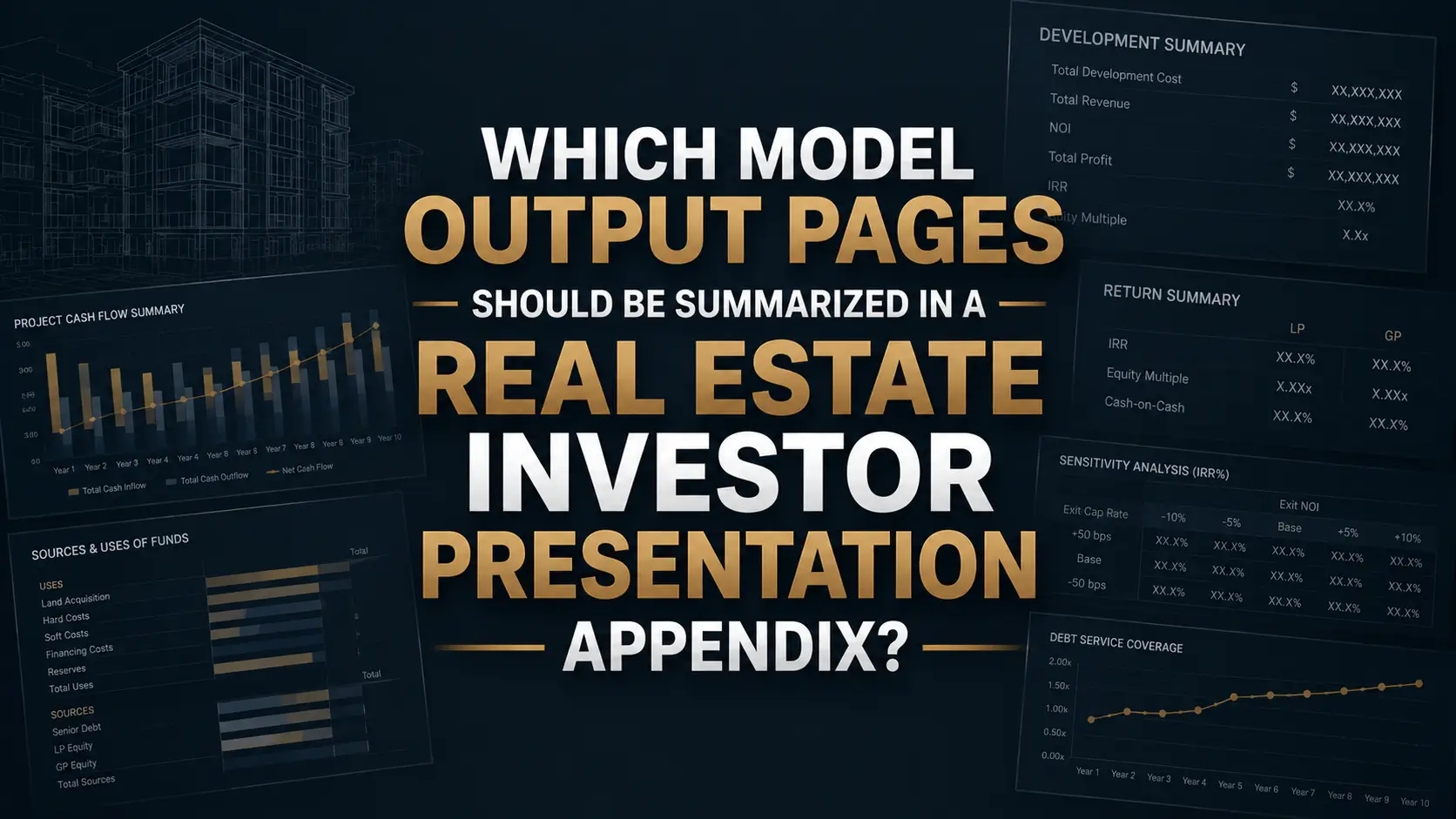
A real estate investor presentation appendix should contain exactly five model output pages: sources and uses, distribution waterfall summary, preferred return schedule, sensitivity table, and project-level cash flow summary. These five pages give a first-pass LP reviewer everything needed to validate the return profile without requesting the full model file. Every other model page, including raw formula tabs, full debt schedules, scenario toggles, and GP-only economics pages, belongs in the data room and should be shared only after the reviewer has completed first-pass review.
The investor-ready materials package for a real estate sponsor covers every document in the set. This article focuses on the appendix specifically: which pages to include, which to exclude, how to label each one, and how the appendix connects to the rest of the package. The LP-facing financial model summary and the preferred return coverage presentation covered in prior articles in this series feed directly into the appendix structure described here.
What the Investor Presentation Appendix Is
The investor presentation appendix is the section of the presentation package that contains formatted model output pages. It sits behind the main deck and in front of the data room. Its job is to give a reviewer the financial detail they need to validate the deck's return claims without requiring access to the live model.
The full model file is a working document. It contains formula tabs, scenario toggles, raw assumption inputs, and debt schedule detail. A reviewer who opens the full model without a walk-through will encounter pages that are not interpretable in isolation. The appendix removes that problem by extracting only the output pages that read cleanly on their own.
Key distinction: A reviewer needs to validate that the deal's math holds up before they will request the full model. The appendix is built to answer that question on its own.
The appendix is also the document that signals packaging quality. A reviewer who sees a well-organized appendix with labeled pages, clear column headers, and outputs that reconcile to the deck body understands that the sponsor has prepared for institutional review. A reviewer who sees a raw model export or a disorganized set of screenshots understands the opposite.
Which Model Output Pages Belong in the Appendix
Five output pages pass the appendix test. Each one is readable in isolation, answers a specific reviewer question, and does not require model context to interpret.
Sources and Uses
The sources and uses page shows the full capital structure at project level. It lists every source of funds in seniority order (senior debt, mezzanine or preferred equity if applicable, LP equity, GP equity) and every use of funds in plain-English categories (land, hard costs, soft costs, financing costs, developer fee, contingency). Every number on this page should reconcile exactly to the sources and uses exhibit in the body of the deck.
Distribution Waterfall Summary
The waterfall summary shows how proceeds are distributed across the equity stack. It presents four tiers in plain English: return of capital, preferred return to LP, catch-up to GP if applicable, and residual profit splits at each tier. The specific terms of each tier are governed by the Limited Partnership Agreement, and each LPA structures these components differently. The page should show the LP and GP dollar amounts at each tier in the base case, not just percentages. A reviewer who can read the waterfall summary without opening the model will not send a distribution question.
Preferred Return Schedule
The preferred return schedule shows how the LP pref accrues, when it is expected to be paid, and what the unpaid balance is at each phase. It should include the terms box (rate, basis, compounding method, day-count), the phase coverage view (construction, lease-up, stabilization, exit), and the promote trigger.
Sensitivity Table
The sensitivity table shows how the base case IRR and equity multiple change across a matrix of exit cap rate and rent assumptions. A standard table runs three exit cap scenarios across three rent scenarios for a 3x3 grid of outcomes. The base case cell should be clearly marked. The table should show LP-level returns, since the LP reviewer needs to see how their position performs under stress. With a standard 8% preferred return and a 70/30 promote, LP net IRR typically runs 3 to 5 percentage points below project IRR across the capital stack, which means project-level returns materially overstate what an LP actually receives.
Project-Level Cash Flow Summary
The cash flow summary shows annual or quarterly net cash flow from operations and the net proceeds at exit. It should be condensed to one page with no formula rows visible. The purpose is to let a reviewer confirm that the deal generates enough cash to service the debt, pay the pref, and produce the projected equity return. For sponsors raising capital for multifamily development, the cash flow summary is also where institutional LP reviewers verify DSCR assumptions against the debt sizing in sources and uses.
Which Pages to Exclude and Why
Four categories of model pages do not belong in the appendix. Including them creates confusion, generates questions, and signals that the sponsor did not filter the output for a reviewer audience.
The debt schedule exclusion is worth a closer look. The LP does need debt information, but at summary level: loan-to-cost ratio, interest rate assumption, and DSCR at stabilization. Those three data points belong in the sources and uses page and the cash flow summary. The full monthly draw schedule belongs in the data room.
The same logic applies to GP economics. The waterfall summary already shows the LP and GP split at each tier. That is the correct disclosure level for the appendix. A page that shows the GP's all-in compensation invites questions that are better answered in a live conversation after the reviewer has formed a view on the deal.
The filter test: Before including any model page in the appendix, ask whether a reviewer with no model access can read it, understand it, and draw a conclusion from it. If the answer requires any model context to interpret, the page belongs in the data room.
How to Label and Format Each Appendix Page
Labeling is what separates a formatted appendix from a model printout. Each page needs four elements before it goes into the package.
The Four Required Label Elements
- Page title. Plain English. "Sources and Uses" not "Tab 3 - S&U v4 FINAL." The title should match the language used in the body of the deck.
- Project identifier. Property name or deal code in the header. A reviewer working across multiple packages needs to know which deal they are looking at without checking the cover page.
- Date stamp. Model as of date in the footer. If the model is updated between drafts, the date stamp tells the reviewer which version they reviewed.
- Page number within the appendix. "Appendix A-1," "Appendix A-2," and so on. This ties each page to the table of contents and makes it easy to reference in conversation.
Formatting Standards by Page Type
{{main-cta}}
The Readability Test
Before the appendix goes into the package, run this check on each page: print it, set it on a desk, and read it without opening the model. If a column header requires model context to interpret, rename it. If a row label is a formula reference, replace it with plain English. If the page runs longer than one printed page, condense it.
A reviewer who has to scroll or zoom to read an appendix page will note the formatting problem. A reviewer who can read each page in under two minutes will move to the next one.
How the Appendix Connects to the Rest of the Package
The appendix does not stand alone. Every number on every appendix page should trace back to a specific exhibit in the body of the deck.
The Three Reconciliation Points
Sources and uses reconciles to the capital stack slide. The total project cost, the equity requirement, and the debt amount in the appendix must match the numbers on the capital stack slide exactly. If the deck shows $42M in total capitalization and the appendix sources and uses shows $41.8M, a reviewer will flag it.
The waterfall summary reconciles to the return summary slide. The LP IRR and equity multiple shown in the deck body must match the base case output in the waterfall summary. If the deck shows a 17% LP IRR and the waterfall summary shows 16.8%, the reviewer will ask which number is correct.
The preferred return schedule reconciles to the pref terms box in the deck. The rate, basis, compounding method, and promote trigger shown in the appendix must match the terms disclosed in the body of the deck. Any discrepancy will generate a clarification request.
Where the Appendix Sits in the Full Package
The appendix sits between the main deck and the data room. A reviewer reads the deck, then turns to the appendix to validate the numbers, then requests the data room if they want to go deeper. That sequence only works if the appendix is complete enough to close the validation loop on its own.
Package sequence: Deck body (narrative and return claims) → Appendix (model output validation) → Data room (full model, legal documents, third-party reports)
For sponsors raising between $5M and $250M, the appendix is often the document that determines whether a reviewer moves to the data room or sends a model walk-through request. A well-built appendix closes the gap between the deck and the data room. IRC has structured this package sequence across capital advisory engagements including a $150M multifamily development in Texas, where the appendix format was a direct factor in the speed of the institutional LP review process.
For sponsors working through the multifamily development capital raise process, the appendix structure described here applies directly to how institutional LPs review the financial package before advancing a deal to committee.
Structure the Appendix for Institutional Review
A well-built appendix is the difference between a reviewer who advances to the data room and one who sends a model walk-through request. The five pages covered here, formatted correctly and reconciled to the deck body, give a first-pass reviewer everything they need to validate the return profile on their own timeline.
Frequently Asked Questions
How many pages should a real estate investor presentation appendix contain?
A complete appendix contains five pages: sources and uses, distribution waterfall summary, preferred return schedule, sensitivity table, and project-level cash flow summary. Each page answers a specific reviewer question. Adding pages beyond these five increases the risk that a reviewer encounters content they cannot interpret without model context, which generates a walk-through request rather than preventing one.
What is the difference between the appendix and the data room in a real estate capital raise?
The appendix is a formatted subset of model outputs included in the presentation package. The data room is the full document repository, including the live model file, legal documents, and third-party reports. The appendix is designed to be read without model access. The data room is shared after a reviewer has completed first-pass review and requested additional detail.
Should the sensitivity table in the appendix show LP-level or project-level returns?
The sensitivity table should show LP-level returns. A reviewer evaluating a development deal needs to see how their position performs across exit cap rate and rent scenarios, not how the project performs in aggregate. Project-level returns can obscure how the capital stack affects LP outcomes under stress. A 3x3 matrix of LP IRR and equity multiple across three exit cap and three rent scenarios is the standard format.
How should a sponsor handle a model update after the appendix has been distributed?
When the model is updated, every appendix page that contains changed outputs must be replaced and the date stamp updated. The revised appendix should be distributed with a brief note identifying which pages changed and why. Distributing an updated deck with a stale appendix creates a reconciliation problem: the reviewer will find discrepancies between the deck body and the appendix and will ask which version is current.
What goes in the preferred return schedule terms box at the top of the appendix page?
The terms box should contain five items: the preferred return rate (for example, 8% per annum), the basis on which it accrues (contributed capital or invested equity), the compounding method (simple or compounding), the day-count convention (360 or 365), and the promote trigger (the IRR or equity multiple threshold at which the GP catch-up begins). All five items should appear on the same page as the accrual schedule so a reviewer does not need to cross-reference the deck to confirm the terms.
Can a sponsor include a scenario comparison page in the appendix?
A scenario comparison page belongs in the data room. The appendix should present the base case only. Including upside and downside scenarios in the appendix invites a reviewer to anchor on the upside case or question the assumptions behind the downside. The sensitivity table covers scenario stress at the output level. A full scenario comparison, with different assumption sets for each case, is a data room document.
How does the appendix format change for a joint venture structure compared to a standard LP-GP deal?
In a joint venture structure, the waterfall summary and preferred return schedule must reflect the specific economics of the JV agreement, which may differ from a standard LP-GP waterfall. The appendix should include a JV economics summary page that shows the contribution split, the preferred return terms for each party, and the residual profit split at each tier. The sources and uses, sensitivity table, and cash flow summary formats remain the same. The key difference is that the waterfall summary must be specific to the JV terms rather than a generic LP-GP template.
Continue reading this series:
- What financial model tabs should a real estate sponsor prepare before institutional LP outreach
- How to model sponsor fee income, promote economics, and GP participation for investors
- What a capital call schedule should include for institutional LP review
IRC Partners advises operators raising $5M to $250M of institutional capital on structure, positioning, and round architecture. We take seven strategic partners per quarter. No placement agent model. No success-only theater. Capital is raised on the strength of how the deal is built. If you want your current raise reviewed before it reaches the market and silently fails, apply here.
Need guidance on your capital raise?



What should an LP-Facing Financial Model Summary Include When Presenting a Single Real Estate Development Project?

What Is a Fund Fact Sheet and Do Institutional LPs Require One Before a First Meeting?

Best Advisors for Real Estate Capital Raising
Disclosure
Nothing on this site constitutes an offer to sell, or a solicitation of an offer to purchase, any security under the Securities Act of 1933, as amended, or any applicable state securities laws. Any offering of securities is made only by means of a formal private placement memorandum or other authorized offering documents delivered to qualified investors.
IRC Partners is a capital advisory firm. IRC Partners is not a registered investment adviser under the Investment Advisers Act of 1940 and does not provide investment advice as defined thereunder.
Certain statements in this article may constitute forward-looking statements, including statements regarding market conditions, capital availability, investor demand, and transaction outcomes. Such statements reflect current assumptions and expectations only. Actual results may differ materially due to market conditions, regulatory developments, company-specific factors, and other variables. IRC Partners makes no representation that any outcome, return, or result described herein will be achieved.
References to prior mandates, transaction volume, network credentials, or capital raised are provided for illustrative purposes only and do not constitute a guarantee or prediction of future results. Past performance is not indicative of future outcomes. Individual results will vary. Network credentials and transaction statistics referenced on this site reflect the aggregate experience of IRC Partners' principals and affiliated advisors and are not a representation of assets managed or transactions closed solely by IRC Partners.
Certain data, statistics, and information presented in this article have been obtained from third-party sources. IRC Partners has not independently verified such information and expressly disclaims responsibility for its accuracy, completeness, or timeliness. Readers should independently verify any third-party data before relying on it.
Readers are strongly encouraged to consult qualified legal, financial, and tax professionals before making any investment, capital raising, or business decision.
Schedule A Meeting
You get one shot to raise the right way. If this raise is worth doing, it’s worth doing with precision, leverage, and control.
This isn’t a practice run. Serious capital. Serious strategy. Let’s raise it right.
We onboard a maximum of seven
new strategic partners each quarter, by application only, to maximize your chances of securing the capital you need.
