.svg "CTA Arrow")


.png "Investor Ready Capital decorative background element")

Construction Loan for Real Estate Developers: What Institutional Lenders Require in Your Data Room Before They Fund

Construction Loan for Real Estate Developers: What Institutional Lenders Require in Your Data Room Before They Fund
TL;DR: What institutional construction lenders require in your data room before they fund - and how to build it before the first lender conversation.
- How Institutional Construction Lenders Underwrite Differently Than Regional Banks: Regional and community banks often underwrite construction loans on the strength of the sponsor relationship, local market familiarity, and a reasonable pro forma.
- What the Data Room Must Contain Before a Construction Loan Application Is Submitted: The data room is not a place to collect documents after the lender asks for them.
- Draw Schedule, Cost Certainty, and Budget Documentation at the Institutional Level: The draw schedule is where most construction loan applications reveal their weakest point.
Most institutional construction loan applications do not fail because the project is wrong. They stall, get repriced, or get declined because the sponsor's data room was not ready when the first lender conversation happened.
In the 2025-2026 lending environment, institutional construction lenders are underwriting to tighter standards than at any point in the past decade. The Federal Reserve's January 2026 Senior Loan Officer Opinion Survey confirmed that construction and land development loan standards remain tight by historical norms, with smaller banks still tightening while demand improves. That combination means lenders have more deal flow to evaluate and less tolerance for incomplete submissions.
The result is a clear pattern: sponsors with complete, organized, defensible data rooms move through underwriting faster, protect their loan proceeds, and avoid the term erosion that happens when a lender finds gaps mid-review.
What this article covers:
- How institutional construction lenders underwrite differently than regional or community banks
- What the data room must contain before a construction loan application is submitted
- Draw schedule, cost certainty, and budget documentation requirements at the institutional level
- Sponsor track record standards specific to construction lending
- The minimum lender-ready threshold before outreach begins
How Institutional Construction Lenders Underwrite Differently Than Regional Banks
Regional and community banks often underwrite construction loans on the strength of the sponsor relationship, local market familiarity, and a reasonable pro forma. Institutional lenders do not operate that way. They underwrite to stressed scenarios, apply portfolio-level concentration discipline, and require documentation that stands on its own without a relationship backstop.
The table below shows where the underwriting standards diverge most sharply.
The practical consequence of this gap is that a sponsor who has successfully financed construction projects at the regional bank level may be genuinely surprised by what institutional lenders require. The OCC's Commercial Real Estate Lending guidance makes the institutional standard explicit: lenders are expected to apply stress testing, concentration management, and documentation discipline before approving any large construction credit. For a detailed breakdown of how lenders build pricing from the ground up across debt layers, including how DSCR, debt yield, and sponsor track record affect the spread, see how institutional lenders build CRE financing rates in 2026. That is not optional underwriting rigor. It is regulatory expectation.
Construction-specific risk factors get heavier scrutiny at the institutional level because the lender is funding a project that does not yet exist. Cost overrun exposure, draw control, interest reserve adequacy, and completion risk all affect the lender's loss exposure in ways that a stabilized asset loan does not. Every item in the data room is there because it answers one of those risk questions.
What the Data Room Must Contain Before a Construction Loan Application Is Submitted
The data room is not a place to collect documents after the lender asks for them. It is the evidence package that answers every underwriting question before the first review call. Sponsors who treat it as a reactive checklist spend weeks responding to lender requests. Sponsors who build it proactively move through credit approval in a fraction of the time.
Building a complete institutional data room before outreach is one of the core disciplines covered in IRC's guide on how to build a data room that closes institutional capital in 30 days instead of 90. For construction lending specifically, the package must address four categories simultaneously.
The full 47-document institutional due diligence standard is detailed in IRC's real estate due diligence checklist for $10M+ sponsors. Sponsors layering mezzanine or preferred equity behind senior construction debt should also review what each mezz lender type requires in a data room, since each capital layer in the stack has distinct documentation expectations that must be addressed simultaneously. For construction lending, the documents above represent the non-negotiable day-one package. Missing any of them does not just slow the process. It signals to the lender that the sponsor has not yet internalized what institutional underwriting requires.
Draw Schedule, Cost Certainty, and Budget Documentation at the Institutional Level
The draw schedule is where most construction loan applications reveal their weakest point. A monthly cash flow summary is not a draw schedule. Institutional lenders require a document that shows exactly how funds will move from loan commitment to project completion, line item by line item, with inspection and approval mechanics built in.
Weak cost certainty has direct lending consequences. Lenders who cannot verify hard-cost support will reduce proceeds, require larger contingency reserves, or price the loan higher to compensate for the execution risk they cannot underwrite away. Documentation gaps in this area are one of the most common causes of construction loan repricing mid-review. Sponsors who want to reduce structural risk before outreach should also review capital stack risk reduction strategies before a $10M+ raise, which covers equity cushion sizing, layer substitution, and document negotiation levers that directly affect how lenders assess overrun exposure.
The five tests institutional lenders apply to draw schedules and budget documentation:
- Line-item budget support. Every major cost category must tie back to a contract, bid, or documented estimate. A lump-sum "construction costs" line does not pass. Hard costs, soft costs, contingency, and interest reserve must each be broken out and supported by evidence.
- Contract pricing alignment. The budget must match the GC contract. If the GC contract is a GMP, the budget should reflect that ceiling. Cost-plus contracts without a GMP require additional lender scrutiny and typically result in a higher contingency reserve requirement or reduced LTC.
- Contingency reserve adequacy. Institutional lenders typically require a minimum 5–10% hard-cost contingency for ground-up construction, with higher reserves for complex projects, phased builds, or markets with documented cost volatility. The contingency must be sized in the budget and controlled by the lender.
- Interest reserve documentation. The interest reserve must cover the full construction period plus a buffer, calculated at the loan's note rate and stress-tested against a realistic timeline. Sponsors who undersize the interest reserve force a mid-project conversation no lender wants to have.
- GC qualification and bonding support. Performance and payment bonds are standard institutional requirements. The lender will evaluate the GC's bonding capacity, financial strength, and prior project complexity. A GC who cannot bond to the project size is a credit risk, not just a contract issue.
Sponsors structuring mixed-use ground-up projects face additional budget documentation requirements specific to phased construction and multi-use capitalization.
Sponsor Track Record Requirements for Institutional Construction Lending
{{main-cta}}
A development resume is not the same as a track record attribution package. Institutional construction lenders want to know what the sponsor personally controlled on prior deals, not just which projects they were associated with.
The distinction matters because construction lending is a completion risk underwrite. The lender is betting that this sponsor can execute this project through to certificate of occupancy without a cost shock, a contractor default, or a market shift that breaks the exit. Prior completions that match the current project's type, complexity, and scale are the most direct evidence available.
Six sponsor proof points institutional construction lenders evaluate:
- Prior construction completions. Ground-up projects with documented cost, timeline, and outcome. Completions must match the product type in front of the lender. A multifamily track record does not substitute for industrial ground-up experience, and vice versa.
- Role attribution on prior deals. The sponsor must document what they actually controlled: sourcing, entitlements, capitalization, construction oversight, lease-up, and exit. Passive GP participation on someone else's deal does not count as a construction completion.
- Liquidity post-close. Institutional lenders require that the sponsor maintain meaningful liquidity after the equity contribution is made. A sponsor who is fully deployed into the equity contribution with no remaining reserves is a credit risk.
- Net worth relative to loan size. Most institutional construction lenders require guarantor net worth of at least 1x the loan amount, with liquid assets equal to 10–20% of the loan amount post-close.
- Completion guaranty capacity. The sponsor must be able to support a full completion guaranty, which obligates them to fund cost overruns and carry the project to completion if loan proceeds are exhausted. The guaranty must be backed by real financial capacity, not just projected promote.
- Prior lender relationships and references. Institutional lenders will verify prior construction loan performance. Clean payoff history and no default record are baseline expectations.
The Minimum Lender-Ready Standard Before Outreach Begins
Most construction loan delays are not caused by bad projects. They are caused by sponsors who begin lender outreach before the data room is complete and then spend the next 60 to 90 days assembling documentation in response to lender requests. That sequence is expensive. It extends the pre-closing period, gives lenders time to reprice or restructure terms, and signals that the sponsor is not yet operating at an institutional execution standard.
The minimum lender-ready standard is not perfection. It is the threshold at which a sponsor can have a first lender conversation without creating new open items that slow the process.
Lender-ready scorecard: what must be resolved before outreach:
- Complete project pro forma with stabilized NOI, exit value, and DSCR support
- Sources and uses with documented equity contribution and capital stack
- Construction budget with hard costs, soft costs, contingency (5–10% minimum), and interest reserve
- GC contract (GMP or fixed-price) with bonding and insurance certificates in hand
- Draw schedule with line-item breakdown and inspection mechanics
- Title commitment, Phase I environmental, plans, permits, and zoning confirmation
- Market study or third-party appraisal
- Entity structure chart and operating agreements
- Personal financial statements and liquidity evidence for all guarantors
- Track record attribution summary with project-level completions
- Any open items labeled with resolution timeline, responsible party, and risk impact
If any item above is missing or materially incomplete, the sponsor should resolve it before the first lender call. Open items discovered by the lender during review carry more weight than open items the sponsor discloses proactively. Lenders interpret undisclosed gaps as execution risk. Disclosed gaps with a clear resolution path are manageable.
This is where IRC's advisory role begins. Institutional readiness preparation, capital stack structuring, and data room organization happen before lender introductions are made, not after lenders identify gaps. Sponsors who want to understand how IRC structures this process can explore IRC's institutional capital advisory approach before outreach begins.
Conclusion
Institutional construction lenders are not looking for reasons to decline a deal. They are looking for evidence that the sponsor has already removed the documentation and execution risk before the first conversation. When that evidence is present, underwriting moves faster, loan proceeds are protected, and the sponsor avoids the term erosion that comes from assembling documentation mid-review.
The core principle is straightforward:
- Prepare the data room before outreach, not in response to lender requests
- Document cost certainty, draw mechanics, and GC qualification to institutional standards
- Build track record attribution that shows what the sponsor controlled, not just what they were near
- Resolve open items before lender engagement, or disclose them proactively with a resolution path
The project is not what gets funded. The sponsor's readiness is what gets funded. Developers who internalize that distinction before the first lender call are the ones who close faster, on better terms, and without the restarts that compress construction timelines and erode economics.
Frequently Asked Questions
What LTC and LTV ratios do institutional construction lenders require for a $10M+ ground-up development in 2025-2026?
For senior debt from banks and life insurance companies, loan-to-cost ratios are typically capped at 50–60% of total project cost in 2025-2026. Institutional debt funds may extend LTC to 75–80% for sponsors with strong track records and documented cost certainty, but at higher pricing. Stabilized loan-to-value ratios are generally held to 60–65%, with mid-60s acceptable for multifamily. Sponsors should plan equity contributions of 40–50% of total project cost before approaching institutional lenders at the senior debt level.
How do institutional construction lenders evaluate a sponsor's track record differently than a permanent lender or LP equity investor?
Institutional construction lenders evaluate track record as a completion risk screen, not a return history review. They want to see prior ground-up projects that match the current deal's product type, construction complexity, and market tier, with documented evidence of what the sponsor personally controlled: entitlements, capitalization, construction oversight, and delivery. A sponsor with strong permanent financing or LP equity history but no documented construction completions in the relevant product type will face additional scrutiny, higher reserve requirements, or a request for a co-sponsor with matching construction experience.
What does a draw schedule need to include to satisfy institutional construction lender requirements?
An institutional draw schedule must show line-item budget allocation by cost category, the timing of each draw request relative to construction milestones, the inspection and approval mechanics that trigger fund release, and the treatment of contingency reserves across the construction period. A monthly cash flow summary does not meet this standard. Lenders use the draw schedule as the control document for every disbursement from closing to completion. Vague or summary-level schedules create draw disputes and are one of the most common causes of construction loan funding delays.
How much contingency reserve do institutional construction lenders require in the construction budget?
Institutional construction lenders typically require a minimum hard-cost contingency of 5–10% of total hard costs for ground-up development, with higher reserves required for complex projects, phased construction, or markets with documented labor and material cost volatility. The contingency must be explicitly sized in the budget, held in a lender-controlled account, and released only through the draw approval process. Sponsors who undersize contingency or treat it as a soft estimate rather than a documented reserve will face reduced proceeds or a lender-imposed contingency holdback at closing.
What GC qualifications and bonding requirements do institutional construction lenders expect before funding?
Institutional construction lenders require performance and payment bonds from the general contractor as a standard condition of loan approval for $10M+ ground-up projects. The GC must demonstrate bonding capacity equal to or exceeding the construction contract value, sufficient financial strength to support the bond, and a prior project history that matches the complexity of the current build. A GC who cannot bond to the required level is a credit issue that affects loan approval, not just a contract negotiation. Lenders will also review the GC's insurance coverage, including general liability, workers' compensation, and builder's risk.
How does the interest reserve requirement work in an institutional construction loan for a $10M+ development?
The interest reserve is a funded amount held within the loan that covers interest payments during the construction period so the sponsor does not need to make out-of-pocket interest payments while the project is being built. Institutional lenders require the interest reserve to be fully documented and stress-tested against the projected construction timeline, calculated at the loan's note rate. If the construction period extends beyond the original timeline, the interest reserve may be insufficient, which creates a funding gap the sponsor must cover. Sponsors should size the interest reserve conservatively, with a buffer of at least one to two months beyond the projected completion date.
What is the difference between a completion guaranty and a payment guaranty in institutional construction lending, and which do lenders require?
A completion guaranty obligates the sponsor to fund any cost overruns and carry the project through to certificate of occupancy if loan proceeds are exhausted, regardless of cause. A payment guaranty obligates the sponsor to repay the outstanding loan balance if the borrower defaults. Institutional construction lenders typically require a full completion guaranty from the sponsoring entity and key principals, not just a payment guaranty, because their primary risk during the construction period is that the project does not get finished. The completion guaranty must be supported by real financial capacity, including documented liquidity and net worth that can absorb a meaningful overrun scenario.
Continue reading this series:
- How to Build a Data Room That Closes Institutional Investors in 30 Days Instead of 90
- Real Estate Due Diligence Checklist: The 47 Documents $10M+ Sponsors Must Have Ready
- Multifamily Real Estate Investment: How Sponsors Structure $10M+ Apartment Deals That Institutional Capital Funds
Most founders don't lose the raise because of the pitch. They lose it because the structure was wrong before the first investor call. IRC Partners advises founders raising $5M to $250M of institutional capital. 7 strategic partners per quarter. Start here to schedule a call with our team.
Sponsors weighing this decision should first complete a capital raise readiness assessment for sponsors to confirm the raise is investor-ready.
Need guidance on your capital raise?


When Should Bridge Financing Include a Minimum-Cash Covenant for the Period Before the Next Equity Round?
How Does Venture Capital Fundraising Advisory Work
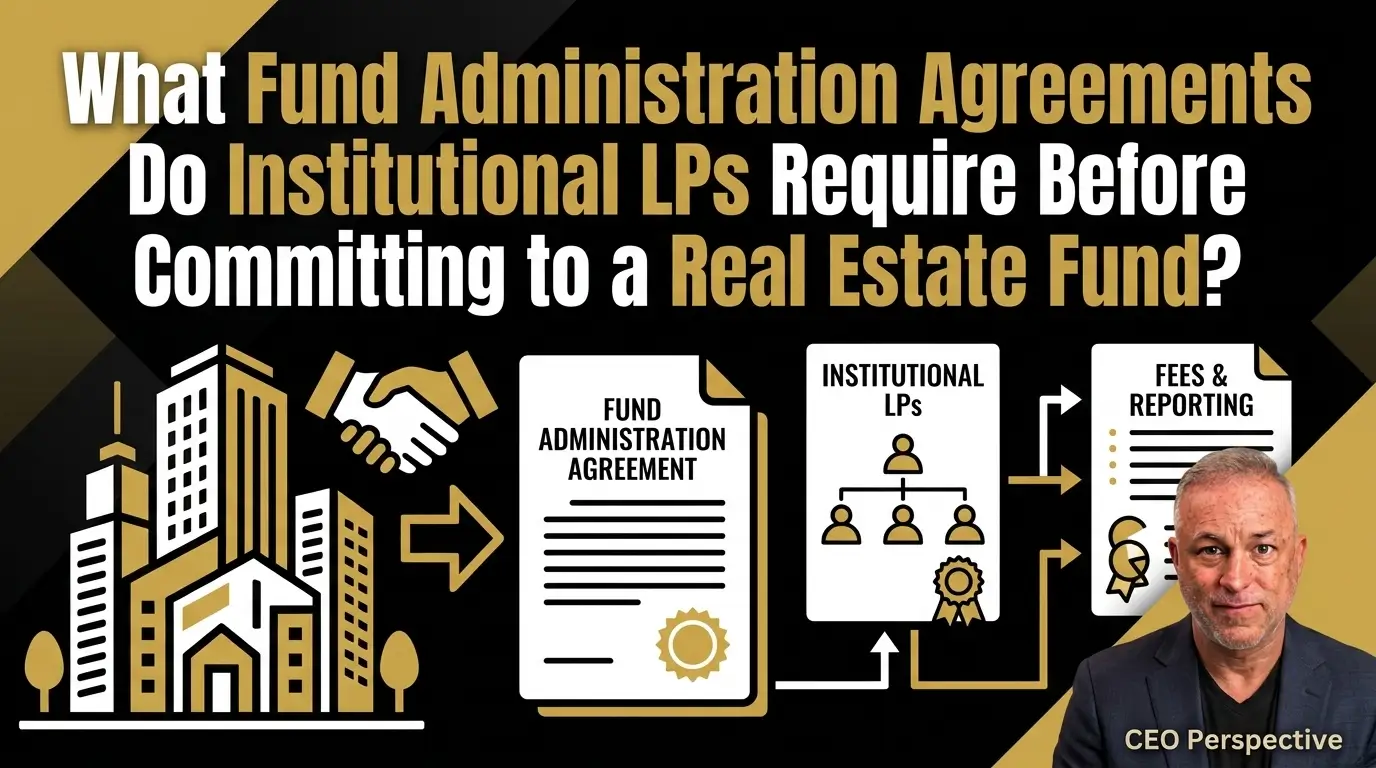
What Fund Administration Agreements Do Institutional LPs Require Before Committing to a Real Estate Fund?
Disclosure
Nothing on this site constitutes an offer to sell, or a solicitation of an offer to purchase, any security under the Securities Act of 1933, as amended, or any applicable state securities laws. Any offering of securities is made only by means of a formal private placement memorandum or other authorized offering documents delivered to qualified investors.
IRC Partners is a capital advisory firm. IRC Partners is not a registered investment adviser under the Investment Advisers Act of 1940 and does not provide investment advice as defined thereunder.
Certain statements in this article may constitute forward-looking statements, including statements regarding market conditions, capital availability, investor demand, and transaction outcomes. Such statements reflect current assumptions and expectations only. Actual results may differ materially due to market conditions, regulatory developments, company-specific factors, and other variables. IRC Partners makes no representation that any outcome, return, or result described herein will be achieved.
References to prior mandates, transaction volume, network credentials, or capital raised are provided for illustrative purposes only and do not constitute a guarantee or prediction of future results. Past performance is not indicative of future outcomes. Individual results will vary. Network credentials and transaction statistics referenced on this site reflect the aggregate experience of IRC Partners' principals and affiliated advisors and are not a representation of assets managed or transactions closed solely by IRC Partners.
Certain data, statistics, and information presented in this article have been obtained from third-party sources. IRC Partners has not independently verified such information and expressly disclaims responsibility for its accuracy, completeness, or timeliness. Readers should independently verify any third-party data before relying on it.
Readers are strongly encouraged to consult qualified legal, financial, and tax professionals before making any investment, capital raising, or business decision.
Schedule A Meeting
You get one shot to raise the right way. If this raise is worth doing, it’s worth doing with precision, leverage, and control.
This isn’t a practice run. Serious capital. Serious strategy. Let’s raise it right.
We onboard a maximum of seven
new strategic partners each quarter, by application only, to maximize your chances of securing the capital you need.
