.svg "CTA Arrow")


.png "Investor Ready Capital decorative background element")

What's the Difference Between Pitch Deck and IC Deck?

A pitch deck is designed to earn an initial meeting, while an investment committee deck must support a formal capital decision. The pitch deck emphasizes the market thesis, team, return profile, and ask; the IC deck adds a self-contained executive summary, deal terms, financial model, downside analysis, and governance.
Sponsors raising $5M to $250M from family offices, private equity funds, and institutional allocators routinely treat the two documents as versions of the same file. The confusion is understandable. Both describe the same deal. Both include financial projections. Both make the case for the sponsor's track record. The structure, depth, and purpose of each document differ in ways that matter to every reader who receives them.
Understanding what financial projections institutional LPs expect to see in a real estate fund pitch deck is the starting point. Projection format is one dimension of a much larger structural gap between these two documents.
Why the Stage Defines the Document
Institutional capital raises move through a defined sequence. The pitch deck operates at the top of that sequence. The IC deck operates near the end, when a named decision-maker must commit capital in writing. The stage of the relationship determines what the document must accomplish and how it must be structured.
The Pitch Deck Stage
At the pitch stage, the sponsor has no established relationship with the LP. The document's job is to generate enough interest to earn a first meeting or a call. Narrative leads the structure. The market thesis, the team's track record summary, and the return profile come first.
The financial section presents target IRR, equity multiple, and preferred return. Full waterfall mechanics, sensitivity tables, and stress cases belong in the IC deck. The raise amount and use of funds are stated clearly. Governance terms are reserved for the IC stage, where the relationship has advanced far enough for those terms to be relevant.
Sponsors preparing materials for pension fund allocators face a more specific version of this standard. A $100M real estate fund pitch deck for pension fund presentations follows a tighter structure than a general institutional pitch, with slide count and section order calibrated to the committee's review process.
The IC Deck Stage
By the time a deal reaches an investment committee, the relationship exists. The LP's analyst has reviewed the data room. Questions have been asked and answered. The IC deck is the document the analyst submits to their committee to support a formal allocation decision.
At this stage, the reader changes. The IC may include members who have never spoken to the sponsor. The document must stand on its own, without a live explanation from the sponsor.
Every conclusion must be supported by the document itself. A gap in the written argument cannot be filled by a verbal explanation from a prior meeting. Committee members who were absent from those conversations have no context, and the document carries the full burden of proof.
How the Two Documents Compare Across Seven Dimensions
The table below maps the structural differences between a pitch deck and an IC deck across the seven dimensions that matter most to institutional reviewers.
Section Order Signals Preparation
The order in which sections appear tells a committee how well the sponsor understands their audience. A pitch deck opens with the market opportunity because the reader needs to be convinced the deal is worth examining. An IC deck opens with an executive summary because the reader already knows the deal and needs a fast path to key terms and decision criteria.
An IC deck that opens with a market narrative is structured for a pitch audience. The IC standard requires the executive summary to deliver the deal thesis, capital structure, return profile, and key risks in a single self-contained section.
Financial Detail Is the Largest Gap
The financial section expands significantly between a pitch deck and an IC deck. A pitch deck presents projected returns. An IC deck must show:
- The full waterfall, step by step, with promote thresholds and catch-up provisions
- A base case, a downside case, and the assumptions that separate them
- Sensitivity tables showing how returns move when rent growth, exit cap rate, or construction cost assumptions change
- Sources and uses tied to the capital stack, matching the financial model in the data room exactly
Risk Treatment Changes Completely
A pitch deck risk section covers macro and market risk at a high level. An IC deck risk section is a structured register. Each risk category gets a named entry, a probability assessment, a severity rating, and a stated mitigant. Categories include:
- Construction and cost risk
- Lease-up and absorption risk
- Interest rate and financing risk
- Key person and sponsor execution risk
- Regulatory and entitlement risk
- Exit and liquidity risk
A risk register that lists categories without mitigants signals that the sponsor identified problems without a resolution plan. Committees use the register to assess sponsor judgment and deal exposure.
What the IC Deck Must Include That the Pitch Deck Does Not
Beyond the structural differences, several sections appear in IC decks that have no equivalent in a pitch deck.
Governance and LP Protections
Institutional LPs commit capital under a legal framework. The IC deck must summarize the governance terms the LP will be agreeing to, including:
- Distribution waterfall mechanics, with the promote structure and hurdle rate stated explicitly
- Key person provisions and what triggers them
- LP consent rights and what decisions require LP approval
- Reporting cadence: quarterly financials, annual audits, capital account statements
- Removal and replacement provisions for the GP
Governance terms belong in the IC deck because the committee must approve them as part of the allocation decision. Sponsors preparing both a PPM and an IC deck for the same raise should confirm that how a PPM and data room work together in a capital raise is clearly understood before either document goes to an LP. Disclosure language across both documents must be consistent. Sponsors raising capital under Regulation D private placement exemptions are required to disclose material terms to investors, and the IC deck is where those terms first appear in structured form.
Cross-Document Consistency
Every number in the IC deck must match every other document in the data room. The sources and uses in the IC deck must match the financial model. The capital stack must match the term sheet. The projected returns must match the model output exactly.
Discrepancies between the IC deck and the data room extend the diligence timeline and raise concerns about controls. A variance between the deck and the model reads as a controls problem, and committees treat it accordingly.
{{main-cta}}
The Executive Summary as a Standalone Document
The IC deck's executive summary must function as a complete, self-contained brief. A committee member who reads only the executive summary should be able to understand the deal, the return profile, the capital structure, the key risks, and the ask.
An executive summary that requires the rest of the deck to make sense was written for a pitch audience. The IC standard requires the summary to stand alone, with the sections that follow providing supporting detail for each element already stated up front.
What to Prepare Before Sending Either Document
The raise timeline for institutional capital typically runs 4 to 9 months. Sponsors who send materials before those materials are ready compress the timeline in the wrong direction. A pitch deck sent before the sponsor's financial model is IC-ready creates a gap that surfaces later, during diligence, when it is harder to address.
The Capital Raise Pre-Flight is IRC Partners' fixed-fee diagnostic that scores a raise against the same twelve institutional gates a deal must clear before IRC Partners takes it into a strategic partnership.
The diagnostic produces a 20 to 30 page report with an Institutional Readiness Score on a 0 to 100 scale. Deals that score 85 or above are considered committee-ready. The turnaround is 10 business days from submission.
Sponsors who complete the diagnostic before LP outreach begins enter conversations with a clear picture of where their materials stand against institutional standards. Gaps identified before outreach are addressable. Gaps discovered during diligence create timeline extensions and raise credibility questions that are harder to resolve.
Before sending either document, confirm: the financial model in the data room matches every number in the deck, the risk section includes mitigants for each named risk, and the governance terms are fully drafted and consistent with the PPM.
Frequently Asked Questions
Who actually reads an IC deck at a family office or private equity fund?
At a family office, the IC deck goes to the investment committee, which typically includes the principal, a senior analyst, and in some cases an outside advisor. At a private equity fund, the analyst who ran preliminary diligence submits the deck to a formal committee that may include partners who have had no prior contact with the sponsor. The IC deck carries the full argument because the committee may include members who joined after preliminary diligence closed.
What causes an investment committee to table a decision after receiving an IC deck?
Committees table decisions when the written argument has gaps that require a follow-up call to resolve. The most common triggers are a risk section with no stated mitigants, financial assumptions with no sourcing, and governance terms that differ from the term sheet already in the data room. Each gap adds a diligence cycle and extends the raise timeline.
How does section order in an IC deck signal sponsor preparation?
A committee reads section order as a signal of how well the sponsor understands the audience. An IC deck that opens with a market narrative is structured for a pitch audience. An IC deck that opens with a self-contained executive summary covering deal thesis, capital structure, return profile, and key risks signals that the sponsor understands committee process. Section order is the first structural element a committee evaluates before reading a single line of financial detail.
What governance terms belong in an IC deck?
An IC deck must summarize the full governance framework the LP is agreeing to, including the distribution waterfall with promote thresholds and hurdle rates, key person provisions and their triggers, LP consent rights, reporting cadence, and GP removal provisions. These terms appear in the LPA and PPM. The IC deck presents them in structured form so the committee can evaluate the full commitment in a single document.
How does risk treatment change between a pitch deck and an IC deck?
A pitch deck covers macro and market risk at a summary level. An IC deck requires a structured risk register with a named entry for each risk category, a probability and severity assessment, and a stated mitigant for each item. Categories include construction and cost risk, lease-up and absorption risk, interest rate and financing risk, key person risk, regulatory and entitlement risk, and exit and liquidity risk. A register without mitigants signals identified problems without a resolution plan.
What makes an executive summary in an IC deck self-contained?
A self-contained executive summary delivers the deal thesis, capital structure, return profile, and key risks in a single section that stands alone. A committee member who reads only the executive summary should be able to understand the full structure of the commitment without reading the sections that follow. An executive summary that requires the rest of the deck to make sense was written for a pitch audience.
Can a sponsor send the same IC deck to a family office and a private equity fund?
The core financial model, governance terms, and risk register remain consistent across LP types. The framing of the executive summary and the emphasis within the deal thesis may shift depending on the LP's mandate. A family office focused on deal-by-deal structures evaluates the same IC deck through a different lens than a PE fund running a blind pool. Sponsors raising from both LP types in the same round should confirm that the IC deck addresses the mandate alignment criteria each LP applies.
Continue reading this series:
- What Institutional LPs Look for in Risk-Adjusted Returns
- Real Estate Asset Management Fees: How to Present Fee Structure to Institutional LPs
- Family Offices vs. Private Equity Funds: Which Institutional LP Is Right for Your Development?
The Capital Raise Pre-Flight is IRC Partners’ fixed-fee diagnostic that scores a raise against the same twelve institutional gates a deal must clear before IRC Partners takes it into a strategic partnership. It is where every engagement begins, whether you are pre-revenue building toward a first institutional round or scaling a company that has raised before. For deals that clear, the full strategic partnership follows. IRC Partners advises operators raising $5M to $250M of institutional capital. If you are taking a raise to market, start here.
Need guidance on your capital raise?


How to Negotiate an Escalating Price Floor in a Drag-Along Clause: 1x in Years 1-2, 2x in Years 3-4, 3x in Year 5 and Beyond
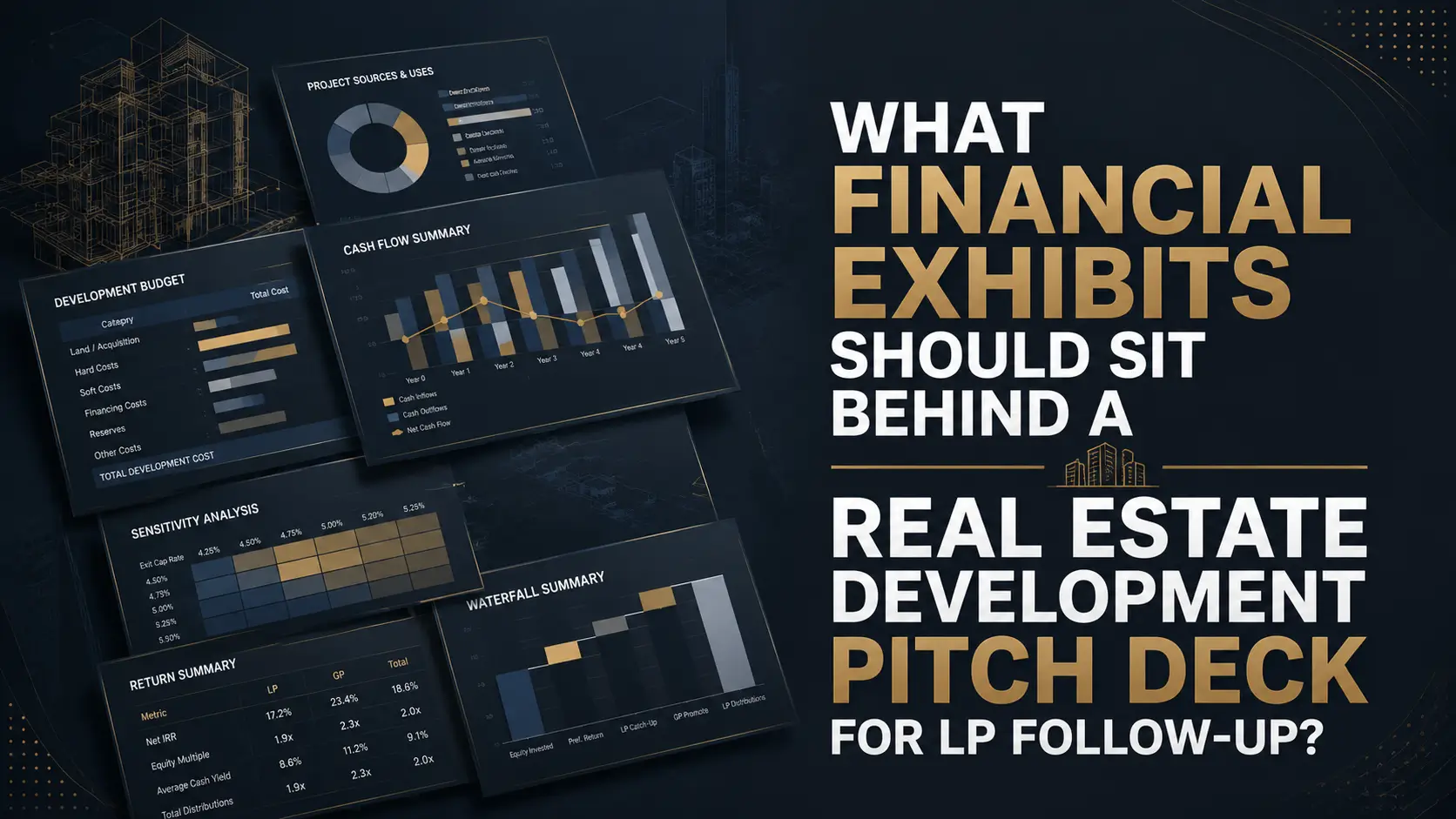
What Financial Exhibits Should Sit Behind a Real Estate Development Pitch Deck for LP Follow-Up?

The Real Reason You're Not Raising Capital (And It's Not Your Deck)
Disclosure
Nothing on this site constitutes an offer to sell, or a solicitation of an offer to purchase, any security under the Securities Act of 1933, as amended, or any applicable state securities laws. Any offering of securities is made only by means of a formal private placement memorandum or other authorized offering documents delivered to qualified investors.
IRC Partners is a capital advisory firm. IRC Partners is not a registered investment adviser under the Investment Advisers Act of 1940 and does not provide investment advice as defined thereunder.
Certain statements in this article may constitute forward-looking statements, including statements regarding market conditions, capital availability, investor demand, and transaction outcomes. Such statements reflect current assumptions and expectations only. Actual results may differ materially due to market conditions, regulatory developments, company-specific factors, and other variables. IRC Partners makes no representation that any outcome, return, or result described herein will be achieved.
References to prior mandates, transaction volume, network credentials, or capital raised are provided for illustrative purposes only and do not constitute a guarantee or prediction of future results. Past performance is not indicative of future outcomes. Individual results will vary. Network credentials and transaction statistics referenced on this site reflect the aggregate experience of IRC Partners' principals and affiliated advisors and are not a representation of assets managed or transactions closed solely by IRC Partners.
Certain data, statistics, and information presented in this article have been obtained from third-party sources. IRC Partners has not independently verified such information and expressly disclaims responsibility for its accuracy, completeness, or timeliness. Readers should independently verify any third-party data before relying on it.
Readers are strongly encouraged to consult qualified legal, financial, and tax professionals before making any investment, capital raising, or business decision.
Schedule A Meeting
You get one shot to raise the right way. If this raise is worth doing, it’s worth doing with precision, leverage, and control.
This isn’t a practice run. Serious capital. Serious strategy. Let’s raise it right.
We onboard a maximum of seven
new strategic partners each quarter, by application only, to maximize your chances of securing the capital you need.
