.svg "CTA Arrow")


.png "Investor Ready Capital decorative background element")

How Do Real Estate Developers Hire Help to Launch Their First Institutional Fund?
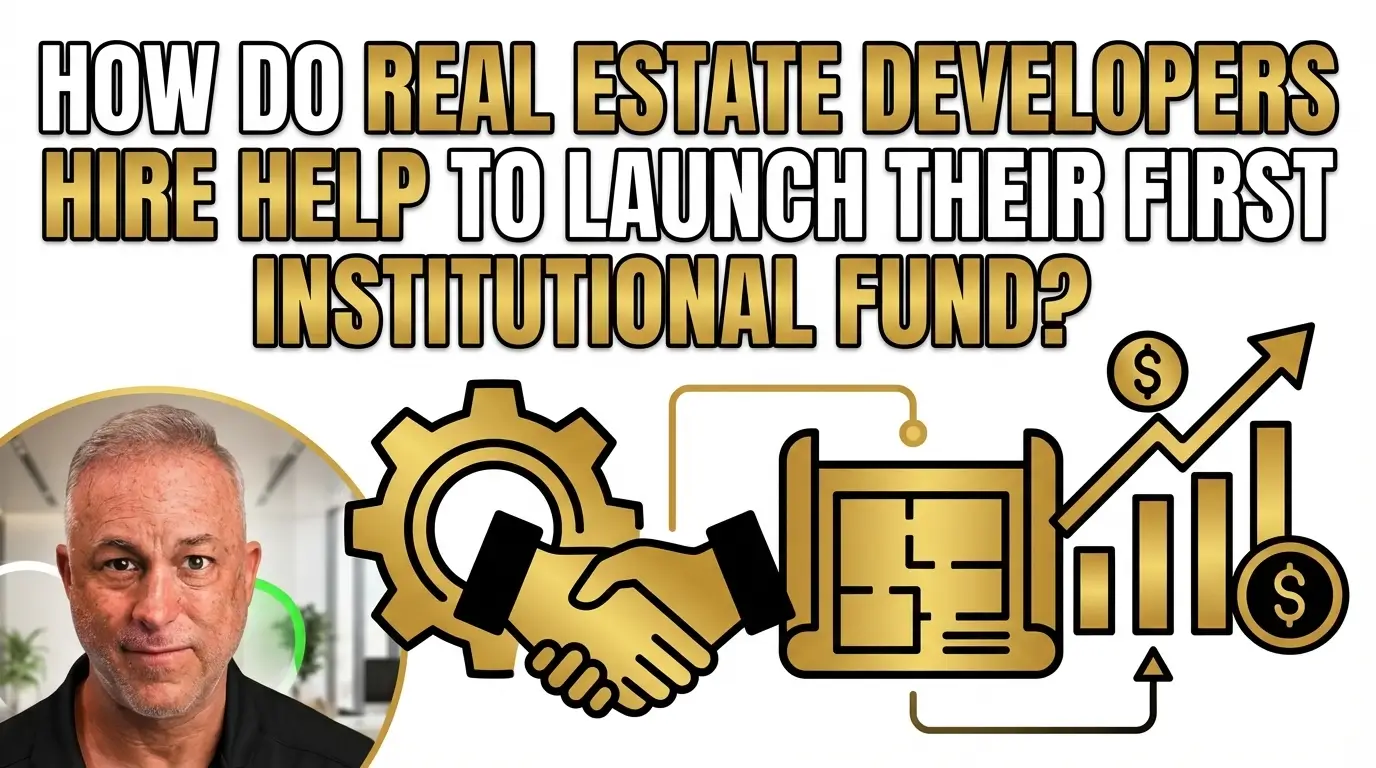
Real estate developers launching their first institutional fund should hire outside advisors in this sequence: fund counsel first, then tax and GP entity counsel, then fund administration and compliance support, and finally capital advisory help once the platform is diligence-ready. Hiring in the wrong order wastes budget and leaves critical gaps that institutional LPs will find.
The four advisor categories every first-time fund sponsor needs before first close are:
- Fund counsel - to structure the vehicle, draft the LPA and PPM, and set the securities exemption strategy
- Tax and GP entity counsel - to lock carried interest mechanics, management company structure, and principal economics
- Fund administrator and compliance support - to handle capital calls, investor reporting, AML and KYC workflows, and operational diligence readiness
- Capital advisory support - to accelerate LP introductions once the fund structure and diligence stack can survive scrutiny
According to NAIOP, the average time from first to final close on a closed-end real estate fund now exceeds 24 months, and North American closed-end fundraising volumes remain roughly 45% below their 2021 peak. Institutional LPs are adding fewer new manager relationships, not more. In that environment, a first-time fund that looks structurally weak or operationally thin gets passed over fast.
The real issue is not documentation. It is diligence readiness.
Institutional LPs review far more than your PPM. They look at your governance structure, your reporting infrastructure, your compliance posture, your AML and KYC workflows, and your data room. If any of those are missing or sloppy when a serious LP starts asking questions, the conversation ends. Most first-time sponsors lose not because their deals were bad, but because their platform did not look ready.
This guide covers which outside advisors to hire, in what order, and why each hire either helps or hurts your first-close timeline.
Why First-Time Fund Launches Fail Before the First LP Meeting
The three most common mistakes developers make when launching a first fund have nothing to do with their deals.
- They assume the launch is mostly a legal exercise. Draft the documents, form the entities, start talking to LPs. But institutional investors review far more than your PPM. They look at your governance structure, your reporting setup, your compliance posture, and your AML and KYC workflows. Missing any of those is enough to end the conversation.
- They hire too broadly, too early. Before the fund thesis, vehicle structure, and LP target profile are locked, adding advisors creates noise and cost without direction. Every hire should solve a defined problem in a defined sequence.
- They try to replicate a mega-fund platform on a first-fund budget. For a $10M-$50M first fund, the goal is not to look like Blackstone. It is to look credible, organized, and investable to the specific LP base you are targeting.
According to NAIOP, the average time from first to final close on a closed-end real estate fund now exceeds 24 months, and North American closed-end fundraising volumes remain roughly 45% below the 2021 peak. Institutional LPs are adding fewer new manager relationships, not more. In that environment, a first-time fund that looks structurally thin or operationally unprepared gets passed over fast.
The real issue is not documentation. It is diligence readiness.
Who You Should Hire First: Fund Counsel
Fund counsel is not a commodity hire. It is the most important decision you make before anything else is built.
The right firm does far more than draft a private placement memorandum. It shapes your fund vehicle, your LP agreement, your subscription documents, your securities exemption strategy, your side-letter framework, and the governance terms that institutional LPs will scrutinize in diligence. Every downstream document and entity flows from the structural decisions your fund counsel makes in the first few weeks.
According to Lathrop GPM, the initial structural decisions in a fund formation affect every stage of the investment lifecycle. Choosing the wrong vehicle, the wrong exemption, or the wrong governance framework creates problems that are expensive to fix once LPs are in the room.
What to ask before you engage fund counsel
Before signing an engagement letter, confirm your prospective firm can handle all of the following for a real estate private fund:
- Fund vehicle formation (Delaware LP or LLC) and management company setup
- PPM drafting, including risk factors, fund strategy narrative, and disclosure obligations
- LPA drafting, including waterfall mechanics, key person provisions, and removal rights
- Subscription documents and investor eligibility verification
- Securities law compliance, including Regulation D exemption filings and blue sky requirements
- Side-letter templates and most-favored-nation (MFN) tracking
- ERISA analysis, including whether your fund needs to limit benefit plan investor participation
- Ongoing fund operations support, including capital call notices and amendment procedures
Foster Garvey's real estate funds practice covers all of these areas as a baseline for institutional-grade fund formation. If a firm cannot clearly address each one, it is likely a transactional real estate practice, not a private funds practice. Those are different disciplines.
Cost benchmarks for fund counsel vary widely based on fund complexity. Straightforward formations at smaller fund sizes can run in a broad range from roughly $35,000 to $75,000 for core legal work, with more complex structures or multi-entity setups running higher. Treat any number you hear as directional until you receive an engagement letter with a defined scope.
Who Comes Next: Tax, GP Entity, and Economics Counsel
Once your fund counsel has confirmed the vehicle structure and offering approach, the second layer of advisors fills in the architecture underneath it.
These hires are often underestimated. Sponsors focus on the fund documents and skip the internal economics layer, then discover later that their carried interest structure, fee arrangements, or GP operating agreement create problems during LP diligence or between co-founders.
Lathrop GPM notes that carried-interest planning and GP commitment mechanics should be addressed from the outset, not retrofitted after the fund is live. This is especially true if your GP has multiple principals. The GP operating agreement governs the economics between fund managers and is a frequent source of co-founder disputes if left vague.
Setting up the GP entity correctly before your first LP meeting is not a formality. It is the governance layer that institutional LPs will ask about directly. If the answer is "we haven't formalized that yet," the conversation often stops there.
{{main-cta}}
What to Hire Before Outreach Starts: Fund Admin, Compliance, and Diligence Support
This is the layer most first-time sponsors skip, and it is the layer that kills the most LP conversations.
Institutional LPs are not only diligencing your deal thesis. They are diligencing your operations. The ILPA Due Diligence Questionnaire (DDQ 2.0) covers 20 sections including governance, compliance, cybersecurity, ESG policies, data security, and operational infrastructure. A developer with strong deals but no fund administration, no compliance documentation, and no AML program will fail that review regardless of track record.
Operational readiness checklist before broad LP outreach
Before you start sending pitch materials to institutional LPs, confirm you have each of the following in place:
- Fund administrator engaged - handles capital calls, NAV calculations, investor reporting, and K-1 preparation
- Compliance documentation in place - written policies covering securities marketing, conflicts of interest, and information barriers
- AML and KYC program documented - investor identification procedures and recordkeeping policies ready before subscriptions open
- Fractional or outsourced CCO support - a named compliance officer or outsourced compliance firm on record
- Audit firm selected - institutional LPs expect audited financials; select your auditor before first close, not after
- Data room organized and accessible - materials available within 24 hours of an LP request
According to IRC Partners, institutional investors expect organized materials and a data room that can respond within 24 hours of request. Sloppy documentation stops deals before they start.
For context on how broadly this operational infrastructure is now standard: ACA Group reports that 72% of the Top 50 private real estate funds in the 2024 PERE 100 use an outsourced compliance partner. First-time funds will not have the same resources, but the expectation that a compliance framework exists applies to them too.
A fund administration agreement is often one of the first things an institutional LP asks to review. Have it in place before your first serious LP meeting, not after.
When Capital Advisors or Placement Help Make Sense, and When They Do Not
Outside fundraising help is not a shortcut. It is a multiplier. And multipliers only work if there is something solid to multiply.
As NAIOP's research shows, institutional LPs are limiting new manager relationships and favoring proven incumbents. Access to LP introductions is valuable only if your fund can survive the diligence that follows.
When outside capital-raising support makes sense
- Your fund structure, PPM, LPA, and data room are complete and diligence-ready
- You need warm introductions to family offices or institutional allocators outside your existing network
- You want a second set of eyes on your fundraising materials and LP positioning before outreach
- You are targeting a first close with a defined timeline and need to accelerate LP conversations in parallel
When it is premature
- Your offering documents are still in draft and you have not confirmed the final vehicle structure
- Your data room is incomplete or your compliance infrastructure is not yet in place
- You are hoping outside help will compensate for gaps in your fund's diligence readiness
- Your LP target list is undefined and you have not yet identified which type of investor fits your fund size and strategy
The trend in 2026 is worth noting. Family offices, which represent a significant slice of the realistic LP base for a $10M-$50M first fund, are increasingly favoring deal-by-deal structures over blind-pool commitments. A fund must earn its fee load and governance case with credible structure and operations, not just a warm introduction.
Capital advisory support is most valuable as the last hire, not the first.
A Practical Hiring Sequence for a $10M-$50M First Fund
Here is the sequence that gives a first-time real estate fund sponsor the best chance of reaching first close without wasting budget or failing LP diligence.
- Engage fund counsel. Lock the vehicle structure, securities exemption, offering documents, and LP agreement framework before spending on anything else. Everything downstream depends on these decisions.
- Add tax, GP entity, and economics counsel. Finalize the GP operating agreement, management company structure, carried interest mechanics, and any blocker or ERISA considerations. Do this before any LP conversations, not after.
- Stand up operational infrastructure. Engage a fund administrator, select an auditor, document your AML and KYC program, and put a compliance framework in place. Organize your data room so it is ready to respond within 24 hours of an LP request. Prepare your fund fact sheet and KYC and AML documentation for LP onboarding.
- Add capital advisory support. Once your fund documents, data room, and operational stack can survive first-pass institutional diligence, outside capital-raising support converts. Before that point, it mostly does not.
Key takeaway: The advisor stack for a first fund is not about looking big. It is about being diligence-ready. Sequence the hires, control the cost, and do not move to the next stage until the previous one is solid.
Frequently Asked Questions
What is the first outside advisor a developer should hire?
Fund counsel is the foundational hire. Unlike a general real estate attorney, fund counsel specializes in securities law, entity formation, and the drafting of the core legal documents. Every structural choice flows from the decisions made with counsel at this initial stage. This includes critical tax efficiency planning and the definition of investor rights.
Do you need a placement agent to raise a first institutional fund?
No. Hiring a placement agent too early can be counterproductive. Outside fundraising support is most effective after the fund structure and compliance infrastructure are fully established. If your platform is not institutional ready, you will likely fail to convert the introductions an agent provides. You should focus on readiness before paying for distribution.
What does a fund administrator do and when should you hire one?
A fund administrator manages the plumbing of the vehicle. This includes capital calls, NAV calculations, and investor reporting. You should engage one before starting outreach. Institutional partners view a third party administrator as a key safeguard for reporting accuracy and financial transparency.
Can a first time sponsor use outsourced compliance support?
Yes. For funds in the initial institutional range, a fractional Chief Compliance Officer is often the most efficient route. Institutional investors care that a documented framework for Anti-Money Laundering and Know Your Customer exists. They do not necessarily require a full time internal hire during the early stages of a platform.
How long does it typically take to get to a first close?
The average timeline from first to final close now exceeds 24 months. For a first institutional fund, sponsors should prepare for a 12 to 18 month active fundraising window. Delays in hiring advisors or preparing documents are the most common causes for these timelines to stretch even further.
What is the difference between fund counsel and a deal attorney?
They are different disciplines. Transactions attorneys handle property acquisitions and loans. Fund counsel manages the collective investment vehicle and governance. Using a deal attorney for fund formation often results in documents that fail the specific rigors of institutional due diligence because they lack the necessary securities law nuances.
When should you build your data room relative to hiring advisors?
The data room should be fully populated after legal structures are finalized but before any serious meetings occur. It must contain your track record attribution and compliance policies. A professional and organized data room is an immediate green flag for operational readiness. It shows that you are prepared for the deep dive required by sophisticated capital.
Continue reading this series:
- What Fund Documents Do You Need to Raise $100M From Institutional Investors in Real Estate?
- How Do You Set Up a Real Estate Fund GP Entity Before Launching a $100M Raise?
- What Goes Into a Private Placement Memorandum for a Real Estate Closed-End Fund?
IRC Partners advises founders raising $5M to $250M of institutional capital on structure, positioning, and round architecture. 7 strategic partners per quarter. No placement agent model. No success-only theater. If you want a structural review of your current raise, apply at HERE
Sponsors weighing this decision should first complete a capital raise readiness assessment for sponsors to confirm the raise is investor-ready.
Need guidance on your capital raise?


How Does Debt Advisory and Venture Debt Placement Work

Quarterly vs Annual Reporting: Negotiate for $10M+ Growth Rounds
How Long Does Institutional LP Due Diligence Take for a First-Time Real Estate Fund?
Disclosure
Nothing on this site constitutes an offer to sell, or a solicitation of an offer to purchase, any security under the Securities Act of 1933, as amended, or any applicable state securities laws. Any offering of securities is made only by means of a formal private placement memorandum or other authorized offering documents delivered to qualified investors.
IRC Partners is a capital advisory firm. IRC Partners is not a registered investment adviser under the Investment Advisers Act of 1940 and does not provide investment advice as defined thereunder.
Certain statements in this article may constitute forward-looking statements, including statements regarding market conditions, capital availability, investor demand, and transaction outcomes. Such statements reflect current assumptions and expectations only. Actual results may differ materially due to market conditions, regulatory developments, company-specific factors, and other variables. IRC Partners makes no representation that any outcome, return, or result described herein will be achieved.
References to prior mandates, transaction volume, network credentials, or capital raised are provided for illustrative purposes only and do not constitute a guarantee or prediction of future results. Past performance is not indicative of future outcomes. Individual results will vary. Network credentials and transaction statistics referenced on this site reflect the aggregate experience of IRC Partners' principals and affiliated advisors and are not a representation of assets managed or transactions closed solely by IRC Partners.
Certain data, statistics, and information presented in this article have been obtained from third-party sources. IRC Partners has not independently verified such information and expressly disclaims responsibility for its accuracy, completeness, or timeliness. Readers should independently verify any third-party data before relying on it.
Readers are strongly encouraged to consult qualified legal, financial, and tax professionals before making any investment, capital raising, or business decision.
Schedule A Meeting
You get one shot to raise the right way. If this raise is worth doing, it’s worth doing with precision, leverage, and control.
This isn’t a practice run. Serious capital. Serious strategy. Let’s raise it right.
We onboard a maximum of seven
new strategic partners each quarter, by application only, to maximize your chances of securing the capital you need.
