.svg "CTA Arrow")


.png "Investor Ready Capital decorative background element")

What Evidence Should a Company Assemble Before Claiming It Is Ready for an Institutional Capital Raise?

What Evidence Should a Company Assemble Before Claiming It Is Ready for an Institutional Capital Raise?
A company is ready for an institutional capital raise when it can produce verified, organized evidence across track record, financial model integrity, capital stack structure, and governance and legal standing. Allocators review these categories before committing capital, and a gap in any one can stop a raise regardless of the underlying deal.
Institutional allocators screen for proof. Allocators run structured diligence across defined categories, and a gap in any one of them can stop a raise regardless of how strong the underlying deal is. Understanding what the 0 to 100 Institutional Readiness Score measures and why 85 is the threshold helps frame why the evidence categories below are sequenced the way they are. A pitch deck satisfies the introduction. The evidence file satisfies the diligence screen.
The 60 to 90 days before market entry is the period to close every gap. This article covers what to build, category by category, so the evidence is ready when the first allocator asks for it.
The Capital Raise Pre-Flight is IRC Partners' fixed-fee diagnostic that scores a raise against the same twelve institutional gates a deal must clear before IRC Partners takes it into a strategic partnership.
Category 1: Track Record Documentation
Track record is the first filter institutional allocators apply. Allocators require documentation that can be independently verified. A verbal summary of past projects leaves that requirement unmet.
What to prepare
- Project-level financials: Cost basis, total capitalization, exit price or current appraised value, and return metrics (IRR, equity multiple, or cash-on-cash) for each completed project. Each figure must trace to a source document.
- Timeline records: Groundbreaking dates, certificate of occupancy dates, and disposition or stabilization dates. These establish execution speed and schedule discipline.
- LP distribution history: Actual distribution records for any prior outside capital, including amounts, dates, and the waterfall tier each distribution satisfied.
- Entity documentation: Operating agreements, partnership agreements, or LLC certificates showing the legal structure of each prior venture. Allocators verify that the GP entity presenting the deal is the same entity that completed the prior work.
What allocators do with it
Allocators cross-reference the documentation against public records, title history, and in some cases third-party appraisals. Inconsistencies between the narrative and the documents are noted and escalate diligence scrutiny across every other category. A clean, consistent track record file reduces friction throughout the raise.
The standard for institutional-grade track record presentation requires every project to stand on its own documentation. Aggregated or blended figures without project-level support do not satisfy institutional diligence.
Category 2: Financial Model Integrity
The financial model is the second major evidence category and the one most likely to surface problems early. Allocators open the model before the second meeting. What they find in the first 15 minutes shapes every conversation that follows.
The financial model red flags institutional diligence catches in 15 minutes include reconciliation gaps between the sources and uses table and the project budget, assumption inputs that are hardcoded without sourcing, and return projections that collapse under a stress case.
What the model must contain
- Sources and uses table that reconciles to the penny against the project budget and the capital stack
- Period-by-period construction draw schedule tied to milestone events, with each draw source labeled
- Three return scenarios: base case, downside, and stress case. Each scenario must use documented assumptions, including rent growth rates, exit cap rates, and cost escalation factors tied to a verifiable market source
- Waterfall model showing LP preferred return, GP promote, and distribution sequence at each tier
- Sensitivity table showing IRR and equity multiple outcomes across key variables including exit cap rate and stabilized NOI
The assumption sourcing requirement
Every assumption that drives a return projection must have a documented source. Market rent growth assumptions sourced from a broker opinion letter, appraisal, or published market report carry weight. Assumptions lacking a documented source are flagged and trigger follow-up requests that slow the raise.
A model that passes institutional review is auditable from the output back to the input. Build it that way before outreach begins.
Category 3: Capital Stack Structure
The capital stack is the third evidence category, and it is where structural problems most often surface during diligence. Allocators evaluate whether the layers of capital in a deal are properly sequenced, whether the economics at each layer are defensible, and whether the GP's position survives a downside scenario.
Key checkpoint: Before outreach, the capital stack must show a clearly defined senior debt position, an equity cushion that meets lender minimums for the asset class, a GP co-investment amount consistent with institutional norms, and a waterfall that distributes proceeds in a sequence allocators recognize.
Structural elements allocators verify
- Senior debt terms: Loan-to-cost ratio, interest rate basis, recourse provisions, and draw conditions. Allocators confirm that the debt terms are consistent with what lenders actually provide for the asset class and market.
- Preferred equity or mezzanine layer: If a preferred equity or mezzanine tranche is in the stack, the intercreditor agreement between that lender and the senior lender must exist and be producible on request.
- GP co-investment: The GP's capital contribution relative to total LP equity. Allocators use this figure to assess alignment. A GP co-investment that is too thin relative to the raise size signals misaligned incentives.
- Waterfall mechanics: The sequence of distributions, the preferred return rate, and the promote percentage at each tier. These must be documented in the operating agreement or term sheet.
Reviewing the five capital stack risk reduction strategies that allocators look for before a $10M raise clarifies which structural adjustments carry the most weight in diligence.
A capital stack that passes institutional review has every layer defined, every obligation disclosed, and every intercreditor agreement producible before the data room opens.
Category 4: Governance and Legal Standing
Governance and legal standing is the fourth evidence category. Allocators confirm that the GP entity is properly formed, that the offering documents are legally sound, and that all material legal and regulatory matters are resolved and disclosed before close.
Documents that must be in order
Proactive disclosure
Allocators expect sponsors to disclose material legal or regulatory history without being asked. The SEC's guidance on private placement disclosure obligations outlines the disclosure standard that institutional allocators use as a baseline when evaluating a sponsor's legal standing. Litigation history, SEC or state regulatory inquiries, prior fund losses, and any material change in key personnel since the last raise all fall into this category. Allocators who discover undisclosed history during background checks treat the omission as a credibility failure that triggers deeper scrutiny. Proactive written disclosure resolves the issue before it becomes one.
The governance file should be complete and organized before the first outreach call. Producing documents piecemeal over 10 business days or more signals that the organization is managing diligence reactively, which raises questions about operational discipline.
How to Use This Evidence Framework Before Outreach
The four categories above map directly to the twelve institutional gates that allocators use to evaluate a raise. The sequence below shows how to work through them before the first outreach call.
A practical pre-market sequence
- Audit track record documentation against the project-level standard above. Identify any project where return figures cannot be traced to a source document and resolve those gaps first.
- Stress-test the financial model against the red flags allocators check in the first 15 minutes. Confirm every assumption has a documented source and the waterfall reconciles to the sources and uses table.
- Review the capital stack for undefined layers, missing intercreditor agreements, or GP co-investment levels below institutional norms for the raise size and asset class.
- Compile the governance file and verify that entity formation documents are current, offering documents are legally reviewed, and any material history is disclosed in writing.
- Build and organize the data room before the first outreach call. Version-control every document and confirm the folder structure matches what allocators expect.
The threshold that matters
A score of 85 or above on the 0 to 100 scale across all twelve gates is the threshold at which institutional allocators treat a raise as ready for serious review. Scores below 85 in any gate category signal gaps that allocators will surface during diligence. Closing those gaps before outreach protects the raise timeline and the allocator relationship.
IRC Partners works with sponsors in the 60 to 90 days before market entry to identify and close evidence gaps across all four categories.
Frequently Asked Questions
What is the difference between a project-level track record and a portfolio-level summary for institutional diligence?
A project-level track record presents each completed deal individually with its own cost basis, capitalization, return metrics, and timeline. A portfolio-level summary aggregates those figures into blended averages. Institutional allocators require project-level documentation because blended figures can obscure underperforming assets. Aggregated summaries are acceptable as a companion to project-level detail. Project-level documentation is the required foundation.
How far back does institutional diligence typically look when reviewing a sponsor's track record?
Allocators generally review the full operating history of the GP entity, with particular focus on the most recent completed projects. Older projects may be included to show consistency over time, but allocators weight recent performance more heavily because it reflects current market conditions, team composition, and operational systems.
Can a sponsor go to market while the financial model is still being refined?
Going to market with an unfinished model creates a specific risk: allocators who receive an incomplete or inconsistent model early in the process form a negative impression that is difficult to reverse. The model should be complete, stress-tested, and assumption-sourced before the first outreach call. Refinements after that point should address specific allocator questions only.
What happens if an allocator discovers undisclosed litigation during background checks?
Undisclosed litigation found during background screening is treated as a credibility issue separate from the legal matter itself. Allocators evaluate whether the omission was intentional or an oversight, but either way it triggers deeper scrutiny across every other category. Proactive written disclosure of any material legal history, provided before the first meeting, is the standard institutional practice.
How does GP co-investment percentage affect institutional LP appetite?
GP co-investment signals alignment. Allocators compare the GP's capital contribution to the total LP equity being raised. A GP co-investment that represents a meaningful percentage of the GP's own net worth carries more weight than a fixed dollar amount that is small relative to the raise. Allocators also look at whether the GP contribution is funded at close or staged over the investment period, with funded-at-close contributions receiving more credit.
What is the standard for version control in an institutional data room?
Institutional data rooms use sequential version numbering for every document that may be updated during the raise. Each version includes a date stamp and a brief change log. Allocators who receive multiple versions of the same document without clear versioning lose confidence in which figures are current. A document management system with access logs and version history satisfies the institutional standard. A shared drive folder without access controls falls below it.
How does an institutional allocator use the data room to verify a sponsor's evidence categories during active diligence?
Allocators treat the data room as the physical proof layer behind every claim made in the pitch. Each folder maps to a specific diligence category: track record, financial model, capital stack, and governance. Allocators move through the folders in sequence, cross-referencing documents against the figures presented in the offering materials. A data room that is complete, version-controlled, and organized before the first outreach call signals that the sponsor manages capital with the same discipline they are asking allocators to trust.
Continue reading this series:
- How Should a Company Sequence Readiness Work, Materials Preparation, Deal Structuring, and Diligence Before Launching an Institutional Raise?
- What Should Be Included in an Investor-Ready Materials Package for a Real Estate Sponsor
- The Critical-Gate Override: Why One Failed Category Zeroes Out a Strong Deal
The Capital Raise Pre-Flight is IRC Partners’ fixed-fee diagnostic that scores a raise against the same twelve institutional gates a deal must clear before IRC Partners takes it into a strategic partnership. It is where every engagement begins, whether you are pre-revenue building toward a first institutional round or scaling a company that has raised before. For deals that clear, the full strategic partnership follows. IRC Partners advises operators raising $5M to $250M of institutional capital. If you are taking a raise to market, start here.
Need guidance on your capital raise?


Reduce VC Reporting Burdens Before Signing a $10M+ Growth Round
.jpg "The capital stack explained - equity, debt, SAFEs, and what investors actually want")
The Capital Stack Explained: Equity, Debt, SAFEs & What Investors Actually Want
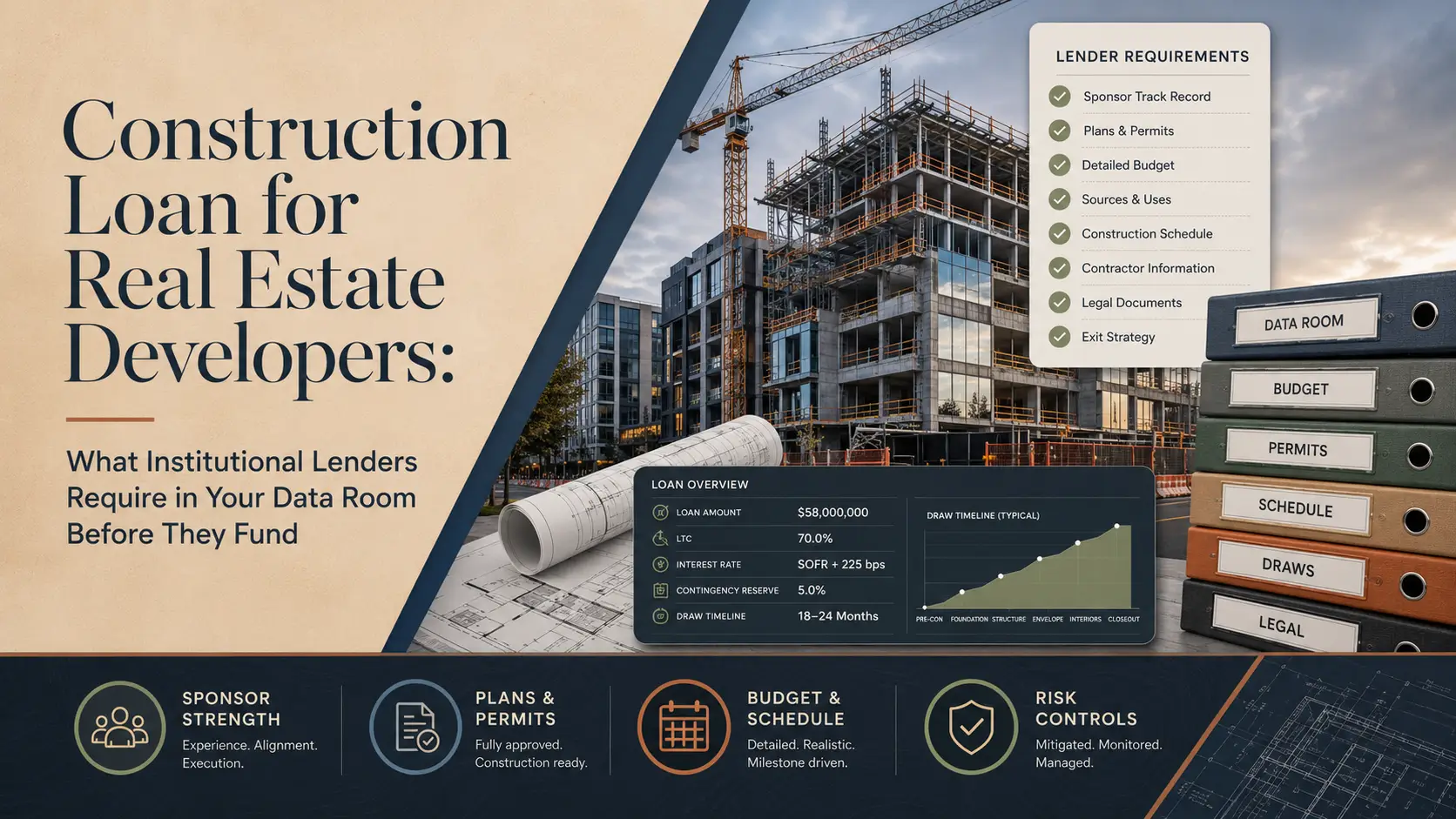
Construction Loan for Real Estate Developers: What Institutional Lenders Require in Your Data Room Before They Fund
Disclosure
Nothing on this site constitutes an offer to sell, or a solicitation of an offer to purchase, any security under the Securities Act of 1933, as amended, or any applicable state securities laws. Any offering of securities is made only by means of a formal private placement memorandum or other authorized offering documents delivered to qualified investors.
IRC Partners is a capital advisory firm. IRC Partners is not a registered investment adviser under the Investment Advisers Act of 1940 and does not provide investment advice as defined thereunder.
Certain statements in this article may constitute forward-looking statements, including statements regarding market conditions, capital availability, investor demand, and transaction outcomes. Such statements reflect current assumptions and expectations only. Actual results may differ materially due to market conditions, regulatory developments, company-specific factors, and other variables. IRC Partners makes no representation that any outcome, return, or result described herein will be achieved.
References to prior mandates, transaction volume, network credentials, or capital raised are provided for illustrative purposes only and do not constitute a guarantee or prediction of future results. Past performance is not indicative of future outcomes. Individual results will vary. Network credentials and transaction statistics referenced on this site reflect the aggregate experience of IRC Partners' principals and affiliated advisors and are not a representation of assets managed or transactions closed solely by IRC Partners.
Certain data, statistics, and information presented in this article have been obtained from third-party sources. IRC Partners has not independently verified such information and expressly disclaims responsibility for its accuracy, completeness, or timeliness. Readers should independently verify any third-party data before relying on it.
Readers are strongly encouraged to consult qualified legal, financial, and tax professionals before making any investment, capital raising, or business decision.
Schedule A Meeting
You get one shot to raise the right way. If this raise is worth doing, it’s worth doing with precision, leverage, and control.
This isn’t a practice run. Serious capital. Serious strategy. Let’s raise it right.
We onboard a maximum of seven
new strategic partners each quarter, by application only, to maximize your chances of securing the capital you need.
