.svg "CTA Arrow")


.png "Investor Ready Capital decorative background element")

Reduce VC Reporting Burdens Before Signing a $10M+ Growth Round
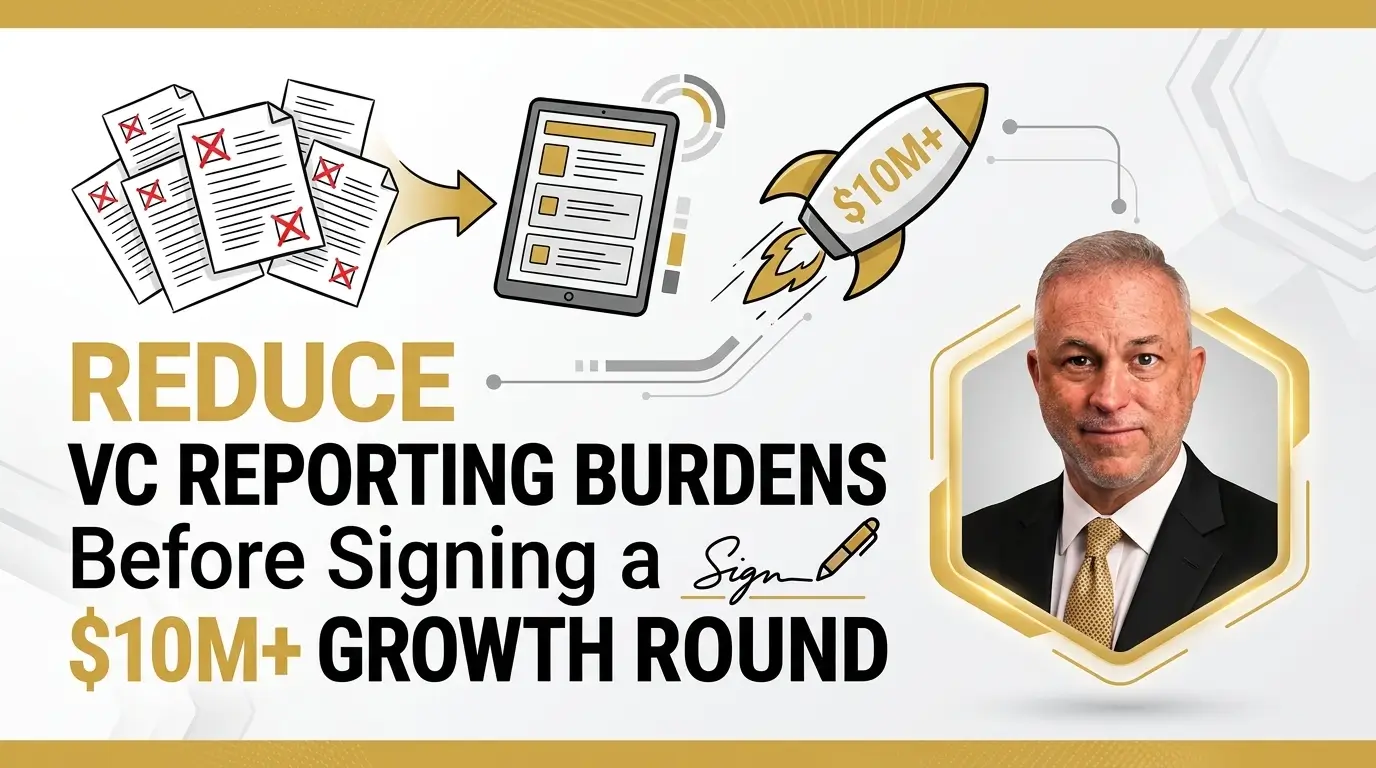
Reporting burden in a $10M+ growth round is not defined by a single clause but by the cumulative recurring workload inherited by your team after closing. This burden encompasses every financial package, custom KPI deck, and ad hoc data request required by the investors' rights agreement (IRA), side letters, and ancillary documents. Most founders mistakenly review these obligations one clause at a time; however, the real operating cost is cumulative and compounds rapidly once the round is executed. Because the negotiation window closes the moment the agreement is signed, it is critical to redesign the reporting package pre-close to ensure it remains decision-useful, stage-appropriate, and operationally survivable.
Most founders review those obligations one clause at a time. That is the wrong unit of analysis. The real operating cost is cumulative, and it compounds fast once the round closes.
Key takeaways before you read further:
- Reporting burden stacks across cadence, format, custom metrics, and multiple documents, not just the investors' rights agreement
- The negotiation window closes the moment the agreement is executed. Edits that seem minor pre-close become permanent post-close
- The goal is not to limit investor visibility. It is to redesign the reporting package so it stays decision-useful, stage-appropriate, and operationally survivable
Audit the Full Document Set for Cumulative Burden, Not Clause-by-Clause Optics
The first mistake founders make is treating the investors' rights agreement as the only document that matters. Side letters, board observer terms, diligence schedules, and ancillary undertakings all carry reporting obligations. Some of the heaviest recurring burdens live in those secondary documents, not in the IRA itself.
Before you propose a single edit, build a complete map. Pull every document in the closing set and list every obligation that requires your team to produce, deliver, or maintain information on a recurring basis. Then score each one.
Hidden duplication is common. The same revenue figures, headcount numbers, or pipeline metrics often appear under different labels across the IRA, a side letter, and a board materials commitment. Each instance looks manageable in isolation. Together, they create a parallel reporting track that runs indefinitely. Founders who have already worked through limiting VC access to sensitive data before signing will recognize this pattern from the diligence stage - it carries forward into the reporting stack if it is not caught early.
If you are raising under a term sheet now, reading how to read a term sheet and identify the clauses that carry the most post-close weight will help you spot these obligations before they reach the IRA draft stage.
Prioritize Edits by Operating Cost, Not by Where the Clause Sits
Once you have a complete obligation map, resist the instinct to redline in document order. A short clause buried in a schedule can cost more than a long clause in the main agreement if it requires monthly custom reporting, manual management commentary, or production of data your systems do not already generate.
Rank every obligation into three buckets before you open the markup conversation. If you are still working through how quarterly and annual cadence obligations should be weighted against each other, negotiating quarterly versus annual reporting terms in $10M+ growth rounds covers that layer in detail.
Bucket 1: Must narrow before signing These are obligations that require new reporting infrastructure, force production of information you do not currently maintain, or create open-ended delivery windows with no defined scope. They are the highest-cost items in the stack and the ones most worth pushing on.
Bucket 2: Can defer to request-only delivery These are obligations where the information exists but does not need to flow automatically on a fixed schedule. Monthly financials are a common example. The October 2025 NVCA Model Legal Documents establish that monthly financials should be available on request rather than delivered automatically. That baseline gives you a credible, non-adversarial anchor for the same ask.
Bucket 3: Acceptable at baseline Quarterly unaudited financials within 45 days and annual audited financials within 120 days are the NVCA standard. These are reasonable, expected by institutional investors, and worth accepting without friction. Spending negotiating capital here is rarely productive.
The operating cost principle: clause length and document position are irrelevant. What matters is how many hours per month, how many outside advisors, and how much new infrastructure each obligation requires after close. That is the number you are negotiating.
Use the NVCA Baseline as a Reduction Anchor
When you propose a narrower reporting obligation, you need a credible reference point. Abstract complaints about burden rarely move institutional investors. Specific, recognized market standards do.
The October 2025 NVCA Model Legal Documents are that reference point. They establish what a stage-appropriate reporting package looks like for growth-stage companies, and they reflect current market norms, not founder preferences. Use them to anchor specific redlines rather than general objections.
Here is how that looks in practice:
- Monthly financials (automatic delivery) → Propose: monthly financials available on request, consistent with NVCA baseline. Rationale: the information exists; automatic delivery creates unnecessary production cycles.
- Custom KPI deck (monthly) → Propose: quarterly KPI summary limited to metrics already maintained internally. Rationale: NVCA guidance holds that companies have no obligation to create new bespoke reports beyond what is reasonably maintained.
- Open-ended supplemental information requests → Propose: supplemental requests limited to information material to investor economics, consistent with the SEC's 2026 direction that disclosures should be decision-useful rather than broad. Rationale: open-ended language creates unpredictable labor with no governance ceiling.
- Management commentary (monthly) → Propose: management commentary included in quarterly package only, not as a standalone monthly deliverable.
The framing matters as much as the ask. You are not resisting transparency. You are aligning the reporting package with recognized standards so it remains reliable and executable after close.
Handle the "All Our Portfolio Companies Provide This" Objection
This is the most common pushback founders receive when they propose narrower reporting terms. It sounds like a market norm argument. It is actually a negotiating position.
The right response is not to dispute what other companies agreed to. It is to shift the conversation to what is decision-useful for this company at this stage.
- Objection: "All our portfolio companies provide monthly financials automatically." Response: "We are happy to make monthly financials available on request. Automatic delivery creates production cycles that do not improve the quality of the information. The NVCA baseline supports request-based delivery for monthly packages."
- Objection: "We need the custom KPI deck to monitor performance." Response: "We will include the metrics we already track in the quarterly package. If you need additional data points, we can discuss those on request. We want to give you reliable reporting, not reporting that gets deprioritized because it is too burdensome to produce consistently."
- Objection: "This is a standard package we use across the portfolio." Response: "We understand. We are proposing adjustments that align with NVCA guidance on stage-appropriate obligations. The CAQ's 2026 research confirms that 91% of institutional investors rely on audited financial statements as their primary financial information source. A clean baseline package with quarterly reporting already covers what most investors actually use."
The goal in each exchange is to preserve the investor's access to meaningful data while removing the operational overhead that produces noise rather than governance value. That is a better governance argument, not a weaker one.
{{main-cta}}
Make Sure Narrowed Obligations Survive Side Letters and Ancillary Documents
Narrowing an obligation in the investors' rights agreement does not mean it stays narrow. Side letters, diligence undertakings, board materials commitments, and email-based drafting concessions can reintroduce the same reporting asks under different labels. This is one of the most common ways pre-close edits get undone.
Before signing, run a final cross-document review. Check that the following are consistent across every signed document:
- Delivery timing: Does the same obligation carry the same deadline in the IRA and every side letter?
- Investor thresholds: Do major investor definitions match across documents, so the reporting obligation does not apply more broadly than intended?
- Scope of ad hoc requests: Is supplemental request language defined consistently, or does one document leave it open-ended while another narrows it?
- KPI and metric definitions: Are the metrics defined the same way in every document, or does a side letter introduce a broader definition that expands what must be tracked?
- Request-only language: If monthly reporting was moved to request-only in the IRA, does any side letter revert it to automatic delivery?
If you have already worked through how to identify and limit sensitive data obligations in the main agreement, securing better information rights terms in growth capital raises covers the next layer of cross-document consistency in more detail.
The pre-sign checklist is the last line of defense. Do not skip it. If your closing set includes inspection or audit rights language alongside reporting obligations, avoiding broad audit rights before signing runs the same cross-document consistency check for that layer of the agreement.
What a Pre-Close Audit Actually Looks Like
One growth-stage operator, closing a $15M institutional round, ran a full document audit before the final markup. The review identified three high-burden items that had been accepted without pushback in earlier drafts.
First, monthly full financial packages were set to automatic delivery. The company proposed moving them to request-only, citing the NVCA baseline. The investor accepted without repricing.
Second, a custom KPI deck required monthly production of metrics the company did not currently track. The company proposed replacing it with a quarterly summary of existing internal metrics. The investor agreed.
Third, a supplemental information clause in a side letter was open-ended with no defined scope or turnaround time. The company proposed a response window and limited scope tied to information already maintained. That edit also held.
The round closed on original economics. The reporting package became manageable. The edits worked because they were framed as execution-minded cleanups, not as resistance to investor oversight.
None of these outcomes were guaranteed. But all three conversations were easier because the company came in with a cumulative burden map, a ranked edit list, and a credible market anchor rather than a general complaint about paperwork.
Pre-Sign Confirmation Checklist
Before you execute the investors' rights agreement, confirm the following across every document in the closing set:
- Reporting cadence is defined and consistent across the IRA and all side letters
- Monthly reporting is request-only or clearly scoped, not open-ended automatic delivery
- KPI and metric definitions are limited to data already maintained internally
- Ad hoc request language includes defined scope and a response window
- Major investor thresholds match across every document that triggers reporting obligations
- No ancillary document reintroduces an obligation that was narrowed in the IRA
The best time to tighten these terms is before documents harden. Once the agreement is executed, every obligation in that stack becomes the operating baseline your team works from indefinitely.
IRC Partners works with founders and growth-stage operators who need institutional reporting terms tightened before close, without disrupting deal momentum or creating investor friction. If your draft investors' rights agreement is in front of you now, that is the right time to bring an advisor in.
Frequently Asked Questions
How do I score a reporting obligation for cumulative burden rather than just reading the clause?
Score each obligation across five dimensions: recurring labor hours per cycle, whether it requires new reporting infrastructure or systems, whether it forces production of data not currently maintained, whether outside advisor time is needed to fulfill it, and whether the same data appears under a different label elsewhere in the document set. Obligations that score high on three or more dimensions are your highest-priority edits before signing.
What is the difference between a reporting obligation that is expensive and one that just feels uncomfortable?
Expensive obligations require your finance team, legal counsel, or outside advisors to produce something on a repeating schedule. Uncomfortable obligations are ones that feel invasive but cost little to fulfill. The distinction matters because you have limited negotiating capital. Spend it on obligations that will consume real hours and dollars post-close, not on ones that feel aggressive but are actually low-cost to execute.
How should I frame a burden-reduction ask so it does not read as founder-resistant?
Lead with what you are preserving, not what you are removing. Tell the investor the baseline package delivers quarterly unaudited financials, annual audited financials, and monthly data on request, which already covers what the NVCA identifies as stage-appropriate and what the CAQ's 2026 research confirms 91% of institutional investors actually rely on. You are not reducing visibility. You are removing production overhead that does not improve the quality of the information the investor receives.
Can I negotiate reporting obligations after the investors' rights agreement is signed?
Technically, yes, through an amendment. In practice, it is difficult. Investors have little incentive to renegotiate terms they already hold, and reopening a signed agreement creates friction and signals that the founder did not do the work pre-close. The negotiation window is before execution. Every obligation you accept at signing becomes the baseline your team manages indefinitely.
What should I do if a side letter reintroduces a reporting obligation I already narrowed in the IRA?
Flag it immediately and request conforming language before signing. The most common version of this problem is a side letter that reverts monthly financials to automatic delivery after the IRA moved them to request-only. The fix is straightforward: the side letter should either reference and adopt the IRA language or be amended to match it. Do not assume the documents are consistent. Confirm it line by line before the closing set is finalized.
How do I handle an investor who insists that their standard package is non-negotiable?
Ask them to walk you through which elements of the package they actively use for investment decisions. Most investors will identify two or three data points they actually review. That conversation often opens the door to a narrower, more focused package that serves their real governance needs without the production overhead of the standard template. Frame it as designing a reporting system that works for both sides rather than a negotiation over their standard terms.
Does the size of an investor's ownership stake affect how much reporting they can reasonably require?
Yes, and this is worth building into your markup. The October 2025 NVCA Model Legal Documents tie major investor status, and the enhanced reporting rights that come with it, to ownership thresholds typically in the 10% to 20% range. Investors below that threshold generally receive the standard package. If your cap table includes smaller participants who are requesting major investor reporting rights, that is a legitimate basis for narrowing their specific obligations before signing.
Continue reading this series:
- How to negotiate information rights and reporting obligations with institutional investors before signing
- Top negotiation tactics for VC information rights before signing
- How to push back on broad investor reporting clauses pre-close
IRC Partners advises founders raising $5M to $250M in institutional capital on structure, positioning, and round architecture. We work with 7 strategic partners per quarter - no placement agent model, no success-only theater. If you want a structural review of your current raise, apply HERE.
Sponsors weighing this decision should first complete a capital raise readiness assessment for sponsors to confirm the raise is investor-ready.
Need guidance on your capital raise?



How Emerging Real Estate Fund Managers Get Their First Institutional LP Anchor Commitment
How Should a Real Estate Sponsor Package Project-Level Financials for LP Committee Review?
.jpg "Illustration for pitch deck mistakes that stop fundraising")
I Studied 1,000 Pitch Decks: What Stops Founders From Raising Money | IRC Partners
Disclosure
Nothing on this site constitutes an offer to sell, or a solicitation of an offer to purchase, any security under the Securities Act of 1933, as amended, or any applicable state securities laws. Any offering of securities is made only by means of a formal private placement memorandum or other authorized offering documents delivered to qualified investors.
IRC Partners is a capital advisory firm. IRC Partners is not a registered investment adviser under the Investment Advisers Act of 1940 and does not provide investment advice as defined thereunder.
Certain statements in this article may constitute forward-looking statements, including statements regarding market conditions, capital availability, investor demand, and transaction outcomes. Such statements reflect current assumptions and expectations only. Actual results may differ materially due to market conditions, regulatory developments, company-specific factors, and other variables. IRC Partners makes no representation that any outcome, return, or result described herein will be achieved.
References to prior mandates, transaction volume, network credentials, or capital raised are provided for illustrative purposes only and do not constitute a guarantee or prediction of future results. Past performance is not indicative of future outcomes. Individual results will vary. Network credentials and transaction statistics referenced on this site reflect the aggregate experience of IRC Partners' principals and affiliated advisors and are not a representation of assets managed or transactions closed solely by IRC Partners.
Certain data, statistics, and information presented in this article have been obtained from third-party sources. IRC Partners has not independently verified such information and expressly disclaims responsibility for its accuracy, completeness, or timeliness. Readers should independently verify any third-party data before relying on it.
Readers are strongly encouraged to consult qualified legal, financial, and tax professionals before making any investment, capital raising, or business decision.
Schedule A Meeting
You get one shot to raise the right way. If this raise is worth doing, it’s worth doing with precision, leverage, and control.
This isn’t a practice run. Serious capital. Serious strategy. Let’s raise it right.
We onboard a maximum of seven
new strategic partners each quarter, by application only, to maximize your chances of securing the capital you need.
