.svg "CTA Arrow")


.png "Investor Ready Capital decorative background element")
Project Financing: How Sponsors Use Project Finance Structures to Raise $10M+ Without Personal Guarantees

Project Financing: How Sponsors Use Project Finance Structures to Raise $10M+ Without Personal Guarantees
The lender is not removing risk. The lender is deciding where it lives.
Project finance is a non-recourse or limited-recourse debt structure where repayment is tied solely to a single project's cash flows, assets, and contracts, held inside a bankruptcy-remote SPV, rather than the sponsor's personal balance sheet. When the project's cash flows, completion certainty, and governance controls are strong enough to satisfy lender underwriting on their own, personal guarantee exposure shrinks or disappears entirely. When they are not, a guarantee comes back regardless of how the deal is labeled.
According to PwC's project finance framework, lenders in a project finance structure look primarily to project-generated revenues and assets as the source of repayment and security. The sponsor's creditworthiness matters, but it is not the primary underwriting basis.
The trade-off is real. Project finance lenders require more intensive diligence than any other lender type. They underwrite completion risk, cash flow mechanics, reserve adequacy, and SPV governance with a level of scrutiny that recourse lenders rarely apply. Sponsors who understand that trade-off, and prepare for it, access institutional debt without pledging personal assets.
This article covers:
- When project finance is structurally appropriate and when it is not
- How it differs from recourse bank financing and debt fund lending across 8 dimensions
- What project finance lenders underwrite that other lenders do not
- How SPVs, waterfalls, completion guarantees, and debt service reserves actually work
- What the data room must include before approaching a project finance lender
When Project Finance Makes Sense and When It Does Not
Project finance is a structural decision, not a rate-shopping exercise. It fits deals where the project can be ring-fenced inside a single SPV with identifiable cash flows, bankable contracts, and a defensible risk-allocation package. It is a poor fit when repayment depends primarily on sponsor-level support or when the project's cash flow logic is too speculative to satisfy lender underwriting.
The PwC/ULI Emerging Trends in Real Estate report continues to highlight that institutional capital in 2025-2026 is flowing most actively toward deals with clear operational fundamentals: multifamily, industrial, logistics, data centers, and mixed-use with a strong residential component. Those are also the asset classes where project finance structures are most plausible.
The key question is not whether the deal is large enough for project finance. It is whether the project's cash flows, contracts, and controls are strong enough to carry the lender's risk without the sponsor's balance sheet as a backstop.
Project Finance vs. Conventional Recourse Financing vs. Debt Fund Lending: The Dimensions That Actually Matter
Sponsors evaluating project finance often compare it only against bank construction loans. That is the wrong comparison set. Debt funds now originate 34% of all U.S. construction loans, making them a primary alternative in 2025-2026. Meanwhile, the Mortgage Bankers Association reports that $875 billion in commercial mortgages mature in 2026, creating real urgency around refinance-ready structures and lender preparedness. The real comparison is across all three, and the dimensions that matter most are not pricing alone.
What this means for sponsors:
- Debt funds move faster and tolerate more structural complexity than banks, but their cost of capital is higher and their covenant structures are more standardized. For construction lending, they are often the practical alternative when banks pull back.
- Project finance is not a cheaper version of debt fund lending. It is a more intensive structure that trades sponsor recourse for project-level underwriting depth. The documentation burden is real.
- As the NAIOP Q4 2025 Debt Market Survey confirms, construction spreads remain the widest across all collateral types. Lenders are still pricing a meaningful premium for development risk, regardless of structure type.
For a deeper comparison of how senior debt, mezzanine, and preferred equity interact within a single stack, see IRC's guide on choosing between senior debt, mezzanine, and preferred equity.
What Project Finance Lenders Underwrite Differently: Completion Risk, Cash Flow Controls, and SPV Governance
Project finance lenders underwrite the project as a self-contained risk system. They are not relying on sponsor recourse to cover gaps, so they go deeper on the variables that will determine whether the project can repay the loan on its own. That depth is what separates project finance diligence from standard bank or debt fund underwriting.
The FDIC's 2025 Risk Review confirmed that banks tightened standards around LTV and DSCR in commercial real estate categories during 2025. That tightening reflects a broader shift: lenders are demanding more proof that cash flows and controls hold up, not just that sponsors are creditworthy.
Here are the five lenses project finance lenders apply that most other lenders do not:
- Completion risk. Lenders want a fixed-price, date-certain construction contract with a single-point responsible contractor, performance guarantees, and liquidated damages sized to cover debt service if delivery slips. A budget with large contingency gaps or a contractor without demonstrated capacity on comparable projects is a credit problem, not just a construction problem.
- Revenue durability. Project finance lenders stress-test revenue assumptions hard. For multifamily and mixed-use deals, that means lease-up pace, absorption assumptions, and market comparable support. For commercial assets, it means tenant credit quality, lease term, and what happens if a major tenant does not renew. Revenue that depends on speculative assumptions will not pass a project finance credit committee.
- Reserve sufficiency. Lenders require funded reserves that can absorb operating shocks before a payment default occurs. The debt service reserve account is the most common, but completion reserves and operating reserves are also standard in project finance structures. Thin reserves are a primary reason deals fail to qualify for non-recourse terms.
- Cash flow controls. Lenders require waterfall mechanics that prioritize debt service and reserves before any equity distribution is permitted. Distribution lock tests and DSCR floors are standard covenant tools that prevent the sponsor from pulling cash out of the project while lender obligations remain unsatisfied.
- SPV governance. Lenders require a bankruptcy-remote vehicle with restricted permitted activities, clean ownership, pledged equity interests, and protections against bad-act carve-outs. Governance is not a formality. It is the legal mechanism that gives the lender control over the collateral if the deal deteriorates.
Key insight: Most recourse lenders focus on the sponsor's ability to repay. Project finance lenders focus on the project's ability to repay. That is a fundamentally different underwriting question, and it requires fundamentally different documentation.
Understanding how structural fragility can undermine a deal before it reaches lender conversations is covered in depth in IRC's analysis of capital stack risk reduction strategies.
{{main-cta}}
How SPV Structure, Cash Flow Waterfalls, Completion Guarantees, and Debt Service Reserves Actually Work
These four elements are where project finance either holds together or falls apart. Understanding each one in plain terms helps sponsors know exactly where recourse disappears and where it re-enters.
The SPV
A special purpose vehicle is a single-purpose legal entity that owns the project and nothing else. The SPV holds the land, the construction contracts, the permits, the insurance, and the debt. Its assets and liabilities are legally separated from the sponsor's other business activities. That separation is what makes non-recourse lending structurally possible.
The SPV only works as a recourse shield if it is clean. That means no cross-collateralization with other assets, no shared liabilities with the sponsor's broader portfolio, restricted permitted activities limited to the project, and a collateral package that pledges equity interests in the entity to the lender. A poorly documented or contaminated SPV gives the lender grounds to look through the structure to the sponsor.
The Cash Flow Waterfall
A project finance waterfall is a control system. It defines the order in which project revenues are distributed, and it is designed to protect the lender before anyone else gets paid. A standard waterfall sequence for a project finance deal flows as follows:
- Operating expenses and taxes (paid first from project revenues)
- Debt service (principal and interest on the senior loan)
- Debt service reserve account top-up (if the DSRA falls below the required balance)
- Completion or operating reserves (funded to required minimums)
- Distribution lock test (lender confirms DSCR and other covenants are satisfied)
- Equity distributions to sponsor (only after all above obligations are satisfied)
If any covenant test fails, the waterfall locks and equity distributions stop. The sponsor cannot access project cash flow until the project is back in compliance.
For context on how waterfall mechanics interact with LP equity economics in a broader capital stack, see IRC's guide on structuring a capital stack for a $10M-$50M development deal.
Completion Guarantees
A completion guarantee is not the same as a full recourse personal guarantee. It is a targeted support obligation that requires the sponsor to ensure the project is completed and delivered to a defined standard. The scope matters. Some completion guarantees cover only cost overruns. Others require the sponsor to fund project completion regardless of cause. The narrower the scope, the closer the deal is to true non-recourse. Lenders in 2025-2026 still require some form of completion support on ground-up development, even in project finance structures.
Debt Service Reserve Accounts
A DSRA is a funded cash account, typically sized at three to six months of debt service, held by or pledged to the lender. It exists to cover scheduled payments if project cash flow is temporarily insufficient due to lease-up delays, seasonal variation, or operating disruptions. The DSRA is a lender comfort mechanism. Its presence allows lenders to accept thinner real-time coverage ratios without requiring sponsor recourse as a backstop. Sponsors who fund a robust DSRA before approaching lenders often see better recourse terms as a result.
What the Data Room Must Include Before Approaching a Project Finance Lender
A project finance data room is not a general lender package. The lender is underwriting contracts, controls, and downside resilience, not just sponsor reputation. A generic package signals that the sponsor does not understand what this lender type is evaluating. The table below shows what belongs in a project-finance-specific data room, why each category matters to credit approval, and the most common red flag in each area.
For the full document-level checklist lenders request before committing to a $10M+ deal, see IRC's real estate due diligence checklist for institutional lenders. For a broader look at how data room organization affects institutional LP diligence timelines, see IRC's guide on how to organize a data room for a real estate fund raise.
The practical rule: a project finance data room should be complete before the first lender conversation. Every gap a lender finds during diligence slows the process and gives them leverage to revisit recourse terms. Sponsors who want to compress that timeline should review IRC's framework on how to build a data room that closes institutional investors in 30 days instead of 90 before outreach begins.
Structure the Deal Before You Approach the Lender
Project finance does not remove lender risk. It relocates it from the sponsor's balance sheet to the project's cash flows, completion certainty, and governance controls. When those elements are credible on paper, lender recourse can shrink. When they are weak, recourse comes back, regardless of the label on the term sheet.
The fastest way to lose leverage in a lender conversation is to ask for non-recourse treatment before the SPV, contracts, reserves, and data room are ready. Sponsors who structure first and approach lenders second close institutional debt on better terms and in less time.
Three actions before lender outreach:
- Confirm the SPV is clean: bankruptcy-remote, single-purpose, restricted activities, pledged equity interests.
- Verify the data room is complete: GMP contract, stress-case model, funded contingency, DSRA sizing, and third-party reports in place.
- Stress-test the waterfall: confirm cash flow covers debt service in a 15% cost overrun and a 12-month lease-up delay before presenting to a lender.
For a full framework on which capital stack layers create the least structural risk before a $10M+ raise, see IRC's overview of capital stack layers that minimize risk for developers.
IRC Partners works with seasoned developers to structure institutional-grade capital stacks and lender-ready materials before outreach begins. Schedule a strategy call to align your deal structure before the first lender conversation.
Frequently Asked Questions
Does project finance fully eliminate personal guarantees on real estate deals?
Not always. Non-recourse project finance limits lender recovery to the SPV's assets and cash flows, but most ground-up deals still require a completion guarantee. That guarantee is narrower than a full personal guarantee: it is typically limited to ensuring the project reaches a defined completion standard, not covering the entire loan balance. True full non-recourse is more common on stabilized assets with proven cash flow.
What DSCR does a project finance lender typically require before approving non-recourse terms?
Project finance lenders generally require a minimum DSCR of 1.20x to 1.35x in the base case, with a stress-case floor of 1.10x to 1.15x. The specific floor depends on asset type, market conditions, and reserve adequacy. Deals that clear these thresholds with a funded DSRA of three to six months of debt service are more likely to receive limited-recourse or non-recourse terms.
What is a bad-boy carve-out and how does it affect non-recourse status?
A bad-boy carve-out is a provision that converts a non-recourse loan to full recourse if the sponsor commits specific prohibited acts: fraud, voluntary bankruptcy filing, unauthorized transfers, misappropriation of project funds, or environmental violations. These carve-outs do not affect the loan's non-recourse character in ordinary operations. They exist to deter sponsor misconduct that would impair the lender's collateral.
How long does it typically take to close a project finance deal compared to a recourse bank loan?
Project finance transactions typically take 60 to 120 days from mandate to close, compared to 45 to 90 days for a recourse bank construction loan. The additional time reflects the documentation burden: third-party reports, SPV legal review, completion guarantee negotiation, and conditions precedent checklists are more extensive than standard bank underwriting. Sponsors with complete data rooms at the start of the process consistently shorten this timeline.
Can a mid-market developer use project finance, or is it only for large infrastructure deals?
Project finance is available to mid-market real estate developers for deals of $10M and above, provided the project meets the structural requirements: a clean SPV, a bankable construction contract, defensible cash flow assumptions, and funded reserves. The structure is not limited to large infrastructure projects. It is available wherever the project's own assets and cash flows can carry lender risk without sponsor balance sheet support.
What is the minimum equity contribution a project finance lender typically requires?
Project finance lenders generally require the sponsor to contribute 25% to 40% of total project cost as equity before the loan is funded. Higher equity contributions reduce the lender's exposure and often correlate with better recourse terms. Thin equity positions, particularly those below 20% of total cost, typically require additional sponsor support regardless of how the deal is structured.
What happens to the DSRA if the project performs above expectations?
If the project consistently exceeds DSCR thresholds and all covenant tests are satisfied, the loan documents typically allow the DSRA balance to be released to the sponsor at loan maturity or upon meeting defined performance conditions. Some structures permit partial releases during the loan term if the project maintains a specified coverage ratio for a consecutive period, typically six to twelve months. The release mechanics are negotiated at origination and documented in the loan agreement.
Continue reading this series:
- Senior Debt vs. Mezzanine vs. Preferred Equity: Which Layer Do You Actually Need?
- 5 Capital Stack Risk Reduction Strategies for Developers
- How to Structure a Capital Stack for a $10M-$50M Real Estate Development Deal
The wrong structure doesn't just cost you this round. It costs you the next three. IRC Partners advises founders raising $5M to $250M of institutional capital. If you're about to go to market and want the structure reviewed before investors see it, book a call here.
Sponsors weighing this decision should first complete a capital raise readiness assessment for sponsors to confirm the raise is investor-ready.
Need guidance on your capital raise?


.jpg "Give me 12 minutes and I'll teach you how to raise 100M")
Give me 12 minutes and I'll teach you how to raise $100M
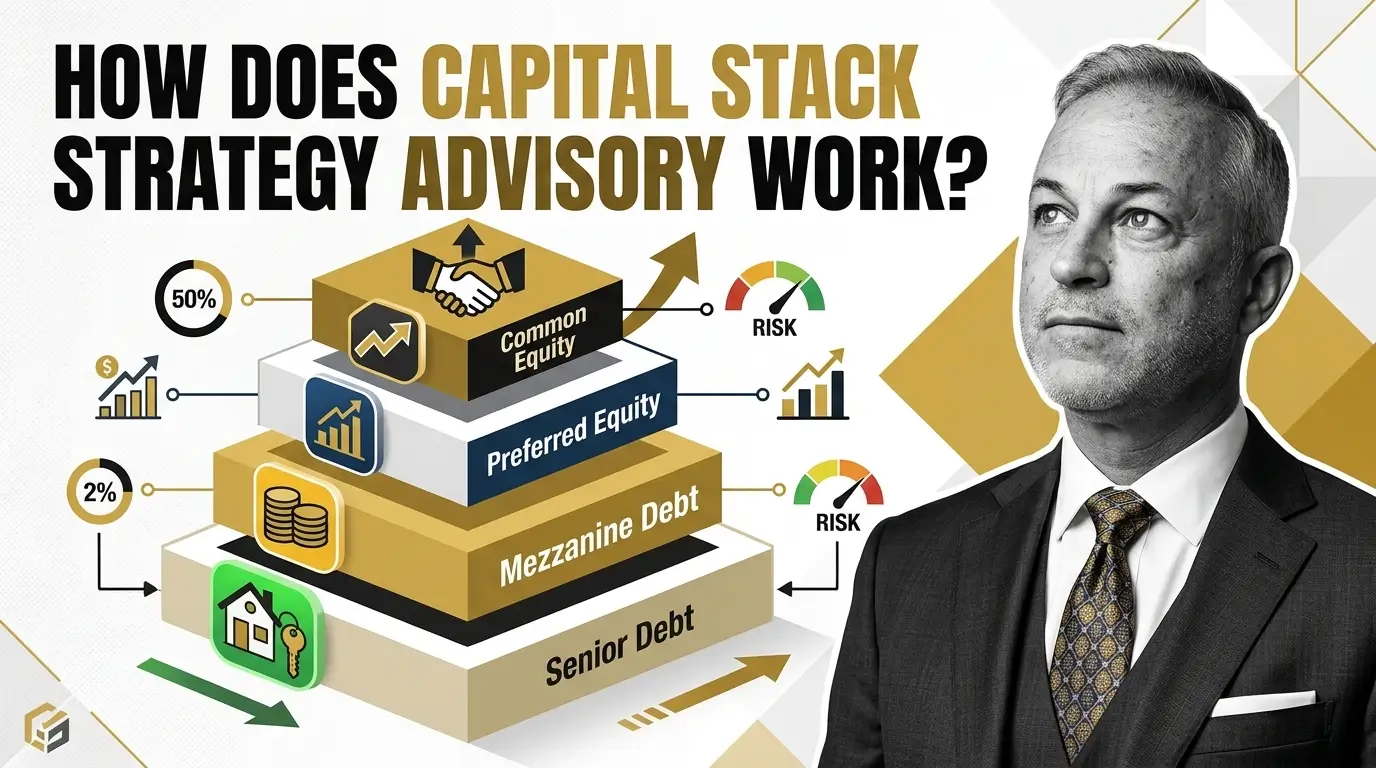
How Does Capital Stack Strategy Advisory Work?
Time-Based Drag-Along Restrictions: How to Negotiate a Founder Veto on Exit in Years 1 Through 5 Unless Price Exceeds a Multiple
Disclosure
Nothing on this site constitutes an offer to sell, or a solicitation of an offer to purchase, any security under the Securities Act of 1933, as amended, or any applicable state securities laws. Any offering of securities is made only by means of a formal private placement memorandum or other authorized offering documents delivered to qualified investors.
IRC Partners is a capital advisory firm. IRC Partners is not a registered investment adviser under the Investment Advisers Act of 1940 and does not provide investment advice as defined thereunder.
Certain statements in this article may constitute forward-looking statements, including statements regarding market conditions, capital availability, investor demand, and transaction outcomes. Such statements reflect current assumptions and expectations only. Actual results may differ materially due to market conditions, regulatory developments, company-specific factors, and other variables. IRC Partners makes no representation that any outcome, return, or result described herein will be achieved.
References to prior mandates, transaction volume, network credentials, or capital raised are provided for illustrative purposes only and do not constitute a guarantee or prediction of future results. Past performance is not indicative of future outcomes. Individual results will vary. Network credentials and transaction statistics referenced on this site reflect the aggregate experience of IRC Partners' principals and affiliated advisors and are not a representation of assets managed or transactions closed solely by IRC Partners.
Certain data, statistics, and information presented in this article have been obtained from third-party sources. IRC Partners has not independently verified such information and expressly disclaims responsibility for its accuracy, completeness, or timeliness. Readers should independently verify any third-party data before relying on it.
Readers are strongly encouraged to consult qualified legal, financial, and tax professionals before making any investment, capital raising, or business decision.
Schedule A Meeting
You get one shot to raise the right way. If this raise is worth doing, it’s worth doing with precision, leverage, and control.
This isn’t a practice run. Serious capital. Serious strategy. Let’s raise it right.
We onboard a maximum of seven
new strategic partners each quarter, by application only, to maximize your chances of securing the capital you need.
