.svg "CTA Arrow")


.png "Investor Ready Capital decorative background element")

Key Benefits of Capital Stack Strategy Advisory
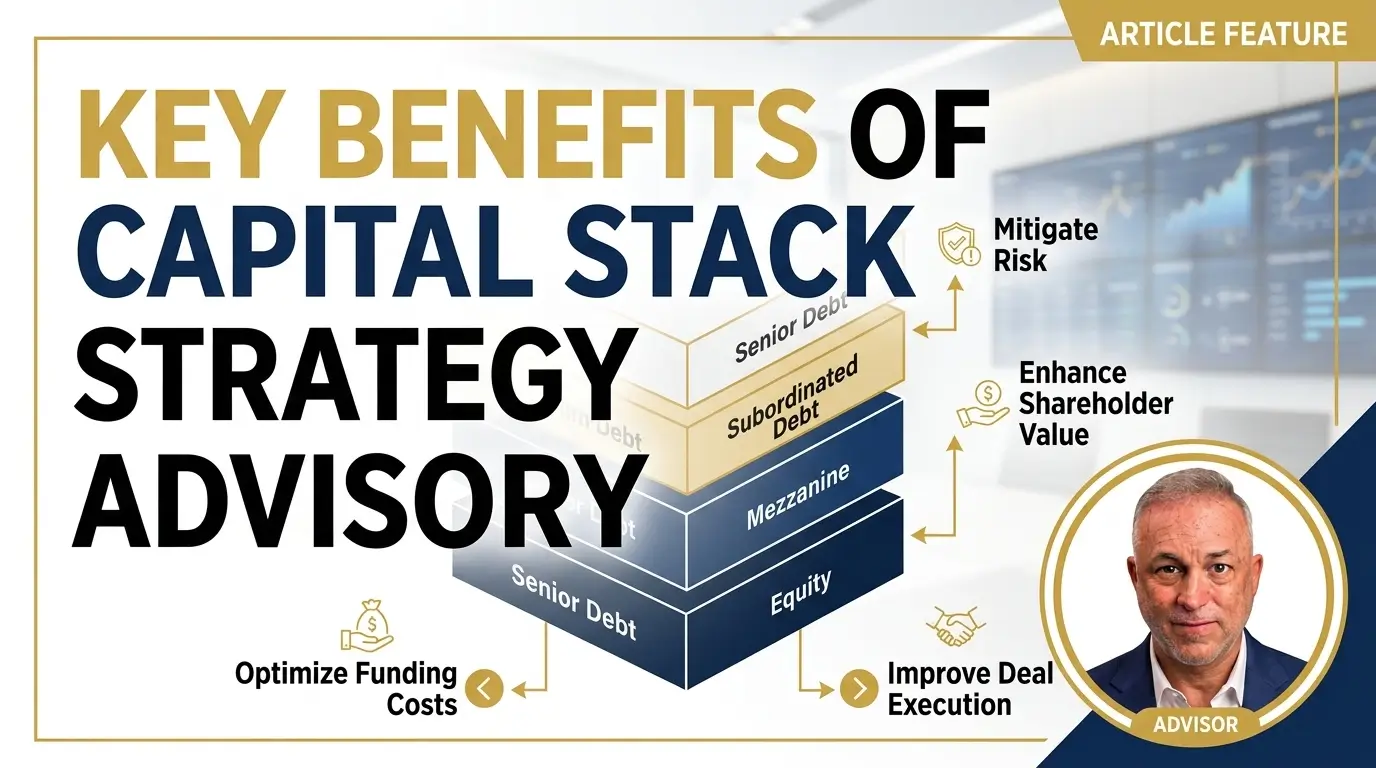
Capital stack strategy advisory produces five measurable outcomes for experienced developers raising $10M or more in institutional capital: it protects GP economics before term sheets harden, improves institutional close rates by matching structure to investor mandate, reduces diligence friction and avoidable delays, improves capital provider fit across family offices and institutional equity sources, and builds a repeatable capital formation process that compounds value across future raises. These are not access-to-capital claims. They are operational and economic outcomes that show up in retained promote, faster closings, and stronger positioning with institutional allocators.
The benefits described here are the downstream result of the four-stage advisory process covered in how capital stack strategy advisory works. If you are still evaluating whether leveraging capital advisory for real estate sponsors applies to your situation, what is capital stack advisory covers the fundamentals. This article focuses entirely on what a well-executed process produces.
Key benefits at a glance:
- GP economics protection before external capital shapes the deal
- Higher institutional close probability through investor-mandate alignment
- Fewer diligence resets and compressed raise timelines
- Targeted introductions to capital sources with actual check-size fit
- Stronger positioning and shorter ramp time on future institutional raises
Protecting GP Economics Before the Term Sheet Hardens
The most significant value advisory delivers often happens before a single investor conversation takes place. Promote splits, preferred return thresholds, waterfall mechanics, and governance rights are far easier to defend when they are structured proactively than when they are negotiated reactively under capital pressure.
Most economics leakage is not the result of bad deals. It is the result of starting the capital process without a clear position on which concessions are market-required and which are simply accepted because the developer needed to move fast or started with the wrong counterparty.
The table below illustrates how advisory-driven structure changes affect retained GP economics on a $25M equity raise with a five-year hold:
Even a 100 to 300 basis point improvement in sponsor economics translates into material retained value across multi-year holds and repeat raises. Advisory earns its cost when it prevents a single avoidable concession at the term sheet stage. For a detailed breakdown of the waterfall engineering and equity cushion decisions that drive this, see the five structural levers that reduce capital stack risk before a raise closes.
Improving Institutional Close Rates Through Mandate Alignment
Institutional raises fail for two reasons: structural weaknesses that surface in diligence, and mandate mismatch that was never identified before outreach began. Advisory addresses both, but mandate alignment is where close-rate improvement is most direct.
A family office with a $2M to $5M average check size is not a realistic lead investor on a $40M equity raise, regardless of how strong the relationship is. A private equity fund with a 3-year return horizon is not the right fit for a 7-year ground-up development. These mismatches consume 30 to 90 days of active process time before they resolve themselves, and they often damage deal momentum at the worst possible point.
The three close-rate drivers that advisory improves most directly:
- Check-size fit: Targeting capital sources whose actual deployment range matches the raise size, not just their stated interest in the asset class.
- Return profile alignment: Matching investor return expectations, hold period preferences, and distribution timing to the deal's actual financial model before the first conversation.
- Structural compatibility: Ensuring governance, reporting, and approval rights are pre-negotiated to a range the deal can support before outreach begins.
"In 2026, equity capital is available but unevenly distributed. Allocators are more selective, decision cycles are longer, and deals that do not arrive with clean structure and clear mandate fit are being passed on regardless of asset quality." - CRE Finance Council, 2026 Conference Takeaways
Developers who have worked with capital stack advisory for their specific raise stage understand that close rates improve when the investor list is short, targeted, and pre-qualified against the deal's actual requirements.
Reducing Diligence Friction and Compressing Avoidable Delays
Diligence friction is one of the most underestimated costs in an institutional raise. It is not just a time problem. Repeated requests for missing materials, inconsistent financial assumptions, and unresolved structural questions signal operating risk to institutional allocators, often more loudly than the underlying deal warrants.
A well-prepared capital stack reduces the surface area for diligence problems before the process begins. The practical result is fewer back-and-forth cycles, more credible committee presentations, and a process that stays alive through final negotiation rather than stalling at the LOI stage.
Common diligence friction points that advisory eliminates or reduces:
- Incomplete or inconsistent sources-and-uses documentation
- Waterfall mechanics that do not match the financial model
- Missing third-party reports or outdated market comps
- Governance rights that conflict with the developer's operating agreement
- Unresolved questions about GP guarantees, recourse structure, or capital call mechanics
- Sponsor track record materials not formatted to institutional standards
- Pro forma assumptions that cannot be supported by comparable exits or market data
Each of these issues, when they surface mid-diligence, can add two to six weeks to a raise timeline. On a $30M equity raise with a construction start date tied to the close, a six-week delay has direct cost consequences in carrying costs, contractor scheduling, and lender fee accrual. IRC's own data shows that 85% of institutional LP rejections are tied to operational due diligence failures, not investment thesis weaknesses, which means most avoidable delays originate in process gaps that predate the first LP conversation.
The benefit is not just speed. It is keeping a live process credible enough to survive institutional committee review, where any signal of disorganization or structural ambiguity tends to raise risk flags that are difficult to walk back.
Getting Better Provider Fit Across Capital Lanes
More introductions is not the right outcome. Fewer, better-targeted conversations with capital sources whose mandate actually fits the transaction is. The distinction matters because the wrong capital source does not just waste time. It can introduce control risk, misaligned hold expectations, or approval timelines that make the deal unworkable.
Each capital lane has different requirements, and advisory helps developers identify which lane fits their deal before committing to a counterparty.
Advisory helps developers avoid the most common provider-fit mistake: approaching family offices with $1M to $5M deployment capacity as lead investors on $25M+ equity raises. The growth advisory and equity framework for $5M to $250M raises covers how provider fit scales across raise sizes and capital structures.
Building Long-Term Capital Pipeline Value Beyond One Deal
The highest-value benefit of advisory is not what it produces on the current raise. It is what it makes possible on the next one.
Developers with active pipelines benefit when each capital process leaves behind cleaner institutional positioning, sharper investor targeting, and a stronger documentation baseline. The ramp time for the next raise shortens because the infrastructure already exists.
Repeatable benefits that compound across multiple raises:
- Institutional-grade track record materials that do not need to be rebuilt from scratch
- Established reporting and governance templates that meet LP expectations on day one
- A pre-qualified investor list segmented by check size, asset class, and return profile
- A documented capital stack framework that can be adapted to new deal structures without starting over
- Stronger capital market credibility with allocators who have seen the developer's diligence process perform under pressure
Key takeaway: Developers who treat each raise as a standalone transaction leave value on the table. The capital formation process is an asset. Advisory helps build it intentionally rather than rebuilding it from scratch every 18 to 24 months.
This repeatable value is why experienced developers with $50M+ in annual raise volume tend to view advisory as an ongoing capital formation function rather than a one-time transaction service. The economics of a well-structured raise on deal three are materially better than deal one because the infrastructure, positioning, and investor relationships are already in place.
What These Benefits Look Like in Practice
One IRC advisory engagement on a multifamily development in Texas with $150M in total capitalization illustrates how these benefits converge in a single transaction.
Anonymized case reference: Multifamily development, Texas, $150M total capitalization
The developer entered the engagement with a capital stack that had not been stress-tested against institutional LP expectations. Promote structure, preferred return design, and governance rights were all negotiated reactively in prior raises. Advisory scope covered full capital stack restructuring, investor mandate alignment, and diligence package preparation before outreach began.
The outcome was a cleaner institutional structure with improved GP economics relative to prior raises, a pre-qualified investor list that eliminated mandate-mismatched conversations, and a diligence package that reduced back-and-forth cycles during the LP review process. The advisory process also produced a documented capital framework the developer could carry forward into future raises without rebuilding from scratch.
This is not an access story. It is a structure and process story. The capital was available before advisory began. What advisory changed was how much of the economics the developer retained, how efficiently the process ran, and how well-positioned the developer was for the next raise.
{{main-cta}}
What Developers Should Evaluate Before the Next Raise
Before launching outreach on the next institutional raise, experienced developers should assess four areas where advisory value is most likely to be material:
- Economics leakage: Does the current promote structure, preferred return design, and waterfall reflect market terms, or were they shaped by capital pressure in a prior raise?
- Mandate fit: Is the investor target list pre-qualified by actual check size, return profile, and hold period, or is it built on relationships and general interest?
- Diligence readiness: Is the capital stack documentation, governance structure, and track record package formatted to institutional standards before outreach begins?
- Repeatability: Will this raise leave behind infrastructure that improves the next one, or will the process need to be rebuilt from scratch?
If any of these questions do not have a clear answer, that is where advisory creates the most direct value. Understanding how the fund terms sheet locks in GP economics before LP negotiation begins is a practical starting point for developers who have not yet stress-tested their economics position before outreach. IRC works with developers raising $10M to $250M+ across institutional LP equity, preferred equity, and structured capital to address exactly these gaps before they become process problems. Evaluating structure, investor fit, and diligence readiness before the raise launches is the starting point.
Frequently Asked Questions
How much GP economics can advisory realistically protect on a $20M equity raise?
On a $20M equity raise with a 5-year hold, a 200 to 300 basis point improvement in sponsor promote can retain $200,000 to $400,000 in additional GP economics depending on the profit distribution. The larger impact often comes from waterfall design and clawback structure, where a single provision change can shift six to seven figures of economic exposure from the GP to the LP in a downside scenario. Advisory is most valuable when it identifies these concessions before the term sheet is drafted.
What is the minimum raise size where capital stack advisory produces a positive ROI?
Advisory tends to produce a measurable return on raises of $10M or more in equity, where even a 1% improvement in retained economics or a 30-day compression in raise timeline offsets the advisory cost. Below $10M, the economics of advisory are harder to justify unless the developer is building institutional infrastructure for a larger pipeline. The clearest ROI cases involve $15M to $75M raises where promote protection, diligence efficiency, and investor-fit improvements all apply simultaneously.
How many weeks does diligence friction typically add to an institutional raise?
Each unresolved structural issue, missing document, or inconsistent financial assumption identified mid-diligence can add two to six weeks to a raise timeline. Developers with three or more open diligence items at the LOI stage frequently see 60 to 90 day delays before reaching a final close. Advisory reduces this by resolving the most common friction points before outreach begins, keeping the process moving through committee review without avoidable restarts.
What percentage of family offices actually write $10M or more per deal?
Approximately 13% of family offices deploy $10M or more per single transaction. The majority write checks in the $1M to $5M range and are not viable lead investors on institutional raises above $15M. Advisory helps developers distinguish between family offices with genuine $10M+ check-writing capacity and those with broad CRE interest but limited single-deal deployment. Targeting the wrong segment is one of the most common sources of wasted process time on mid-market real estate raises.
Does advisory improve close rates on first-time institutional raises or only repeat raises?
Advisory improves close rates on both, but the impact is most direct on first-time institutional raises where developers lack a pre-built institutional documentation package, a tested investor target list, and a capital stack that has already survived LP diligence. Repeat raisers benefit primarily from economics optimization and mandate alignment. First-time institutional raisers benefit from all five outcome categories simultaneously, making advisory more material to the overall process outcome.
How does advisory affect governance rights and control in a structured capital deal?
Advisory helps developers establish governance positions before external capital shapes the negotiation. The practical difference is significant: a GP-controlled operating agreement with notice-only rights on major decisions versus LP consent requirements on dispositions, refinancings, and capital calls. In structured capital deals with preferred equity or mezzanine layers, advisory also addresses control trigger provisions that can transfer operational authority to the capital provider in a default scenario. These provisions are far easier to negotiate before capital is committed than after.
How long does the benefit of advisory last beyond the current raise?
The structural and documentation benefits of a well-executed advisory process typically carry forward two to three raise cycles before requiring a full rebuild. Institutional-grade track record materials, governance templates, and investor segmentation lists remain usable across multiple deals with updates rather than replacement. The investor relationships and capital market credibility built through a clean advisory process have a longer shelf life, often three to five years, as long as the developer's deal quality and reporting standards remain consistent.
Continue reading this series:
- What is capital stack strategy advisory
- How does capital stack strategy advisory work
- Growth advisory and equity for $5M to $250M raise
IRC Partners advises founders raising $5M to $250M in institutional capital on structure, positioning, and round architecture. We work with 7 strategic partners per quarter - no placement agent model, no success-only theater. If you want a structural review of your current raise, apply HERE.
Sponsors weighing this decision should first complete a capital raise readiness assessment for sponsors to confirm the raise is investor-ready.
Need guidance on your capital raise?


How Should Founders Handle a Convertible Note When the Investor Entity Has Dissolved, Merged, or Changed its Legal Name?
Private Placement Memorandum vs. Data Room: When You Need Both and How They Work Together
Engagement Model for Real Estate Capital Raising
Disclosure
Nothing on this site constitutes an offer to sell, or a solicitation of an offer to purchase, any security under the Securities Act of 1933, as amended, or any applicable state securities laws. Any offering of securities is made only by means of a formal private placement memorandum or other authorized offering documents delivered to qualified investors.
IRC Partners is a capital advisory firm. IRC Partners is not a registered investment adviser under the Investment Advisers Act of 1940 and does not provide investment advice as defined thereunder.
Certain statements in this article may constitute forward-looking statements, including statements regarding market conditions, capital availability, investor demand, and transaction outcomes. Such statements reflect current assumptions and expectations only. Actual results may differ materially due to market conditions, regulatory developments, company-specific factors, and other variables. IRC Partners makes no representation that any outcome, return, or result described herein will be achieved.
References to prior mandates, transaction volume, network credentials, or capital raised are provided for illustrative purposes only and do not constitute a guarantee or prediction of future results. Past performance is not indicative of future outcomes. Individual results will vary. Network credentials and transaction statistics referenced on this site reflect the aggregate experience of IRC Partners' principals and affiliated advisors and are not a representation of assets managed or transactions closed solely by IRC Partners.
Certain data, statistics, and information presented in this article have been obtained from third-party sources. IRC Partners has not independently verified such information and expressly disclaims responsibility for its accuracy, completeness, or timeliness. Readers should independently verify any third-party data before relying on it.
Readers are strongly encouraged to consult qualified legal, financial, and tax professionals before making any investment, capital raising, or business decision.
Schedule A Meeting
You get one shot to raise the right way. If this raise is worth doing, it’s worth doing with precision, leverage, and control.
This isn’t a practice run. Serious capital. Serious strategy. Let’s raise it right.
We onboard a maximum of seven
new strategic partners each quarter, by application only, to maximize your chances of securing the capital you need.
