.svg "CTA Arrow")


.png "Investor Ready Capital decorative background element")

How Does Capital Stack Strategy Advisory Work?
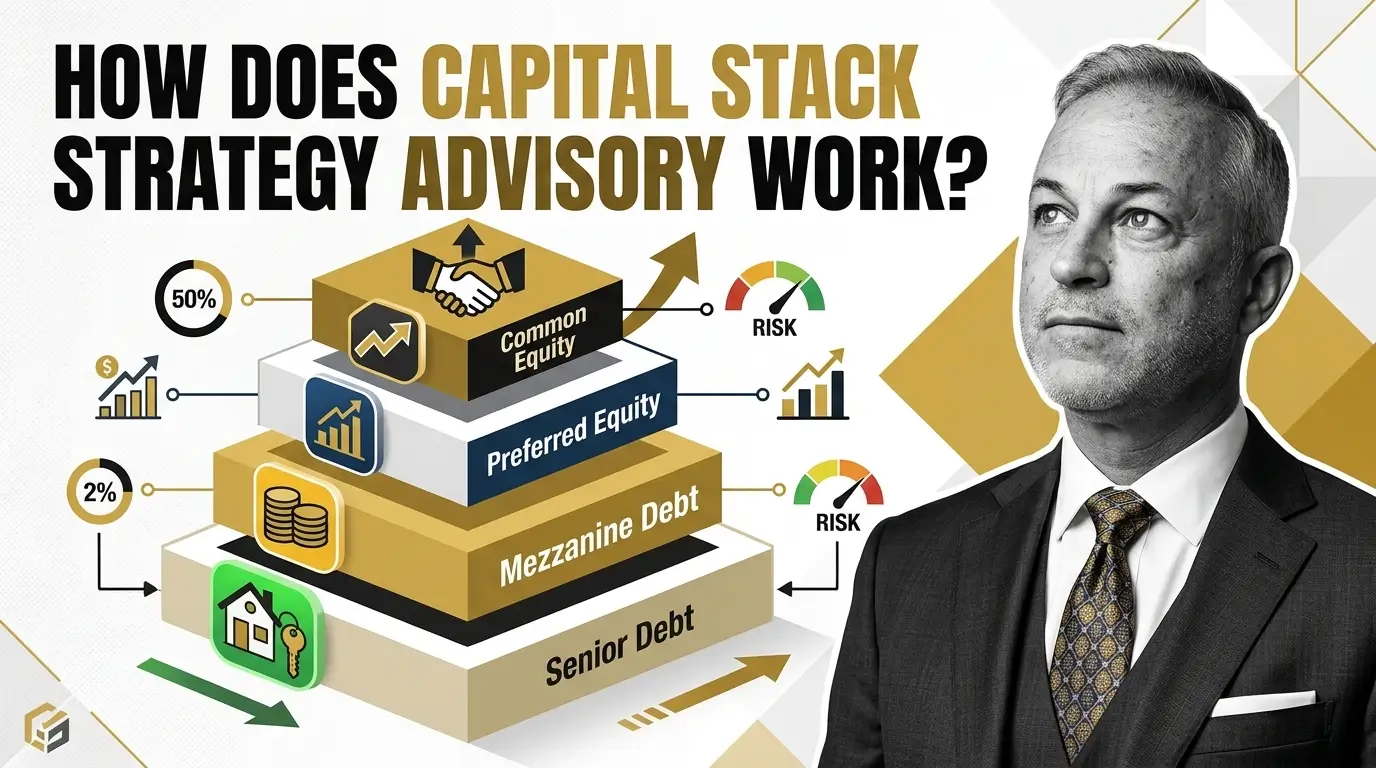
Capital stack strategy advisory works in four sequential stages: audit the existing stack, align documents and economics to institutional diligence standards, select capital providers that match the deal's structure and risk profile, and sequence outreach so serious investors review a coherent, underwritable opportunity. The process starts before any investor meeting and is designed to eliminate structural friction before it becomes a reason to pass.
For developers already operating at the capital stack strategy advisory level, the question is not whether advisory exists but what it actually produces at each stage of a raise. This article walks through the operational workflow so you can evaluate whether the process fits your current deal stage.
Before outreach begins, most deals have at least one structural problem that institutional capital will find. According to ILPA's due diligence framework, LP diligence on real estate funds can run 250 or more questions across seven distinct review tracks. Advisory exists to get the deal ready for that scrutiny, not to paper over it after the fact. If you are still evaluating whether your deal needs this kind of preparation at all, the 47 Due Diligence Documents $10M+ Sponsors Must Have Ready checklist is a useful benchmark.
The four stages of capital stack strategy advisory:
- Stage 1: Audit the existing stack for structural weaknesses before any materials go out
- Stage 2: Align the model, deck, data room, and waterfall terms into a single coherent story
- Stage 3: Match the deal to capital providers that fit the asset class, check size, and risk layer
- Stage 4: Sequence outreach so diligence does not break midstream
Stage 1: Audit the Existing Stack Before Anyone Sees the Deal
The advisory engagement opens with a full structural review. This is not a gut-check on the pro forma. It is a systematic test of whether the stack holds under institutional scrutiny.
The audit covers sources and uses, projected leverage ratios, equity layering, promote structure, timing assumptions, and downside sensitivity at 15% to 25% stress scenarios. The goal is to find where the wrong risk is sitting in the wrong layer before a sophisticated LP or preferred equity provider finds it first.
The output of Stage 1 is a revised stack thesis and a prioritized list of structural issues to resolve before materials go out. Developers who skip this step often find that LP questions during diligence become concessions rather than clarifications.
Stage 2: Align Documents, Economics, and Diligence Materials
Once the structural audit is complete, advisory moves into document alignment. The model, investor deck, data room, entity structure, and waterfall terms all need to tell the same story. When they do not, institutional capital reads the inconsistency as operational risk.
Diligence reality check: A fully prepared institutional data room covers 47 documents across 7 diligence tracks. LP questionnaires from ILPA-aligned allocators routinely run 250 or more questions. Document alignment is not administrative overhead. It is the difference between a deal that moves through diligence and one that stalls in the first review round.
The document alignment process follows a specific sequence:
- Reconcile the financial model against the deck narrative and term sheet economics so every number is traceable to a single source
- Organize the data room by diligence track so senior lenders, preferred equity providers, and LP equity each receive the materials relevant to their review layer
- Clarify the waterfall and promote terms in plain language before LP counsel reviews them, reducing negotiation friction on economics that should already be settled
- Audit the entity structure for clean ownership, control rights, and decision authority at each capital layer
- Stress-test the narrative against the most common LP objections for the asset class and deal size
The point of Stage 2 is not generating more paperwork. It is eliminating the structural ambiguity that turns LP questions into renegotiated terms. Protecting economics here costs far less than recovering them later.
Stage 3: Match the Deal to the Right Capital Providers
With a structurally clean deal and aligned materials, advisory shifts to provider selection. This is where most developers assume the process is simply a list of names. It is not.
Provider selection screens for fit across multiple dimensions before a single outreach call is made. The wrong capital source at the wrong layer creates problems that no amount of relationship management fixes later.
Provider selection checklist:
- Check size alignment: Does the provider actually write $10M to $75M+ checks in this asset class, or is their stated range aspirational?
- Risk layer fit: Is this provider underwriting senior debt, mezzanine, preferred equity, or LP equity? Mismatched risk appetite creates structural conflict.
- Geography and asset class mandate: Active mandates in 2026 are concentrated in multifamily, industrial, data centers, and mixed-use. Confirm the provider has a live mandate for this deal type.
- Amendment and control behavior: How does this provider behave when a deal hits a variance? Amendment history matters more than headline terms.
- Diligence speed and decision authority: Can the provider move within the deal's timeline, or will their internal process create a sequencing problem?
- Deal-by-deal vs. fund structure preference: Family offices have shifted decisively toward deal-by-deal structures. Confirm the provider's current preference before outreach.
Understanding when a deal actually needs capital stack strategy advisory informs which providers belong on the shortlist at each stage of development.
Stage 4: Sequence Outreach So Diligence Does Not Break Midstream
Outreach sequencing is the stage most developers underestimate. The order in which capital sources see the deal, what package they receive, and when deeper materials are released all affect how diligence runs and whether multiple tracks can close in parallel.
A structured outreach sequence looks like this:
- Week 1-2: Lead with the capital sources most aligned to the deal's current stage and risk profile. Messaging is tested here before wider distribution.
- Week 3-6: Release teaser materials and gauge initial response. Adjust positioning based on early feedback before committing to full data room access.
- Week 6-12: Open data room access for qualified providers. Manage parallel diligence tracks so one provider's timeline does not block another.
- Week 12+: Coordinate term sheet timing across layers. Senior debt, pref, and LP equity rarely close simultaneously without active sequencing.
Institutional LP timelines commonly run 6 to 18 months from first contact to close. Advisory manages that timeline proactively, not reactively.
The key benefits of capital stack strategy advisory become most visible in this stage, where process discipline directly affects close probability and final economics.
When Process Changes the Outcome
The four-stage process is not theoretical. Its value shows up in deals where structural problems would have surfaced during diligence instead of before it.
IRC Partners case snapshot
Deal: Multifamily development, Texas | Total capitalization: $150M
The developer had a strong track record and a viable asset but arrived with a capital stack that layered pref and LP equity in a sequence institutional allocators would not underwrite. The promote structure also gave away GP economics that were recoverable with minor restructuring.
Advisory began with the Stage 1 audit, identified the waterfall conflict, and realigned the equity layers before any materials went to market. The data room was reorganized across seven diligence tracks before first LP contact.
The outcome was a deal that institutional capital could actually underwrite. The complexity was not the asset. It was translating an operator track record into a structure that matched how serious allocators evaluate risk.
Developers interested in how advisory protects GP economics across a full raise should review 5 Capital Stack Risk Reduction Strategies as a companion resource.
{{main-cta}}
Is Your Deal Ready for This Process?
The right time to evaluate advisory is when the deal is real enough for a full structural review but before broad market outreach has started. Once materials are in the market, fixing structural problems costs economics.
Three things worth evaluating now:
- Does your current stack hold up under a 15%-25% downside stress test?
- Can your data room answer 47 document requests across 7 diligence tracks without gaps?
- Have you screened your target capital providers for active mandates, check size, and risk layer fit?
If any of these are uncertain, the advisory process described above is designed to resolve them before they become LP objections. IRC Partners works with developers raising $10M or more in institutional capital to run this process from initial audit through outreach sequencing. Apply to work with IRC Partners to evaluate whether your current deal is institutionally ready.
Frequently Asked Questions
How long does a capital stack audit typically take before outreach begins?
A thorough capital stack audit for a $15M to $75M raise takes 2 to 4 weeks depending on how complete the existing materials are. Deals with clean models, organized entity structures, and a current data room move faster. Deals where the model and deck tell different stories, or where the waterfall has not been documented in term sheet form, routinely take 4 to 6 weeks before materials are ready for institutional distribution.
What documents does advisory actually prepare before LP outreach?
The standard institutional data room covers 47 documents organized across 7 diligence tracks: financial, legal, operational, market, environmental, sponsorship, and capital structure. Advisory does not generate all 47 from scratch. It audits what exists, identifies gaps, and aligns existing materials so each diligence track is complete before first LP contact. The most common gaps are in the capital structure track and the sponsorship track, where GP background and co-invest documentation is often missing or inconsistent.
At what raise size does a structured advisory process make economic sense?
The advisory process described in this article is designed for raises of $10M or more in institutional capital. Below $10M, the diligence overhead and provider selection complexity rarely justify a full four-stage process. Between $10M and $25M, the audit and document alignment stages deliver the most value. Above $25M, all four stages are typically necessary because institutional allocators at that check size apply full ILPA-aligned diligence regardless of asset class.
How does advisory handle multiple capital layers at the same time?
Each capital layer, senior debt, mezzanine, preferred equity, and LP equity, has a different diligence standard, timeline, and decision authority. Advisory manages these as parallel tracks rather than sequential negotiations. The outreach sequence is designed so senior debt terms are largely settled before LP equity providers receive full materials, which prevents waterfall conflicts from surfacing mid-diligence. Coordinating parallel tracks typically adds 4 to 8 weeks to the overall timeline but reduces the risk of a late-stage structural renegotiation.
What happens to GP economics during the document alignment stage?
Document alignment is where GP economics are most at risk if the process is not managed carefully. Waterfall terms, promote thresholds, and co-invest requirements that are ambiguous or inconsistently documented become negotiating points during LP diligence. Advisory resolves these in writing before first contact so the GP is not negotiating from a defensive position. The most common recoverable economics are promote structures where the GP inadvertently gave up 3% to 5% of upside through imprecise waterfall language.
How are capital providers selected for a specific deal?
Provider selection starts with a screen of active mandates in the deal's asset class and geography, then filters by check size, risk layer, and diligence behavior. For a $30M multifamily raise in 2026, that screen typically narrows a starting universe of 40 to 60 potential providers down to 12 to 18 that have live mandates and a track record of closing at that check size. The final shortlist of 6 to 10 providers is selected based on amendment history, decision speed, and structural fit with the specific equity layering of the deal.
What is the typical advisory fee structure for a capital stack engagement?
Advisory fee structures vary by engagement scope but commonly include a retainer component covering the audit and document alignment stages, plus a success component tied to capital close. For raises between $10M and $50M, retainer fees typically range from $15,000 to $50,000 depending on deal complexity and the scope of document preparation required. IRC Partners structures engagements with equity alignment, taking 3% to 5% advisory equity rather than a purely transactional placement fee, which aligns advisor incentives with GP outcomes across the full raise rather than a single close event.
Continue reading this series:
- What Is Capital Stack Strategy Advisory?
- Key Benefits of Capital Stack Strategy Advisory
- How Long Does Institutional LP Due Diligence Take?
IRC Partners works with operators raising $5M to $250M of institutional capital. The full engagement is for founders at $1M+ ARR who have raised before. The $2,997 Capital Raise Pre-Flight audit is open to earlier-stage companies, including pre-revenue, that are raising $5M+ and have a pitch deck and financial model ready for review. If that's you, schedule a call to discuss HERE.
Sponsors weighing this decision should first complete a capital raise readiness assessment for sponsors to confirm the raise is investor-ready.
Need guidance on your capital raise?



What Do Series B Growth Equity Investors Look for in a Company?
Option Pool Shuffle Explained: How Investors Use Your Pre-Money Valuation to Quietly Dilute You Before the Round Closes
What is Original Issue Discount, and When Can It Affect a Convertible Note Financing?
Disclosure
Nothing on this site constitutes an offer to sell, or a solicitation of an offer to purchase, any security under the Securities Act of 1933, as amended, or any applicable state securities laws. Any offering of securities is made only by means of a formal private placement memorandum or other authorized offering documents delivered to qualified investors.
IRC Partners is a capital advisory firm. IRC Partners is not a registered investment adviser under the Investment Advisers Act of 1940 and does not provide investment advice as defined thereunder.
Certain statements in this article may constitute forward-looking statements, including statements regarding market conditions, capital availability, investor demand, and transaction outcomes. Such statements reflect current assumptions and expectations only. Actual results may differ materially due to market conditions, regulatory developments, company-specific factors, and other variables. IRC Partners makes no representation that any outcome, return, or result described herein will be achieved.
References to prior mandates, transaction volume, network credentials, or capital raised are provided for illustrative purposes only and do not constitute a guarantee or prediction of future results. Past performance is not indicative of future outcomes. Individual results will vary. Network credentials and transaction statistics referenced on this site reflect the aggregate experience of IRC Partners' principals and affiliated advisors and are not a representation of assets managed or transactions closed solely by IRC Partners.
Certain data, statistics, and information presented in this article have been obtained from third-party sources. IRC Partners has not independently verified such information and expressly disclaims responsibility for its accuracy, completeness, or timeliness. Readers should independently verify any third-party data before relying on it.
Readers are strongly encouraged to consult qualified legal, financial, and tax professionals before making any investment, capital raising, or business decision.
Schedule A Meeting
You get one shot to raise the right way. If this raise is worth doing, it’s worth doing with precision, leverage, and control.
This isn’t a practice run. Serious capital. Serious strategy. Let’s raise it right.
We onboard a maximum of seven
new strategic partners each quarter, by application only, to maximize your chances of securing the capital you need.
